The County Clerk Handed You a Stack of Forms. The Bank Froze the Account. The Will Has a 30-Day Filing Deadline You Did Not Know About. And Nobody Told You Whether Your County Uses a Fiduciary Supervisor or a Fiduciary Commissioner --- Which Determines What You File, Where You File It, and What It Costs.
Your father died in Kanawha County on a Monday. By Wednesday the funeral director asked how many certified death certificates you need at $12 each. You said four. You will need ten or fifteen. Every bank, every insurance company, every County Clerk's office requires an original with a raised seal, and the Vital Registration Office in Charleston takes weeks to process reorders.
You drove to the County Clerk's office to ask about probate. There is no probate court in West Virginia --- you learned that at the window. The clerk handed you an Application of Fiduciaries and a stack of forms and explained that they cannot tell you how to fill them out or in what order to file them. You called an attorney. Average hourly rates in West Virginia run around $196, and a straightforward estate costs $3,000 to $4,000 in legal fees before filing costs. The estate is worth $40,000. The attorney fees would eat a tenth of it.
Then your sister mentioned mineral rights. Your father inherited a fractional interest in a coal lease in McDowell County three decades ago. Nobody knows what it is worth, but the royalty checks were still arriving. Mineral rights are real property under West Virginia law. They require their own probate handling --- and if the executor lives out of state, ancillary probate in the specific county where the minerals sit.
The West Virginia Probate Process Guide is a Probate Navigation System built entirely around West Virginia Code Chapters 41, 42, and 44 --- mapping every form, every deadline, every county filing fee, and every statutory pathway into one chronological sequence. It tells you whether the estate qualifies for the Small Estate Act ($50,000 personal property / $100,000 real property, separate thresholds), whether your county uses a Fiduciary Supervisor or a Fiduciary Commissioner, whether you can close with a Short-Form Settlement instead of a full final accounting, and exactly which creditors get paid in which order so you never take on personal liability. It covers the Appalachian complexities that no national guide touches: severed mineral rights, heirs' property protections, and Medicaid estate recovery exemptions.
What's Inside the Probate Navigation System
A 15-chapter guide with a cost estimator worksheet, a printable 18-item action checklist, and a complete forms directory --- covering every probate pathway, county procedure, creditor defense, and filing deadline available under West Virginia law:
Chapters 1-2: How Probate Works in West Virginia and the Decision Tree
The system nobody explains: West Virginia has no probate court. The County Commission holds probate authority, and the County Clerk is the person you actually deal with. The dual-fiduciary system --- Fiduciary Supervisors (salaried county employees, fees $25-$175) vs. Fiduciary Commissioners (private attorneys appointed by the county, fees from $300 and up). Ex parte probate (what most uncontested estates use, no attorney required) vs. solemn form probate (contested wills, requires an attorney). Then the decision tree that determines your entire path: the Small Estate Act ($50,000 personal / $100,000 real, separate thresholds), the Short-Form Settlement for mid-size estates, and full formal administration. The side-by-side comparison table showing timeline, cost, and requirements for each track.
Chapter 3: Filing for Appointment
Step-by-step instructions for the formal probate process in the order you will actually experience it: securing the original will (30-day criminal deadline under W. Va. Code Section 41-5-1), ordering 10-15 certified death certificates ($12 each from the Vital Registration Office), filing the Application of Fiduciaries with the County Clerk, the statutory appointment priority (executor named in will, then surviving spouse, then next of kin), taking the oath of office, posting the fiduciary bond (approximately 0.5% of estate value annually), and receiving Letters Testamentary or Letters of Administration. County-by-county filing fees for Berkeley, Logan, Monroe, and Monongalia counties.
Chapter 4: The 90-Day Inventory
The two mandatory State Tax Department forms --- Form ET 6.01 (Estate Appraisement for probate assets) and Form ET 6.02 (Nonprobate Inventory) --- due within 90 days of appointment. What goes on each form. How to determine fair market value as of the date of death for bank accounts, real estate, vehicles, stocks, and personal property. The forensic search strategy for discovering unknown assets through tax returns, bank statements, incoming mail, and safe deposit boxes. Consequences of missing the deadline: penalties, removal, forfeiture of executor commission.
Chapter 5: Creditors, Debts, and the Priority Waterfall
Publishing the Notice of Administration (two consecutive weeks, $20-$50). The 60-day creditor claim window. The 20-day deadline to approve or reject each claim. The statutory priority waterfall under W. Va. Code Section 44-2-21 --- seven tiers from administrative costs down to general unsecured creditors, with worked examples showing how insolvency math determines who gets paid. The surviving spouse's $50,000 in statutory protections ($20,000 homestead + $30,000 family allowance) that come off the top before any creditor. Why paying debts out of order creates personal liability for the executor.
Chapter 6: Banking and the Estate Account
Which accounts freeze on notice of death and which transfer automatically. Joint accounts with right of survivorship, POD accounts, and TOD securities --- what bypasses probate entirely. How to open a dedicated estate bank account with its own EIN. Why commingling personal and estate funds is one of the most serious fiduciary breaches you can commit.
Chapters 7-8: Executor Compensation and Appalachian Complexities
The statutory commission formula: 5% on the first $100,000, 4% on the next $300,000, 3% on the next $400,000, 2% above $800,000 --- with worked commission math. When to waive compensation (executor is also the primary beneficiary). Then the three issues that make West Virginia probate unlike any other state: severed mineral rights and the ancillary probate requirement for out-of-state executors, heirs' property and the Uniform Partition of Heirs Property Act protections against forced sales, and Medicaid estate recovery --- West Virginia's probate-only recovery limitation, the statutory exemptions (surviving spouse, child under 21, disabled child, sibling equity), and the hardship waiver provisions.
Chapters 9-12: When You Need a Professional, Timeline, Taxes, and Closing
The honest line between what you can handle with this guide and what requires a licensed attorney: contested wills, insolvent estates, complex mineral rights, heirs' property disputes. The complete timeline with every statutory deadline from day one through final distribution. West Virginia's tax environment --- no state estate tax, no inheritance tax (abolished after December 31, 2004), but the final income tax returns and estate income tax returns you still owe. Two closing paths: Short-Form Settlement (Waiver of Final Settlement) for qualifying estates vs. full Report of Receipts, Disbursements, and Distribution.
Chapters 13-15: Intestate Succession, Forms Directory, and Cost Estimator
West Virginia's intestacy rules when there is no will --- the distribution chart for every family structure (spouse + children, spouse + parents, descendants only, siblings). The complete forms directory organized by purpose: Application of Fiduciaries, Small Estate Affidavit (testate and intestate), Forms ET 6.01 and ET 6.02, Waiver of Final Settlement, and more. The probate cost estimator worksheet with fixed costs, variable costs, and sample estimates by estate size.
Who This Guide Is For
- The first-time executor of a modest West Virginia estate who consulted with an attorney, received a quote of $3,000-$4,000, and realized the fees would consume a significant portion of the estate --- and wants to know whether the Small Estate Act or Short-Form Settlement applies before writing that retainer check.
- The surviving spouse navigating statutory protections who needs to claim the $20,000 homestead allowance and $30,000 family allowance before a single creditor gets paid --- and does not know that these protections exist because the County Clerk cannot provide legal guidance.
- The out-of-state executor with mineral rights to settle whose parent owned coal, oil, or gas interests in a West Virginia county and just learned that mineral rights require ancillary probate in the specific county where the minerals are located --- regardless of where the primary probate is happening.
- The family facing Medicaid estate recovery who received a claim from HMS/Gainwell and needs to understand that West Virginia is a probate-only recovery state --- meaning joint accounts, POD/TOD accounts, and trust property are protected --- and that surviving spouse, minor child, and disabled child exemptions may block the claim entirely.
- Appalachian families protecting heirs' property who inherited undivided rural land across multiple generations and need the Uniform Partition of Heirs Property Act protections to prevent an outside party from forcing a below-market courthouse sale.
- Anyone who does not know which filing track applies and needs a five-minute decision tree to determine whether the estate qualifies for the Small Estate Act, the Short-Form Settlement, or full administration --- before making a commitment that wastes time and money on the wrong path.
Why Free Resources Do Not Replace a Sequenced Filing Guide
Every form referenced in this guide is available for free from a West Virginia County Clerk's office or the State Tax Department. The Application of Fiduciaries is at the clerk's window. Forms ET 6.01 and ET 6.02 are on the State Tax Department website. The Small Estate Affidavit is a standard notarized form. Here is why the forms alone are not enough:
- The County Clerk cannot tell you how to file. West Virginia County Clerks are administratively prohibited from providing legal advice. They hand you the forms and point you to the door. You get the raw paperwork without a single word of instruction about sequencing, deadlines, or which forms apply to your situation.
- Most families do not know which county system they are dealing with. Whether your county uses a Fiduciary Supervisor or a Fiduciary Commissioner changes the cost, the oversight structure, and the paperwork. Most free resources and national form vendors do not even mention this distinction --- it is unique to West Virginia.
- The Small Estate Act thresholds are bifurcated in a way no other state uses. $50,000 for personal property and $100,000 for real property --- separate limits, not a combined total. Different waiting periods depending on whether you are the named executor (30 days) or not (60 days). Most families either assume they do not qualify when they do, or assume they qualify when they do not. Both mistakes cost months.
- Law firm websites explain the problem. They withhold the solution. West Virginia probate attorneys publish detailed articles about estate settlement complexity. The content is accurate. It is also deliberately incomplete --- designed to trigger a consultation call at $196 per hour, not to empower you to handle it yourself. The question is not "how complicated is this?" but "does my estate actually require an attorney?" For many West Virginia estates under $200,000 in net probate value, the answer is no.
- West Virginia has state-specific hazards that no generic guide covers. Severed mineral rights requiring ancillary probate. The 30-day criminal deadline for filing the will. Heirs' property vulnerable to forced partition. Medicaid recovery that is limited to probate assets (a protection most families never learn about). The creditor priority waterfall that creates personal liability if you pay debts out of order. These are not footnotes --- they are the issues that derail West Virginia estate settlements when families use national templates.
Free resources give you one agency at a time, with no sequencing, no cross-referencing, and no way to know what you are missing. The Probate Navigation System maps every form, every deadline, and every county procedure into one chronological sequence --- so you file correctly, pay debts in the right order, and determine whether you actually need an attorney before spending a dollar on one.
--- Less Than Fifteen Minutes of a West Virginia Attorney's Time
West Virginia families lose weeks and thousands of dollars every year --- not because the estate was complicated, but because nobody explained the system before they walked into the County Clerk's office. An estate that qualifies for the Small Estate Act opens full formal probate because nobody explained the bifurcated thresholds. A surviving spouse never claims the $50,000 in statutory protections because the clerk cannot provide legal advice. An executor pays a credit card company before Medicaid and takes on personal liability because nobody showed them the priority waterfall. An out-of-state heir discovers mineral royalties have stopped because nobody filed ancillary probate in the right county. This guide costs less than any of those mistakes.
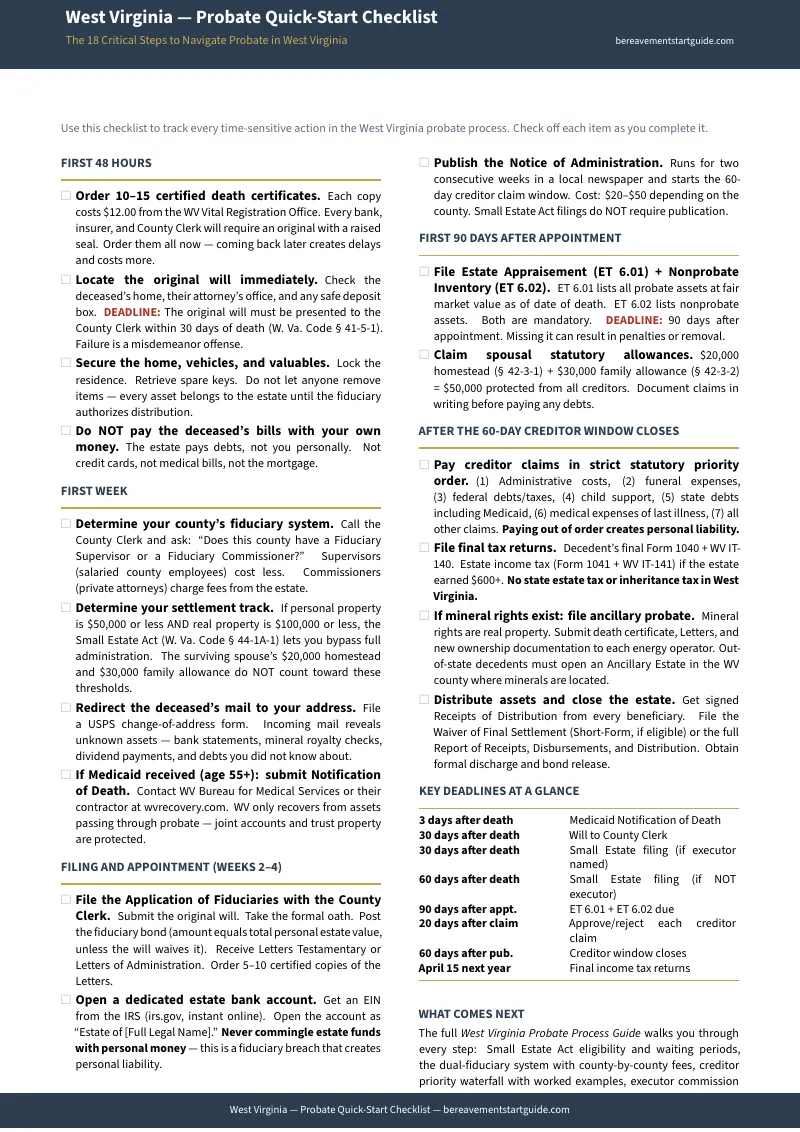
Your download includes 7 PDFs: the complete 15-chapter guide, the West Virginia --- Probate Quick-Start Checklist (18 items organized by phase), plus five standalone printable tools --- a Probate Decision Tree, Creditor Priority Waterfall, Mineral Rights Checklist, Medicaid Recovery Defense reference, and a Probate Cost Estimator worksheet --- covering every time-sensitive step from securing the estate on day one through the 30-day will filing deadline, the 90-day inventory requirement, the 60-day creditor window, and final estate closure.
Money-back guarantee, no time limit. If the guide does not give you a clear map of every probate pathway available for your West Virginia estate, every form you need to file, and every deadline you need to meet --- email us for a full refund. No questions asked.
Not ready for the full guide? Download the free West Virginia --- Probate Quick-Start Checklist --- a summary of the most time-sensitive actions, forms, deadlines, and the key decision points that determine which probate track applies to your estate. Enough to start the right sequence on day one.
You did not plan for this. But you can plan what happens next. The guide gives you the forms, the deadlines, the statutory shortcuts, and the filing sequence --- so the next six months are spent settling the estate correctly, not discovering what you missed.