The Benefit Recovery System — Every Dollar West Virginia Owes Your Family, Every Deadline That's Ticking
Your spouse died. The CPRB pension deposit just landed in the joint account — and now the state wants it back. The PEIA letter says you have two calendar months to file for continued health insurance or you lose it forever. The County Clerk said something about a fiduciary commissioner and a $300 fee. And nobody explained what any of it means.
That's because West Virginia doesn't coordinate survivor benefits. They're scattered across the Consolidated Public Retirement Board, the Public Employees Insurance Agency, the County Commission's fiduciary office, the Division of Motor Vehicles, the DHHR Bureau for Family Assistance, the Court of Claims, and the county Assessor's Office. Each agency expects you to find them, file their specific forms, and meet their specific deadlines — while you're grieving. And several of those deadlines started the day the death certificate was signed, whether anyone told you or not.
The West Virginia Survivor Benefits Navigator is the sequenced action plan that replaces dozens of siloed government websites with one chronological roadmap. Every benefit you might qualify for. Every form number. Every deadline that costs money if missed. Every exemption that protects the family home — including the ones that only matter because West Virginia has severed mineral rights, heirs' property, and a county-based probate system that works differently from every other state.
— Less Than 8 Minutes of Attorney Time
West Virginia probate attorneys charge an average of $196 per hour. Walking into a law office without your documents organized, your benefits identified, or your deadlines mapped guarantees thousands in fees just for the intake conversation. This guide organizes the administrative work — so if you do hire a lawyer, you spend their time on legal strategy, not on explaining what a fiduciary commissioner does or how the Small Estate Act works.
What's Inside
The 14-Day Emergency Stabilizer
Exactly what to do (and what NOT to do) in the first two weeks: order 8-12 certified death certificates at $12 each from the DHHR Vital Registration Office, notify the bank and CPRB immediately to stop pension direct deposits before clawback, and lock down assets before premature distribution creates personal liability. Includes the "Do Not Do This Yet" list — why closing joint accounts, paying the deceased's debts from your own money, or distributing assets early can cost you thousands.
The Deadline Map
Every statutory clock running against you, in one place: the 2-month window for PEIA surviving dependent health insurance enrollment, the 30-day Small Estate filing window for named executors (60 days for intestate estates), the deadline to refile the $20,000 Homestead Exemption by December 1st, the 72-hour crime reporting deadline for Victims' Compensation, and the 2-year claim filing window. Miss any of these and the money is gone.
The CPRB Pension Decoder
How to file for Consolidated Public Retirement Board survivor benefits — including the critical difference between 100% Joint and Survivor annuities (full pension continues to the spouse), 50% Joint and Survivor (half continues), and Straight Life (nothing continues). Why any pension funds deposited after the date of death must be returned to the state treasury immediately. How to verify which annuity option the retiree selected — because that election was irrevocable, and no one at CPRB will volunteer this information.
The PEIA Health Insurance Rescue
Surviving dependents of public employees can continue employer-sponsored health coverage — but only if the PEIA Surviving Dependent enrollment form is submitted within the calendar month of the death or the two following calendar months. Miss this window and coverage terminates permanently. The guide walks through the enrollment process, explains how Medicare Advantage Plan holders are automatically enrolled when the death is reported, and clarifies that coverage ends permanently upon remarriage or divorce.
The Probate Pathfinder
Two distinct West Virginia probate mechanisms — and choosing the wrong one wastes months and money. The Small Estate Act (personal property under $50,000 and real property under $100,000) bypasses the fiduciary commissioner entirely — but you cannot amend the application once filed. One forgotten asset means filing a brand-new application and paying another fee. Classic probate through the County Commission, with its $300 fiduciary commissioner fee cap, is the only path for larger estates. Each option explained with eligibility rules, county filing procedures, and the forms you'll need.
Workers' Comp and Crime Victims' Compensation
Workers' compensation death benefits pay 70% of the deceased's average weekly wage to dependents, plus up to $10,000 for funeral and cemetery expenses. Crime Victims' Compensation covers up to $50,000 for death claims, including up to $10,000 for burial expenses — but the crime must be reported within 72 hours and the claim filed within 2 years. Both programs explained step by step with form numbers, contact information, and deadlines.
The Home Protection Strategy
If the deceased was 55+ and received Medicaid long-term care, the state may file a claim against the estate. But Medicaid estate recovery is blocked if survived by a spouse, a child under 21, or a blind or permanently disabled child. Estates under $5,000 are exempt. And heirs can file an undue hardship waiver. The guide explains exactly which assets are immune (POD accounts, TOD deeds, joint tenancy property) and when to file the waiver — plus how to refile the $20,000 Homestead Exemption so property taxes don't jump after losing a spouse.
The Appalachian Real Estate Module
West Virginia has complications no other state guide covers: severed mineral rights passed down for generations without a will, heirs' property held by dozens of relatives as tenants in common, and the Cotenancy Modernization Act that lets operators develop mineral tracts with 75% consent. The guide explains how Transfer on Death deeds can bypass probate for mineral rights, what triggers a forced partition sale, and the foundational steps to protect family land from predatory co-tenant actions.
Burial Assistance Programs
Three avenues for families who need help covering funeral costs: the DHHR burial assistance program (up to $1,000 for families at or below 133% of the Federal Poverty Level), the $10,000 workers' compensation funeral benefit for work-related deaths, and the Crime Victims Compensation Fund (up to $10,000 for funeral and burial expenses for eligible crimes). Eligibility rules, income calculations, and application instructions for each.
Who This Guide Is For
- Surviving spouses trying to claim every benefit before the deadlines pass — and protect the family home from Medicaid recovery, property tax increases, and mineral rights complications
- Adult children serving as administrator who need to secure benefits for a surviving parent while navigating the county-based probate system and fiduciary commissioner process
- Families of teachers, state troopers, and public employees navigating CPRB survivor pensions and the irrevocable annuity elections
- Families of workers killed on the job filing for workers' comp death benefits and the $10,000 burial benefit
- Families dealing with heirs' property trying to protect inherited land with severed mineral rights from forced partition and development disputes
- Low-income families who need to access DHHR burial assistance and may not realize the state holds funds specifically for their situation
Why Not Just Use Government Websites?
You can. Every form, statute, and eligibility rule in this guide exists somewhere on wv.gov, cprb.org, peia.wv.gov, and 55 individual county clerk websites. That's the problem — "somewhere" across dozens of dense, uncoordinated government pages written in statutory language, with no chronological sequencing and no explanation of how one agency's requirements interact with another's.
The County Clerk provides the Small Estate form for free but is legally prohibited from advising you on how to fill it out — or warning you that a forgotten asset requires an entirely new filing and fee. CPRB's website explains pension options but doesn't mention PEIA health insurance. PEIA's enrollment form doesn't tell you to stop the deceased's direct deposits before the state claws back overpayments. The state gives you the puzzle pieces. This guide gives you the picture on the box.
What You Get
- The Complete Navigator — 13 chapters covering every benefit, exemption, and administrative process, organized in the order you need to act
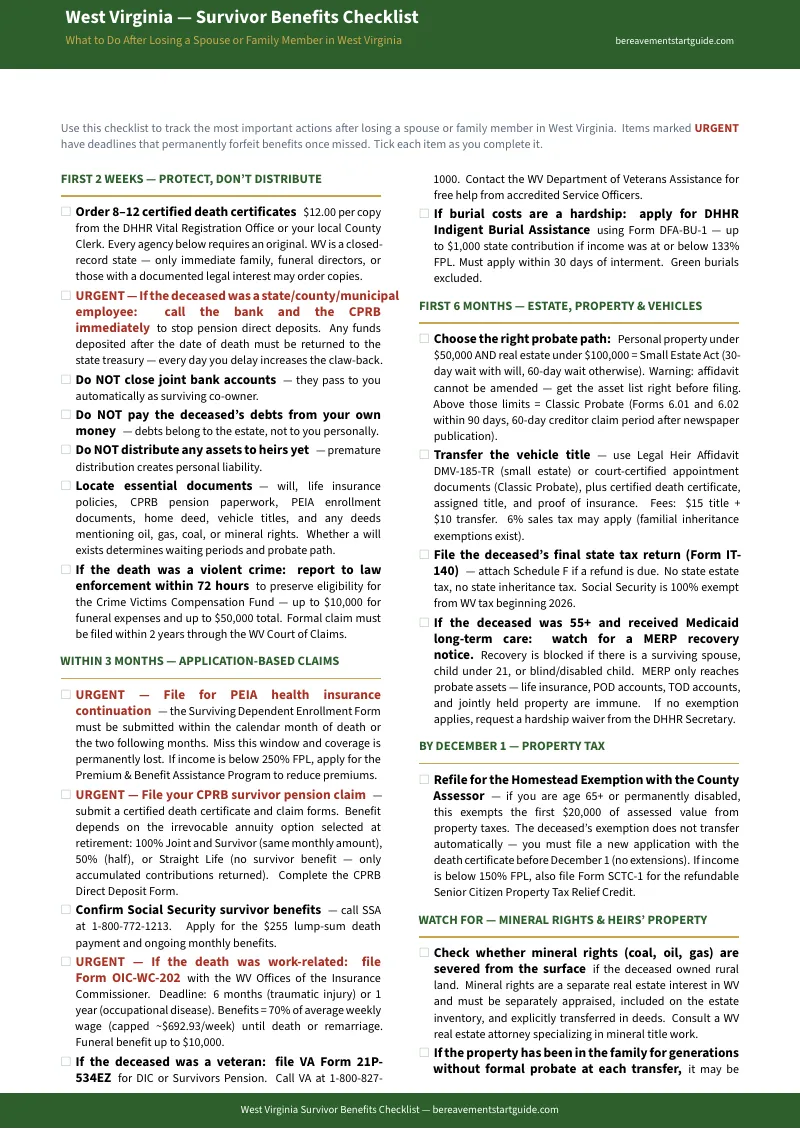
- Quick Start Checklist — the 18 most critical actions in the exact order you need to take them
- Master Benefits Worksheet — fill-in worksheet mapping every benefit you qualify for, the agency, the form number, and your personal deadline
- Deadline Map — printable table of every statutory deadline with a fill-in column for your personal dates
- Official Forms Directory — every West Virginia form referenced in the guide with the issuing agency and where to find it online
- Key Contacts Reference — every West Virginia agency, phone number, and key figure on one landscape sheet you can keep by the phone
Satisfaction Guarantee
If the Navigator doesn't save you time, confusion, or money — email [email protected] and we'll make it right. No questions, no hassle.
Start Protecting Your Family's Benefits
Download the free West Virginia Survivor Benefits Checklist for the 18 most critical actions — or get the complete Navigator with full step-by-step instructions, CPRB pension decoder, PEIA health insurance rescue, Medicaid defense strategies, mineral rights guidance, and every form walkthrough.