Your Spouse Died in Wisconsin. The Bank Froze Everything Because You Cannot Prove What Is "Survivorship Marital Property." The County Register Wants a Form HT-110. The Department of Health Services Sent a Certified Letter About Medicaid Recovery. And You Have Bills Due Next Week.
You assumed everything was jointly owned. In Wisconsin, it is -- sort of. The state adopted Marital Property Law in 1986, making it one of only nine community property states. Your bank accounts, your house, your vehicles -- all presumed marital property. But when you walked into the bank with the death certificate, the account officer said she cannot release funds until you prove the account qualifies as "survivorship marital property" under Chapter 766. The form she needs is not something the bank provides. The county Register in Probate needs an HT-110 to clear title on the house. And nobody told you that the Transfer on Death deed your spouse filed three years ago does not protect the property from the Department of Health Services, which just mailed a certified recovery notice to every address on file.
Here is what makes Wisconsin uniquely complicated. The state has no estate tax and no inheritance tax. Everyone said this would be simple. But "no death tax" does not mean "no tax obligations" and it does not mean "no probate." Wisconsin has three separate paths for settling an estate -- Formal Administration, Informal Administration, and Transfer by Affidavit -- and the rules for qualifying are strict. Transfer by Affidavit only works for estates under $50,000, and it comes with a mandatory 10-day waiting period after you send certified mail to the Department of Health Services. Miss that step and the affidavit is void. Choose the wrong path and you restart from zero, paying a second filing fee and losing weeks. If the estate earns any income above $600 during administration, you owe a fiduciary income tax return on Form 2 that most families never learn about until the Department of Revenue sends a notice.
The When Someone Dies in Wisconsin -- Estate Settlement Guide is a Settlement Command System -- a sequential, Wisconsin-specific system that tells you what to do, when to do it, and what forms to use. Not legal advice. Not a stack of blank government forms you can already download for free. A preparation manual built around the Wisconsin Statutes, the Marital Property Act, DHS recovery rules effective after August 1, 2014, and the county-level procedures that vary from Milwaukee to Dane to Brown County. It converts the dense statutory language of Wisconsin's probate bureaucracy into a plain-English, chronological action plan so you file correctly the first time and do not accidentally create personal liability by paying the wrong creditor first.
What's Inside the Settlement Command System
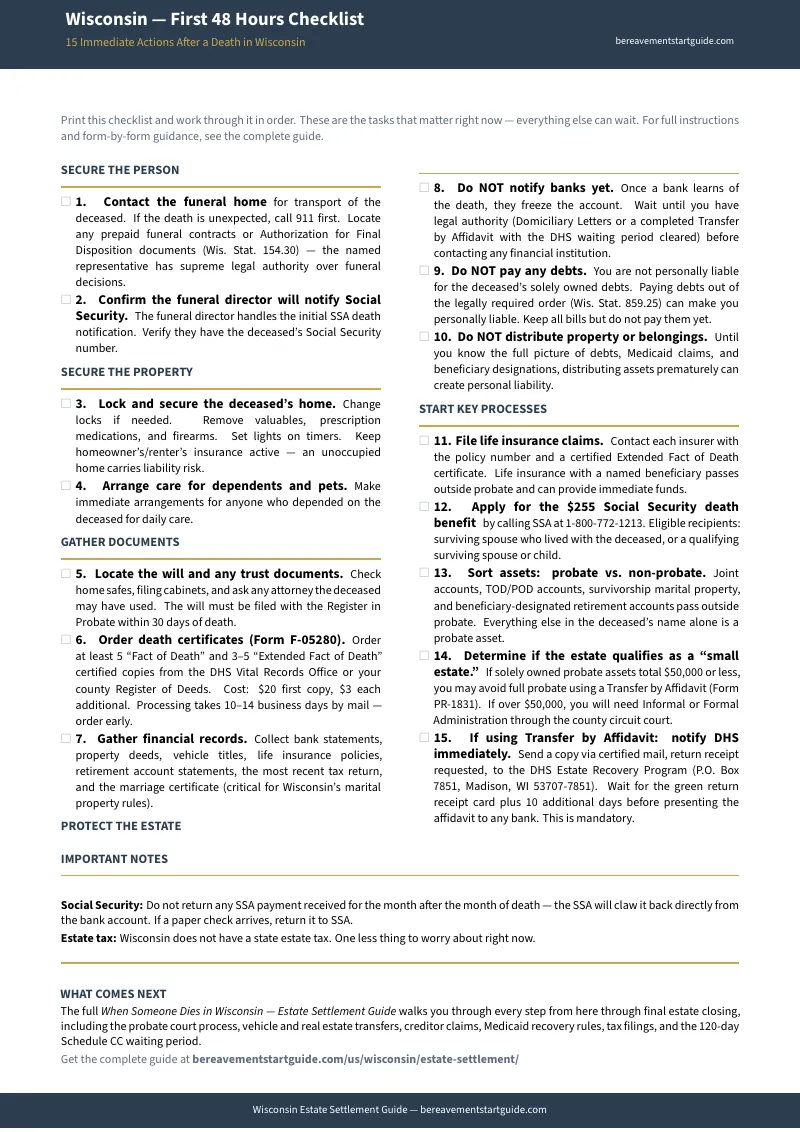
A comprehensive guide and printable First 48 Hours Checklist -- covering every probate pathway, marital property classification, creditor priority rule, vehicle transfer, Medicaid recovery defense, and tax obligation specific to Wisconsin estates, organized by deadline so you act in the right sequence:
Wisconsin's Three Paths: Which One Fits Your Estate
Transfer by Affidavit for estates under $50,000. Informal Administration for straightforward estates that do not require court hearings. Formal Administration for contested estates, unclear assets, or creditor disputes. Each path has different filing fees, different timelines, and different paperwork -- and choosing the wrong one wastes months and hundreds of dollars. The guide includes a diagnostic that determines your path based on estate value, asset types, and whether any creditor or heir is likely to object. It covers the $50,000 threshold calculation (which excludes certain exempt property), the 10-day DHS certified mail waiting period for Transfer by Affidavit, and the differences between supervised and unsupervised Informal Administration.
Marital Property: The Wisconsin Rule That Freezes Bank Accounts
Wisconsin is one of nine community property states, but it uses its own terminology. "Marital property" is not the same as "joint ownership" even though banks treat them identically while both spouses are alive. When one spouse dies, everything depends on classification: individual property, marital property, survivorship marital property, or mixed property. Only survivorship marital property passes automatically without probate. Everything else may need court involvement. The guide walks through the classification rules under Chapter 766, explains why banks freeze accounts pending proof of survivorship status, tells you exactly how to document the classification, and covers the Form HT-110 filing that clears real property title so you can sell the house without a six-month delay.
The DHS Certified Mail Rule: Wisconsin's 10-Day Trap
If you are using Transfer by Affidavit (estates under $50,000), Wisconsin Statutes Section 867.03 requires you to send a certified letter to the Department of Health Services at least 10 days before you present the affidavit. If the decedent ever received any form of Medicaid, DHS has the right to object. If you skip this step or present the affidavit before the 10-day window closes, the entire transfer is void and you start over. The guide provides the exact DHS mailing address, a template for the certified letter, the calculation for counting the 10-day waiting period, and what to do if DHS responds with a recovery claim.
MERP: Medicaid Estate Recovery After August 1, 2014
Wisconsin's Medicaid Estate Recovery Program changed dramatically after August 1, 2014. Before that date, DHS could only recover from probate assets. After that date, DHS can recover from non-probate assets -- joint bank accounts, Transfer on Death real estate, life estates, and any asset that would have been in the probate estate but was transferred through a non-probate mechanism. The Transfer on Death deed your spouse filed does not protect the house if Medicaid paid for nursing home care. The joint bank account does not protect the funds if the decedent was a Medicaid recipient. The guide covers every asset type DHS can reach, the statutory exemptions (surviving spouse living in the home, children under 21, disabled dependents), the hardship waiver process, the timing of recovery claims, and the critical difference between pre-2014 and post-2014 cases.
Creditor Priority: Wis. Stat. 859.25 and Personal Liability
Wisconsin law establishes a strict priority order for paying estate debts. Administrative expenses first, then funeral costs, then federal claims, then state claims, then medical expenses of the last illness, then general creditors. If you pay a lower-priority creditor before a higher-priority one and the estate runs out of money, you are personally liable for the difference. This is not theoretical -- it happens when executors pay the obvious bills (credit cards, utilities) before confirming whether DHS has a Medicaid recovery claim or whether the IRS has a federal tax lien. The guide maps the exact priority order, explains which debts fall into which tier, and gives you a payment sequence that eliminates personal liability risk.
Vehicle Transfers: Form MV2300 and the Surviving Spouse Exemption
The surviving spouse can transfer up to five vehicles without paying the $214.50 title fee per vehicle -- a savings of over $1,000 for families with multiple cars, trucks, or recreational vehicles. Everyone else pays the full fee. But you need Form MV2300, the death certificate, and the correct supporting document depending on whether the vehicle was jointly titled, solely owned with a will, or part of a Transfer by Affidavit estate. The guide covers every scenario: surviving spouse transfers, transfers through probate, transfers via affidavit, and the separate process for vehicles with outstanding loans.
Health Care Power of Attorney: The Two-Witness Requirement
Wisconsin has one of the strictest Health Care Power of Attorney statutes in the country. Two witnesses are required, and the list of disqualifying relationships is extensive: the health care agent, anyone related by blood, marriage, or adoption, anyone who has a claim against the estate, the attending physician, and anyone employed by the health care facility. If a single witness is disqualified, the entire document is invalid and falls back to statutory default decision-making. The guide covers the witness requirements, the disqualifying relationships, how to validate an existing POA, and what happens when the POA fails.
Wisconsin's Tax Obligations: No Estate Tax, But the Form 2 Trap
Wisconsin has no estate tax and no inheritance tax. But if the estate generates income above $600 during administration -- bank interest, rental payments, stock dividends, business income -- you must file a Wisconsin Fiduciary Income Tax Return on Form 2. Most families learn about Form 2 only when the Department of Revenue sends a notice months after the estate should have been closed. The guide covers the $600 filing threshold, the Form 2 due date, estimated payment requirements, the final personal income tax return (Form 1), and the federal Form 706 portability election that preserves the deceased spouse's unused federal exemption for the survivor.
The Complete Settlement Timeline: First 48 Hours Through Final Closing
From ordering death certificates through the Vital Records Office ($20 each), through the 10-day DHS certified mail waiting period, the creditor publication deadline (requires newspaper notice in Formal and Informal Administration), the 4-month creditor claim window, the Form 2 filing deadline, real property transfers at the county Register of Deeds, vehicle title transfers at the DMV, and the final account and petition for discharge -- every deadline and action consolidated into one chronological reference. Wisconsin probate fees are 0.2% of estate assets, among the lowest in the country, but the complexity is in the sequencing, not the cost.
Who This Guide Is For
- The surviving spouse whose bank accounts are frozen -- who walked into the credit union expecting immediate access to marital funds and was told nothing moves until they prove survivorship marital property classification under Chapter 766, while bills are piling up and the mortgage payment is due in twelve days
- The out-of-state adult child named personal representative -- who lives in Illinois or Minnesota and must navigate Wisconsin's three administration paths, the DHS certified mail requirement, and county-specific filing procedures remotely, while managing the risk of personal liability under Wis. Stat. 859.25 if they pay creditors in the wrong order
- The budget-conscious heir who qualifies for Transfer by Affidavit -- who knows the estate is under $50,000 and wants to avoid the time and cost of formal probate, but needs step-by-step instructions for the DHS notification, the 10-day waiting period, and presenting the affidavit to banks, the DMV, and the county Register of Deeds
- The family facing a Medicaid recovery claim on the family home -- who assumed the Transfer on Death deed or joint tenancy protected the property, then received a certified letter from DHS citing the post-August 2014 expanded recovery rules and demanding reimbursement from non-probate assets
- The proactive planner validating advance directives -- who wants to confirm their Health Care Power of Attorney meets Wisconsin's strict two-witness requirement before a crisis, and needs to understand which relationships disqualify a witness and how to fix a defective document before it matters
Why Free Resources Will Not Get You Through This
The county Register in Probate provides the forms. The state court system publishes instructions. Law firm blogs describe the process. Here is what you actually encounter when you try to navigate Wisconsin estate settlement using these free sources:
- Wisconsin Courts (wicourts.gov) provides forms without strategy. The court system publishes PR-1800 series probate forms with brief instructions. But the forms assume you already know which administration path applies, whether the estate qualifies for Transfer by Affidavit, and how to classify marital property. The Register in Probate cannot tell you which path to choose or how to fill in the numbers. You get the blank form and a filing fee schedule.
- The State Bar's PINNACLE forms are locked behind an attorney-only paywall. Wisconsin's most comprehensive probate form system costs $159 to $359 per year and is restricted to State Bar members. Individual consumers cannot purchase access. The forms are excellent -- and completely inaccessible to the families who need them most.
- Law firms design content to generate anxiety, not clarity. Firms like Safe Harbor Estate Law and Garvey Burckel & Bayer publish Wisconsin probate articles that deliberately leave the critical details vague -- then offer $300/hr consultations to answer the questions their articles raised. Their content strategy is to make you feel you cannot do this without them.
- National legal tech platforms lack Wisconsin-specific depth. Atticus, Trust & Will, and Nolo cover probate at a national level but miss the details that matter in Wisconsin: the 10-day DHS certified mail requirement, the HT-110 filing for clearing marital property title, the post-2014 MERP expansion to non-probate assets, and the Form MV2300 surviving spouse vehicle exemption. Follow their generic guidance and you will miss steps that are mandatory in this state.
- Funeral homes provide surface-level checklists. Wisconsin funeral homes hand families a one-page checklist that says "notify the bank" and "contact Social Security." It does not tell you that the bank will freeze the account pending marital property classification, that Social Security may claw back the final month's payment, or that you have 10 days of mandatory DHS waiting before the Transfer by Affidavit is valid. The checklist creates a false sense of completion while critical deadlines run.
Free resources give you blank forms from a court system that cannot advise you and checklists from funeral homes that cover 10% of the actual process. The Settlement Command System puts every pathway decision, every marital property classification, every DHS notification requirement, every creditor priority rule, every vehicle transfer form, and every tax deadline into one document, in the order you actually need them -- with the post-2014 MERP rules, the Chapter 766 classification guide, the Wis. Stat. 859.25 payment sequence, and the county-specific procedures that tell you exactly what to file and when.
-- Less Than 12 Minutes With a Wisconsin Probate Attorney
A single consultation with a Wisconsin probate attorney costs $250 to $400 per hour. A CPA session to handle Form 2 fiduciary income tax runs $200 or more. Filing the wrong administration path costs the second filing fee plus weeks of lost effort. Paying a lower-priority creditor before DHS submits their Medicaid recovery claim creates personal liability that no amount of good intentions erases. Presenting a Transfer by Affidavit before the 10-day DHS waiting period expires voids the entire transfer and forces you to restart. This guide costs less than a single brief phone call with a professional and gives you the complete Wisconsin estate settlement roadmap -- every form, every classification rule, every deadline, and the filing sequence that keeps you out of personal liability.
Your download includes the complete guide, the printable Wisconsin -- First 48 Hours Checklist, and six standalone reference sheets you can print individually: the Administration Pathway Decision Tree, Marital Property Classification Guide, MERP Defense Reference, Creditor Priority Reference, Vehicle Transfer Reference, and Tax Obligations Reference. Instant download, no account required.
Money-back guarantee, no time limit. If the guide does not give you clarity on which administration path applies to your Wisconsin estate, confidence in classifying marital property, and a clear filing sequence from the DHS notification through final discharge, email us for a full refund. No questions asked.
Not ready for the full guide? Download the free Wisconsin -- First 48 Hours Checklist -- a printable action list covering the most time-sensitive decisions, forms, and deadlines for the first two days. Enough to make sure you do not miss the steps that matter most while you decide whether you need the full system.
You did not choose this. But the deadlines are real, the creditor priority rules carry personal liability, and the process for settling an estate in Wisconsin is something you can navigate. The guide puts every pathway decision, every marital property rule, every DHS requirement, and every deadline in one place so you can focus on your family instead of decoding statutes that the Register in Probate is not allowed to explain.