Your Mother Died in Wisconsin. The Funeral Home Handed You a $8,280 Package and Said Embalming Is "Required by State Law." The Hospital Will Not Release the Body Because Your Sister Disagrees on Cremation. And Nobody Told You That Your Healthcare Power of Attorney Expired the Second She Stopped Breathing.
You had everything prepared. The Healthcare Power of Attorney was signed, notarized, filed in the family safe. Your mother named you as her agent. You assumed that authority extended to funeral decisions. It does not. Under Wisconsin law, a Healthcare POA terminates at the exact moment of death. Unless your mother separately signed a Wisconsin Authorization for Final Disposition form (Form F-00086), control over her body just reverted to the default statutory hierarchy in Wis. Stat. 154.30 -- which requires a majority of surviving children to agree. Your sister wants a traditional burial. Your brother wants cremation. The funeral home says they cannot proceed until everyone agrees. Meanwhile, the body is at the hospital, the clock is running, and you are being charged a daily storage fee.
Here is the part nobody explains: the funeral director who handed you that itemized General Price List is not required to tell you the cheapest option. They are not required to mention that you can legally buy a casket online and they cannot charge you a handling fee. They are not required to inform you that Wisconsin law does not mandate embalming for a direct cremation, that your family can legally transport the body without hiring their removal service, or that the mandatory 48-hour cremation waiting period starts from the time of death, not from the time the medical examiner signs off. Their business model depends on the $8,280 average traditional funeral, and every minute you spend confused is a minute you spend more susceptible to upgrading to the sealed vault, the premium urn, the three-day viewing package you never planned to buy.
The Wisconsin Funeral Laws & Consumer Rights Guide is a Death Care Defense System -- a consumer-first, Wisconsin-specific system that converts the state's scattered funeral statutes, the FTC Funeral Rule, Medicaid burial trust regulations, and county-level disposition procedures into a single chronological action plan. Not a list of laws. Not a collection of government forms you can already download for free from six different state agencies. A preparation manual built around verified Wisconsin statutes, federal consumer protection rules, and the financial defense strategies that protect families from overspending during the most vulnerable hours of their lives.
What's Inside the Death Care Defense System
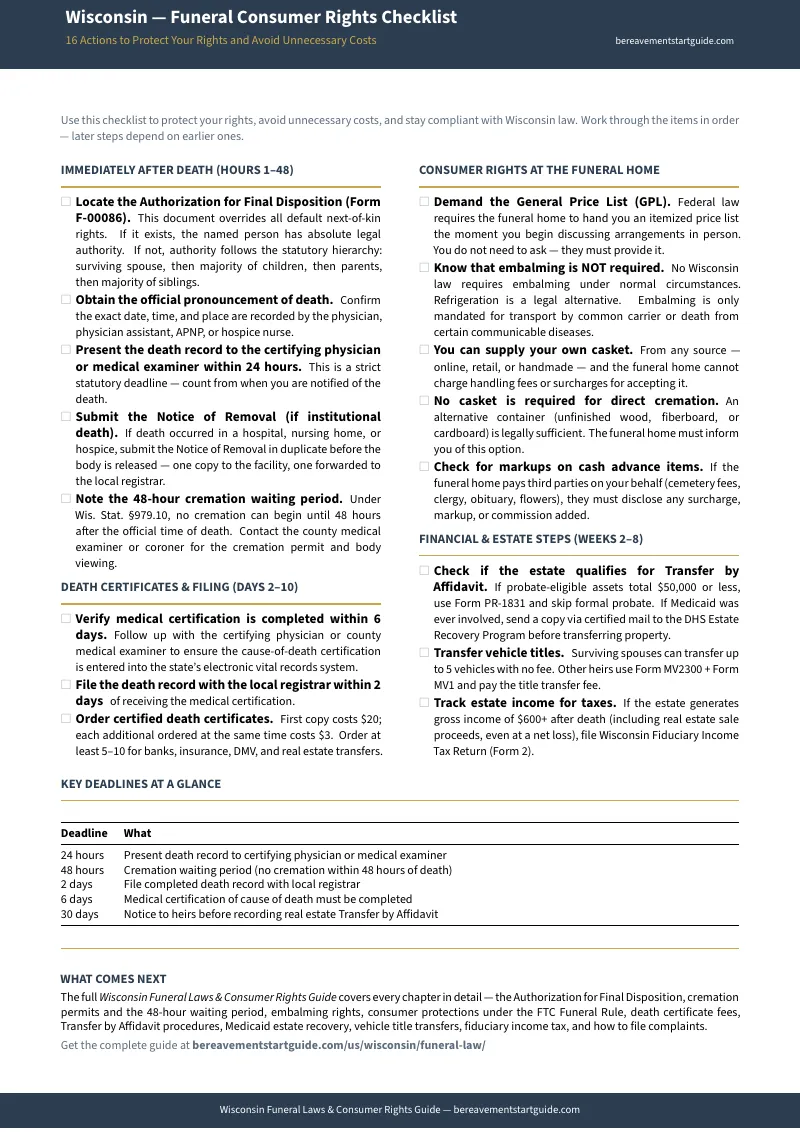
A comprehensive guide and printable Funeral Consumer Rights Checklist -- covering every disposition right, consumer protection, pricing benchmark, Medicaid funeral trust rule, and DIY funeral option specific to Wisconsin, organized by decision point so you act from knowledge instead of pressure:
The POA Trap: Why Your Healthcare Power of Attorney Cannot Plan a Funeral
Every year, thousands of Wisconsin families discover this the hard way. The Healthcare POA that cost $300 to prepare with an attorney expires the instant the principal dies. It grants zero authority over funeral arrangements, cremation decisions, or burial choices. The only document that controls disposition in Wisconsin is the Authorization for Final Disposition form, which must be signed while the person is still alive and legally competent, with two qualified witnesses or a notary public. The guide explains the default statutory hierarchy that takes over when no Authorization exists, the specific witness disqualification rules that can invalidate the form, how to resolve disputes when siblings cannot reach a majority consensus, and the exact procedure for filing the Authorization so it is legally enforceable when the moment comes.
The FTC Funeral Rule: Six Federal Rights Wisconsin Funeral Homes Must Honor
Federal law gives you six enumerable consumer protections that override anything a funeral director tells you in that arrangement room. The right to receive an itemized General Price List before discussing any services. The right to select only the individual items you want without being forced into a bundled package. The right to decline embalming when state law does not require it. The right to use an alternative container for direct cremation instead of purchasing a casket. The right to provide your own casket from any third-party vendor without the funeral home charging a handling fee. And the right to receive an itemized statement of goods and services before paying anything. The guide provides word-for-word scripts for exercising each right in the arrangement room, the exact regulatory citations to reference if a funeral director pushes back, and the procedure for filing a formal complaint with both the FTC and the Wisconsin Department of Safety and Professional Services if any of these rights are violated.
Medicaid Funeral Trust Strategy: The $4,500 Bank Cap vs. Unlimited Insurance-Funded Trusts
If you or a loved one is approaching a Medicaid spend-down for nursing home care, the type of funeral trust you choose determines whether $4,500 or $15,000 stays protected from the state's asset calculations. Wisconsin Medicaid rules cap bank-funded irrevocable burial trusts at $4,500 per individual. But a life insurance-funded irrevocable burial contract can protect up to $15,000 -- and it does not count against the $2,000 countable asset limit for Medicaid eligibility. The guide explains both mechanisms, the five-year look-back period implications, how to structure the trust so the Wisconsin Estate Recovery Program cannot claw it back after death, and the critical difference between revocable and irrevocable contracts that determines whether the money is sheltered or exposed.
DIY Disposition: Home Funerals, Private Burial, and Transporting Remains
Wisconsin law explicitly permits immediate family members to personally prepare and conduct the final disposition of a decedent without hiring a licensed funeral director. Wis. Stat. 69.18 grants this right. But exercising it requires following a precise bureaucratic sequence: securing the Report for Final Disposition from the coroner or medical examiner, obtaining the cremation permit while navigating the mandatory 48-hour waiting period, filing the death certificate with the local Register of Deeds within nine days, and complying with local zoning ordinances if you choose private property burial. The guide provides the complete procedural roadmap for each DIY option -- home funeral preparation, private land burial, green burial, transporting remains across county lines, and scattering cremated remains (which requires particle reduction to 1/8 inch under Wis. Stat. 440.80). It covers what is legally required, what is merely customary, and what funeral homes tell families is mandatory when it is not.
Wisconsin Funeral Cost Benchmarks and Negotiation Strategy
A direct cremation in Wisconsin averages $2,866. A traditional funeral with viewing and burial averages $8,280. The high end reaches $17,471. These numbers vary dramatically between Milwaukee, Madison, Green Bay, and rural counties -- and most families have no baseline for comparison when they sit down in the arrangement room. The guide provides verified Wisconsin price benchmarks for every major service category (basic services fee, embalming, facility use, hearse, casket, vault, cremation, urn), a line-by-line comparison framework you can use to evaluate any General Price List, and a spending plan template that separates the services you genuinely want from the services being presented as necessary when they are optional.
Estate Settlement Shortcuts: Transfer by Affidavit for Estates Under $50,000
Wisconsin allows estates valued at $50,000 or less to be settled without formal probate through a Transfer by Affidavit process. But if the decedent ever received Medicaid, you must notify the Department of Health Services Estate Recovery Program via certified mail before transferring property -- and DHS can object and recover from the estate. The guide covers the threshold calculation, the DHS notification procedure, the exact affidavit filing process with banks and the county Register of Deeds, and how funeral expenses are prioritized above most other creditors under Wis. Stat. 859.25 -- ensuring that the cost of the funeral gets paid before unsecured creditors can claim the remaining assets.
Who This Guide Is For
- The family sitting in the arrangement room right now -- who just received a General Price List totaling thousands more than they expected, who feel pressured to decide within hours, and who need to know which items on that list are legally required in Wisconsin and which are optional add-ons being presented as standard practice
- The adult child managing a parent's Medicaid spend-down -- who needs to set up a funeral trust that protects assets from Wisconsin's $2,000 countable limit, but cannot afford to choose the wrong trust type and trigger a five-year look-back penalty that jeopardizes their parent's nursing home care
- The family member who wants a home funeral or green burial -- who knows Wisconsin law permits alternatives to commercial funeral homes but needs the exact statutory citations, the procedural sequence for filing with the coroner and Register of Deeds, and the zoning verification process for private property burial
- The proactive planner filling in the gaps their estate attorney left open -- who has a will, a trust, and a Healthcare POA but has never heard of the Wisconsin Authorization for Final Disposition form and does not realize that without it, their funeral wishes are legally unenforceable and their family defaults to the statutory hierarchy that requires majority consent among children
Why Free Resources Will Not Get You Through This
The Wisconsin statutes are public record. Government forms are downloadable. Funeral home websites publish FAQ pages. Here is what you actually encounter when you try to navigate Wisconsin funeral law using these free sources:
- Wisconsin statutes are scattered across six chapters with no connective logic. Chapter 154 covers disposition authorization. Chapter 440 regulates crematories. Chapter 69 governs vital records and death certificates. Chapter 979 controls the 48-hour cremation waiting period. Chapter 157 addresses cemeteries. The Marital Property Act lives in Chapter 766. Each chapter was written for attorneys and regulators, not for a grieving family member trying to figure out whether they need a cremation permit before or after the medical examiner signs the death certificate.
- Elder law firms publish articles designed to generate $300/hour consultations. Firms like Schloemer Law and Wokwicz Law publish detailed articles about Medicaid funeral trusts and irrevocable burial contracts -- then stop just short of telling you the exact dollar thresholds, the precise trust structure, or the filing sequence. Their content strategy is to make the topic feel impossibly complex so you book a paid appointment to get the answer they already know.
- Funeral home websites never mention your FTC rights. Browse any Wisconsin funeral home website. You will find service descriptions, pricing packages, and memorial options. You will not find a single mention of the FTC Funeral Rule, your right to decline embalming, your right to supply your own casket, or the fact that Wisconsin law allows families to handle disposition without hiring a funeral director. The information that saves families money is the information funeral homes have no commercial incentive to publish.
- National legal platforms miss the Wisconsin-specific details that matter. Nolo and Justia provide readable overviews of funeral law. They do not cover the two-witness requirement for the Authorization for Final Disposition form, the $4,500 bank trust cap versus the $15,000 insurance trust exemption, the 1/8 inch particle size rule for scattering ashes, or the county-specific zoning requirements for private property burial. Follow their generic guidance in Wisconsin and you will miss procedures that are mandatory in this state.
- The Funeral Consumers Alliance chapters provide price surveys without procedural guidance. The FCA chapters in Wisconsin publish valuable price comparison data. But they do not provide the sequential, form-by-form, deadline-by-deadline procedural roadmap that a family needs when they are trying to execute a home funeral, navigate a Medicaid spend-down, or resolve a family dispute over disposition rights. Price data without a procedure is a tool without instructions.
Free resources give you raw statutes from six different chapters, price surveys without negotiation strategies, law firm teasers designed to sell consultations, and funeral home content that never mentions the federal rights protecting you. The Death Care Defense System puts every disposition right, every consumer protection, every Medicaid trust rule, every DIY procedure, and every cost benchmark into one document, sequenced by decision point -- with the statutory citations, the word-for-word scripts, and the filing procedures that tell you exactly what to do and what to refuse.
-- Less Than 10 Minutes With a Wisconsin Elder Law Attorney
A single consultation with a Wisconsin elder law attorney costs $300 or more per hour. A Medicaid planning session runs $1,500 to $3,000. Choosing the wrong funeral trust type -- a bank-funded trust when you needed insurance-funded -- costs $10,500 in lost asset protection. Failing to exercise your FTC rights in the arrangement room costs the difference between the $2,866 direct cremation you wanted and the $8,280 traditional funeral package you were steered into. Not knowing that a Healthcare POA expires at death costs your family weeks of paralysis while siblings argue over disposition. This guide costs less than a brief phone call with a professional and gives you the complete Wisconsin funeral law and consumer rights roadmap -- every disposition right, every federal protection, every Medicaid trust threshold, every DIY procedure, and the word-for-word scripts for the arrangement room.
Your download includes the complete guide, the printable Wisconsin -- Funeral Consumer Rights Checklist, and standalone reference sheets you can print individually: the FTC Funeral Rule Rights Card, the Authorization for Final Disposition Filing Guide, the Medicaid Funeral Trust Comparison, the DIY Disposition Procedure, and the Wisconsin Funeral Cost Benchmarks. Instant download, no account required.
Money-back guarantee, no time limit. If the guide does not give you clarity on your FTC rights in the arrangement room, confidence in the Medicaid funeral trust structure that protects the most assets, and a clear procedural roadmap for every Wisconsin disposition option, email us for a full refund. No questions asked.
Not ready for the full guide? Download the free Wisconsin -- Funeral Consumer Rights Checklist -- a printable one-page summary of the federal and state rights that protect you when making funeral arrangements in Wisconsin. Enough to walk into any arrangement room knowing what you can decline, what you can provide yourself, and what no funeral director can legally charge you for.
You did not choose this. But the arrangement room pressure is real, the Medicaid trust deadlines carry financial consequences, and your rights under federal and Wisconsin law are absolute. The guide puts every consumer protection, every disposition option, every cost benchmark, and every filing procedure in one place so you can make decisions from knowledge instead of grief.