The Bank Said You Need "Letters Testamentary." Wisconsin Does Not Issue Them. The Register in Probate Handed You 25 Forms and Said She Cannot Tell You Which Ones Apply. Your Father Received Medicaid, Which Means the State Has a Claim Against the Estate You Did Not Know About. And Nobody Has Explained Whether the Estate Is Small Enough to Skip Court Entirely.
Your mother died on a Tuesday. By Thursday the funeral director asked how many certified death certificates you need. You said three. You will need ten or twelve. Every bank, every insurance company, every county office requires an original with a raised seal, and reorders through the Vital Records Office take weeks.
You went to the Register in Probate to ask what to file. She handed you a stack of PR-series forms and told you she is legally prohibited from advising you on which ones apply to your situation or what order to file them in. You called a probate attorney. The initial consultation was free. The retainer quote was $3,500. The estate is worth $85,000. Your sister said there might be a way to avoid probate for smaller estates, but she does not know the cutoff or what counts toward it.
Then you found a tractor and a hay baler registered solely in your father's name. Nobody mentioned that Wisconsin has a specific statute allowing farm implements to transfer outside of probate to a named beneficiary — which could mean the difference between qualifying for the simplified process and being forced into full court administration.
The Wisconsin Probate Process Guide is a Probate Filing Sequence built entirely around Wisconsin Statutes Chapters 851 through 882 — mapping every form, every deadline, every filing fee, and every statutory pathway into one chronological sequence. It tells you whether the estate qualifies for the $50,000 Transfer by Affidavit (and exactly which assets count toward that threshold), whether you need Informal or Formal Administration, how to obtain Domiciliary Letters (Wisconsin's version of Letters Testamentary, Form PR-1810), and exactly which creditors get paid in which order so you never take on personal liability. It covers the Wisconsin-specific complications that no national guide touches: marital property classification, the farm implement exclusion, Medicaid expanded estate recovery, and the Closing Certificate for Fiduciaries that the court will not let you skip.
What's Inside the Probate Filing Sequence
A 14-chapter guide with a printable 20-item action checklist — covering every probate pathway, county procedure, creditor defense, and filing deadline available under Wisconsin law:
Chapters 1-2: Does the Estate Need Probate, and Which Pathway Applies
The first decision that determines everything: which assets actually require court supervision and which transfer automatically. Life insurance, retirement accounts, POD/TOD accounts, survivorship marital property, and joint tenancy property all skip probate — but still require paperwork. Then the four statutory pathways side by side: Transfer by Affidavit ($50,000 or less, no court involvement), Summary Settlement ($50,000 or less with a surviving spouse or minor children), Summary Assignment ($50,000 or less without a surviving spouse), and full Informal or Formal Administration. The comparison table showing timeline, cost, and requirements for each track — so you know which path to follow before spending a dollar on filing fees or attorney retainers.
Chapters 3-4: Non-Probate Asset Transfers and the Small Estate Shortcut
Step-by-step instructions for transferring assets that bypass probate: updating beneficiary designations, retitling joint accounts, recording TOD deeds, and the survivorship marital property transfer process. Then the complete Transfer by Affidavit walkthrough (Form PR-1831): who can file, which assets count toward the $50,000 threshold (and which do not — jointly owned property, beneficiary-designated accounts, and farm implements under Wis. Stat. § 705.18 are excluded), the mandatory notarization requirement, the special procedures when real estate is involved (30-day notice to heirs, Affidavit of Heirship, electronic Real Estate Transfer Return), and the legal obligation to pay decedent's debts before distributing to heirs.
Chapters 5-7: Opening Probate, Creditors, and the Inventory
The sequential filing process you actually walk through at the county Register in Probate: Application for Informal Administration (Form PR-1801), Proof of Heirship (PR-1806), Consent to Serve (PR-1807), Statement of Informal Administration (PR-1808), the bond requirement (PR-1809A — signature bond for Wisconsin residents, surety bond for non-residents), and receiving your Domiciliary Letters (PR-1810). Then the creditor notice process: publishing once per week for three consecutive weeks (first publication within 15 days of the Registrar's signature), mailing to all known creditors, the 3-to-4-month claims window, and the debt priority order under Wis. Stat. § 859.25. The inventory (PR-1811) with the 0.2% filing fee calculation and the critical difference between filing an inventory (public record) and exhibiting it to the Registrar (stays private).
Chapter 8: Medicaid Estate Recovery
The chapter most Wisconsin families do not know they need until a claim arrives in the mail. Wisconsin operates under an "expanded estate" recovery model — meaning the Department of Health Services can pursue not just probate assets but also the decedent's interest in joint tenancy real property, revocable trusts, and POD accounts. The mandatory notification requirement (applies even for small estates). The surviving spouse protection that postpones recovery while the spouse is alive. The hardship waiver provisions. The funeral expense deduction. The specific steps to respond to an Estate Recovery Program claim letter — so you do not inadvertently waive protections the statute provides.
Chapters 9-10: Taxes, the Closing Certificate, and Closing the Estate
Wisconsin has no state estate tax and no inheritance tax — but there are still tax obligations that can block estate closure. The final income tax returns (federal and state). The fiduciary income tax return (Form 2) if the estate earned income. The Closing Certificate for Fiduciaries (Schedule CC filed electronically through the Department of Revenue) — allow up to 120 days for processing, and the court will not close the estate without it. Then the closing paperwork: Estate Account (PR-1814), Estate Receipts (PR-1815) from each beneficiary, and the Statement to Close Estate (PR-1816). After six months with no objections, you are automatically discharged from all liability.
Chapters 11-14: Special Situations, Compensation, When to Hire an Attorney, and eFiling
Ancillary probate for non-residents who owned Wisconsin real estate (the requirement to appoint a resident agent). Farm estates and the Wis. Stat. § 705.18 farm implement transfer. Intestate succession when there is no will — the distribution chart for every family structure. The executor compensation formula (2% of inventory value). The honest line between what you can handle with this guide and what requires a licensed attorney: contested wills, insolvent estates, complex marital property disputes, multi-state ancillary proceedings. Practical tips for navigating Wisconsin's eFiling system.
Who This Guide Is For
- The first-time executor who got a $3,500 attorney quote and realized the legal fees would consume a significant portion of a modest estate — and wants to know whether the Transfer by Affidavit or Informal Administration applies before writing that retainer check.
- The surviving spouse confused by marital property rules who needs to understand which assets pass automatically as survivorship marital property and which require probate — and does not know that the surviving spouse's protections under Chapter 766 exist because the Register in Probate cannot provide legal guidance.
- The family trying to figure out the $50,000 threshold who cannot tell whether the estate qualifies for the simplified Transfer by Affidavit because nobody has explained which assets count toward the limit and which are excluded — including jointly owned property, beneficiary-designated accounts, and farm implements.
- The executor facing a Medicaid recovery claim who received a letter from the DHS Estate Recovery Program and needs to understand Wisconsin's expanded estate recovery model, the surviving spouse protection, and the hardship waiver provisions — before making a payment that waives protections the statute provides.
- The out-of-state executor named in a Wisconsin will who just learned they must appoint a Wisconsin resident agent, post a surety bond (not just a signature bond), and navigate court filings from hundreds of miles away.
- Anyone who does not know which filing pathway applies and needs five minutes with a decision tree to determine whether the estate qualifies for the Transfer by Affidavit, Summary Settlement, Summary Assignment, or full administration — before committing to a path that wastes time and money.
Why Free Resources Do Not Replace a Sequenced Filing Guide
Every form referenced in this guide is available for free from the Wisconsin Court System website or the county Register in Probate. Form PR-1801 is on wicourts.gov. The Transfer by Affidavit (PR-1831) is available from the State Bar. Here is why the forms alone are not enough:
- The Register in Probate cannot tell you how to file. County Probate Registrars are legally prohibited from providing legal advice. They hand you the forms and explain they cannot tell you which ones apply, what order to file them in, or how to fill them out. You get the raw paperwork without a single word of instruction about sequencing or deadlines.
- Wisconsin uses terminology that does not match what banks ask for. Every financial institution in the country asks for "Letters Testamentary." Wisconsin does not issue Letters Testamentary. The state uses "Domiciliary Letters" (Form PR-1810). Families lose days or weeks because they are searching for a document that does not exist under that name in this state.
- The $50,000 threshold is more nuanced than it appears. Transfer by Affidavit, Summary Settlement, and Summary Assignment all use the $50,000 limit — but they have different eligibility rules, different procedures, and different outcomes. The farm implement exclusion under Wis. Stat. § 705.18 can drop the estate below the threshold. Most families either assume they do not qualify when they do, or assume they qualify when they do not.
- Law firm websites explain the problem. They withhold the solution. Wisconsin probate attorneys publish detailed articles about estate settlement complexity. The content is accurate and deliberately incomplete — designed to trigger a consultation call, not to empower you to handle it yourself. For many Wisconsin estates under $200,000 in net probate value with cooperative heirs, the answer is that you do not need an attorney for Informal Administration.
- Wisconsin has state-specific hazards no generic guide covers. The marital property classification system. Medicaid expanded estate recovery that reaches beyond probate assets. The farm implement transfer statute. The Closing Certificate for Fiduciaries that takes up to 120 days and blocks estate closure until it arrives. The 15-day first-publication deadline for creditor notices. The mandatory resident agent for non-resident executors. These are the issues that derail Wisconsin estate settlements when families use national templates.
Free resources give you one agency at a time, with no sequencing, no cross-referencing, and no way to know what you are missing. The Probate Filing Sequence maps every form, every deadline, and every county procedure into one chronological order — so you file correctly, pay debts in the right priority, and determine whether you actually need an attorney before spending a dollar on one.
— Less Than Ten Minutes of a Wisconsin Probate Attorney's Time
Wisconsin families lose weeks and thousands of dollars every year — not because the estate was complicated, but because nobody explained the system before they walked into the Register in Probate's office. An estate that qualifies for the Transfer by Affidavit opens full formal probate because nobody explained the $50,000 threshold or which assets are excluded. A surviving spouse never claims marital property protections because the Registrar cannot provide legal advice. An executor pays a credit card company before Medicaid and takes on personal liability because nobody showed them the priority order. A farm family gets forced into full administration because nobody mentioned the farm implement transfer statute. This guide costs less than any of those mistakes.
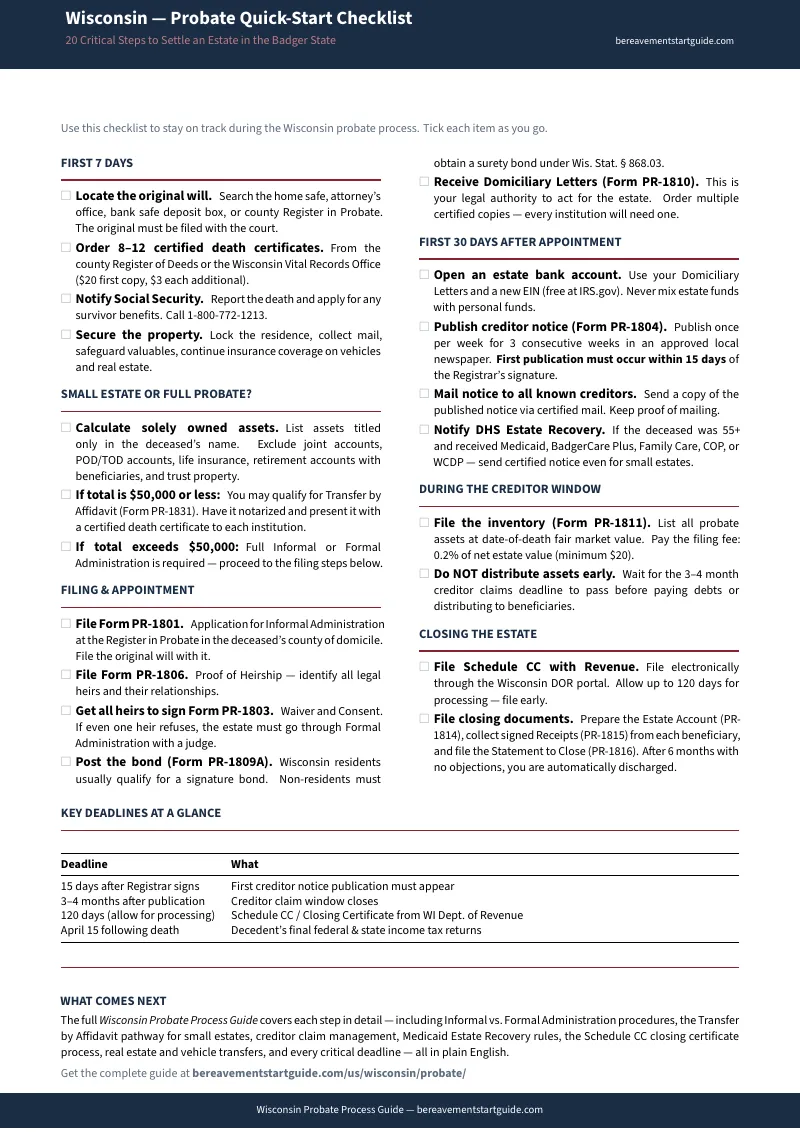
Your download includes the complete 14-chapter guide, the Wisconsin — Probate Quick-Start Checklist (20 items organized by phase), and four standalone reference sheets: a Forms Directory (every PR-series form sequenced in filing order), a Cost Worksheet (fillable tracker for every statutory fee and expense), a Key Deadlines Reference (every critical deadline on one page), and a Creditor Priority Reference (the statutory debt payment order under Wis. Stat. § 859.25) — covering every time-sensitive step from determining whether probate is required through the $50,000 threshold calculation, the Transfer by Affidavit process, opening Informal Administration, the creditor notice timeline, the inventory filing fee, Medicaid Estate Recovery obligations, the Closing Certificate for Fiduciaries, and final estate closure.
Money-back guarantee, no time limit. If the guide does not give you a clear map of every probate pathway available for your Wisconsin estate, every form you need to file, and every deadline you need to meet — email us for a full refund. No questions asked.
Not ready for the full guide? Download the free Wisconsin — Probate Quick-Start Checklist — a summary of the most time-sensitive actions, forms, deadlines, and the key decision points that determine which probate track applies to your estate. Enough to start the right sequence on day one.
You did not plan for this. But you can plan what happens next. The guide gives you the forms, the deadlines, the statutory shortcuts, and the filing sequence — so the next several months are spent settling the estate correctly, not discovering what you missed.