The bank froze every account. The Standesamt needs paperwork by tomorrow. A notary you did not choose is already opening probate. And if you touch the wrong asset before filing the right form, Austrian law makes you personally liable for debts you did not know existed.
When someone dies in Austria, the system moves on a timeline designed for German-speaking locals who already know the rules. The death must be registered at the civil registry office by the next working day. Banks freeze every sole account the moment they hear about the death — revoking all drawing rights, including those granted to a spouse. A court-appointed notary (the Gerichtskommissär) is automatically assigned to administer probate, and the heirs have no say in who that notary is.
And buried in Austria's civil inheritance code is a trap that catches English speakers every year: if you take physical possession of estate assets — move into the apartment, drive the car, even accept a set of keys — before filing your formal inheritance declaration, Austrian courts can treat that as an implied unconditional acceptance. The result is unlimited personal liability for every euro of estate debt, with no way to reverse it.
The English-language resources that exist are scattered across the federal portal oesterreich.gv.at (simplified English summaries of dense German procedures), funeral home websites designed to funnel you toward their paid services, expat forum threads with anecdotal advice that frequently conflates Austrian civil law with German or common-law procedures, and generic Etsy checklists that lack Austria-specific terminology. No single source covers the full sequence — from the first phone call to the court's final transfer decree — in plain English, with the Austrian-German legal terms you need at each office.
The Austrian Death Administration Roadmap — every deadline, every office, every German legal term explained, in the order things actually happen
The Someone Died in Austria: English Speaker's Emergency Guide is a chronological administrative roadmap built for the specific situation of navigating Austrian death bureaucracy without fluent German. It follows the actual sequence — not alphabetical topics, not a glossary, but the order in which Austrian registries, banks, courts, landlords, and pension offices expect you to act.
Every Austrian-German legal term appears with its English translation the first time it is used. Every deadline is flagged with its legal basis. Every office is identified by its official name and role. And every step tells you whether you can handle it yourself or whether this is the point where you need a Rechtsanwalt, a Gerichtskommissär, or a consular officer.
What's inside
- First 24 hours protocol — who to call in what order, how the medical examiner's inspection works, getting the Anzeige des Todes form, the Totenbeschaubefund certification, and the critical difference between the medical verification and the civil death certificate (Sterbeurkunde) that trips up every English speaker
- Death registration at the Standesamt — the next-working-day deadline, in-person (free) versus written application (€21 fee), the €11 + €2.10 certificate cost, and the complete document checklist including what to bring for non-Austrian citizens
- Embassy and consular notification — how to obtain a Consular Report of Death Abroad (CRODA) for US citizens, the equivalent process for UK and other nationals, and exactly what your embassy can and cannot do (they will issue a death report — they will not liquidate the estate or clear the apartment)
- Burial, cremation, and repatriation — local burial logistics and costs, cremation rules including the province-by-province private release prohibition (only Salzburg allows ashes released to individuals), full repatriation requirements (Leichenpass, zinc-lined coffin, embalming at $3,000–$4,000, total transport cost approximately $7,500), and TSA urn compliance for carry-on transport
- Bank account freeze mechanics — how Einzelkonto freezes work, the critical Oder-Konto versus Und-Konto distinction for joint accounts (one stays accessible, the other freezes entirely), the 50% estate rule for joint account balances, and how a transmortale Vollmacht established before death can bypass the freeze
- The inheritance liability decision — unconditional acceptance (unlimited personal liability for all debts) versus conditional acceptance (liability capped at inherited assets), how to file the Erbantrittserklärung, and the "deemed acceptance" trap where taking physical possession of assets before your formal declaration strips your right to choose
- Probate and the Gerichtskommissär — how Austrian courts automatically initiate the Verlassenschaftsverfahren, the Todesfallaufnahme initial consultation, the Central Register of Wills (Zentrales Testamentsregister) search, the €5,000 simplified estate threshold, and when to hire your own Rechtsanwalt versus relying on the court-appointed notary
- The 14-day tenancy trap — how the Mietrechtgesetz automatically transfers the lease to surviving spouses and cohabitants, and the two-week window to formally object before you become liable for rent on a property you may not want
- Real estate transfer tax — the progressive Grunderwerbsteuer rates for family transfers (0.5% to 3.5% depending on value), the 1.1% Land Register (Grundbuch) registration fee, and professional costs for the Verbücherung at 1.5–2.0% plus VAT
- Pension and insurance claims — PVA survivor pension deadlines, the two-week notification requirement, the six-month retroactive application window, and the Lebensbestätigung trap for foreign-resident pension recipients
- Translations and apostilles — when you need a court-certified translation, the apostille process at Vienna's Geschäftsbereich Recht, and the super-legalisation pathway for non-Hague Convention countries
Plus 9 standalone printables — the emergency checklist, a deadline calendar, German letter templates (bank, employer, tenancy rejection), a legal terms glossary to carry to appointments, an essential contacts card, a bank freeze decision tree, an inheritance decision worksheet, a contract cancellation checklist, and a probate meeting preparation checklist. Print the ones you need and bring them to each appointment.
Who this is for
- Expats living in Austria whose spouse, parent, or partner has just died — and who need to know what to do tonight, not after a week of translating Austrian government portals
- Family members abroad who just received a call from an Austrian hospital, police station, or embassy — and have no idea where to start
- Non-resident heirs dealing with an Austrian estate from outside the country — needing to understand the Verlassenschaftsverfahren, bank freeze timeline, and what can be done remotely versus what requires physical presence
- Estate executors and professional advisors — foreign attorneys, solicitors, or wealth managers who need a reliable primer on Austrian probate and repatriation procedures
Why not just use the free resources?
Austria's federal portal oesterreich.gv.at publishes a useful overview — in German, with highly simplified English summaries that omit critical procedural details. The Notariatskammer (Austrian Chamber of Notaries) publishes probate guidance — in German, structured to promote their notary directory. Funeral home websites explain just enough to funnel you toward their services. And the expat forum threads that come up on Google frequently conflate Austrian civil law with German procedures, or cite advice that predates current fee structures.
No single free source covers the full sequence from death registration to the court's Einantwortungsbeschluss in English, with current law, with all the German legal terminology you need at the counter. This guide does.
The cost of not knowing the system
- Signing an unconditional inheritance declaration — then discovering the estate carries €50,000 in hidden debts that are now your personal liability
- Missing the two-week tenancy opt-out window under the Mietrechtgesetz — then paying months of rent on an apartment you do not want and cannot use
- Paying an Austrian lawyer €200–350 per hour to write a bank notification letter — a task you can do yourself with the right German-language template
- Assuming the embassy will manage the estate — then discovering that consular services are limited to a death report and passport cancellation
- Taking the car from the apartment to run errands — then learning that Austrian courts treat this as an implied acceptance that strips your right to limit liability
- Failing to apply for the PVA survivor pension within six months — and losing the retroactive payments you were entitled to from the day after the death
Satisfaction guarantee
If the guide does not give you a clear path through Austrian death administration, email us for a full refund. No questions, no hoops. You are dealing with enough bureaucracy already.
Get the free checklist or the full guide
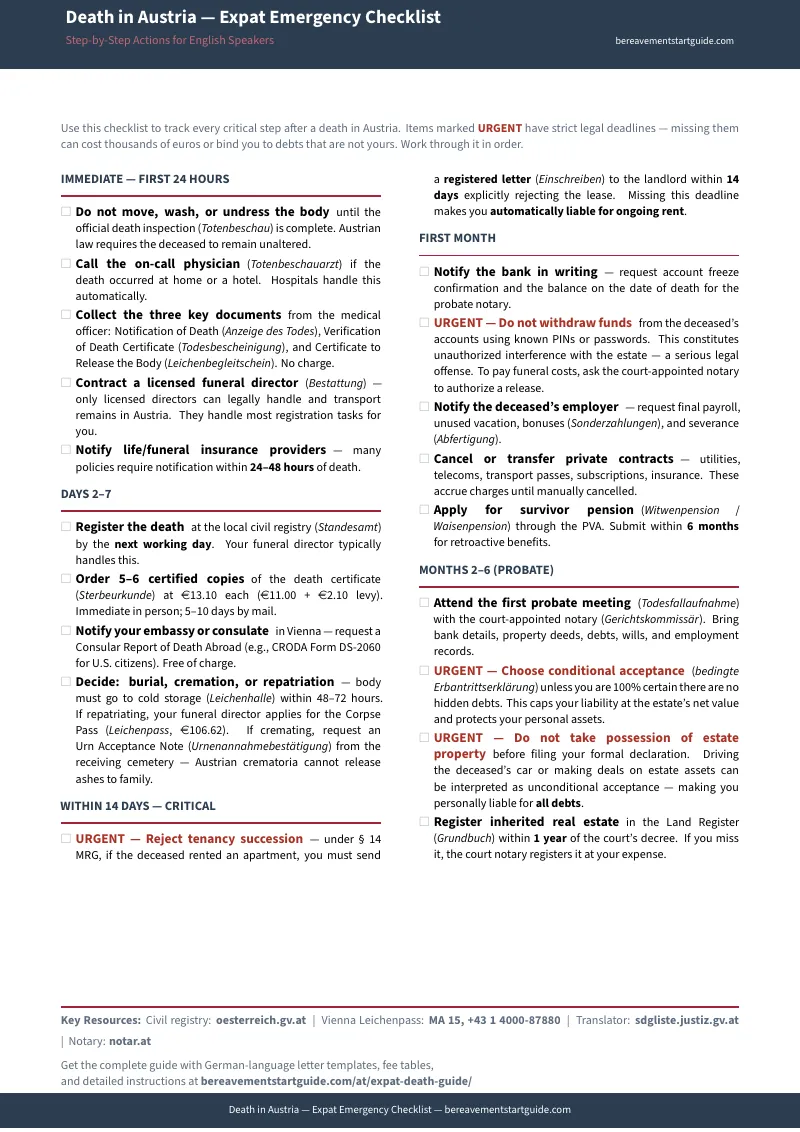
The free Emergency Checklist gives you the critical first steps — who to call, what documents to gather, and the key deadlines. It is the right starting point if you need to act tonight.
The full guide covers the complete process from death to estate settlement — bank freezes, probate, tenancy traps, repatriation, real estate tax, and pensions — with the German legal terminology and practical guidance you need at every stage. For , it replaces hours of fragmented research and potentially thousands of euros in avoidable mistakes.
Frequently Asked Questions
What if the rules change after I buy?
We update the guide when the rules change. Email us any time, even years later, and we'll send you the current edition free.