The ACT Has No Funeral Pricing Law. The Medical Referee Can Reject Your Cremation Application. Canberra Memorial Parks Charges a Separate "Re-Open" Fee on Top of the Plot You Already Paid For. And the Funeral Director Is Not Required to Tell You Any of This.
Someone has died and the clock is running. The bank accounts froze instantly. The attending doctor issued the Medical Certificate of Cause of Death, but the funeral director is now telling you about a "Medical Referee" who must independently approve the cremation before it can proceed — and that is going to cost more time and money you did not expect. You called three funeral homes for quotes and received three bundled "package prices" with no line-by-line breakdown. One included embalming. You did not ask for embalming. Nobody mentioned it was optional.
Meanwhile your brother is insisting the deceased wanted a burial, not cremation. Your mother says she holds Power of Attorney and can make the decision. She cannot — the Power of Attorney died the moment the person did. The executor named in the Will holds absolute legal authority over the body, and their decision overrides everyone else's wishes. But nobody in the family knows that, and the funeral director has put everything on hold until the dispute is resolved — while daily storage fees accumulate.
You are not a funeral industry professional. You are a grieving family member in Canberra trying to do right by someone you loved, in a territory that — unlike NSW or Western Australia — has no specific funeral-pricing law requiring directors to hand you an itemised price list. Your only protection is the general Australian Consumer Law, which means you have to know to demand transparency. Nobody does it for you.
That is the gap this guide fills. The ACT Funeral Laws & Consumer Rights Guide is a Consumer Defence System — a single, independent manual that synthesises the Cemeteries and Crematoria Act 2020, the Coroners Act 1997, the Fair Trading Act 1987, and the Births, Deaths and Marriages Registration Act 1997 into one sequential roadmap. Not a funeral director's brochure. Not a government page that covers one form but leaves you to find the next four yourself. An executor-level manual built for the person who needs to make decisions under pressure without overpaying, losing legal ground, or missing a deadline that costs weeks.
What's Inside the Consumer Defence System
A 9-chapter guide plus the ACT Funeral & Consumer Rights Quick-Start Checklist — covering every stage from the moment of death through registration, fees, disputes, and complaints, built specifically for the ACT regulatory environment:
Who Is Actually in Charge: Executor, Next of Kin, and the EPOA Trap
Almost every funeral dispute and delay traces back to one misunderstanding: families assume the surviving spouse or eldest child automatically controls arrangements. They do not. The named executor holds absolute authority over the body from the moment of death. An Enduring Power of Attorney ends instantly at death — you cannot use it to access bank accounts or sign funeral contracts. This chapter maps the legal hierarchy, provides a decision tree for establishing your standing, and explains when to involve the ACT Public Trustee and Guardian immediately.
The First 48 Hours: Verifying Death, the Coroner, and Death at Home
If the death was expected (palliative care), call the attending doctor — calling emergency services can accidentally trigger a coronial investigation. If it was sudden or suspicious, the body goes to the Forensic Medicine Centre in Mitchell and you cannot proceed with any funeral until the Coroner releases it. This chapter covers the Medical Certificate of Cause of Death, FMC communication protocols (they refuse unannounced visits and operate through ACT Policing), and the interim death certificate — the obscure document that lets you unlock frozen bank accounts while the coronial process runs.
Choosing the Disposition: Cremation, Burial, or Home Burial
Cremation requires independent Medical Referee approval under Section 41 of the Cemeteries and Crematoria Act 2020 — a real legal safeguard, not a funeral-director invention. Pacemakers and drug infusion pumps must be surgically removed before cremation or the application is rejected. Burial is available at Gungahlin, Woden, or Hall cemetery, with green burial only at Gungahlin. Home burial on private land is technically legal but requires regulatory approval that is rarely granted, and it creates a permanent encumbrance on your property title. The guide includes a cremation-vs-burial-vs-green-burial decision table with costs and paperwork for each path.
Your Consumer Rights When There Is No "Funeral Rule"
This is the chapter the funeral industry would rather you did not read. Much online advice references the US FTC Funeral Rule, which mandates itemised pricing for American funeral homes. No equivalent exists in the ACT. Your only protection is the Australian Consumer Law, and nobody is required to proactively hand you a price breakdown. The guide gives you a quote-comparison script to take to three funeral homes — demanding separate lines for the Basic Services Fee, Transfer of Remains, Preparation/Refrigeration, Casket, and Third-Party Disbursements. It explains that embalming is not legally required, that you can supply your own coffin, and how to cross-check cemetery disbursements against the published Canberra Memorial Parks rates to spot funeral-director markups.
What Things Actually Cost: The Fee Directory
Every published 2025-2026 ACT fee in one place: Access Canberra death certificates ($52), adult cremation ($1,195 weekday, $1,535 Saturday), child cremation (free), monumental lawn burial ($10,243), natural burial ($7,835), ashes interment, exhumation, probate filing fees ($0 for estates under $50,000, up to $2,859 for million-dollar estates), and the cemetery reservation-versus-re-open fee structure that catches families off guard — because the plot you pre-purchased years ago carries a separate charge just to open it at the time of death.
Financial Hardship: The ACT Funeral Assistance Program
If you cannot afford a funeral, you must apply to the ACT Funeral Assistance Program before signing any commercial contract — there is no retroactive reimbursement. Family contributions are capped at $500 for approved hardship cases. The guide covers eligibility, the application process, the 90-day deadline, and what happens to destitute or unclaimed bodies under the Unclaimed Body Scheme administered by the ACT Public Trustee and Guardian.
Registration, Certificates, and Estate Paperwork
The Death Registration Statement must be lodged with Access Canberra after burial or cremation — usually handled by the funeral director, but rejected if parental or marital history is incomplete. The guide lists every piece of personal information you need to gather before meeting the director, the Australian Death Notification Service for notifying banks and utilities in one step, bank thresholds for releasing funds without probate ($20,000-$50,000 on an indemnity form), and the 14-day Notice of Intention to Apply timeline that runs before you can file for probate.
Disputes, Cross-Border Complications, and Complaints
The ACT is surrounded by NSW — cross-border issues (an ACT resident who dies in Queanbeyan, property in both jurisdictions) are common. An ACT probate grant will not transfer NSW property without a formal reseal. Family disputes over burial versus cremation can escalate to the ACT Supreme Court. And if a funeral director treats you unfairly, the complaint pathway runs through Access Canberra Fair Trading to ACAT. The guide maps each escalation with the forms and contacts you need.
Who This Guide Is For
- The executor named in the Will who has never arranged a funeral and needs to know their absolute legal authority, the mandatory cremation forms, and how to demand transparent pricing from directors who are not required to offer it
- The grieving spouse or adult child dealing with a family dispute over cremation versus burial — who needs to understand the legal hierarchy, when an executor's decision overrides everyone else's, and what legal options exist to challenge it
- The family shocked by the costs who received a $10,000+ quote and needs to know which charges are legitimate government fees, which are funeral-director markups, and how to access the ACT Funeral Assistance Program before signing a contract
- The family waiting on the Coroner whose loved one died suddenly and is at the Forensic Medicine Centre in Mitchell — who needs the interim death certificate process, the FMC communication channels, and a realistic timeline for body release
- The adult child pre-planning for an ageing parent who wants to audit a prepaid funeral contract, understand the Fair Trading Act rules requiring fund transfer within 7 days and investment within 28 days, and compare cemetery options without relying on a single provider's sales pitch
Why Free Resources Leave You Exposed
The information exists — scattered across four government agencies and a handful of funeral-director websites that each cover their own piece and nothing else. Here is what you actually encounter:
- Access Canberra publishes registration forms but not strategy. They explain how to apply for a death certificate. They do not explain who has the legal right to fill out the form when the family is fighting, what happens when the funeral director delays lodgement, or how to get an interim certificate while the Coroner holds the body.
- Canberra Memorial Parks publishes its fee schedule but not the comparison. Their fees are transparent. They do not warn you that funeral directors roll these government charges into bundled invoices where you cannot tell a real fee from a markup. And they do not mention the re-open fee on pre-purchased plots until you ask.
- Tender Funerals publishes honest prices but funnels you to their services. They are a genuine not-for-profit with clear pricing. Their content still inherently steers you toward booking with them, not toward an independent analysis of your rights across every provider.
- Law firm blogs explain executor rights to sell retainers. MV Law and others produce technically correct content about funeral disputes. Every article is structured to convince you the situation is too dangerous to handle without a $350-per-hour solicitor. For genuine court disputes, that may be true. For the majority of cases, knowing your legal standing and having the right template letter resolves the conflict without professional fees.
- The ACT Regulator explains cremation rules in isolation. They describe the Medical Referee requirement. They do not connect it to the death certificate timeline, the coroner process, or the cemetery booking that depends on all of them happening in the right sequence.
Free resources give you fragments from agencies that do not talk to each other. The Consumer Defence System puts every ACT-specific law, form, fee, deadline, and consumer right into one document, in the order you need them — with the gaps and traps flagged before you walk into them.
— Less Than a Single Funeral Director's "Administrative Fee"
Funeral directors in Canberra charge anywhere from $3,200 for a basic direct cremation to well over $15,000 for a full-service funeral with burial. The average Basic Services Fee alone — the non-declinable overhead charge — runs $1,500 to $3,000 depending on the provider. A single consultation with an estate solicitor costs $350 to $500 per hour. This guide costs less than the administrative fees most families pay without questioning — and it tells you exactly which fees you can question, which you can decline, and which are genuine government charges you must pay.
Your download includes the complete 9-chapter guide plus four standalone printable PDFs you can take to the funeral home, the cemetery, or Access Canberra:
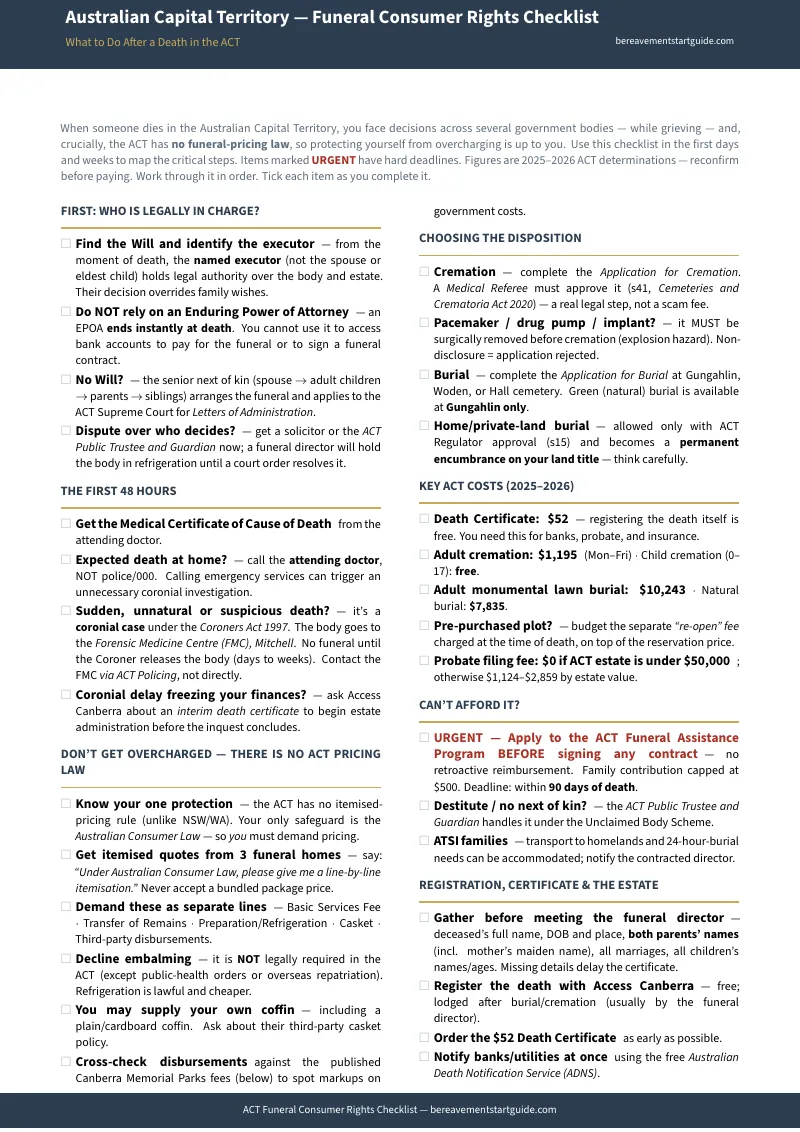
- ACT Funeral & Consumer Rights Quick-Start Checklist — the legal authority hierarchy, first-48-hours actions, quote-comparison demands, key 2025-2026 ACT fees, financial assistance eligibility, and cross-border warnings on a printable 2-page action list
- First 48 Hours Action Sequence — the step-by-step guide for the critical first two days, from medical verification through establishing legal authority, with the EPOA warning and a STOP checklist before signing anything
- Funeral Quote Comparison Worksheet — a fillable table for comparing itemised quotes from three funeral homes side by side, with the Canberra Memorial Parks disbursement cross-check and consumer rights audit
- Forms, Fees & Contacts Reference — every 2025-2026 Access Canberra, Supreme Court, and Canberra Memorial Parks fee in one printable reference card, plus key ACT contacts and deadlines
Plus a money-back guarantee, no time limit. If the guide does not give you clarity on your consumer rights and confidence that you are not overpaying, email us for a full refund. No questions asked.
Not ready for the full guide? Download the free Australian Capital Territory — Funeral Consumer Rights Checklist — the most urgent actions from establishing legal authority through demanding itemised pricing, plus key ACT fees and the financial assistance eligibility rules. It is enough to protect yourself today.
You should not have to become a funeral-industry expert to bury someone you love. But in a territory with no pricing law, knowing your rights is the only protection you have. This guide makes sure you know them.