You Were Named Executor in a Will You Barely Remember Signing. The ACT Supreme Court Requires an Online Probate Notice With a 14-Day Window You Did Not Know Existed. The Public Trustee Wants 4.4% of Everything. And If You File Form 3.1 With a Single Formatting Error, the Registry Will Halt Your Entire Application.
The funeral is over but the paperwork has barely started. The banks froze every account the morning the death certificate was issued. Siblings are asking when they will receive their share. The ATO will want two tax returns — one for the deceased and one for the estate trust — but you do not even know how to get a TFN for an estate. The deceased owned a house in Canberra, and Access Canberra will not let you touch the title until the ACT Supreme Court issues a Grant of Probate. But the Supreme Court requires you to publish a Notice of Intention on their online smart form at least 14 days before you file — and nobody told you about this step until you tried to submit the application and the registry rejected it.
You are not a solicitor. You are a family member doing what the will asked you to do, in a jurisdiction governed by the Administration and Probate Act 1929, the Court Procedures Rules 2006, and a set of mandatory forms (3.1, 3.4, 3.11, 3.14) that read as if they were written for paralegals. The ACT Supreme Court registry explicitly warns that staff cannot provide legal advice. The Public Trustee and Guardian offers to handle everything — for a capital commission of 4.4% on the first $300,000, 3.3% on the next $300,000, and 6.6% on all estate income. On a $600,000 Canberra property, that is $23,100 before the estate even accounts for income. And every Canberra probate solicitor charges $350 to $500 per hour, with standard probate retainers starting at $3,000 to $5,000.
There is a space between "too expensive to outsource" and "too complex to figure out alone." That is exactly where the ACT Probate Process Guide sits — a Court Filing Command Centre that walks you through every form, every fee, every deadline, and every trap that causes the Supreme Court to reject self-represented applications. Not a generic Australian overview. Not a law firm blog designed to convince you the process is too dangerous without a retainer. A structured, ACT-specific manual built for executors and administrators who want to do this properly, save thousands, and avoid the mistakes that cost weeks.
What's Inside the Court Filing Command Centre
An 11-chapter guide with 3 appendices, plus the ACT Probate Quick-Start Checklist — covering every stage from the moment of death through final asset distribution, built specifically for the ACT Supreme Court and the territory-specific rules that make probate here different from every other state:
Understanding Probate in the ACT: The Legal Transition at Death
The moment someone dies, every Enduring Power of Attorney is immediately extinguished. Every Health Direction ceases. Every ACAT guardianship order stops having effect. And you — the executor named in the will — hold only limited common-law powers until the court formally issues the Grant of Probate. You can arrange the funeral and secure the house. You cannot sell property, access bank accounts, or distribute a single dollar. This chapter explains the four statutes that govern everything you are about to do, so you understand why each step exists and what happens if you skip one.
Immediate Actions After Death: The First 48 Hours to 2 Weeks
Death certificates from Access Canberra cost $52.00 each and take approximately 15 business days to process — and you need multiple certified originals because the bank, the Supreme Court, and Land Titles all demand separate copies and will not accept photocopies. This chapter covers registering the death, the multi-step medical authorisation required for cremation in the ACT (attending physician plus independent medical referee), and what the Coroner's involvement means for your timeline. Every day you delay ordering certificates adds 15 business days to your total probate timeline.
Do You Actually Need Probate? The Decision That Saves Thousands
Not every estate requires a Grant of Probate — and filing unnecessarily means paying court fees between $1,124 and $2,859 for a process you might not need. This chapter maps the exact scenarios: joint tenancy property passes by survivorship with a $178 Form 015-ND (no probate). Bank accounts below institutional thresholds can often be released informally — but those thresholds are corporate policy, not law. CBA and ANZ generally trigger at around $50,000. Westpac triggers between $75,000 and $114,000. Superannuation with a valid Binding Death Benefit Nomination bypasses the estate entirely. The guide gives you the current threshold for every major bank and the decision framework to determine whether you can skip probate altogether.
Publishing the Notice of Intention: The Step Nobody Warns You About
Since March 2022, the ACT Supreme Court requires all probate notices to be published through their online smart form system — not in newspapers. The mandatory rule: the notice must be published not less than 14 days and not more than 3 months before your formal application is filed. Publication costs $61.00. If you amend the notice after publishing, the 14-day clock resets and you pay another $21.00. If the notice expires past the 3-month window, you republish from scratch. The guide tells you to publish the notice the same week you receive the death certificate — before you have finished gathering valuations — so the 14-day waiting period runs in parallel with your document preparation instead of adding two weeks on top of it.
Preparing and Filing the Court Application: Line by Line
The ACT Supreme Court holds self-represented applicants to the exact same procedural standards as qualified solicitors. If your application is defective, processing halts and you receive a formal requisition. This chapter walks you through Form 3.1 (Originating Application for Probate), Form 3.4 (Grant of Probate — must be submitted in duplicate, with a certified copy of the will physically attached to each duplicate), Form 3.11 (Applicant's Affidavit), and Form 3.14 (Affidavit of Search). It flags every error that commonly triggers requisitions: removing staples from the original will (the Court interprets this as tampering or a detached codicil), mismatched names between the will and death certificate that require "also known as" clauses, listing net rather than gross estate value, and failing to explain why a substitute executor is applying when the named executor has died or renounced.
For Intestate Estates: Letters of Administration When There Is No Will
If the deceased left no valid will, you need Letters of Administration instead of probate — and the forms are different. Form 3.3 (Originating Application for Letters of Administration), Form 3.6 (Grant of Letters of Administration), Form 3.13 (Affidavit), and critically, Form 3.10 (Consent to Administration), which requires the written agreement of other eligible beneficiaries. The guide covers who has priority to apply under the Administration and Probate Act 1929, how intestacy distribution works in the ACT (spouse, children, parents, siblings — in a specific statutory order), and when the Public Trustee and Guardian automatically becomes involved.
After the Grant: Distribution, Liability, and the Six-Month Window
Getting the Grant of Probate is the halfway point, not the finish line. You must publish a Notice of Intended Distribution under Section 64 of the Administration and Probate Act 1929, and you must observe the six-month window under the Family Provision Act 1969 during which eligible persons can challenge the will. If you distribute assets before both of these deadlines pass and a successful claim is later lodged, you personally are liable for the shortfall. The guide includes the distribution timeline, the debt priority order (funeral and administration costs first, then secured creditors, then unsecured), and the exact process for obtaining ATO tax clearance before final distribution.
Who This Guide Is For
- The adult child named as executor who has never filed anything in the ACT Supreme Court — who needs the online probate notice process explained step by step, the Forms 3.1 and 3.11 walkthrough, and a timeline showing what is urgent versus what must wait for the 14-day publication period
- The surviving spouse who needs to know whether they even require probate — joint tenancy property may transfer with a $178 Form 015-ND and no court involvement, and bank accounts below institutional thresholds may release informally
- The family dealing with no will who just learned the ACT has specific intestacy rules governing who applies for Letters of Administration, who gets what, and whether the Public Trustee and Guardian steps in
- The small estate representative frustrated that the administrative burden seems wildly disproportionate to the estate's value — who needs to know about the filing fee exemption for estates under $50,000 and the PTG's simplified "Election to Administer" for estates under $150,000
- The executor managing from interstate or overseas who needs to understand the online notice system, how to handle Access Canberra forms remotely, and when a Reseal of Foreign Grants (Forms 3.16–3.20) applies to cross-border situations
Why Free Resources Will Not Get You Through the ACT Supreme Court
The information exists — scattered across the ACT Supreme Court website, Access Canberra, the ACT Revenue Office, and a dozen law firm blogs that each cover one piece of the puzzle. Here is what you actually encounter:
- The ACT Supreme Court publishes forms but not instructions. They list Form 3.1, Form 3.4, Form 3.11, and the fee schedule. They do not explain how to phrase your affidavit, how to handle name discrepancies between the will and the death certificate, or what happens if your 14-day notice window expires while you are still gathering valuations. The registry warns that staff cannot provide legal advice — and they mean it.
- Law firm blogs explain probate complexity to sell retainers. Canberra firms like Farrar Gesini Dunn and Bradley Allen Love produce excellent technical content about probate processing times and family provision claims. Every article is structured to convince you the process is too dangerous to handle alone. For genuinely contested estates, that is true. For the majority of straightforward estates, the process is mechanical — forms, fees, deadlines — and a structured guide replaces thousands in professional fees.
- The Public Trustee and Guardian wants you to hand it all over. The PTG publishes transparent fee information — 4.4% capital commission on the first $300,000, 3.3% on the next $300,000, 6.6% on income. On a typical Canberra estate, that is $23,100 or more. Their content is designed to persuade you that professional administration is worth the cost. For families who want to keep control and preserve the estate's value, the alternative is knowing how to do it yourself.
- Bank bereavement pages protect the institution, not you. CBA, ANZ, Westpac, and NAB each publish estate administration processes. Every one focuses on what documents the bank needs from you. None explain the variation in their own informal release thresholds, how to request early access for funeral costs, or why the threshold at one bank differs from the threshold across the street.
- Generic Australian guides miss ACT-specific rules. National portals and online will platforms cover "probate in Australia" without distinguishing between state jurisdictions. The ACT's online notice system, its specific Supreme Court forms, its unique Public Trustee commission structure, and its Access Canberra property transfer process are all territory-specific. Applying New South Wales or Victorian procedures to an ACT estate creates filing errors that cost weeks.
Free resources give you fragments from sources that do not reference each other. The Court Filing Command Centre puts every ACT-specific form, fee, deadline, and procedure into one document, in the order you need them — with the common errors that trigger requisitions flagged before you make them.
— Less Than Fifteen Minutes With a Canberra Probate Solicitor
A single consultation with a Canberra estate solicitor costs $350 to $500 per hour. Standard probate representation starts at $3,000 to $5,000 — and that covers only obtaining the grant. The Public Trustee charges $23,100 or more in capital commission on a $600,000 estate. This guide costs less than fifteen minutes of professional legal time and gives you the complete ACT Supreme Court probate roadmap — every form, every fee tier, every deadline, the online notice process, the common requisition triggers, and the six-month distribution protection window.
Your download includes the complete 11-chapter guide with 3 appendices, plus four standalone printables you can take to the court, the bank, or Access Canberra:
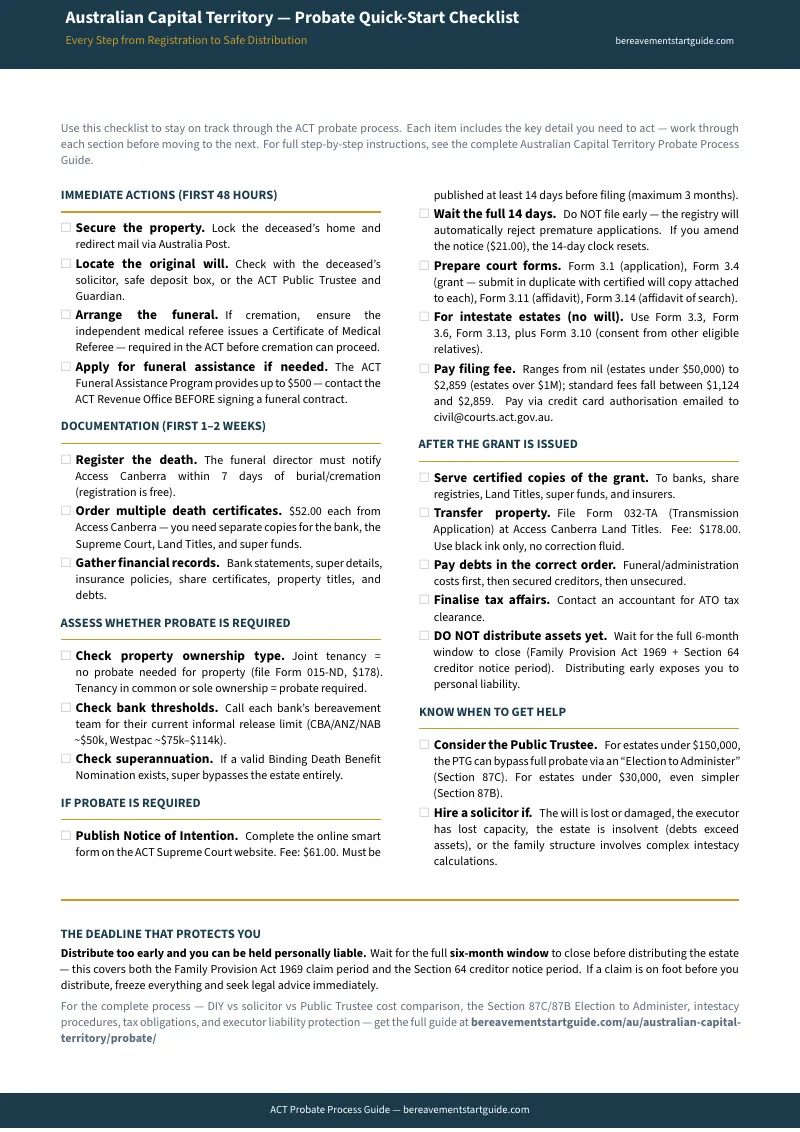
- ACT Probate Quick-Start Checklist — the most urgent actions, court fee tiers, bank thresholds, and critical warnings that prevent requisitions
- Court Filing Quality-Assurance Checklist — a pre-submission checklist covering the 14-day notice window, name matching, duplicate grants, and every formatting error that triggers a requisition
- Access Canberra Land Titles Checklist — the Form 015-ND vs Form 032-TA decision, black ink rules, correction protocols, and the conveyance duty assessment
- Fees Quick Reference — all 2025-26 court filing fees, Access Canberra charges, and the full Public Trustee commission schedule on a single printable page
Plus a money-back guarantee, no time limit. If the guide does not give you clarity on the ACT probate process and confidence that you are filing correctly, email us for a full refund. No questions asked.
Not ready for the full guide? Download the free Australian Capital Territory — Probate Quick-Start Checklist — the most urgent actions from ordering death certificates through publishing your Notice of Intention, plus bank thresholds, court fee tiers, and the critical warnings that prevent requisitions. It is enough to get started tonight.
You did not ask for this responsibility. But you can do it. The guide shows you how, one form at a time.