Someone You Love Just Died in New South Wales. The Funeral Director Is Quoting You $8,000. You Do Not Know What You Are Legally Required to Pay, What You Can Refuse, or Whether Your Family Even Has the Right to Make This Decision.
The phone call came, and now the clock is running. A funeral director is sitting across from you with a glossy brochure and a bundled package that includes services you have never heard of — mortuary preparation, chapel hire, hearse transfer, casket surcharge — and a total that lands somewhere between $5,000 and $10,000. You are exhausted, you are grieving, and the unspoken pressure in the room says: this is what people do for their loved ones.
Nobody tells you that under the NSW Funeral Information Standard, that funeral director is legally required to show you their least expensive option, provide a fully itemised quote before you agree to anything, and disclose every commission or referral fee they receive from the crematorium, the florist, and the mortuary. Nobody tells you that if you sign a prepaid funeral contract during this fog, NSW Fair Trading gives you a 30-day cooling-off period and the fund manager must transfer your money to a registered trust within 10 days. Nobody tells you that the old cremation certificate your local GP is searching for was abolished in 2022 and replaced by a completely different form called a Cremation Risk Advice — and that the confusion between these two documents delays funerals across NSW every single week.
Meanwhile, your family is fighting. Your brother wants cremation. Your mother insists on burial. And no one can agree on who actually has the legal authority to decide — the executor named in the will, the Senior Next of Kin under the Coroners Act 2009, or the surviving spouse who believes the decision is theirs by default. In the worst cases, this escalates to the Supreme Court of NSW, where a single injunction costs tens of thousands of dollars. In the 2025 Mackie v Tedesco case, the Court had to intervene on something as fundamental as whether a family member could view the body.
The New South Wales Funeral Laws & Consumer Rights Guide is a Funeral Rights Navigator — a single, independent resource that puts every NSW funeral statute, consumer protection, and regulatory process into one document, in the order things actually happen. Not a funeral director's brochure designed to upsell you. Not a government factsheet written for medical professionals. Not a grief counselling pamphlet that tells you to "take your time" while the 5-day body retention clock is ticking. A practical manual that tells you exactly what the law says, what your rights are, and what you can legally refuse — so you stop overpaying, stop guessing, and stop letting other people make decisions that belong to you.
What's Inside the Funeral Rights Navigator
A 12-chapter guide and the First 48 Hours Checklist — covering every stage from the moment of death through final disposition, built specifically for NSW statutes and the consumer protections that most families never learn about until it is too late:
Who Has the Legal Right to Direct the Funeral
The executor named in the will holds the primary common law right — overriding the spouse, children, and siblings. But if there is no will, authority cascades down the Succession Act 2006 hierarchy. And if the Coroner is involved, the Senior Next of Kin under the Coroners Act 2009 is the investigative liaison, but that does not give them funeral authority. The guide maps the exact overlap between executor rights, SNOK status, and intestacy hierarchy — and explains what to do when family members disagree, including when court intervention is necessary and when it is not.
Your Consumer Rights Under the Funeral Information Standard
Since February 2020, every NSW funeral director must provide a written, itemised quote before you sign anything. They must display their least expensive funeral package — both in-store and on their website. They must disclose any commissions or referral fees from crematoria, florists, or mortuaries. And they must allow you to select individual services rather than forcing a bundled package. The guide gives you the exact questions to ask, what to look for in a quote, and what to do when a funeral director fails to comply — including how to lodge a complaint with NSW Fair Trading.
The 2022 Cremation Rules That Your Doctor Probably Does Not Know About
The Public Health Regulation 2022 abolished the old Attending Practitioner's Cremation Certificate entirely. It was replaced by the Cremation Risk Advice (Form 1) — a completely different document that focuses on whether the deceased had a pacemaker, implanted battery device, or recent radioactive treatment. A Medical Referee reviews this and issues the Cremation Permit (Form 6). The guide explains the current process step by step, because the most common cause of cremation delays in NSW is doctors and hospitals searching for a form that no longer exists.
Body Retention, Transport, and the Rules Most Families Learn Too Late
If you are keeping the body at home, you have 5 days maximum under the Public Health Regulation 2022 — after that, you need written approval from the NSW Health Secretary and must demonstrate refrigeration at 2–5°C. Hospital mortuaries can hold a body for 21 days, but only for people who died in the hospital. If you need more time — waiting for family from overseas, observing an extended religious mourning period — you must apply to the Local Health District Public Health Unit, and beyond 28 days, full arterial embalming is legally required. The guide covers every retention limit, storage requirement, and the PHU extension application process.
Private Land Burials: The 5-Hectare Rule and Council Permits
Burying a loved one on the family farm is a deep cultural preference in rural NSW, but the bureaucratic requirements are strict. The property must be a continuous holding of at least 5 hectares. The coffin must be buried at minimum 900mm depth. Local council approval is mandatory — and councils routinely require costly geotechnical investigations to ensure the burial will not contaminate groundwater. The guide walks through the entire council application process, the site requirements, and the exemption process for shroud burials (burial without a coffin) through the NSW Health Secretary.
Cemetery Contracts: The 99-Year Cap Nobody Mentions
When you "buy" a burial plot in NSW, you do not buy the land. You buy an interment right — either perpetual (must be used within 50 years or it can be revoked) or renewable (minimum 25 years, maximum 99 years). When a renewable right expires and is not renewed, the cemetery operator can remove the memorial, exhume the remains, and re-use the site. The Cemeteries and Crematoria Act 2013 and the Interment Industry Scheme (mandatory since October 2024) govern these contracts. The guide explains both types, what the contract must include, and how to protect long-term family burial arrangements.
When the Coroner Takes Over
Sudden, unexpected, or suspicious deaths are referred to the State Coroner. The body is transported to the Forensic Medicine facility at Lidcombe (metro Sydney) or held at a regional hospital. You cannot set a funeral date until the Coroner issues an Order for Disposal. The guide maps the coronial investigation timeline — preliminary review, non-invasive testing, full autopsy — and explains your rights as Senior Next of Kin during the investigation, including how to request information about organ retention and estimated release dates.
Paying for a Funeral When No One Can Afford It
Average funeral costs in NSW range from $3,988 for a direct unattended cremation to over $8,000 for a standard service with burial. If the estate has no liquid assets and the family cannot pay, the guide covers three paths: demanding the funeral director's least expensive package under the Funeral Information Standard, applying for a state-funded destitute funeral through NSW Health (contact the hospital social worker or Local Health District before signing any private contract), and claiming the Centrelink Bereavement Payment for surviving spouses. It also covers how to get banks to pay the funeral director directly from frozen estate accounts without probate.
Who This Guide Is For
- The executor named in a will who is suddenly responsible for the funeral and does not know the legal boundaries of their authority — who needs to understand that their decision overrides the family's preferences, how to handle a relative threatening cremation against the deceased's written wishes, and what the Funeral Information Standard requires the funeral director to disclose
- The surviving spouse or eldest child acting without a will who has been told "you are in charge" but does not know the Succession Act hierarchy, the difference between executor authority and Senior Next of Kin status, or what happens when siblings disagree about burial versus cremation
- The family facing a $8,000+ funeral quote with no savings who needs to know their legal right to demand the cheapest available option, how to access the NSW Health destitute funerals program, and how to get the bank to pay the funeral director directly from the frozen account
- The rural family planning a private land burial who needs the 5-hectare minimum, 900mm depth rule, council approval process, and geotechnical investigation requirements — before wasting thousands on an application that will be rejected
- The anticipatory planner helping an ageing parent pre-plan their funeral — who needs to understand prepaid contract cooling-off periods, the difference between perpetual and renewable interment rights, and how to structure a Centrelink-exempt prepaid funeral plan
- The family in crisis where siblings are threatening to override the executor, a cultural or religious request has been refused, or someone is trying to proceed with cremation against the deceased's written objection — who needs definitive legal answers before the situation escalates to the Supreme Court
Why Free Resources Will Not Get You Through This
The information exists. It is scattered across NSW Fair Trading, NSW Health, Cemeteries and Crematoria NSW, the Coroners Court, Legal Aid NSW, the Registry of Births Deaths and Marriages, and half a dozen other agency websites that do not reference each other. Here is what you actually encounter:
- NSW Fair Trading explains the law but does not teach you how to use it. Their Funeral Information Standard pages are legally precise. They do not include scripts for asking a funeral director to show the cheapest package, a quote comparison framework, or guidance on what to do when a director does not comply. The law exists; the ability to enforce it at 9am the morning after your mother dies does not.
- NSW Health factsheets are written for medical professionals. The body retention limits, cremation form changes, and private burial rules are buried in clinical directives, PDF factsheets, and regulatory impact statements. They are accurate. They are also written for morticians, Public Health Unit staff, and local council planners — not for a grieving family member trying to figure out whether they can keep the body at home for one more day.
- Funeral director websites are designed to sell. The Australian Funeral Directors Association provides planning guides that frame the funeral director as indispensable. Commercial disruptors like Bare Cremation offer transparent pricing but exist to funnel you into their services. Neither is going to teach you how to aggressively audit a quote or demand the mandated least-expensive option.
- Legal Aid NSW covers hardship, not negotiation. Their resources are excellent for families in severe financial distress. They explain destitute funerals and estate bank access. They do not cover prepaid contract auditing, cemetery interment rights, the 2022 cremation changes, or intra-family authority disputes for middle-income families.
- Cemeteries and Crematoria NSW covers the cemetery and nothing else. Their consumer guides on interment rights are detailed and authoritative. They provide zero guidance on funeral director pricing, coronial processes, body transport, or anything that happens before the body reaches the cemetery gate.
Free resources give you fragments from a dozen agencies that do not talk to each other. The Funeral Rights Navigator puts every NSW-specific statute, consumer right, timeline, and procedure into one document, in the order things actually happen.
— Less Than One Hour With a Funeral Industry Advocate
A single consultation with a funeral industry advocate or estate solicitor costs $250 to $500 per hour. The average NSW family overpays by $2,000 to $3,000 on funeral costs because they do not know they can demand itemised pricing and the least expensive package. This guide costs a fraction of one professional consultation and gives you the complete NSW-specific reference — every statute, every consumer right, every form, and the negotiation framework that funeral directors hope you never learn.
Your download includes the complete 12-chapter guide, the standalone First 48 Hours Checklist, and eight printable standalone references — a Funeral Quote Comparison Worksheet, Cremation Paperwork Guide, Legal Authority Decision Path, Private Land Burial Checklist, Cemetery Contract Audit, Financial Hardship Navigator, Key Deadlines Reference, and Complaints & Agency Directory. Ten PDFs total. Plus a money-back guarantee, no time limit. If the guide does not give you clarity on your rights and confidence that you are making informed decisions, email us for a full refund. No questions asked.
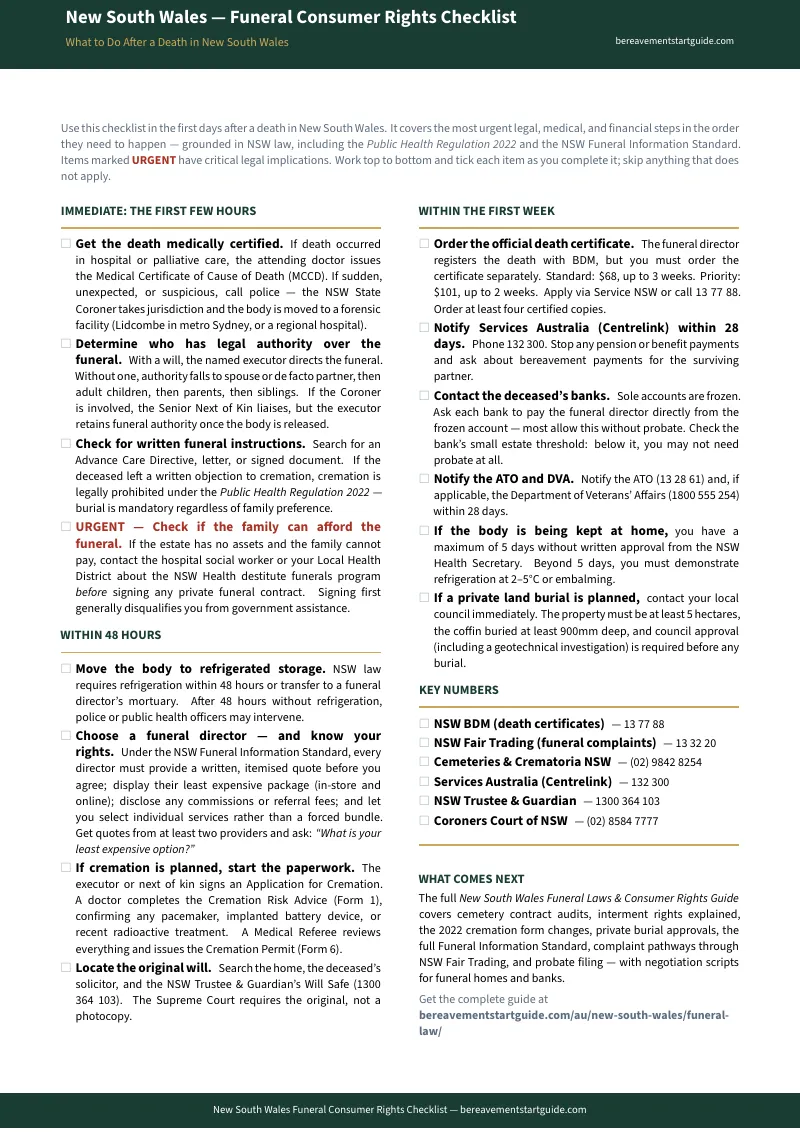
Not ready for the full guide? Download the free New South Wales — Funeral Consumer Rights Checklist — the most urgent actions covering everything that must happen in the first 48 hours: getting the death certified, establishing who has legal authority, choosing a funeral director (and the questions you must ask under Fair Trading rules), starting the cremation or burial paperwork, and checking destitute funeral eligibility. It is enough to get through tonight and tomorrow.
You should not have to make the most expensive decisions of your life while you are grieving. The guide makes sure you do not have to make them blind.