Someone You Love Died in New South Wales. The Bank Froze the Accounts. The Supreme Court Wants Four UCPR Forms Filed in a Precise Sequence. And Nobody Told You That Removing a Staple From the Will Can Get Your Application Rejected.
You were named executor in someone's will. Or there is no will, and you are the surviving spouse or the eldest child, so the obligation landed on you. The funeral home needs payment. The bank told you the accounts are frozen until they see a Grant of Probate. You went to the Supreme Court website and found UCPR Forms 111, 112, 117, and 118 -- blank PDFs that give you no indication of what order to file them, how to assemble the physical package, or what mistakes will trigger a "requisition" that adds months to an already slow process.
Then you looked into costs. A private solicitor charges a regulated scale fee -- roughly $3,200 for a $500,000 estate, on top of the $1,250 court filing fee. The NSW Trustee & Guardian charges a capital commission that could reach $14,300 on the same estate. And the free resources? The Supreme Court publishes the forms but not the filing sequence. Law firm blogs explain the complexity to convince you the process is too dangerous to handle alone. National platforms like Willful and EstateExec apply the wrong state's rules -- missing the AI prohibition on affidavits, the PEXA electronic conveyancing barrier, and the 14-day mandatory wait after publishing the Notice of Intended Application.
Here is what those sources do not tell you: the NSW probate process follows a strict chronological sequence, and once you understand it, it is manageable. Publish the Notice of Intended Application ($57). Wait 14 days. Use those 14 days to prepare your four UCPR forms, get the affidavit witnessed, and build your asset inventory. File digitally, then mail the originals. Wait 60 to 83 business days for the sealed Grant. Publish the Notice of Intended Distribution. Wait until six months after death plus 30 days after publication. Then distribute. The process is not mysterious. It is just poorly documented.
The New South Wales Probate Process Guide is a Court-Ready Filing System for the complete probate process in NSW -- from the first 48 hours after death through final distribution and estate closure. Not a generic Australian probate overview. Not a fill-in-the-blank legal kit (those cost $129 to $385 and carry real risk if the forms are wrong). A structured, 15-chapter NSW-specific manual built around the current UCPR forms, the actual Supreme Court Practice Notes, the NSW Land Registry Services requirements, and the fee schedules for the 2025/2026 and 2026/2027 financial years -- so your application passes the court registrar the first time.
What's Inside the Court-Ready Filing System
A 15-chapter guide and a Quick-Start Probate Checklist -- covering every stage from the probate decision through final distribution, built specifically for the Supreme Court of New South Wales and the UCPR forms as they exist right now:
Chapters 1-2: Do You Actually Need Probate?
Not every NSW estate requires a trip to the Supreme Court. Joint tenancy property passes automatically through survivorship -- file a Notice of Death (Form 02ND, $182.73) with NSW LRS instead. Superannuation with a binding death benefit nomination bypasses the estate entirely. Bank accounts below the institution's internal threshold (typically $50,000 to $100,000) can often be released with an indemnity form. And if the total estate is under $150,000, the NSW Trustee & Guardian can administer it via an "Election to Administer," bypassing court entirely. These chapters give you the decision framework so you do not spend months preparing an application you never needed.
Chapter 3: What Probate Costs -- DIY vs Solicitor vs Public Trustee
The side-by-side cost comparison nobody else provides. On a $500,000 estate: DIY costs approximately $1,500 to $2,100 in court fees, notices, and certificates. A solicitor adds roughly $3,200 in regulated scale fees plus GST. The NSW Trustee & Guardian can charge up to $14,300 in capital commission alone. Pre-built fee tables for every estate bracket from under $100,000 (no fee) through $5,000,000+ ($7,099), so you know the exact cost before you file.
Chapters 4-6: The 14-Day Notice Period, the Four UCPR Forms, and Filing
This is the content that does not exist in any free resource. The mandatory 14-day waiting period after publishing the Notice of Intended Application -- and exactly what to do during those 14 days. The form-by-form walkthrough: Form 111 (Summons for Probate), Form 112 (Draft Grant -- two sets, stapled with Form 117), Form 117 (Inventory of Property), and Form 118 (Affidavit of Executor). The physical will handling rules that catch executors off guard -- never remove staples, sign only the left-hand margin of the first page, never separate pages to photocopy. The AI prohibition under Practice Note SC Gen 23 -- your affidavit must be written in your own words. And the two-stage filing process: digital submission through the NSW Online Registry, then physical originals by registered mail to 184 Phillip Street, Sydney.
Chapter 7: Requisitions -- What They Are and How to Avoid Them
A requisition is a formal demand from the court registrar for correction. It is the single most common cause of delays beyond the standard 60-to-83 business day processing time. This chapter covers every common requisition trigger -- staple marks, missing identification signatures, incorrect certification, form assembly errors, AI compliance failures, alias discrepancies -- and gives you the pre-filing checklist that prevents each one.
Chapter 8: After the Grant -- Calling In Assets and the PEXA Barrier
How to release bank accounts, transfer shares, and handle the real estate problem that blindsides DIY executors. Since 2019, NSW has mandated electronic conveyancing through PEXA. Ordinary members of the public cannot access PEXA directly. Even after obtaining the Grant yourself, you need a solicitor or licensed conveyancer to lodge the Transmission Application electronically. This chapter explains exactly how to engage a conveyancer for this single step (typically $500 to $1,500) -- far less than hiring a solicitor for the entire probate process.
Chapter 9: Letters of Administration -- When There Is No Will
The intestacy pathway: who can apply under the Succession Act 2006 hierarchy, the different UCPR forms (Form 119, Form 126), the Administration Bond requirement (Form 130) with two independent sureties, how to dispense with the bond when all adult beneficiaries consent, the statutory distribution formula for surviving spouses and children, and the recognition of Aboriginal and Torres Strait Islander customary law under Part 4.4 of the Act.
Chapters 10-15: Safe Distribution, Tax, Executor Protection, and Estate Closure
The Notice of Intended Distribution ($57) and the two conditions that must both be met before you distribute -- six months from death and 30 days from publication. The 12-month family provision claim window and why distributing at six months is legally protected but still carries timing risk. The two-year CGT exemption window for the main residence -- settlement must occur within two years of death, not just listing. Superannuation death benefits tax (the 17% trap for non-dependant adult children). Every key deadline consolidated in one reference. And the executor liability protections that keep you from paying claims out of your own pocket.
Who This Guide Is For
- The newly named executor who has never dealt with the Supreme Court and needs the complete UCPR form sequence, the filing order, and the requisition traps explained in plain language -- before a rejected application costs months of delay
- The surviving spouse who needs to know whether the house, the bank accounts, and the super actually require probate -- or whether joint tenancy, beneficiary designations, and the $150,000 small estate threshold mean the estate can be settled without going to court
- The family with no will who just learned that the Succession Act 2006 controls everything -- and needs to understand who has priority to apply for Letters of Administration, what the distribution rules are, and how to handle the Administration Bond requirement
- The interstate or overseas executor trying to settle a parent's NSW estate from Queensland, Victoria, or another country -- who needs the remote filing path, the witnessing requirements, and the logistics of managing the Supreme Court and NSW LRS from a distance
- The executor on a budget who received a $3,000+ legal quote and knows the estate is straightforward enough to handle without a solicitor -- and needs a guide that replaces that retainer, not one that tells them to hire a lawyer
- The executor dealing with real property who discovered the PEXA electronic conveyancing barrier -- and needs to understand exactly which step requires a conveyancer, how much it costs, and how to handle everything else without professional help
Why Free Resources Will Not Get You Through This
The information exists. It is scattered across the Supreme Court website, the NSW Online Registry, NSW Land Registry Services, the ATO, Services Australia, and a half-dozen other portals that do not reference each other. Here is what you actually encounter when you try to navigate probate using free sources alone:
- The Supreme Court publishes the UCPR forms but not the filing sequence. Every form is available as a downloadable PDF. What is not on the website: the order in which they must be completed, the requirement to publish a Notice and wait 14 days before filing, the precise way to assemble the physical package (two sets of Form 112, each with Form 117 stapled to it), or the specific errors that trigger requisitions. The forms are there. The instructions to use them correctly are not.
- LawAccess NSW covers the law but not the implementation. The Legal Aid Commission publishes the best free overview of the probate process in NSW. It explains what the law requires. It does not walk you through preparing each form, calculating the correct filing fee, avoiding requisitions, or navigating the two-stage digital-then-physical filing process. It is reading material, not a filing system.
- Law firm websites explain complexity to justify retainer fees. Sydney estate lawyers publish helpful overviews, but their content is designed to demonstrate that the process is too dangerous for a non-lawyer. For contested estates or complex trust structures, that is true. For the majority of straightforward estates with a clear will and cooperative beneficiaries, the DIY path saves thousands of dollars.
- National platforms apply the wrong state's rules. Willful, EstateExec, and Atticus provide general Australian probate overviews. But they gloss over the AI prohibition on affidavits (Practice Note SC Gen 23), the PEXA electronic conveyancing mandate, the specific UCPR form numbers and assembly requirements, the NSW-specific fee schedule, and the difference between the 14-day application notice and the 30-day distribution notice. Following Victorian or Queensland advice for an NSW estate means missing requirements that are unique to this state.
- Government websites are accurate but siloed. The Supreme Court covers filing. NSW LRS covers property transfers. The ATO covers tax obligations. Services Australia covers bereavement payments. Each source is correct about its own piece. None connect the pieces into a sequence. None tell you that the Notice must be published 14 days before filing, or that distributing assets before the six-month-plus-30-day threshold makes you personally liable for late claims.
Free resources give you forms without instructions, fragments without sequence, and advice from the wrong state. The Court-Ready Filing System puts every NSW-specific form, fee, deadline, and filing step into one document, in the order the Supreme Court actually requires them.
-- Less Than Fifteen Minutes With a Sydney Estate Solicitor
A single consultation with an estate solicitor in Sydney costs $300 to $500 per hour. Standard probate representation starts at a $3,000 minimum fee plus court costs. For a $500,000 estate, that is $4,800 or more in legal fees for a process the Supreme Court deliberately designed to be accessible to self-represented applicants. This guide costs less than fifteen minutes of professional legal time and gives you the complete state-specific filing system -- every UCPR form in sequence, every requisition trap flagged, every fee calculated, and the PEXA conveyancing step that most executors do not discover until the property transfer stalls.
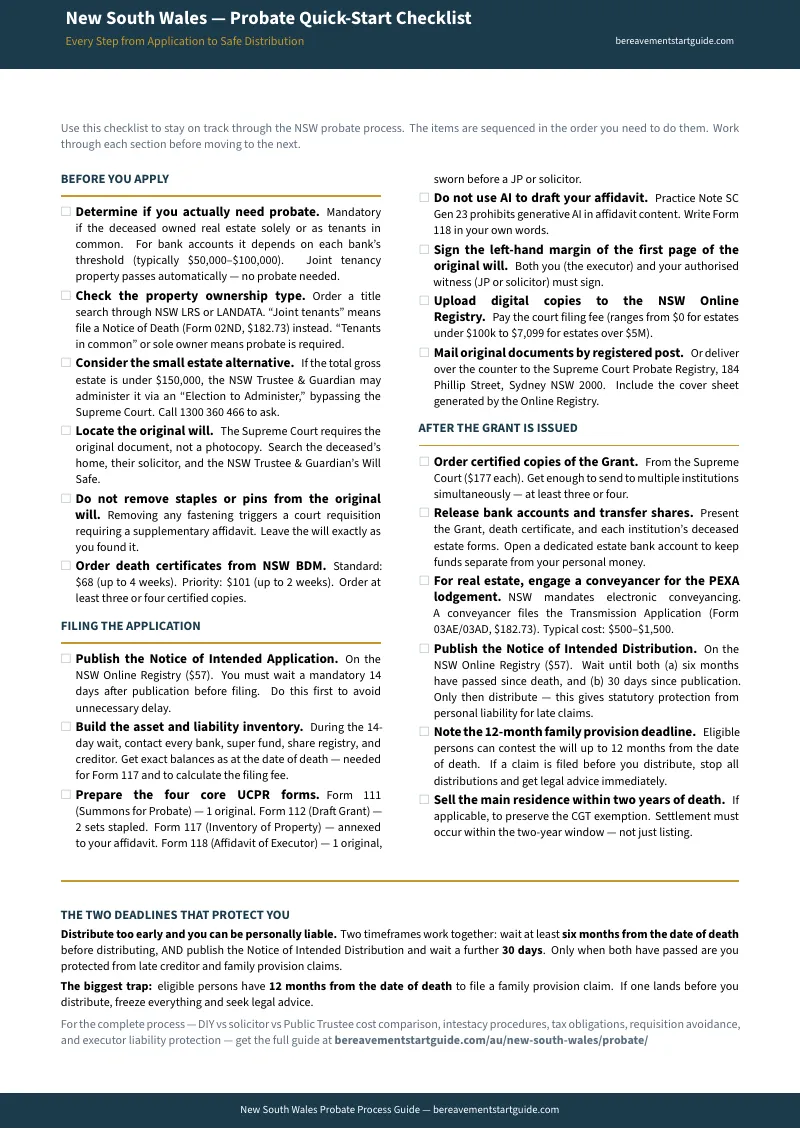
Your download includes the complete 15-chapter guide, the Probate Quick-Start Checklist (18 items across 3 phases), and 5 standalone printable references -- a Requisition Avoidance Checklist, a Side-by-Side Cost Comparison, a Fees Quick Reference, a Key Deadlines sheet, and a PEXA Conveyancing Guide. Seven PDFs total, each designed to be printed and used independently at the specific moment you need it. Plus a money-back guarantee, no time limit. If the guide does not give you clarity on what to do next and confidence that your application will pass the court registrar, email us for a full refund. No questions asked.
Not ready for the full guide? Download the free New South Wales -- Probate Quick-Start Checklist -- 18 items covering every critical action from the probate decision through estate closure. It is enough to see the full picture and start gathering what you need.
You did not choose to be the executor. But the bank does not wait, the 14-day notice period does not wait, and the 12-month family provision deadline does not wait. The guide makes sure you do not miss any of them.