Someone You Love Just Died in the Northern Territory. The Supreme Court Charges $1,542 to File for Probate and Rejects Applications With a Single Formatting Error. The Land Titles Office Demands Double-Sided Printing While the Court Demands Single-Sided. And a Mandatory Will Search You Have Never Heard of Must Happen Before Any of It.
You are standing in a place nobody prepared you for. Maybe you were named executor in a will you barely remember agreeing to, and now the funeral director in Darwin is asking about arrangements while the hospital still has not issued the medical certificate. Maybe you are the surviving spouse and the Commonwealth Bank just told you every account is frozen — and you cannot access a dollar to pay the Power and Water bill, let alone the funeral invoice that could reach $10,000 in the Territory. Maybe there was no will at all, and under the Administration and Probate Act 1969, nobody actually has legal authority to do anything until the Supreme Court of the Northern Territory grants it.
You are grieving, exhausted, and possibly managing this from interstate — thousands of kilometres away in Melbourne or Sydney — but the paperwork does not wait. Births, Deaths and Marriages NT needs notification within seven days or the registration lapses. Services Australia needs to know immediately or the estate will owe back overpayments on the pension. And somewhere in a process nobody explained to you, there is a mandatory step that exists in no other Australian state: you must email the Public Trustee of the Northern Territory at agd.publictrustee@nt.gov.au and formally request a will search of their index — even if you are holding the original will in your hands — before the Supreme Court will accept your probate application. Skip it, and the court sends you a Requisition. Your $1,542 filing fee sits in limbo. The estate stalls for weeks.
That is just one trap. The Supreme Court of the Northern Territory requires every probate document printed on single-sided A4, saved as individually named PDFs — Form 88T, Form 88B, Form 88H, each as a separate file. Walk across the street to the Land Titles Office to transfer the family home, and they require the exact opposite: property transfer applications must be printed on a single sheet using double-sided printing. Get either wrong and the application is rejected. Meanwhile, bank thresholds for releasing funds without probate vary from $15,000 at credit unions to $114,674 at Westpac — and those thresholds are corporate policy, not law, meaning they can change without notice. The NT does not have small estate provisions, so if the estate owns real property, probate is unavoidable regardless of value.
The When Someone Dies in Northern Territory — Estate Settlement Guide is a Territory Settlement Blueprint for every legal, financial, and administrative step between the funeral home and final distribution. Not a law textbook. Not a generic Australian checklist that does not know the Northern Territory from New South Wales. A structured, NT-specific manual that separates what must be done in the first 48 hours from what legally cannot happen until the statutory notice periods close — so you stop guessing, stop panicking, and start working through this in the right order.
What's Inside the Territory Settlement Blueprint
A 17-chapter guide with standalone worksheets and the First 48 Hours Checklist — covering every stage from the moment of death through final asset distribution, built specifically for NT statutes, the Supreme Court of the Northern Territory, and the jurisdiction-specific rules that make settling an estate here different from anywhere else in Australia:
The First 48 Hours: People, Not Paperwork
The moment someone dies in the Northern Territory, every power of attorney is legally void. If you managed their finances under a general or enduring power, you no longer have authority. This chapter covers getting the death medically verified, understanding when the NT Coroner takes jurisdiction (including all deaths in custody, during police operations, and unexpected deaths), securing the home and property, checking for a prepaid funeral plan, and the critical insurance rule most people discover too late: an unoccupied home can void a standard insurance policy. If the house sits empty while you administer the estate from interstate, the insurer may deny any claim.
Death Registration, Certificates, and the Seven-Day Window
NT death registration must happen within seven days. Death certificates cost $56 each from Births, Deaths and Marriages NT — and you need multiple certified originals because banks, the ATO, and the Supreme Court all require them and will not accept photocopies. The guide gives you the calculation so you order the right number now instead of waiting weeks for extras. It covers the notification hierarchy: Services Australia immediately, the ATO, NT Motor Vehicle Registry, Power and Water Corporation, digital accounts, and the tiered system for reaching every agency efficiently.
Finding the Will and the Mandatory Public Trustee Search
This is the step that catches every executor in the Northern Territory. Before you can apply for probate, you must contact the NT Public Trustee to search their will index. This is not optional and it is not a formality — the Supreme Court will issue a Requisition and stall your application if this search has not been done. The guide includes the exact email address, what to write, what information to provide, and how long the response typically takes. It also covers will-handling rules: never remove staples, add paperclips, or write on the original. The Supreme Court inspects the original for tampering — any damage forces additional affidavit evidence.
The Probate Decision: When You Need It and When You Can Skip It
Probate is mandatory in the NT if the deceased owned real property solely or as tenants in common. For bank accounts, it depends on each institution's internal threshold. The Commonwealth Bank and NAB enforce a threshold of approximately $76,449 — amounts above that require a grant. Westpac may allow up to $114,674. Credit unions like Territory Credit Union can demand probate at $15,000. The guide includes the current threshold for every major Australian bank operating in the NT, explains right of survivorship for joint accounts and joint tenancies, covers Binding Death Benefit Nominations for superannuation, and maps the scenarios where you can settle without going to court.
The Supreme Court Process, Step by Step
This is the chapter that does not exist in any free resource. The Supreme Court of the Northern Territory charges $1,506 in filing fees plus a $36 search fee — $1,542 total. You must first publish a Notice of Intended Application (Form 88B) on the Supreme Court website and wait a mandatory 14 clear days before filing the grant application. Most executors do not discover this requirement until they are ready to lodge — adding two weeks of unnecessary delay. The guide tells you to publish Form 88B the same week you receive the death certificate. It then walks through every form: Form 88B (Notice), Form 88T (Affidavit of Assets and Liabilities), Form 88H (Affidavit of Executor) — plus the formatting rules that trip up every self-represented applicant. Every document must be single-sided A4. Every form must be saved as a separately named PDF. The court's registry staff cannot give you legal advice — they will only tell you what is wrong after you lodge and pay.
Property Transfers, Tax, and the LTO Double-Sided Rule
The remaining chapters cover property transfers through the Land Titles Office (the $176 lodgement fee and the critical double-sided printing requirement that contradicts every Supreme Court formatting rule), motor vehicle transfers through the NT Motor Vehicle Registry, ATO obligations (date of death return and estate trust return), the creditor notice period and when you can safely distribute, intestacy rules under the Administration and Probate Act 1969 (the $350,000 statutory legacy for surviving spouses plus the distribution formula for children), the complex provisions for traditional Indigenous marriages where multiple spouses may split the statutory legacy equally, remote and Indigenous estate considerations including funeral assistance through the Northern Land Council and Central Land Council, and a complete set of worksheets and timeline trackers.
Who This Guide Is For
- The surviving spouse whose partner just died and whose bank accounts were frozen this morning — who needs to know which accounts stay accessible under right of survivorship, how to get the bank to pay the funeral director directly from the frozen account, and how to lodge the correct form with the Land Titles Office to transfer the family home without probate if they were joint tenants
- The adult child named as executor who has never navigated the Supreme Court of the Northern Territory and is terrified of making a mistake that triggers a Requisition and weeks of delay — who needs the complete Form 88B/88T/88H walkthrough, the mandatory Public Trustee will search, and a timeline that separates what is urgent from what must wait for the 14-day notice period
- The family with no will who just learned that the Administration and Probate Act 1969 dictates everything — who needs to understand who has priority to apply for Letters of Administration, how the $350,000 statutory legacy works, and how intestacy provisions apply to de facto relationships (two years continuous cohabitation required) and traditional Indigenous marriages
- The executor living interstate who is managing this from Melbourne or Sydney and cannot walk into the Supreme Court registry in Darwin — who needs to understand postal filing options, how to arrange affidavits sworn interstate, and how to manage the entire process remotely without multiple expensive flights
- The family in a remote community dealing with funeral repatriation, cultural obligations, and the specific pathways for funeral assistance through the Northern Land Council, Central Land Council, or the Coroner's Office Indigent Persons Funeral Scheme — who need clear guidance on intestacy provisions for traditional marriages and the Public Trustee's role in remote estates
Why Free Resources Will Not Get You Through This
The information exists. It is scattered across the NT Government website, the Supreme Court of the Northern Territory, Births Deaths and Marriages NT, the Land Titles Office, Services Australia, the ATO, and a dozen institutional portals that do not talk to each other. Here is what you actually encounter when you try to settle an estate using free sources alone:
- Government pages tell you what to do but not how to do it. The Supreme Court of the Northern Territory publishes guides for self-represented applicants. They are dense PDFs filled with warnings about what registry staff cannot do — they cannot give legal advice, cannot review your documents before filing, and cannot tell you whether your application will succeed. The guides assume prior legal knowledge and leave you to connect the dots between departments that use contradictory formatting requirements.
- Law firm blogs highlight complexity to justify retainer fees. Ward Keller and Darwin NT Lawyers publish excellent technical breakdowns of executor duties and liability risks. All of their content is designed to convince you the process is too dangerous to handle alone — and that you need a retainer starting at $2,500. For contested estates or complex business structures, that is true. For the majority of straightforward estates, the answer costs a fraction of a solicitor's hourly rate.
- National platforms gloss over NT-specific requirements. Bare Law, Willed, and Gather provide modern interfaces and empathetic content optimised for national searches. They consistently miss the mandatory Public Trustee will search, the specific Form 88T details, and the single-sided vs. double-sided printing contradiction between the Supreme Court and the LTO. A generic Australian probate checklist will get your NT application rejected.
- The Public Trustee offers administration but charges commission. The Public Trustee of the Northern Territory charges tiered commission rates starting at 4.4% on the first $200,000, then 3.3% on the next $200,000. On a $400,000 estate, that is $15,400 in fees alone — plus disbursements. Families who want to keep estate administration private and preserve the inheritance need a self-guided alternative.
Free resources give you fragments from a dozen sources that do not reference each other. The Territory Settlement Blueprint puts every NT-specific statute, form, deadline, and procedure into one document, in the order you actually need them.
— Less Than Fifteen Minutes With a Darwin Estate Solicitor
A single consultation with a Northern Territory estate solicitor costs $300 to $500 per hour. Standard probate representation starts at $2,500 — and that only covers obtaining the grant. The actual estate administration (closing accounts, transferring property, organising tax returns) is billed separately. The Public Trustee charges commission that can run to tens of thousands of dollars. This guide costs less than fifteen minutes of professional legal time and gives you the complete NT-specific roadmap — every statute, every form, every deadline, and the Supreme Court process that the government websites assume you already understand.
Your download includes the complete 17-chapter guide, the standalone First 48 Hours Checklist, and print-ready standalone worksheets: the Agency Notification Tracker, Asset and Debt Inventory, Bank Threshold Matrix, Probate Timeline Planner, Property Transfer Reference Card, and Distribution Tracker. Plus a money-back guarantee, no time limit. If the guide does not give you clarity on what to do next and confidence that you are doing it in the right order, email us for a full refund. No questions asked.
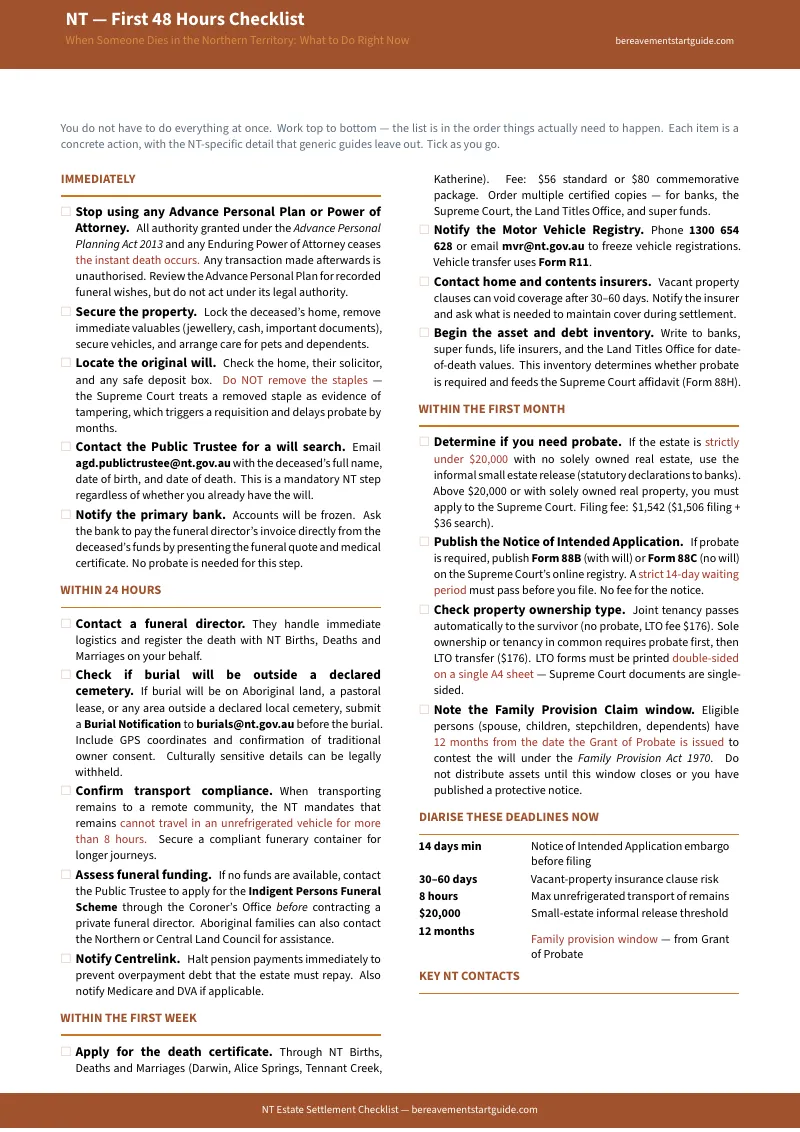
Not ready for the full guide? Download the free Northern Territory — First 48 Hours Checklist — the most urgent actions covering everything that must happen in the first two days after a death in the Northern Territory: the seven-day registration window, securing property, the mandatory Public Trustee will search email address, how to get the bank to pay the funeral director directly, insurance notifications, and what not to touch. It is enough to get through tonight and tomorrow.
You did not ask for this job. But you can do it. The guide shows you how, one step at a time.