You Were Named Executor in a Northern Territory Will. The Supreme Court Filing Is Entirely Electronic — But the Documents Must Be Printed, Signed, Witnessed, and Scanned as Separate PDFs Before You Can Email Them. One Combined PDF and the Registry Rejects Everything.
You have never done this before. The Supreme Court website lists Forms 88A, 88G, 88H, and 88T — with no explanation of how they connect, what order they go in, or why you need an Affidavit of Identity just because you are filing without a solicitor. Maybe you have already phoned a lawyer and been quoted $2,500 to $6,000 for what they called a "straightforward, uncontested grant." Maybe the Public Trustee offered to handle everything — without mentioning that their administration fee is 4.4% of the gross estate value, plus disbursements, and that their services have attracted sustained public criticism for excessive charges levied against vulnerable estates.
Meanwhile, the estate is frozen. The bank accounts were locked the day they received the death certificate. The family is asking when they will see their inheritance. The funeral invoice is unpaid. And somewhere in the back of your mind is the question that keeps every first-time executor awake at night: if I scan the forms into one PDF instead of separate files, or forget the Affidavit of Identity, or accidentally remove the staples from the original will — does the court reject everything? Am I personally liable for what happens next?
Here is what the free resources will not tell you: the NT Supreme Court registry issues formal requisitions on applications that contain formatting errors, naming discrepancies, or assembly mistakes. Not because the law is impossible to follow, but because the free resources — the government forms portal, the law firm blogs, the Public Trustee checklists — explain what documents you need without explaining how to prepare and submit them under Practice Direction 3 of 2020. They do not explain that every document must be printed single-sided, signed in the physical presence of a JP, then scanned as a separate PDF — not combined into one file. They do not explain that the death certificate must be annexed front and back to the Affidavit of Death before the witnessing appointment, not after. They do not explain that removing a single staple from the original will forces you to prepare an Affidavit of Plight and Condition, adding weeks and additional sworn documents to an already rigid process. And they do not warn you that if you Google "Northern Territory probate," half the results are for Canada's Northwest Territories — leaving you reading the wrong country's law without realising it.
The Northern Territory Probate Process Guide is a Requisition-Proof Filing System that walks you through every step of the Supreme Court application — from the moment you confirm that probate is necessary through the day you collect the sealed grant from the Darwin registry and distribute the estate. Not a law textbook. Not a generic Australian probate explainer that treats the Northern Territory the same as New South Wales or Victoria. A structured, jurisdiction-specific manual built around the forms, fees, deadlines, and institutional mechanics that are unique to the Supreme Court of the Northern Territory.
What's Inside the Requisition-Proof Filing System
A 10-chapter guide plus the Probate Quick-Start Checklist — covering every stage from the first 48 hours through final distribution, built specifically for the NT's Supreme Court procedures, the Administration and Probate Act 1969, Practice Direction 3 of 2020, and the institutional rules that make probate here different from anywhere else in Australia:
Do You Actually Need Probate?
This is the question that saves you the entire process — or confirms you cannot avoid it. If the deceased owned real property solely or as tenants in common, probate is legally unavoidable. But for bank accounts, the threshold is not a legal standard — it is internal bank policy, and the thresholds vary between institutions. The Commonwealth Bank and NAB typically release up to $50,000 without a grant. Smaller credit unions may demand probate at $15,000 to $20,000. The guide maps the current thresholds for every major institution, explains joint tenancy survivorship (which bypasses probate entirely), and covers superannuation death benefit nominations — which are not estate assets at all if the nomination is valid. The NT also has a notably low small estate threshold of just $20,000 for informal administration. You may be one title search and two phone calls away from discovering you do not need the Supreme Court.
The Mandatory 14-Day Notice Period
Before you can file your probate application, you must complete Form 88B (Notice of intended application for probate) and email it to the Probate Officer for publication on the Court's website. You are legally prohibited from filing until 14 clear days have elapsed — and "clear days" means the publication date and the filing date both do not count. Any outdated advice telling you to publish in the NT News is wrong — Practice Direction 3 of 2020 abolished the newspaper requirement entirely. You must also search the Index of Wills with the Public Trustee and search the Court's own probate records. Most executors do not discover these mandatory pre-filing steps until they have assembled the full application — adding weeks of avoidable delay. The guide tells you to start the notice the same week you receive the death certificate.
Assembling and Filing the Supreme Court Application
This is the chapter that does not exist in any free resource. It walks through every form in filing order: Form 88A (Application for Grant of Representation), Form 88G (Affidavit of Death — with the death certificate front and back annexed before witnessing), Form 88H (Affidavit of Executor), Form 88T (Affidavit of Assets and Liabilities — using date-of-death valuations, not current values), and the Affidavit of Identity required for self-represented applicants. It covers the rigid electronic filing process under Practice Direction 3 of 2020: print single-sided, sign in the physical presence of a JP, scan each form as a separate PDF, name each file exactly, and email the complete set to ProbateOfficer.NT@nt.gov.au with the Electronic Payment Form. Total fees: $1,506 filing plus $36 search fee — $1,542. One combined PDF, one double-sided page, one missing affidavit, and the registry rejects the entire application.
Protecting the Original Will
The Supreme Court inspects the physical condition of the original will. Removed staples, missing pages, handwritten annotations, or damaged bindings trigger automatic requisitions demanding an Affidavit of Plight and Condition — a sworn document explaining why the will looks the way it does. The guide covers what the court is actually looking for, the distinction between formal and informal probate requirements, and the critical rule that you must never use a sheet-fed scanner on the will (it requires removing the staples).
Letters of Administration, Property Transfers, Tax, and Safe Distribution
The remaining chapters cover every step after the grant is issued and the critical alternative pathway when there is no will. Letters of Administration on Intestacy (Forms 88A and 88C, the statutory priority order under the Administration and Probate Act 1969, and the intestacy distribution rules in Schedule 6). Property transfers through the NT Land Titles Office (joint tenancy survivorship vs. sole ownership transfer, the $176 lodgement fee per application). Advance Personal Plans that cease at death — why the person named in the APP has zero authority after the death occurs. Superannuation (why it may not be an estate asset). ATO obligations (the date-of-death tax return and the estate trust return). The 2-month creditor notice period under Form 88ZF and the 6-month family provision window under the Family Provision Act 1970. Final distribution. And a chapter on edge cases — the Section 110B election to administer for estates under $150,000, Aboriginal and Torres Strait Islander estates under the Burial and Cremation Act 2022, insolvent estates, and interstate probate resealing.
Who This Guide Is For
- The first-time executor who has been named in a parent's will and has never navigated the NT Supreme Court — who needs the complete Form 88A/88G/88H/88T walkthrough, the Practice Direction 3 of 2020 electronic filing rules explained step by step, and a process that eliminates the guesswork that triggers requisitions
- The surviving spouse who needs to know whether probate is required at all — whether right of survivorship on joint tenancy means the family home transfers without court involvement, whether the bank thresholds cover the accounts, and what happens to superannuation under a binding death benefit nomination
- The family with no will who needs to understand Letters of Administration on Intestacy — who has priority to apply under the Administration and Probate Act 1969, how the intestacy distribution rules in Schedule 6 work, and the additional forms and court requirements
- The cost-conscious administrator who wants to avoid spending $2,500 to $6,000 on a solicitor for a straightforward, uncontested estate — who needs a step-by-step process that makes self-representation realistic, not just theoretically possible
- The interstate or remote executor who lives in Sydney or Melbourne but must administer an NT estate — who needs to understand how to swear affidavits before a local JP, how the electronic filing process works for remote applicants, and that the sealed grant must be collected in person from the Darwin registry
Why Free Resources Will Not Get You Through the Supreme Court
The information exists. It is scattered across the NT Supreme Court website, the Department of Attorney-General website, the Land Titles Office, the Public Trustee, and the content marketing funnels of law firms in Darwin and Alice Springs. Here is what you actually encounter when you try to apply for probate using free sources alone:
- Google sends you to the wrong country. Search "Northern Territory probate" and you will find results for Canada's Northwest Territories mixed in with Australian content. The legal frameworks are completely different. Without jurisdiction-specific guidance, you risk following Canadian procedures for an Australian court — and you may not realise the mistake until the registry rejects your application.
- The government forms portal tells you what to file but not how to submit it. The Supreme Court Rules 1989 prescribe Forms 88A, 88G, 88H, and 88T. The website lists them. It does not explain that each form must be scanned as a separate PDF (not combined), that printing must be single-sided, that the death certificate must be annexed front and back before the witnessing appointment, or that self-represented applicants need an additional Affidavit of Identity.
- Law firm blogs explain complexity to justify retainer fees. Ward Keller, Halfpennys, and Cridlands publish detailed breakdowns of executor duties and personal liability. Every one of those articles is designed to convince you the process is too dangerous to handle alone — and that you need a retainer starting at $2,500. For contested estates, that is true. For straightforward estates with a clear will and cooperative beneficiaries, you are paying thousands for a process you can handle with the right instructions.
- The Public Trustee markets simplicity but charges dearly. The Public Trustee of the Northern Territory offers government-backed estate administration. Their commission is 4.4% of the gross estate value, plus disbursements. On a $500,000 estate — a modest house in Darwin and some bank accounts — that is $22,000. And the Public Trustee has no incentive to tell you that for a simple, uncontested estate, you could file the application yourself for $1,542 in court fees.
Free resources give you form numbers from one website, filing rules from another, fee schedules from a third, and property transfer procedures from a fourth — with Canadian search results mixed in throughout. The Requisition-Proof Filing System puts every NT-specific form, fee, deadline, and electronic filing instruction into one document, in the exact order the Supreme Court expects to receive them.
— Less Than Fifteen Minutes With a Darwin Estate Solicitor
A single consultation with a Darwin estate solicitor costs $300 to $600 per hour. A standard probate retainer starts at $2,500 and only covers obtaining the grant — not the actual estate administration. The Public Trustee charges 4.4% of the gross estate value. On a $500,000 estate, that is $22,000. This guide costs less than fifteen minutes of professional legal time and gives you the complete filing system — every form, every deadline, every electronic submission instruction, and the pre-filing steps that catch the errors responsible for requisitions.
Your download includes the complete 10-chapter guide, the Probate Quick-Start Checklist, and 7 standalone printable reference sheets — the Do I Need Probate? decision flowchart, Filing Preparation Checklist, Court Filing Quality-Assurance Checklist, Distribution Timeline, Forms Reference, Fee Reference, and Contact Directory — plus a money-back guarantee, no time limit. If the guide does not give you clarity on what to file, when to file it, and how to prepare and submit it so the Supreme Court accepts it on the first attempt, email us for a full refund. No questions asked.
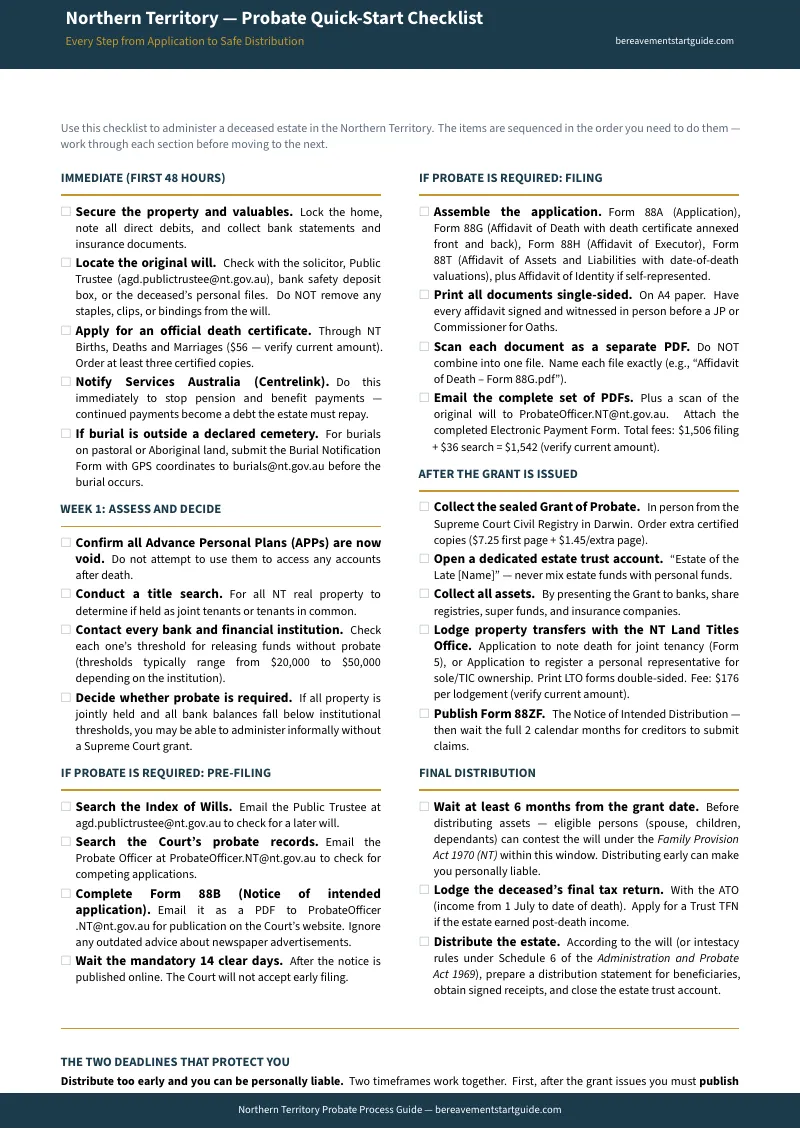
Not ready for the full guide? Download the free Northern Territory — Probate Quick-Start Checklist — every step in the exact sequence the Supreme Court process requires, from ordering death certificates through final distribution. It tells you what to do and when. The full guide tells you how.
You did not choose to be an executor. But you can do this. The guide shows you exactly how.