Someone You Love Just Died in Queensland. The Bank Froze Their Accounts. The Supreme Court Rejects One in Three Unrepresented Probate Applications. And a Land Tax Deadline You Have Never Heard of Could Cost the Estate Thousands.
You are standing in a place nobody prepared you for. Maybe you were named executor in a will you barely glanced at years ago, and now the funeral director is asking about cremation permits while you try to figure out whether the medical certificate of cause of death is the same thing as the official death certificate from RBDM Queensland. (It is not.) Maybe there was no will at all, and because you are the surviving spouse or the eldest child, everyone is looking at you — but under the Succession Act 1981, nobody actually has authority to do anything until the Supreme Court of Queensland grants it. Maybe the Commonwealth Bank just told you the accounts are frozen and you cannot access a dollar to pay the electricity, the rates, or the funeral invoice that could reach $10,000.
You are grieving, exhausted, and sleep-deprived, but the paperwork does not wait. Services Australia needs notification immediately or the estate will owe back overpayments on the pension. The funeral director needs you to check for a prepaid funeral plan before you sign anything new — because under Queensland's Cremations Act 2003, a signed cremation request must be honoured by the executor. Siblings are already asking about the house. The ATO will eventually demand separate tax returns: one for income earned up to the date of death and another for the estate trust. And somewhere in the back of your mind, a terrifying question keeps circling: if I distribute assets before the statutory creditor notice period runs, or miss the June 30 QRO land tax deadline, or accidentally trigger a court requisition by removing a staple from the original will — am I personally liable?
The short answer: the estate pays its debts, not you. But the long answer — the one that involves a Supreme Court that charges $819.90 in filing fees and rejects roughly 30% of do-it-yourself applications for minor errors, bank account thresholds that vary wildly between institutions (some release up to $114,000 without probate while credit unions demand it at $15,000), a mandatory Queensland Law Reporter notice costing $161.70 plus a 14-day waiting period before you can even file, property transfers through Titles Queensland requiring different forms depending on whether the home was jointly or solely owned, and a Public Trustee that charges thousands to administer even simple estates — that answer is what separates families who settle an estate in months from families who spend years and thousands of dollars untangling mistakes they did not know they were making.
The When Someone Dies in Queensland — Estate Settlement Guide is a Settlement Blueprint for every legal, financial, and administrative step between the funeral home and final distribution. Not a law textbook. Not a generic Australian checklist that does not know Queensland from Victoria. A structured, Queensland-specific manual that separates what must be done in the first 48 hours from what legally cannot happen until the statutory creditor notice period closes — so you stop guessing, stop panicking, and start working through this in the right order.
What's Inside the Settlement Blueprint
A 12-chapter guide with standalone worksheets and the First 48 Hours Checklist — covering every stage from the moment of death through final asset distribution, built specifically for Queensland statutes, the Supreme Court of Queensland, and the state-specific rules that make settling an estate here different from anywhere else in Australia:
The First 48 Hours: People, Not Paperwork
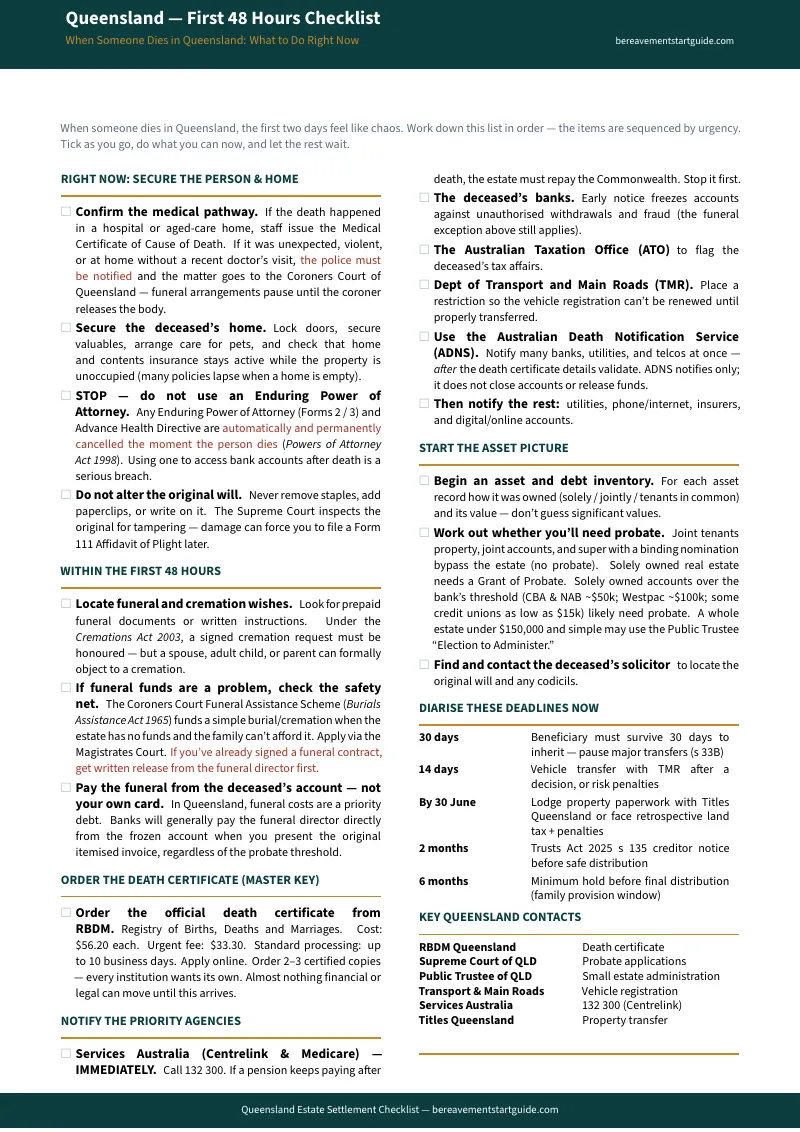
The moment someone dies in Queensland, every Enduring Power of Attorney under the Powers of Attorney Act 1998 is legally void. If you managed their finances under an EPA, you no longer have authority. This chapter covers getting the death medically verified, understanding when the Coroners Court of Queensland takes over, checking for a prepaid funeral plan, the Coroners Court Funeral Assistance Scheme under the Burials Assistance Act 1965, securing the home and property, and the critical insurance rule most people discover too late: an unoccupied home can void a standard insurance policy, and if the house burns or floods while empty and the insurer was not told, the estate's primary asset may be uninsured.
Death Certificates, Notifications, and Finding the Will
Death certificates from RBDM Queensland cost $56.20 each — and you need several certified originals because banks, the ATO, and the Supreme Court all require them and will not accept photocopies. The guide gives you the calculation so you order the right number now instead of waiting weeks for extras. It covers the Australian Death Notification Service (ADNS) — the free government portal that notifies banks, utilities, and super funds in one submission — plus the tiered notification system (Services Australia immediately, the ATO, TMR, digital accounts) and the critical will-handling rule: never remove staples, add paperclips, or write on the original. The Supreme Court inspects the original for tampering — damage forces you to file a Form 111 Affidavit of Plight.
The Probate Decision: When You Need It and When You Can Skip It
This is the most critical decision point in the entire process. Probate is mandatory if the deceased owned real estate solely or as tenants in common. For bank accounts, it depends on each institution's internal threshold — and those thresholds are corporate policy, not law, meaning they can change without notice. The Commonwealth Bank and NAB enforce a threshold of approximately $50,000, while Westpac may allow up to $114,000 — and credit unions like CUA (Great Southern Bank) may demand probate at $15,000. The guide includes the current threshold for every major Australian bank, explains right of survivorship for joint accounts, covers Binding Death Benefit Nominations for superannuation (which bypass the estate entirely if valid), and maps the exact scenarios where you can settle without going to court.
Accessing Bank Accounts and Paying for the Funeral
This is the chapter that resolves the most urgent crisis. Banks freeze accounts when they are notified of a death, but Queensland law treats funeral expenses as a priority debt. Regardless of the probate threshold, banks will generally pay the funeral director directly from the frozen account when you present the original itemised invoice. The guide explains exactly how to use this mechanism, how the small estate indemnity process works at each institution, and how to open an "Estate of Late" account to consolidate funds as they are released.
The Supreme Court Probate Process, Step by Step
This is the chapter that does not exist in any free resource. The Supreme Court of Queensland requires you to first publish a Notice of Intention to Apply (NOITA) in the Queensland Law Reporter using the precise wording of Form 103, costing $161.70, and serve a copy on the Public Trustee. Then you must wait a mandatory 14 clear days before filing. Most executors do not discover this requirement until they are ready to file — adding two weeks of unnecessary delay. The guide tells you to publish the QLR notice the same week you receive the death certificate. It then walks through every form: Form 101 (Application), Form 105 (Supporting Affidavit), Form 104 (Oath of Executor) — plus the court's $819.90 filing fee, the $149.60 concession rate, and a mistake-proofing checklist built from the Supreme Court's own Troubleshooting Guide to avoid the requisitions that reject 30% of applications.
Property Transfers, Vehicles, Tax, and Safe Distribution
The remaining chapters cover property transfers through Titles Queensland (Form 4 for joint tenants vs. Form 5 for sole ownership, plus the $226 lodgement fee per lot), the June 30 QRO land tax deadline that can trigger retroactive assessments with penalties and interest, motor vehicle transfers through TMR (Form F5296), ATO obligations (date of death return and estate trust return), the new creditor notice rules under the Trusts Act 2025 (commenced 28 April 2026, replacing the old six-week rule with a two-month notice period under s 135), the family provision window under the Succession Act 1981 that restricts when you can safely distribute, intestacy rules ($150,000 spousal threshold plus distribution formula), edge cases (insolvent estates, interstate probate resealing, Indigenous and Torres Strait Islander estates), and a complete set of worksheets and timeline trackers.
Who This Guide Is For
- The surviving spouse whose partner just died and whose bank accounts were frozen this morning — who needs to know which accounts stay accessible under right of survivorship, how to get the bank to pay the funeral director directly from the frozen account, and how to lodge a Form 4 (Request to Record Death) with Titles Queensland to transfer the family home without going through probate
- The adult child named as executor who has never navigated the Supreme Court of Queensland and is terrified of making a mistake that triggers personal liability — who needs the complete Form 101/105 walkthrough, the QLR advertising requirement, and a timeline that separates what is urgent from what must wait for the creditor notice period
- The family with no will who just learned that the Succession Act 1981 dictates everything — who needs to understand who has priority to apply for Letters of Administration, how the $150,000 spousal threshold and household chattels distribution works, and how to file Form 102 and Form 109 without triggering court requisitions
- The executor living interstate or in regional Queensland who cannot walk into the Supreme Court registry in Brisbane — who needs to understand the postal filing options, how to locate the right Magistrates Court for remote lodgement, and the notarisation rules for affidavits sworn interstate
- The helper or substitute decision-maker who stepped in because the immediate family is too overwhelmed to manage Queensland's bureaucracy — who needs printable worksheets, visual flowcharts, and a project-management approach to ensure critical deadlines (QRO June 30, creditor notice period, family provision window) are met without anything falling through the cracks
Why Free Resources Will Not Get You Through This
The information exists. It is scattered across the Queensland Courts website, RBDM Queensland, Services Australia, Titles Queensland, the Queensland Revenue Office, the ATO, and a dozen institutional portals that do not talk to each other. Here is what you actually encounter when you try to settle an estate using free sources alone:
- Government pages tell you what to do but not how to do it. The Queensland Courts Wills & Probate Portal explains that probate requires Form 101 and Form 105. It does not explain how to construct the narrative affidavit that the registrar expects, or that the court will reject your application if a single staple has been removed from the original will. The Troubleshooting Guide reads like an internal directive for legal clerks, not a consumer support document.
- Law firm blogs highlight complexity to justify retainer fees. Connor Hunter Lawyers, Qld Estate Lawyers, and Jacaranda Law publish excellent technical breakdowns of executor duties and liability risks. All of their content is designed to convince you the process is too dangerous to handle alone — and that you need a retainer starting at $2,000. For contested estates, that is true. For the majority of straightforward estates, the answer costs a fraction of a solicitor's hourly rate.
- Bank estate pages protect the bank, not you. Each bank publishes its own deceased estate process. Every one is focused on institutional liability protection. They explain why accounts are frozen. They do not explain how to negotiate early fund releases for funeral expenses, how the small estate indemnity process works, or why their thresholds differ from the bank across the street.
- The Public Trustee markets simplicity but charges dearly. The Public Trustee of Queensland offers accessible checklists and a "Guide to Estate Management." Their service fee for a simple grant of probate is $3,239.60 — and they have faced sustained public scrutiny, critical government reviews, and investigative media reports regarding excessive fee extraction, particularly from vulnerable Queenslanders. Families who want to keep estate administration private need an alternative.
- Fixed-fee legal services are cheaper but still expensive. Bare Law offers probate for $1,999. Resolve Estate Law charges $2,750. These are genuine improvements over traditional hourly billing, but they remain substantial sums for an estate that might consist of a $60,000 bank account and a used car. And they are "done-for-you" services — they do the work but leave you with no understanding of what happened or why.
Free resources give you fragments from a dozen sources that do not reference each other. The Settlement Blueprint puts every Queensland-specific statute, form, deadline, and procedure into one document, in the order you actually need them.
— Less Than Fifteen Minutes With a Queensland Estate Solicitor
A single consultation with a Queensland estate solicitor costs $300 to $600 per hour. Standard probate representation starts at $2,000 — and that only covers obtaining the grant. The actual estate administration (closing accounts, transferring property, organising tax returns) is billed separately at unregulated hourly rates. This guide costs less than fifteen minutes of professional legal time and gives you the complete Queensland-specific roadmap — every statute, every form, every deadline, and the Supreme Court process that the government websites assume you already understand.
Your download includes the complete 12-chapter guide, the standalone First 48 Hours Checklist, and seven print-ready standalone worksheets: the Agency Notification Tracker, Asset and Debt Inventory, Bank Threshold Matrix, Probate Timeline Planner, Property Transfer Reference Card, Master Deadline Table, and Distribution Tracker. Plus a money-back guarantee, no time limit. If the guide does not give you clarity on what to do next and confidence that you are doing it in the right order, email us for a full refund. No questions asked.
Not ready for the full guide? Download the free Queensland — First 48 Hours Checklist — the most urgent actions covering everything that must happen in the first two days after a death in Queensland: medical certificates vs. death certificates, securing property, cremation rules, funeral assistance eligibility, insurance notifications, and what not to touch. It is enough to get through tonight and tomorrow.
You did not ask for this job. But you can do it. The guide shows you how, one step at a time.