Someone Just Died in Queensland. You Have 48 Hours to Choose a Funeral Director. The Industry Is Unlicensed. And a Regulation You Have Never Heard of Is the Only Thing Standing Between Your Family and Thousands in Unnecessary Charges.
You are standing in a hospital corridor, or sitting at a kitchen table, or answering a phone call that changes everything. Someone has died. Within hours, you need to decide who arranges the funeral — and whether that person is you, a sibling, or the executor named in a will nobody can find. The funeral director the hospital recommends is already asking whether you want embalming, a premium casket, and a viewing room. They have not mentioned that embalming is almost never legally required in Queensland, that the casket is consumed in a cremation, or that the viewing is optional. They will not mention these things. It is not in their interest.
Queensland operates an unlicensed funeral industry. No licence, degree, or certification is required to open a funeral home. The state responded with the Fair Trading (Funeral Pricing) Regulation 2022. It requires funeral directors to display specified price information at each place of business and on any public website, provide that information within 48 hours of a request or before entering an agreement if that happens sooner (unless a longer period is agreed), and display the price of the least expensive combination of goods and services. But a regulation you do not know exists cannot protect you. And the regulation only covers pricing transparency — it does not explain that Section 8 of the Cremations Act 2003 lets a spouse, adult child, parent, or personal representative object to a cremation unless the deceased left signed instructions for cremation; that a coroner may release the body for burial or cremation after formal identification and any required medical examination; or that the Registry's standard death certificate costs $58.10 while at least one commercial site has charged more than three times that fee, adding about $100 in extra fees.
Meanwhile, solely held bank accounts may be placed on hold once the bank is notified. The funeral director wants a deposit. Banks set their own probate requirements. ANZ generally requires probate when solely held estate funds are $100,000 or more, while CommBank generally requires it above $100,000. Both can pay funeral invoices from estate funds before releasing the remaining funds, subject to their requirements. The Supreme Court of Queensland's current probate filing fee is $748.10. And if the estate qualifies for the Funeral Assistance Scheme, you must apply at a Magistrates Court using Form FAS-003A — but not the Brisbane Magistrates Court at 363 George Street, which does not process these applications.
The Queensland Funeral Laws & Consumer Rights Guide is a Consumer Defence Manual for every legal, financial, and administrative decision between the moment of death and the final post-funeral paperwork. Not a generic Australian funeral guide. Not a funeral director's brochure dressed up as consumer advice. A structured, Queensland-specific reference that tells you exactly what funeral directors must disclose by law, what services are legally mandatory and what are not, who has the right to make decisions when families disagree, and where to go when something goes wrong.
What's Inside the Consumer Defence Manual
17 chapters plus 6 standalone printable PDFs — covering funeral authority rights, consumer protections, permits, financial assistance, and post-funeral administration, built specifically for Queensland statutes and the state-specific rules that make arranging a funeral here different from anywhere else in Australia:
Legal Authority and Family Disputes
Under Australian common law, the executor named in the Will has the absolute right to arrange the funeral — superseding the spouse, the children, and every other family member. But Queensland's Cremations Act 2003 qualifies this. Section 7 requires a personal representative arranging disposal who knows of signed cremation instructions to ensure they are followed. Section 8 lets a spouse, adult child, parent, or personal representative object to a cremation; if the coroner or independent doctor is aware of the objection, they must not issue permission, and the crematorium must not proceed if it is aware of the objection. Section 8 does not apply if the deceased left signed instructions for cremation. This chapter maps the complete legal framework for who decides what — including what happens when there is no Will, when the executor is unavailable, when siblings disagree, and when the only resolution is an urgent Supreme Court injunction filed within a 5-day window.
The First 48 Hours: What to Do and in What Order
Medical certification, coronial involvement, locating the Will, searching for prepaid funeral contracts, and understanding why your Enduring Power of Attorney is no longer valid. This chapter gives you the exact sequence — because doing things out of order can trigger coronial referrals, void insurance contracts, and cost the estate thousands.
Consumer Rights Under the 2022 Regulation
What funeral directors must disclose by law and what they routinely fail to mention. The chapter covers the funeral-price information they must display, the 48-hour rule for providing that information, the prices, disbursements, and total they must give before an agreement, the required display of the least expensive combination price, and the distinction between the funeral director's professional fees and third-party disbursements. It includes a quote comparison framework so you can evaluate competing quotes on an apples-to-apples basis — stripping out the bundled charges that obscure optional services as mandatory ones.
Cremation: Permits, Forms, and Objection Rights
The cremation-permission process: a Cremation Risk Certificate (checking for pacemakers and implants), followed by Form 4 Permission to Cremate from an independent doctor who did not sign the cause-of-death certificate or Cremation Risk Certificate, or Form 3 permission from the coroner after a coronial autopsy. Plus the Section 7/Section 8 framework that determines whether the executor or a family member has the final say — and what happens when they disagree.
Burial: Cemeteries, Private Property, and Home Burial
Council cemetery permits, the difference between lawn beam and monumental graves, and Mareeba Shire Council's Subordinate Local Law No. 1 requirements for burial outside a cemetery — including the 50-hectare minimum in a rural zone, GPS reference points for the burial location, written agreement from the landowner and anyone else with a registered interest, and the permanent impact on the property title that makes a home burial effectively irreversible.
Death Registration, Certificates, and Scam Prevention
The 14-day registration deadline, Form 8 submission (via funeral director or self-lodged at a Magistrates Court), death certificate costs ($58.10 standard, $92.55 with urgent processing), and the explicit warning about third-party certificate websites that exploit grieving families — the Registry has warned that at least one commercial site charged more than three times the official fee, adding about $100 in extra fees, while simultaneously exposing applicants to identity theft.
Bank Accounts, Probate Thresholds, and Accessing Funds
Queensland does not have a legislated "small estate" threshold. Each bank sets its own probate requirements. For example, ANZ generally requires probate when solely held estate funds are $100,000 or more, while CommBank generally requires it above $100,000. The chapter explains how to request early payment of funeral invoices from estate funds, when probate is needed, and how to navigate the Supreme Court application process (Form 103 QLR advertisement at $161.70, the 14-day waiting period, Forms 101/104/105/47, the $748.10 filing fee, and the six-month protection for distributions made without notice of a family provision application).
Prepaid Funerals, Financial Assistance, and Government Schemes
The Funeral Benefit Business Act 1982 trust fund requirements, the 30-clear-day cooling-off period with a maximum $50 cancellation penalty, and how to verify an existing contract. Plus every financial assistance pathway: the Funeral Assistance Scheme (Forms FAS-003A/003B), Victim Assist Queensland (up to $15,000 for funeral expenses if the death resulted directly from an act of violence in Queensland), Centrelink bereavement payments, and superannuation death benefit claims.
Transport, Embalming, Coroner, and Everything Else
When embalming is genuinely legally required (air transport only — not for standard local funerals), the NSW Permit for Removal for road transport across the border, international repatriation logistics, reportable death criteria, the Form 14 body release process, religious and cultural requirements including Sorry Business protocols, the Patient Travel Subsidy Scheme's repatriation of a deceased patient who was travelling under the scheme to their Queensland place of residence, Traditional Homelands, or First Nations Country, and the complete DIY funeral process for families who choose to arrange everything without a funeral director.
Complete Reference Tables
Every form number, every fee, every agency contact, every deadline — in one place. Forms 8, 14, 1, 3, 4, 101, 103, 104, 105, 47, FAS-003A, FAS-003B, FAS-007. Fees from $22.65 (record correction) to $748.10 (probate filing). Contacts for RBDM, the Office of Fair Trading, the Coroners Court, the Supreme Court, the Public Trustee, Titles Queensland, Victim Assist Queensland, and Services Australia.
Standalone Printable PDFs
Print these and keep them on hand — each one works independently, without needing to open the full guide:
- Quick-Start Checklist — 20 critical actions for the first week, organised by category
- The First 48 Hours After a Death — step-by-step action sequence from medical certification through choosing a funeral director
- Funeral Quote Comparison Worksheet — side-by-side comparison of up to three quotes, separating professional fees from disbursements
- Financial Assistance for Funerals — quick reference for the Funeral Assistance Scheme, Victim Assist Queensland, Centrelink, and super death benefits
- Forms, Fees and Contacts Reference — every form number, fee amount, and agency contact in one table
- Post-Funeral Administration Checklist — timeline-based checklist for the 2 weeks, 1 month, and 6 months after the service
Who This Guide Is For
- The overwhelmed executor who was named in a parent's Will and has 48 hours to choose a funeral director without knowing what services are legally required, what services are optional upsells, and whether a sibling can override their decisions — this guide gives you the legal framework, the consumer checklist, and the exact regulatory protections that put you in control of the process
- The family member in a dispute — a spouse who wants burial while the executor insists on cremation, an adult child who wants to block a cremation, or a sibling fighting over the ashes — who needs to know the exact statutory mechanisms (Section 8 objection, Supreme Court injunction) before the window closes
- The family on a tight budget who cannot afford the average Brisbane funeral cost but does not know that embalming is optional, that the "least expensive package" price must be displayed, that the Funeral Assistance Scheme exists, or that Victim Assist Queensland can provide up to $15,000 in funeral expense assistance when a death results directly from an act of violence in Queensland
- The caregiver planning ahead evaluating prepaid funeral contracts for an aging parent — who needs to verify the funds are in a regulated trust, understand the 30-clear-day cooling-off period, and check whether the contract is "fixed price" or "contribution" before committing
- Anyone arranging a funeral in Queensland who wants a single, independent reference instead of stitching together advice from government portals (sterile and bureaucratic), funeral director websites (designed to sell packages), and law firm blogs (designed to sell consultations)
Why Free Resources Leave You Exposed
- The Office of Fair Trading publishes the pricing regulation but does not teach you how to use it as a negotiation tool. They explain what funeral directors must disclose — they do not explain what funeral directors routinely charge for services that are not legally required.
- The Coroners Court explains the Form 14 body release process but does not prepare you for the emotional toll of a coronial investigation that can take several months, or the 5-day window you have to file an injunction if you dispute the release decision.
- Funeral director websites explain their services and pricing in the language of care and compassion. They do not explain that Queensland's funeral industry is unlicensed, that embalming is almost never legally required, or that the average Brisbane funeral cost ($5,075–$5,922) includes services most families did not know they could decline.
- Law firm blogs publish detailed breakdowns of executor rights, cremation disputes, and coronial processes. Every article is a lead-generation funnel designed to sell you a retainer starting at $400 per hour. The complexity is real — the implication that you cannot navigate it without a solicitor is not.
- Community forums (Reddit r/AusLegal, r/Brisbane) provide raw consumer experiences but are riddled with misinformation — users confusing Queensland law with other states, assuming Power of Attorney survives death, and conflating the death certificate with the medical certificate of cause of death.
This guide bridges all of these sources into a single chronological reference — with every Queensland-specific form, fee, deadline, consumer right, and escalation path in one document. Written for families, not lawyers. Written to protect you, not sell you something else.
The Guarantee
If the guide does not help you navigate your situation, email hello@bereavementstartguide.com and we will make it right.
Start With the Free Checklist
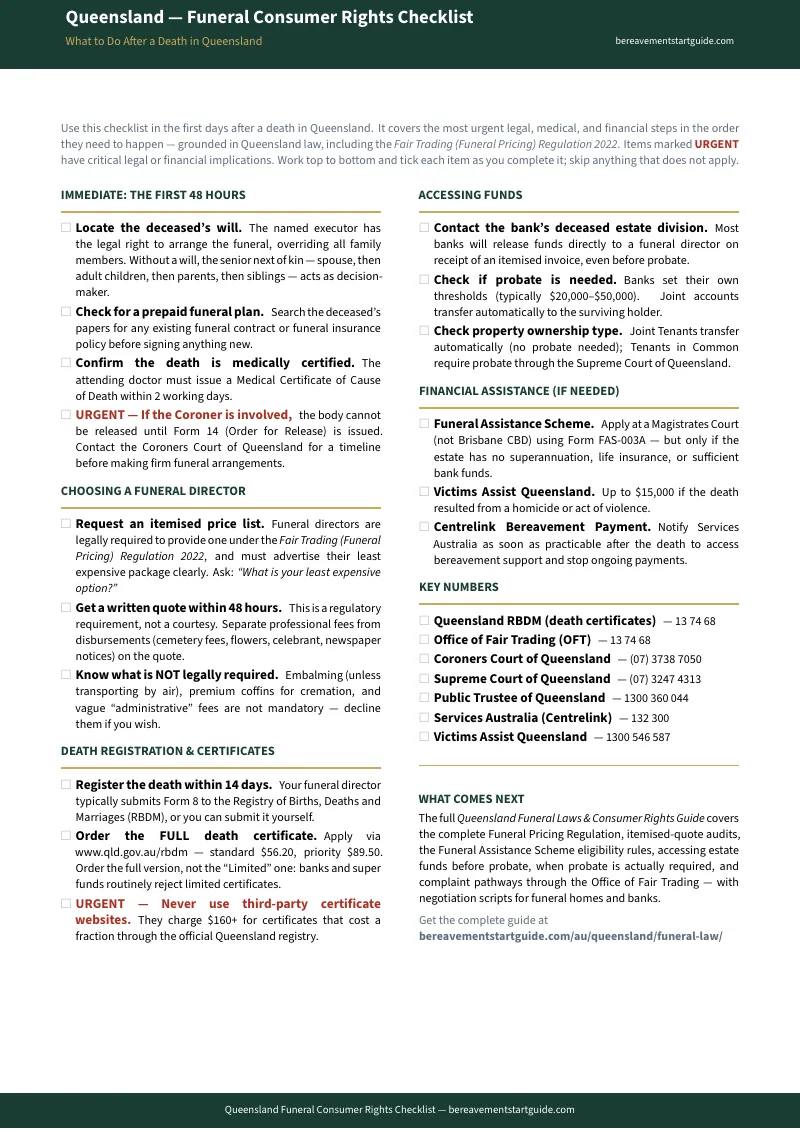
Download the Queensland Funeral Consumer Rights Checklist — a standalone PDF covering the 20 most critical actions for the first week after a death, including funeral director vetting questions, mandatory vs optional services, death registration deadlines, and financial assistance pathways. If the checklist is enough, keep it. If you need the full legal framework, consumer defence strategies, and reference tables, the complete guide is .
Frequently Asked Questions
What if the rules change after I buy?
We update the guide when the rules change. Email us any time, even years later, and we'll send you the current edition free.