You Were Named Executor in a Queensland Will. The Supreme Court Rejects One in Three Unrepresented Applications. The Queensland Law Reporter Notice Has a Monday Deadline You Have Never Heard Of. And Removing a Single Staple From the Original Will Can Derail the Entire Process.
You have never done this before. Nobody teaches you how to apply for probate, and now you are staring at a Supreme Court website that lists Form 101, Form 105, Form 104, Form 103, and Form 47 — with no explanation of how they fit together, what order they go in, or why you need a Certificate of Exhibit stapled to every single document you attach. Maybe you have already phoned a solicitor and been quoted $2,000 to $5,000 for what they called a "standard, uncontested grant." Maybe the Public Trustee told you they could handle everything — without mentioning that their administration fee starts at $3,239.60 and has been the subject of sustained parliamentary scrutiny, public advocate reviews, and investigative media reports about excessive charge extraction from vulnerable estates.
Meanwhile, the estate is on hold. The bank froze the accounts the day they were notified. Siblings or beneficiaries are asking when they will receive their share. The funeral invoice has not been paid. And somewhere in the back of your mind is the question that keeps every first-time executor awake at night: if I fill out Form 105 wrong, or miss the Queensland Law Reporter advertising deadline, or accidentally damage the original will — does the court reject my application entirely? Am I personally liable for what happens next?
Here is what the free resources will not tell you: the Supreme Court of Queensland issues requisitions on roughly 30% of unrepresented probate applications. Not because the law is impossible to follow, but because the free resources — the government forms portal, the law firm blogs, the Public Trustee checklists — explain what documents you need without explaining how to physically assemble them. They do not explain that the QLR notice must use the exact wording of Form 103, submitted and paid by Monday 3:30 PM for Friday publication, with a mandatory 14 clear days before you can file. They do not explain that you must serve a copy on the Public Trustee and wait an additional 7 days. They do not explain that removing the original staples from the will — even to photocopy it — forces you to prepare a Form 111 Affidavit of Plight and Condition, adding weeks and additional sworn documents to an already complex process.
The Queensland Probate Process Guide is a Requisition-Proof Filing System that walks you through every step of the Supreme Court application — from the moment you confirm that probate is necessary through the day you lodge the sealed grant with Titles Queensland and distribute the estate. Not a law textbook. Not a generic Australian probate explainer that treats Queensland the same as New South Wales or Victoria. A structured, jurisdiction-specific manual built around the forms, fees, deadlines, and institutional mechanics that are unique to the Supreme Court of Queensland.
What's Inside the Requisition-Proof Filing System
A 13-chapter guide with 3 appendices and the Probate Quick-Start Checklist — covering every stage from the first 48 hours through final distribution, built specifically for Queensland's Supreme Court procedures, the Succession Act 1981, and the institutional rules that make probate here different from anywhere else in Australia:
Do You Actually Need Probate?
This is the question that saves you the entire process — or confirms you cannot avoid it. If the deceased owned real property solely or as tenants in common, probate is almost universally required. But for bank accounts, the threshold is not a legal standard — it is internal bank policy, and the thresholds vary wildly. The Commonwealth Bank and NAB enforce limits around $50,000. Westpac may release up to $114,000. Credit unions like CUA may demand probate at $15,000. The guide maps the current threshold for every major institution, explains joint tenancy survivorship (which bypasses probate entirely), and covers Binding Death Benefit Nominations for superannuation — which are not estate assets at all if the nomination is valid. You may be one title search and two phone calls away from discovering you do not need the Supreme Court.
Protecting the Original Will
The Supreme Court inspects the physical condition of the original will. Removed staples, missing pages, handwritten annotations, or damaged bindings trigger automatic requisitions demanding a Form 111 Affidavit of Plight and Condition — a sworn document explaining why the will looks the way it does. This chapter covers what the court is actually looking for, the distinction between informal and formal proof requirements, and the circumstances under which a court requires "solemn form" proceedings that turn a routine application into contested litigation.
The Mandatory Advertising and Notice Period
Queensland is unique among Australian states: before you can file your probate application, you must publish a Notice of Intention to Apply (NOITA) in the Queensland Law Reporter using the precise wording of Form 103. This costs $161.70, must be submitted and paid via the ICLRQ portal by Monday 3:30 PM for publication the following Friday, and starts a mandatory 14 clear days before you can file with the Supreme Court. You must also serve a copy on the Public Trustee and wait an additional 7 clear days. Any error in the Form 103 wording means paying for a second advertisement and restarting the entire waiting period. Most executors do not discover this requirement until they have assembled the full application — adding three weeks of avoidable delay. The guide tells you to publish the QLR notice the same week you receive the death certificate.
Assembling and Filing the Supreme Court Application
This is the chapter that does not exist in any free resource. It walks through every form in filing order: Form 101 (Application for Probate), Form 105 (Affidavit Supporting Application for Grant — the narrative document where most requisitions occur), Form 104 (Affidavit of Publication), and the critical Form 47 (Certificate of Exhibit) that must be attached to every single annexure — the original will, the photocopy of the will, the death certificate, the QLR notice. It covers the $819.90 filing fee, the $149.60 concession rate available to Pensioner Concession Card holders and those demonstrating financial hardship, physical assembly instructions (what to staple, what to clip, what goes in what order), and a pre-filing audit checklist built from the Supreme Court's own Troubleshooting Guide — the document designed for court registrars that is nearly impossible for the public to parse.
Letters of Administration, Property Transfers, Tax, and Safe Distribution
The remaining chapters cover every step after the grant is issued and the critical alternative pathway when there is no will. Letters of Administration on Intestacy (Forms 102 and 109, the statutory priority order, and the $150,000 spousal threshold under the Succession Act 1981). Real property transfers through Titles Queensland (Form 4 for joint tenancy survivorship vs. Form 5 for sole ownership, the $226 lodgement fee per lot, and the June 30 QRO land tax deadline). Asset collection and the estate trust account. Superannuation (why it may not be an estate asset). ATO obligations (the date-of-death tax return, the estate trust return, and the safe harbour for executor liability). The statutory protection period (the creditor notice rules under the Trusts Act 2025 and the family provision window under the Succession Act 1981). Final distribution. And a chapter on edge cases — insolvent estates, contested probate, Indigenous and Torres Strait Islander estates, and interstate probate resealing.
Who This Guide Is For
- The first-time executor who has been named in a parent's will and has never navigated the Supreme Court of Queensland — who needs the complete Form 101/105 walkthrough, the QLR advertising requirement explained step by step, and a filing sequence that eliminates the guesswork that causes 30% of applications to be returned with requisitions
- The surviving spouse who needs to know whether probate is required at all — whether right of survivorship on joint tenancy means the family home transfers with a Form 4 and no court involvement, whether the bank threshold covers the accounts, and what happens to superannuation under a Binding Death Benefit Nomination
- The family with no will who needs to understand Letters of Administration on Intestacy — who has priority to apply under the Succession Act 1981, how the $150,000 spousal threshold and household chattels distribution works, and the additional forms (Form 102, Form 109) and court requirements
- The cost-conscious administrator who wants to avoid spending $2,000 to $5,000 on a solicitor for a straightforward, uncontested estate — who needs to know the $149.60 concession filing fee, how to access it, and a step-by-step process that makes self-representation realistic, not just theoretically possible
- The regional or interstate executor who cannot attend the Brisbane Supreme Court registry in person — who needs to understand postal filing procedures, how to swear affidavits before a local JP or notary, and the execution requirements that prevent mailed applications from triggering immediate requisitions
Why Free Resources Will Not Get You Through the Supreme Court
The information exists. It is scattered across the Queensland Courts website, the ICLRQ portal, Titles Queensland, the Public Trustee, and the content marketing funnels of a dozen law firms. Here is what you actually encounter when you try to apply for probate using free sources alone:
- The government forms portal tells you what to file but not how to assemble it. The Uniform Civil Procedure Rules prescribe Form 101, Form 105, Form 104, and Form 47. The Queensland Courts website lists them. It does not explain how to construct the narrative affidavit in Form 105 that the registrar expects, how to physically annex Form 47 to each exhibit, or that every annexure must be identified by exhibit letter — and that the letters must run consecutively across forms, not restart at "A" for each document.
- Law firm blogs explain complexity to justify retainer fees. QLD Estate Lawyers, Connor Hunter, Armstrong Legal, and Jacaranda Law publish detailed technical breakdowns of executor duties and personal liability. Every one of those articles is designed to convince you the process is too dangerous to handle alone — and that you need a retainer starting at $1,500. For contested estates, that is true. For straightforward estates with a clear will and cooperative beneficiaries, you are paying thousands for a process you can handle with the right instructions.
- Fixed-fee providers are cheaper but still expensive. Safewill offers probate from $748.10 plus filing fees. Bare Law charges $1,999. These are genuine improvements over hourly billing, but they remain substantial sums when the estate consists of a modest bank account, a used car, and a family home. And they are "done-for-you" services — you pay, they file, and you learn nothing about what happened or why.
- The Public Trustee markets simplicity but charges dearly. The Public Trustee of Queensland offers government-backed estate administration. Their fee for a simple grant starts at $3,239.60. They have faced sustained public and parliamentary scrutiny, critical government reviews, and investigative reports regarding excessive fees, conflicts of interest, and the systematic erosion of vulnerable estates.
Free resources give you form numbers from one website, advertising rules from another, fee schedules from a third, and property transfer procedures from a fourth — with no connecting thread. The Requisition-Proof Filing System puts every Queensland-specific form, fee, deadline, and assembly instruction into one document, in the exact order the Supreme Court expects to receive them.
— Less Than Fifteen Minutes With a Queensland Estate Solicitor
A single consultation with a Queensland estate solicitor costs $300 to $600 per hour. A standard probate retainer starts at $2,000 and only covers obtaining the grant — not the actual estate administration. The Public Trustee charges $3,239.60 for a simple estate. This guide costs less than fifteen minutes of professional legal time and gives you the complete filing system — every form, every deadline, every assembly instruction, and the pre-filing audit checklist that catches the errors responsible for the 30% requisition rate.
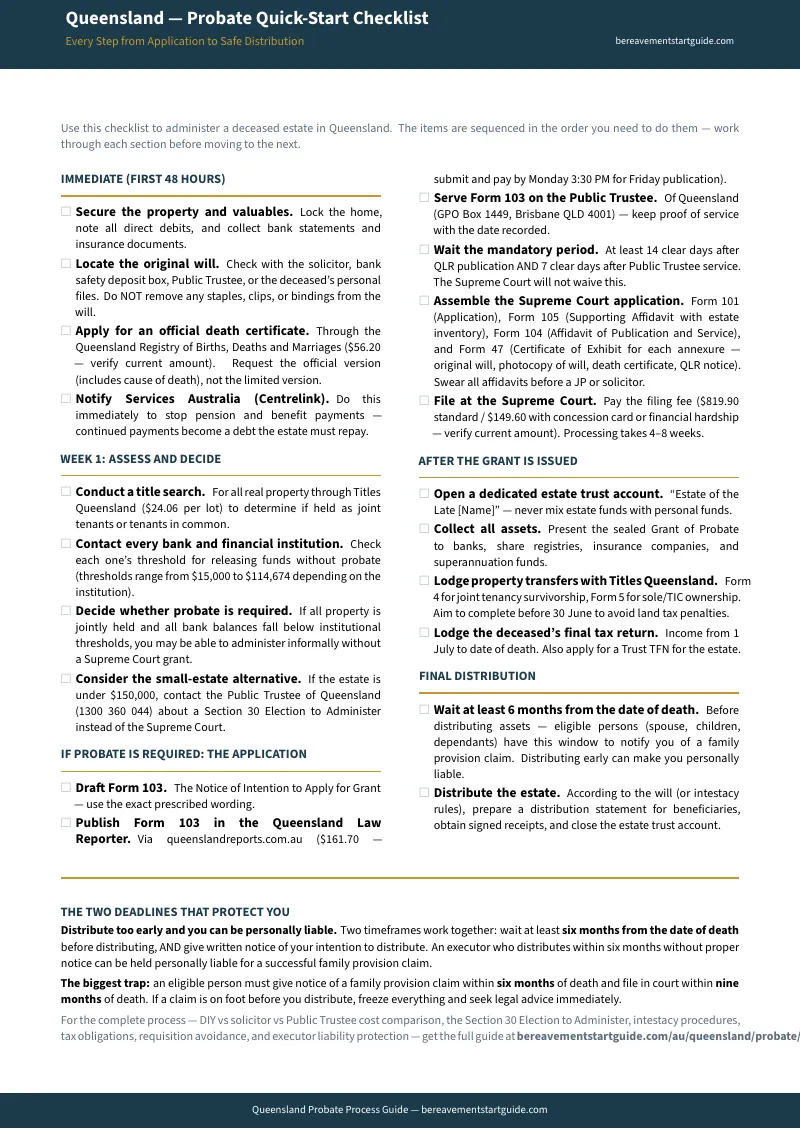
Your download includes the complete 13-chapter guide with 3 appendices, the Probate Quick-Start Checklist (20 actionable items from first 48 hours through final distribution), and 4 standalone print-ready reference cards: the Pre-Filing Error Trap Checklist (take it to the registry), the Bank Threshold Decision Matrix (bring it to your calls with each institution), the Form Assembly Reference (filing order and Form 47 exhibit rules), and the Fee, Timeline & Contacts Quick Reference (pin it to the fridge). Plus a money-back guarantee, no time limit. If the guide does not give you clarity on what to file, when to file it, and how to assemble it so the Supreme Court accepts it on the first attempt, email us for a full refund. No questions asked.
Not ready for the full guide? Download the free Queensland — Probate Quick-Start Checklist — 20 items in the exact sequence the Supreme Court process requires, from ordering death certificates through final distribution. It tells you what to do and when. The full guide tells you how.
You did not choose to be an executor. But you can do this. The guide shows you exactly how.