The CourtSA Portal Accepted Your Login. Then It Rejected Your Identity Verification. The Bank Froze the Accounts. Land Services SA Wants an Ad Valorem Fee Nobody Mentioned. And the Succession Act Changed Every Rule You Thought You Knew.
Someone you love just died in South Australia. You called the bank to pay the funeral director. The bereavement team said the account is frozen and asked for a "grant of probate" — a document you cannot produce because you do not know what it is or how to apply for one. They mentioned something about releasing up to $50,000 without probate, but when you pushed, they said it depends on their "internal risk assessment" and asked you to sign an indemnity form you do not understand. Meanwhile, the funeral home needs a deposit, the electricity bill is overdue, and the mortgage payment is due next week.
You tried CourtSA. You created an account, uploaded your identification, and the system told you that you failed the 100-point identity check under Rule 351.8 of the Uniform Civil Rules 2020. You do not know what a "100-point identity check" involves, which documents qualify as Category A or Category B, or why the system rejected your driver's licence when you use it for everything else. You still have not reached the part where you are supposed to physically mark the original Will on the reverse side of the last page, place it unfolded in an A4 envelope with a printed coversheet taped to the outside, and deliver it to the Probate Registry in Victoria Square — because nobody told you the digital system still requires physical lodgement of the original Will.
You went online. One site says the Succession Act 2023 changed everything on 1 January 2025. Another still references the Administration and Probate Act 1919 — a law that no longer exists. A third mentions a $15,000 statutory release threshold under Section 100, but the bank is quoting $50,000. A funeral home blog covers the first seven days and then stops. A law firm blog explains executor liability under Section 98 — a new provision that lets beneficiaries sue you personally — and suggests you hire them immediately at $350 per hour.
Here is the reality: South Australia overhauled its entire succession law framework in 2025, mandates one of the most procedurally rigid probate systems in Australia, and provides almost no practical guidance for the families who must navigate it. The CourtSA portal is digital but the Will lodgement is physical. The Succession Act 2023 introduced personal liability for executors but the government websites still reference repealed legislation. And every law firm blog is designed to make you feel so overwhelmed that you hire a solicitor at $5,000 to $15,000 for work you may be able to do yourself.
The When Someone Dies in South Australia — Estate Settlement Guide is the Probate Registry's Missing Manual — the step-by-step workbook that bridges the gap between what SA government websites tell you exists and how you actually do it. Not a generic Australian overview. Not a pre-2025 guide still citing the Administration and Probate Act. A 13-chapter, South Australia-specific manual built entirely on the Succession Act 2023 and the Uniform Civil Rules 2020 — covering every stage from death certificate to final distribution, with the CourtSA procedures, Land Services SA forms, bank negotiation strategies, and statutory deadlines that no free resource puts into one sequence.
What's Inside the Probate Registry's Missing Manual
A 13-chapter guide, the First 48 Hours Checklist, and three appendices — covering every stage from the moment of death through final asset distribution, built specifically for the Succession Act 2023, CourtSA electronic lodgement, and South Australia's unique institutional requirements:
The First 48 Hours: Death Certificates and Immediate Actions
SA Health protocols, engaging a funeral director, and the critical distinction between a Medical Certificate of Cause of Death (which the doctor provides) and a Registered Death Certificate (which you must apply for through Consumer and Business Services). A standard certificate costs $69.50 and a priority certificate costs $118 — but the real cost is ordering too few. You need originals for every bank, every insurance company, Land Services SA, the Probate Registry, and Centrelink. Order 8 to 12 at the outset, because coming back later means re-applying and waiting weeks. This chapter also covers registering the death via the Australian Death Notification Service and why you should never pay the deceased's personal debts with your own money.
Securing the Estate Before You Have Legal Authority
Before probate gives you formal authority, you have a common-law duty to prevent assets from being lost, stolen, or damaged. Locking the home, securing vehicles, redirecting mail through Australia Post (your best tool for discovering unknown bank accounts, superannuation statements, and outstanding debts), cancelling subscriptions, and the family conversation where you establish one rule: nobody removes anything from the property until a grant is issued.
Unlocking Frozen Bank Accounts: The $15,000 Rule vs. Bank Discretion
Section 100 of the Succession Act 2023 permits any person or institution holding $15,000 or less in cash or personal property to release it to a surviving spouse, domestic partner, or child without a grant of probate. That is your statutory right — the bank cannot refuse it. But major institutions like Westpac and the Commonwealth Bank have internal discretionary thresholds of $50,000 to $114,000 for releases without probate. The catch: these higher releases require you to sign an indemnity form that makes you personally liable if an undisclosed beneficiary or creditor later surfaces. The guide explains exactly when to invoke the statutory $15,000 right, when to negotiate the higher discretionary release, what the indemnity form actually commits you to, and the specific documents each major bank's bereavement team requires.
The CourtSA Probate Application: Rule 351.8 and Rule 356.5
The most procedurally dangerous stage of estate settlement in South Australia. The guide walks you through the 100-point identity check under Rule 351.8 — which Category A and Category B documents qualify, why your identity must be verified before a Justice of the Peace or notary public (not a probationary constable), and the exact combination that satisfies the threshold. Then Rule 356.5: physically marking the original Will on the reverse side of the last page, preparing the Certificate of Identity, and assembling the physical lodgement package — an unfolded Will in an A4 envelope with the CourtSA coversheet printed and affixed to the outside, original staples intact, delivered to the Probate Registry in the Sir Samuel Way Building. Any deviation triggers a requisition that delays the grant by weeks or months.
Intestacy Under the Succession Act 2023: The New $120,000 Preferential Legacy
If there was no valid Will, the Succession Act 2023 dictates who inherits. The surviving spouse or domestic partner receives the first $120,000 (up from $100,000 under the old law) plus the deceased's personal effects and a share of the residual estate. But Section 107 introduces a critical exception: a separated spouse who entered a financial agreement on or after 1 January 2025 loses their intestate entitlement entirely. And the presumption of survivorship has changed — if joint owners die simultaneously, the property is now treated as tenants in common, not presuming the younger outlived the elder. The guide maps the complete intestate distribution hierarchy with worked examples for every family structure.
Real Property Transfers: Land Services SA, PEXA, and the Fee Shock
The transfer of real property in South Australia runs through Land Services SA — and the costs are far higher than most families expect. The standard lodgement fee is $198 for 2025/2026, but that is only the administrative baseline. Transfers are assessed by RevenueSA for stamp duty, and ad valorem registration fees scale rapidly based on property value — approaching $7,000 for a property valued at $700,000. The guide explains the critical distinction between a Survivorship Application (joint tenants — just a death certificate) and a Transmission Application (sole owner or tenants in common — requires a grant of probate), why self-represented individuals effectively need a registered conveyancer because lodgement goes through PEXA, and exactly what Verification of Identity and Verification of Authority documents to prepare.
Vehicle Transfers and the 14-Day Rule
South Australia requires vehicle registration transfers to be completed within 14 days. The guide covers the specific forms needed at Service SA, the documentation required for executor-held vehicles versus jointly owned vehicles, and how to handle vehicles that are still under finance.
The Public Trustee Question: Calculating Whether to Keep or Replace Them
Many South Australians use the Public Trustee's free will-drafting service without realising that the service is contingent on the Public Trustee being appointed as executor. The commission structure is aggressive: 4.4% on the first $200,000 of gross estate value, 3.3% on the next $200,000, 2.2% up to $600,000, and 1.1% on the remainder — calculated on gross value before debts. Plus a 5.5% income commission, $204 annual audit fees, and $277-per-hour tax fees. For a $500,000 estate, that is over $13,000 in commissions alone. The guide provides a fee calculator worksheet and explains how to request that the Public Trustee renounce their appointment in favour of a private administrator — and when that is a good idea versus when the Public Trustee's institutional infrastructure is actually worth the cost.
Executor Liability Under the Succession Act 2023
Section 98 of the new Act introduces a statutory cause of action allowing aggrieved beneficiaries to sue an executor who fails to perform their duties. Section 81 codifies the duty to distribute the estate "as soon as practicable." These are not theoretical risks — they are enforceable legal obligations with real financial consequences. The guide maps every executor duty, every statutory deadline, and the specific actions that create or prevent personal liability.
Taxes, Superannuation, and Final Government Notifications
The ATO date-of-death tax return, whether you need a separate trust tax return, the superannuation death benefit claim process (which bypasses the estate entirely unless the fund trustee directs otherwise), notifying Services Australia within 28 days to avoid overpayment debts, and every federal and state agency notification mapped to a single tracking list. Plus the Funeral AssistanceSA program for low-income families — eligibility requires the deceased's estate to be under $4,000, the family to own no home, and family funds to be under $4,000. The guide includes the application process and the warning that contracting a private funeral director and paying in full before applying disqualifies you entirely.
Who This Guide Is For
- The surviving spouse who cannot access the bank accounts. The joint account is accessible but the sole-owner account is frozen, the funeral director needs payment, and the bank is asking for documents you have never heard of. The guide tells you exactly when to invoke the $15,000 statutory release under Section 100, when to negotiate a higher discretionary release, and what the indemnity form actually means before you sign it.
- The adult child named as executor who has never navigated probate. You are now personally liable under Section 98 of the Succession Act 2023 for administering someone else's financial affairs correctly — and you do not know what that means. The guide gives you the complete CourtSA procedure, the 100-point ID requirements, the Will marking rules, and every statutory deadline that determines whether you fulfil your obligations or breach them.
- The family trying to decide between DIY probate and hiring a solicitor. The solicitor quoted $5,000 to $15,000. You suspect there is a simpler path but you do not know how to navigate CourtSA, whether the estate qualifies for the $15,000 small estate threshold, or what the property transfer fees actually amount to. The guide includes the decision framework.
- The family discovering the Public Trustee's commission after the death. The free will came with a hidden cost — thousands in commissions calculated on gross estate value before debts. The guide provides the fee calculator and the renunciation process so you can make an informed decision before the Public Trustee begins charging.
- The regional family managing an estate from outside Adelaide. You live in Mount Gambier, Port Lincoln, or interstate, and the Probate Registry is in Victoria Square. The guide explains how to mail the physical Will package via registered post, which regional Service SA locations handle CBS death certificate applications, and how to coordinate every step without driving to Adelaide.
- The family on a limited income facing funeral costs. The guide covers Funeral AssistanceSA eligibility, the strict $4,000 estate and family asset thresholds, the application process, and the $625 cap on after-the-event grants — because applying in the wrong order or paying the funeral home first disqualifies you from receiving any assistance.
Why Free Resources Will Not Get You Through This
The information exists across dozens of South Australian government websites. The instructions for using it do not. Here is what actually happens when you try to settle an estate using free sources:
- SA.GOV.AU covers the first 48 hours and then stops. The government portal explains how to register a death and how to use the Australian Death Notification Service. It does not explain how to navigate CourtSA, how to physically prepare the Will for lodgement, how to negotiate bank fund releases, or how to calculate Land Services SA ad valorem fees. The checklist ends where the hard administrative work begins.
- The Legal Services Commission is accurate but passive. The LSC Law Handbook is the most legally reliable free resource in South Australia — fully updated for the Succession Act 2023. But it functions as an encyclopedia, not a workbook. It answers "What is probate?" but does not tell you "Do these five things before opening the CourtSA portal." You must already know the legal term you are looking for to find the answer.
- Funeral home websites cover their service and nothing else. Alfred James, Blackwell Funerals, and other SA funeral providers offer excellent first-week guidance — Centrelink notifications, death certificate applications, immediate logistics. Their guidance ends the moment the funeral invoice is paid. Probate mechanics, property transfers, bank negotiations, tax obligations, and asset distribution are entirely absent.
- Law firm blogs create anxiety to generate client enquiries. Boylan Lawyers, Scammell & Co, and similar practices produce accurate content about executor liability, probate triggers, and intestacy basics. Every article is strategically designed to convince you the process is too dangerous to attempt alone. They explain that Rule 351.8 requires identity verification but omit which documents satisfy it. They mention that the Will must be physically marked but do not explain how. The tactical steps remain proprietary — because selling you the consultation is the point.
- The internet is contaminated with pre-2025 advice. The Succession Act 2023 only took effect on 1 January 2025, replacing legislation that had been in force for over a century. The majority of blog posts, forum answers, and downloadable guides still reference the Administration and Probate Act 1919 — a law that no longer exists. Following pre-2025 advice risks distributing assets under the wrong intestacy rules, missing new executor duties, and overlooking statutory provisions that did not exist six months ago.
Free resources give you fragments across a dozen government websites, law firm blogs designed to sell consultations, and outdated advice based on repealed legislation. The Probate Registry's Missing Manual puts the complete post-2025 South Australian sequence into one workbook — from death certificate to final distribution — in the order you actually need it.
— Less Than Thirty Minutes With a South Australian Probate Solicitor
A single consultation with a South Australian probate solicitor costs $300 to $500 per hour. Full estate administration runs $5,000 to $15,000 depending on complexity. The Public Trustee charges 4.4% on the first $200,000 of gross estate value — over $8,800 on a $200,000 estate before they even begin calculating income commissions and audit fees. This guide costs less than thirty minutes of professional legal time and gives you the complete South Australia-specific roadmap — every Succession Act 2023 provision, every CourtSA procedure, every Land Services SA form, every bank negotiation strategy, and the decision framework that tells you whether you actually need a solicitor or whether you are paying thousands for administrative work you can do yourself.
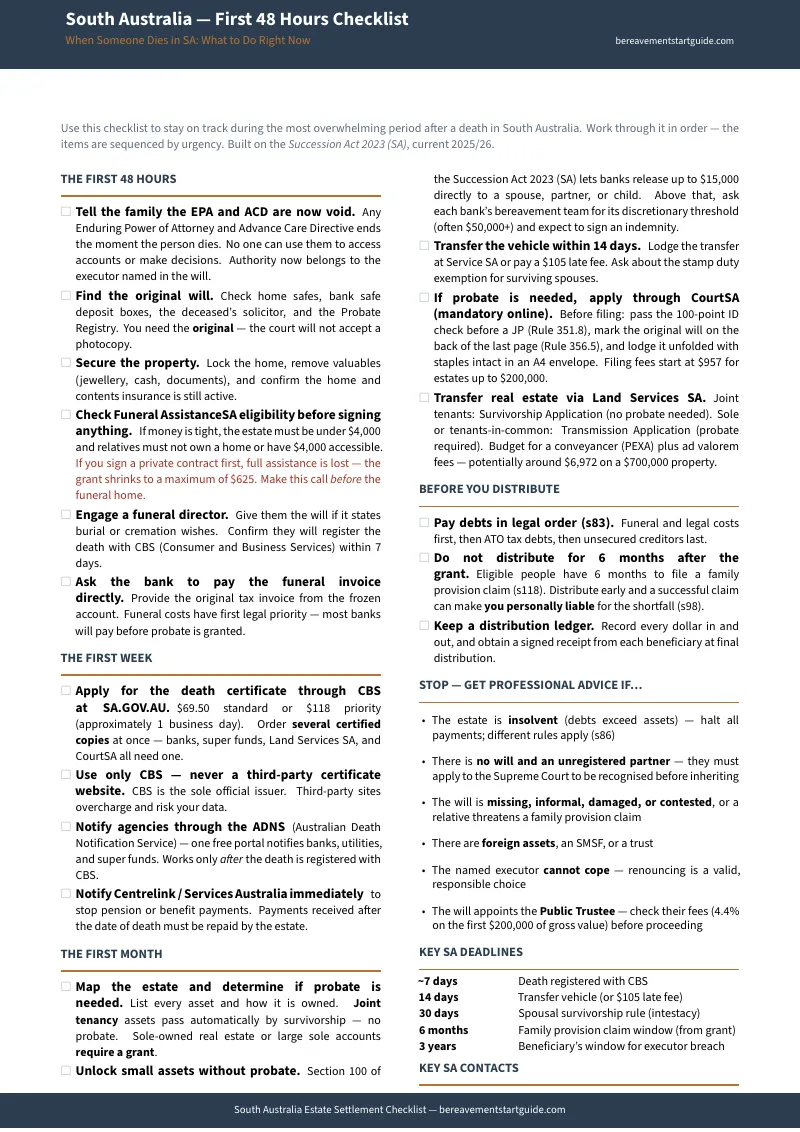
Your download includes the complete 13-chapter guide with three appendices (key contacts directory, essential forms reference, and glossary of SA legal terms), the standalone South Australia First 48 Hours Checklist, and fillable worksheets — the Estate Inventory Tracker, Public Trustee Fee Calculator, CourtSA Identity Verification Checklist, and Statutory Deadline Calendar. Instant download, no account required.
Money-back guarantee, no time limit. If the guide does not give you clarity on what to do next and confidence that you are doing it in the right order, email us for a full refund. No questions asked.
Not ready for the full guide? Download the free South Australia First 48 Hours Checklist — covering death certificate ordering, securing the home, financial boundaries, and the critical actions that must happen in the first two days. It is enough to get through tonight and tomorrow.
You did not ask for this job. But you are the one doing it. The bank will not release the money. CourtSA will not explain the rules. Land Services SA will not warn you about the fees. This guide puts every South Australia-specific step into one sequence so you can stop searching and start settling.