Someone Just Died in South Australia. The Funeral Director Wants a Deposit. The Bank Accounts Are Frozen. And the One Law That Could Save Your Family Thousands Took Effect Eight Months Ago.
You are standing in a hospital corridor, or sitting at a kitchen table, or answering a phone call that changes everything. Someone has died. Within hours, a funeral director is asking whether you want embalming, a premium casket, and a chapel viewing. They have not mentioned that embalming is almost never legally required in South Australia. They have not mentioned that you can purchase a coffin from a third-party supplier. They will not mention these things. It is not in their interest.
South Australia does not have the strict funeral pricing transparency laws that protect consumers in New South Wales and Victoria. Until August 2025, funeral directors were not even required to publish their price lists. The state has no funeral industry licensing requirement. Your protection comes from the broader Australian Consumer Law and your own knowledge of what is mandatory versus what is optional. If you do not know the difference, you will pay for the difference.
Meanwhile, the deceased's bank accounts are frozen. The funeral director wants a deposit within days. And the law that could unlock those funds — Section 100 of the Succession Act 2023, which lets banks release up to $15,000 without probate — took full effect on 1 January 2025. Most families do not know it exists. Most pay a solicitor thousands for a probate application they never needed.
The South Australia Funeral Laws & Consumer Rights Guide is a Consumer Defence System for every legal, financial, and administrative decision between the moment of death and the final post-funeral paperwork. Not a generic Australian funeral guide. Not a funeral director's brochure dressed up as consumer advice. A structured, South Australia-specific reference that tells you exactly what funeral directors must disclose, what services are legally mandatory and what are not, who has the legal right to make decisions when families disagree, and how to access estate funds without paying for unnecessary legal applications.
What's Inside the Consumer Defence System
10 chapters plus 2 printable reference tables — covering advance planning, immediate actions, consumer rights, cremation and burial rules, estate administration under the new Succession Act 2023, financial assistance, and transport and repatriation. Built specifically for South Australian statutes and the state-specific rules that make arranging a funeral here different from anywhere else in Australia:
Legal Authority and Family Disputes
Under Australian common law, the executor named in the will has supreme authority over funeral arrangements and method of disposal — superseding the spouse, the children, and every other family member. But the Burial and Cremation Act 2013 complicates this. Section 9 gives a spouse, parent, or child the power to formally object to a cremation, legally halting the process. The only override is a signed, witnessed document from the deceased explicitly directing cremation. This chapter maps the complete legal framework for who decides what — including what happens when there is no will, when the executor is unavailable, when siblings disagree, and when the only resolution is an urgent Supreme Court application.
The First 48 Hours: What to Do and in What Order
Medical certification, coronial involvement, locating the will, searching for prepaid funeral contracts, and understanding why your Enduring Power of Attorney is no longer valid. This chapter gives you the exact sequence — because doing things out of order can trigger coronial referrals, void insurance contracts, and cost the estate thousands.
Consumer Rights When Dealing With Funeral Directors
What funeral directors must disclose by law and what they routinely fail to mention. The chapter covers the new mandatory price list requirements taking effect from August 2025, the right to itemised quotes separating professional fees from third-party disbursements, the critical distinction between legally required and optional services, and a Consumer Rights Comparison Worksheet you can bring to the funeral director meeting. Because South Australia lacks the strict pricing regulations of other states, this chapter is your primary financial defence.
Cremation: Permits, Forms, and Objection Rights
The multi-step cremation permit process: Form 1 (Application for a Cremation Permit), the primary medical certificate, and the secondary medical certificate (Form 4) from an independent doctor to rule out foul play. Plus the Section 9 framework that determines whether the executor or a family member has the final say on cremation — and the signed-document override that settles blended family disputes before they start.
Burial: Cemeteries, Home Burial, and Interment Rights
The difference between 50-year and 99-year interment right leases, the Adelaide Cemeteries Authority's 25-year grace period for pre-purchased plots, lift-and-deepen procedures for shared graves (with the mandatory 6-year decay period), and the strict rules for home burial on private property — which is only permitted outside Metropolitan Adelaide with council approval, 1-metre depth, and 20-metre setbacks from buildings and water wells.
Estate Administration Under the Succession Act 2023
The chapter that can save your family thousands. Three distinct pathways depending on estate size: the $15,000 bank release rule (Section 100 — no probate needed), the $100,000 Public Trustee threshold (no Supreme Court application needed), and the full probate process through the CourtSA digital portal with filing fees from $987 to $3,945. Includes the common e-filing rejection traps that get self-represented executors "requisitioned," the Form DOC 73.0 process for joint tenancy transfers through Land Services SA, and the intestacy distribution rules when there is no will.
Financial Assistance for Funeral Costs
The Funeral AssistanceSA eligibility audit — the $4,000 estate limit, the $4,000 immediate-family asset limit, and the critical timing rule that drops your assistance from a fully coordinated funeral to a maximum $625 grant if you contract a private funeral director first. Plus Centrelink bereavement payments and superannuation death benefit claims.
Transport, Repatriation, and the Coronial Process
When embalming is genuinely legally required (international transport and above-ground vaults only), the hermetically sealed container mandate for overseas repatriation, Commonwealth biosecurity coordination, and what happens when the Coroner takes jurisdiction — including typical body release timelines (48 hours unless toxicology is required) and the Senior Next of Kin's right to object to autopsy or organ retention.
Complete Reference Tables
Every form number, every fee, every agency contact, every deadline — in one place. Death certificates ($69.50 standard, $118.00 priority), probate filing fees ($987 to $3,945), BDM registration, Consumer and Business Services complaints, the Public Trustee, Land Services SA, SACAT, and the Adelaide Cemeteries Authority.
Standalone Printable Tools
Print these and keep them on hand — each works independently without needing to open the full guide:
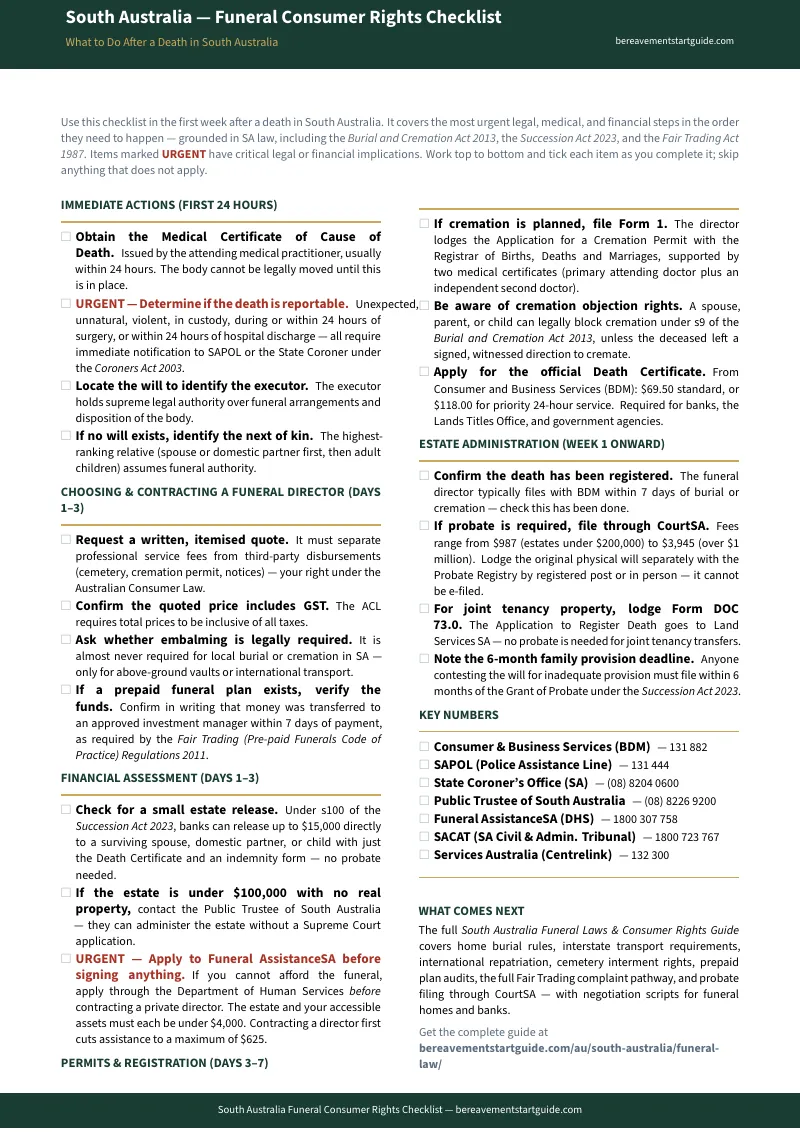
- Consumer Rights Checklist — 18 critical actions across 5 phases: immediate actions, funeral director contracting, financial assessment, permits and registration, and estate administration. Each item includes the specific law, form, or agency you need.
- Consumer Rights Comparison Worksheet — a table of questions to bring to your funeral director meeting, with your legal rights and what to check for each answer.
- Advance Planning Checklist — step-by-step checklist for Advance Care Directives, Enduring Powers of Attorney, and recording funeral wishes before incapacity.
- Forms and Fees Reference — every form number, fee, deadline, and agency contact in one printable sheet.
Who This Guide Is For
- The overwhelmed executor who was named in a parent's will and has 48 hours to choose a funeral director without knowing what services are legally required, what services are optional upsells, and whether a sibling can override their decisions — this guide gives you the legal framework, the consumer checklist, and the exact regulatory protections that put you in control of the process
- The family member in a dispute — a spouse who wants burial while the executor insists on cremation, an adult child who wants to block a cremation, or a blended family fighting over who has legal authority — who needs to know the Section 9 objection mechanism and when the Supreme Court is the only resolution
- The family on a tight budget who cannot afford the average Adelaide funeral cost but does not know that embalming is optional, that Funeral AssistanceSA exists, that contracting a director before applying slashes your assistance to $625, or that the $15,000 bank release rule can cover funeral expenses without a solicitor
- The caregiver planning ahead evaluating prepaid funeral contracts for an ageing parent — who needs to verify the funds are held by an approved investment manager (not the director's operating account), understand the Fair Trading Code of Practice protections, and check whether the contract actually covers future price increases
- Anyone arranging a funeral in South Australia who wants a single, independent reference instead of stitching together advice from government portals (sterile and bureaucratic), funeral director websites (designed to sell packages), and law firm blogs (designed to sell consultations)
Why Free Resources Leave You Exposed
- The Legal Services Commission Law Handbook is the most comprehensive free legal resource in the state — accurate, exhaustive, and written in dense academic legalese for law students. It states the law precisely but provides zero operational checklists, no commercial negotiation tactics, and no sympathetic guidance for a family in crisis.
- SA.GOV.AU explains how to order a death certificate but not why you need one for probate versus joint tenancy transfers. It lists fees without explaining which pathway eliminates fees entirely. It is siloed, bureaucratic, and assumes you already know what you need.
- Consumer and Business Services enforces the Fair Trading Act but does not teach you how to use it proactively. They explain what you can complain about after the fact — they do not prepare you for the funeral director meeting where the overcharging happens.
- Funeral director websites explain their services in the language of care and compassion. They do not explain that embalming is almost never legally required, that you can bring your own coffin, or that South Australia has weaker pricing transparency than other states — leaving you entirely dependent on their good faith.
- Law firm blogs publish detailed breakdowns of executor rights, the Succession Act 2023, and probate applications. Every article is a lead-generation funnel designed to sell you a retainer. The complexity is real — the implication that you cannot navigate a $15,000 bank release without a solicitor is not.
This guide bridges all of these sources into a single chronological reference — with every South Australia-specific form, fee, deadline, consumer right, and escalation path in one document. Written for families, not lawyers. Written to protect you, not sell you something else.
The Guarantee
If the guide does not help you navigate your situation, email hello@bereavementstartguide.com and we will make it right.
Start With the Free Checklist
Download the South Australia Funeral Consumer Rights Checklist — a standalone PDF covering the 18 most critical actions for the first week after a death, including funeral director vetting questions, mandatory vs optional services, death registration deadlines, financial assessment pathways, and estate administration steps. If the checklist is enough, keep it. If you need the full legal framework, consumer defence strategies, and reference tables, the complete guide is .