The Bank Froze the Accounts. CourtSA Rejected Your Identity Documents. The Will Must Be Physically Marked and Hand-Delivered. And Everything You Read Online Was Written Before the Law Changed.
Someone you love just died in South Australia. You were named as executor. You have never done this before. The solicitor quoted $5,000 to handle the probate application — on top of court filing fees that start at $987 and climb to $3,945. You decided to do it yourself. Then you logged into the CourtSA portal.
The portal asked for a 100-point identity verification under Rule 351.8 of the Uniform Civil Rules 2020. You do not know what Rule 351.8 is, which documents qualify as Category A or Category B, or why the system rejected your driver's licence when you use it for everything else. You have not yet reached the part where you must physically mark the original Will — both you and an authorised witness signing the reverse side of the last page — then place it unfolded in an A4 envelope with a printed CourtSA coversheet taped to the outside and deliver it to the Probate Registry in Victoria Square. Nobody told you the digital system still requires a physical Will lodgement.
You went online. Half the results still reference the Administration and Probate Act 1919 — a law that was repealed on 1 January 2025. A funeral home blog covers the first seven days and stops. The Legal Services Commission explains what probate is but not how to file for it. A law firm blog warns that Section 98 of the Succession Act 2023 lets beneficiaries sue executors personally — and recommends you hire them at $350 per hour to avoid that risk.
Here is the reality: South Australia replaced its entire succession law framework in January 2025, introduced a mandatory digital filing system with physical lodgement requirements, and left executors to piece together the procedure from government FAQs that reference rule numbers without explaining what the rules say.
The South Australia Probate Process Guide is the CourtSA Filing Manual — the step-by-step workbook that translates Rule 351.8, Rule 356.5, and every other CourtSA requirement into plain-English instructions. Not a generic Australian overview. Not a pre-2025 guide citing repealed legislation. A 13-chapter, South Australia-specific manual built entirely on the Succession Act 2023 and the Uniform Civil Rules 2020 — covering every stage from "Do I actually need probate?" through final distribution, with the CourtSA portal procedures, bank release strategies, Land Services SA forms, and statutory deadlines that no free resource assembles into one sequence.
What's Inside the CourtSA Filing Manual
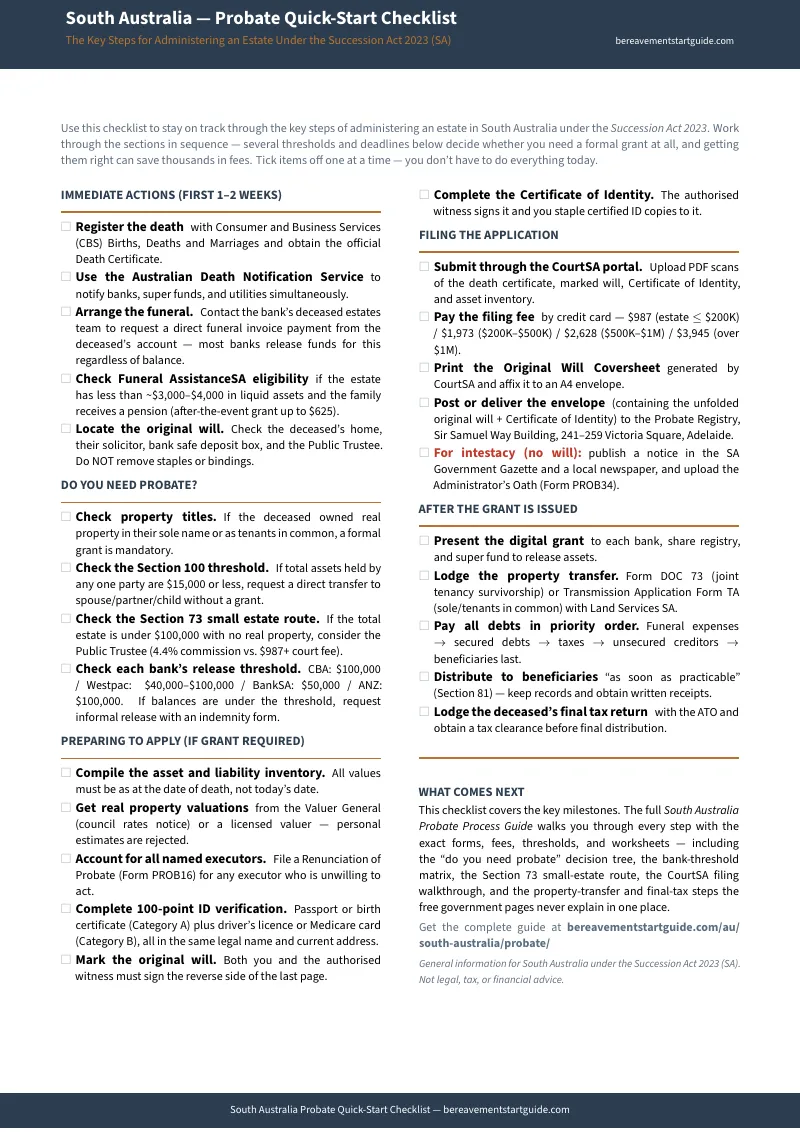
A 13-chapter guide and a 20-item quick-start checklist — covering every stage of the probate process under the Succession Act 2023, built specifically for the CourtSA electronic filing system and South Australia's unique institutional requirements:
Do You Actually Need Probate? The Decision Framework
Before spending $987 to $3,945 on court filing fees, work through the four-step decision tree that determines whether you need a formal grant at all. Section 100 of the Succession Act 2023 permits direct transfers of up to $15,000 to a surviving spouse, domestic partner, or child without any court application. Section 73 allows the Public Trustee to administer estates under $100,000 with no real property through a simplified gazettal process. And each major bank sets its own internal release threshold — CBA will release up to $100,000 without probate, while BankSA demands it at $50,000. The guide maps every threshold so you know exactly where you stand before filing anything.
The CourtSA Application: Identity Verification and Will Marking
The most procedurally dangerous stage of probate in South Australia. Rule 351.8 requires a 100-point identity check — specific combinations of Category A documents (passport, birth certificate) and Category B documents (driver's licence, Medicare card), all verified before an authorised witness who is NOT a probationary constable. Rule 356.5 requires you to physically mark the original Will: both you and the authorised witness sign the reverse side of the last page, you prepare a Certificate of Identity with certified copies of your ID stapled to it, and you place everything in an A4 envelope — will unfolded, original staples intact — with the CourtSA-generated coversheet affixed to the outside. Any deviation triggers a requisition that delays your grant by weeks.
Electronic Filing and Physical Lodgement
CourtSA is a digital portal that requires a physical delivery. The guide walks you through every screen of the CourtSA application — creating your account, entering the deceased's details, completing the Statement of Assets and Liabilities (with exact naming conventions that prevent requisitions), paying the tiered filing fee by credit card, generating the Original Will Coversheet, and assembling the physical lodgement package for delivery to the Probate Registry at the Sir Samuel Way Building, 241–259 Victoria Square, Adelaide SA 5000. If you live outside Adelaide, you can send it by registered post — the guide explains the exact mailing protocol.
Intestacy: Letters of Administration Under the New Rules
If the deceased died without a valid Will, you need Letters of Administration instead of probate — and the Succession Act 2023 rewrote the rules entirely. The surviving spouse or domestic partner receives the first $120,000 (up from $100,000 under the old law) plus personal effects and a share of the residue. But Section 107 strips a separated spouse who entered a financial agreement on or after 1 January 2025 of any intestate entitlement. The guide maps the complete intestacy hierarchy, explains the Administrator's Oath (Form PROB34), and covers the mandatory Gazette and newspaper notice requirements.
Bank Account Release Strategies
The critical gap between what the law says and what the bank actually does. Section 100 gives you a statutory right to $15,000 — but CBA will often release up to $100,000 with an indemnity form, while BankSA demands probate at $50,000. The guide explains exactly when to invoke the statutory right, when to negotiate a discretionary release, what the indemnity form commits you to, and the specific documents each major bank's bereavement team requires. This chapter alone can save you $987 in unnecessary court fees if the estate qualifies for an informal release.
Real Property Transfers Through Land Services SA
Property cannot be sold or transferred until you are recorded on the title. Joint tenancy requires a Survivorship Application (Form DOC 73) — straightforward. Sole ownership or tenants in common requires a Transmission Application (Form TA) with the grant of probate attached. Land Services SA enforces strict Verification of Identity and Verification of Authority protocols, charges a $198 lodgement fee for 2025/2026, and effectively requires a registered conveyancer because all lodgements go through PEXA. The guide walks through the forms, the VOI document requirements, and the RevenueSA stamp duty exemption under Section 71A for in specie distributions.
After the Grant: Distribution, Liability, and Closing
Getting the grant is half the work. Section 81 of the Succession Act 2023 requires you to distribute the estate "as soon as practicable." Section 98 creates a statutory cause of action allowing beneficiaries to sue you personally for failures in administration. The guide maps the priority order for paying debts — funeral expenses, then secured debts, then taxes, then unsecured creditors, then beneficiaries — and the specific steps to close the estate, lodge the deceased's final ATO tax return, and protect yourself from future claims.
Who This Guide Is For
- The executor who has never navigated probate before. You were named in the Will but you have no idea what Rule 351.8 means, how to mark a Will, or what a "requisition" is. The guide translates every CourtSA requirement into step-by-step instructions with the exact documents, forms, and sequences you need.
- The family trying to decide between DIY probate and hiring a solicitor. The solicitor quoted $5,000 to $15,000. You suspect the CourtSA portal was designed for self-represented applicants but the instructions assume you already understand the Uniform Civil Rules. The guide bridges that gap.
- The surviving spouse who cannot access the bank accounts. The sole-owner account is frozen and the bank is asking for a "grant of probate" you do not have. The guide explains when you can invoke the $15,000 statutory release, when to negotiate a higher discretionary release, and what the indemnity form means before you sign it.
- The administrator of a small estate weighing the Public Trustee option. The court fee is $987 for a $60,000 estate — but the Public Trustee charges 4.4% on the first $200,000 of gross value. The guide provides the cost comparison so you can make an informed decision.
- The interstate or regional executor managing remotely. You live in Mount Gambier, Melbourne, or overseas. The Probate Registry is in Victoria Square. The guide explains how to mail the physical Will package by registered post and coordinate every step without travelling to Adelaide.
Why Free Resources Will Not Get You Through CourtSA
The information exists across South Australian government websites. The instructions for using it do not.
- CourtSA guidelines reference rule numbers without explaining the rules. The official instructions tell you to "refer to Rule 356.3" for asset listing requirements. They do not tell you how to correctly describe a 2018 Holden Commodore, a jointly-held CommBank savings account, or a self-managed super fund on the digital form. The guide does.
- The Legal Services Commission is accurate but passive. The LSC Law Handbook is fully updated for the Succession Act 2023 — it is the most reliable free legal reference in South Australia. But it functions as an encyclopedia, not a workbook. It answers "What is probate?" but not "Do these five things before opening the CourtSA portal."
- Law firm blogs explain complexity to sell consultations. Genders & Partners calls probate a "very exacting process" requiring "care and skill." Boylan Lawyers warns about executor liability under Section 98. Every article is designed to make you feel the process is too dangerous to attempt alone — because selling you the consultation at $350 per hour is the point.
- Most online content still cites repealed legislation. The Succession Act 2023 only took effect on 1 January 2025. The majority of blog posts, forum answers, and downloadable guides still reference the Administration and Probate Act 1919. Following pre-2025 advice risks filing under the wrong rules, triggering a requisition, or distributing assets under an intestacy hierarchy that no longer exists.
Free resources give you fragments across a dozen government websites, law firm blogs designed to sell consultations, and outdated advice based on repealed legislation. The CourtSA Filing Manual puts the complete post-2025 South Australian probate procedure into one workbook — from "Do I need probate?" to final distribution — in the order you actually need it.
— Less Than Thirty Minutes With a South Australian Probate Solicitor
A single consultation with a South Australian probate solicitor costs $300 to $500 per hour. Full estate administration runs $5,000 to $15,000. The Public Trustee charges 4.4% on the first $200,000 of gross estate value — over $8,800 on a $200,000 estate before income commissions and audit fees. This guide costs less than thirty minutes of professional legal time and gives you the complete South Australia-specific probate roadmap — every Succession Act 2023 provision, every CourtSA procedure, every bank threshold, and the decision framework that tells you whether you need probate at all.
Your download includes 8 PDFs: the complete 13-chapter guide, the standalone Quick-Start Checklist (20-item printable covering the complete probate sequence), plus 6 standalone reference tools — the Probate Decision Tree, Bank Release Thresholds sheet, Pre-Lodgement Checklist, Intestacy Distribution Map, Timeline and Deadlines reference, and Forms and Fees Quick Reference. Print the ones you need and bring them to the bank, the Probate Registry, or the solicitor's office. Instant download, no account required.
Money-back guarantee, no time limit. If the guide does not give you clarity on what to do next and confidence that you are filing correctly, email us for a full refund. No questions asked.
Not ready for the full guide? Download the free South Australia Probate Quick-Start Checklist — covering the decision framework for whether probate is needed, the key CourtSA identity verification and Will marking steps, and the filing sequence. It is enough to understand the process and decide your next move.
You did not ask to be executor. But the Will named you and the law holds you accountable. CourtSA will not explain the rules. The bank will not release the money. Law firms will not show you how to do it yourself. This guide puts every South Australia-specific step into one sequence so you can stop searching and start filing.