The Bank Froze the Account. The Supreme Court Wants the Original Will in Perfect Condition. The Land Titles Office Just Barred You from Lodging the Transfer Yourself. And Tasmania's Three-Month Contest Window Is Shorter Than Any Other State.
Someone you love just died in Tasmania. You called the bank to pay the funeral director. The bereavement team said the account is frozen and asked for a "grant of probate" — a document you cannot produce because you do not know what it is or how to apply for one. They mentioned something about releasing funds without probate, but when you pushed, they quoted a threshold you have never heard of and asked you to call back with a death certificate you do not have yet. Meanwhile, the funeral home needs a deposit, the power bill is overdue, and the rates are due next month on a property you are not sure how to secure.
You found the will in a drawer. You pulled it out, unfolded it, and noticed a small tear near the staple. You did not know that the Supreme Court of Tasmania inspects the physical condition of every original will — staple holes, rust marks, tears, pin marks — and that any anomaly triggers a formal requisition, a $61.12 fee, and a sworn Affidavit of Plight Condition and Finding. You also did not know you needed to handle the will like archival evidence. Nobody told you that before you opened the drawer.
You went online. One site explains how to register the death with BDM Tasmania. Another covers the first seven days and then stops. A law firm blog describes executor personal liability — how you can be sued for distributing assets too early — and suggests you hire them immediately at $350 per hour. A government page mentions the Land Titles Office, but the March 2024 conveyancing reforms barred unrepresented individuals from lodging Transmission Applications, meaning you cannot transfer solely-owned property without hiring a conveyancer. Nobody told you that either. And the Public Trustee's fee schedule — 4.5% commission on the first $200,000 of gross estate, plus 6.6% on estate income — is buried in the fine print of a service that markets itself as the safe, government-backed option.
Here is the reality: Tasmania runs genuinely different estate rules from every mainland state, has a three-month contest window that is the shortest in Australia, physically inspects every original will for damage, barred DIY property transfers for Transmission Applications in March 2024, and provides almost no practical guidance for the families who must navigate it all. Law firms write just enough to make you feel you need them. The Supreme Court website gives you blank forms but no instructions. And the Public Trustee's "free will service" comes with commission fees that can consume thousands from a modest estate.
The When Someone Dies in Tasmania — Estate Settlement Guide is the Probate Registry Roadmap — the step-by-step workbook that bridges the gap between what Tasmanian government websites tell you exists and how you actually do it. Not a generic Australian overview. Not a mainland guide with "Tasmania" swapped into the heading. A 10-chapter, Tasmania-specific manual built on the Administration and Probate Act 1935, the Intestacy Act 2010, and the Testator's Family Maintenance Act 1912 — covering every stage from death certificate to final distribution, with the Supreme Court forms, Land Titles Office rules, bank negotiation strategies, and statutory deadlines that no free resource puts into one sequence.
What's Inside the Probate Registry Roadmap
A 10-chapter guide, the First 48 Hours Checklist, and a complete asset-mapping system — covering every stage from the moment of death through final distribution, built specifically for Tasmanian legislation and the actual procedures of the Supreme Court, BDM Tasmania, the Land Titles Office, and the State Revenue Office:
The First 48 Hours: Medical Certification and Securing the Estate
The critical distinction between the Medical Certificate of Cause of Death (which a doctor issues to allow the funeral director to take the deceased into their care) and the official Death Certificate (which you must apply for through BDM Tasmania via Service Tasmania). A standard certificate costs approximately $59 to $66, with a priority option available. But the real cost is ordering too few. You need originals for every bank, every insurance company, the Land Titles Office, the Probate Registry, and Centrelink. Order 8 to 12 at the outset, because coming back later means re-applying and waiting weeks. This chapter also covers why powers of attorney die the moment the person dies — any Enduring Power of Attorney, Enduring Guardianship, or Advance Care Directive registered with TASCAT becomes void at the moment of death — and why you must tell everyone who held authority under those documents that their authority has ended.
Protecting the Surviving Spouse's Cash Flow
Before you notify a single bank, make sure the surviving spouse can still buy groceries. Joint accounts are never frozen — the survivor keeps full access by showing the Death Certificate. But sole accounts get frozen the moment the bank is notified. The Australian Death Notification Service (ADNS) is efficient and free, but it can freeze sole accounts automatically. The guide tells you exactly when to run the ADNS notification and when to hold off — because the wrong sequence can leave a surviving spouse unable to access money for weeks.
Unlocking Frozen Bank Accounts: The Threshold Question
Every major bank sets its own threshold for releasing funds without a formal Grant of Probate — historically anywhere from around $22,934 to $114,674 depending on the institution. The guide gives you the two questions to ask every bank: (a) Will you pay the funeral invoice directly from the frozen account? (banks usually will) and (b) What is your threshold for releasing funds without probate? If the sole-account balance falls below the threshold, you may be able to collect funds by showing the Death Certificate, the will, and your identification — without applying for probate at all. This chapter explains the documents to bring, what to say, and what the indemnity form actually commits you to before you sign it.
Mapping the Estate: The Asset Matrix That Tells You Whether You Need Probate
Not every Tasmanian estate needs a Grant of Probate. If all significant assets were held jointly, sole accounts fall below bank thresholds, and the net estate is small enough for the Section 20A Public Trustee pathway (net estate no more than $30,000), you may skip formal probate entirely. The Asset Matrix worksheet walks you through every asset, its ownership type (sole, joint tenant, or tenants in common), the relevant institution, and the threshold — so you can make an informed decision about whether a formal application is necessary or whether informal collection is sufficient.
Getting the Grant: Supreme Court Probate Application
The most procedurally dangerous stage of estate settlement in Tasmania. The guide walks you through the Form 2 notice (14 clear days before the Court can issue a grant), the Form 4 application, Form 5 affidavit sworn before a Justice of the Peace, and Form 10 inventory — plus the original will handling rules that trip up most self-represented applicants. The Supreme Court inspects the original will for staple holes, rust marks, tears, and pin marks. Any anomaly triggers a formal requisition — a $61.12 fee and a Form 27 Affidavit of Plight Condition and Finding that usually requires solicitor involvement. The guide tells you exactly how to handle, store, and lodge the will to avoid this. And if there is no will, the guide covers Letters of Administration under the Administration and Probate Act 1935 — including the priority order for who can apply and the additional security bond requirements.
Real Property Transfers: The March 2024 Rule Change
This is where Tasmania diverged from the mainland in a way that catches every family off guard. Since 7 March 2024, an unrepresented person can lodge an Application by Survivorship for property held as joint tenants — that costs $163.30 and you can do it yourself with the Death Certificate and the title reference. But for property held as tenants in common or in the deceased's sole name, a Transmission Application is required — and an unrepresented individual is completely barred from lodging one. You must engage a licensed conveyancer or solicitor. There is no DIY path. The guide explains the distinction, tells you exactly which path your property falls on, and gives you the information to brief your conveyancer efficiently so you are not paying for hours of orientation at their hourly rate.
Vehicle Transfers and the Duty Exemption
Estate vehicle transfers in Tasmania are exempt from transfer duty under the Duties Act 2001 — but you must file the statutory declaration with the State Revenue Office within 14 days of taking ownership. Miss the window or forget the declaration, and you pay the full duty. The guide covers the specific SRO forms, the documentation requirements for executor-held vehicles versus jointly owned vehicles, and how to handle vehicles still under finance.
The Public Trustee Question
Many Tasmanians use the Public Trustee's free will-drafting service without realising the service is contingent on the Public Trustee being appointed as executor. The commission structure: 4.5% on the first $200,000 of gross estate value, 3.75% on the next $200,000, and 2.25% on the balance — plus a 6.6% commission on estate income. For a $400,000 estate, that is over $16,000 in commissions before they start billing for outsourced legal work. The guide explains how to request that the Public Trustee renounce their appointment in favour of a private administrator — and when the Public Trustee's institutional infrastructure is actually worth the cost despite the fees.
The Three-Month Rule and Protected Distribution
Tasmania has the shortest contest window in Australia. Eligible people have just three months from the date the Grant is issued to bring a family provision claim under the Testator's Family Maintenance Act 1912. Three months — not six, not twelve. If you distribute assets before that window closes and a successful claim then lands, you can be held personally liable to reimburse the estate from your own pocket. The guide maps every executor duty, every statutory deadline, and the exact sequence of creditor notices (Section 25A of the Trustee Act 1898), debt priority rules (Section 34 of the Administration and Probate Act 1935), and distribution steps that protect you from personal liability.
Taxes, Superannuation, and Final Notifications
The ATO date-of-death tax return, whether you need a separate estate trust tax return, the superannuation death benefit claim process (which bypasses the estate entirely unless the fund trustee directs otherwise), and every federal and state agency notification mapped to a single tracking list. Plus the Tasmanian Department of Health's Essential Care Funeral Policy for families who cannot afford funeral costs — a publicly funded direct committal that most families do not know exists.
Who This Guide Is For
- The surviving spouse who cannot access the bank accounts. The joint account works fine, but the sole account is frozen, the funeral director needs payment, and the bank is asking for documents you have never heard of. The guide tells you exactly when to ask the bank to pay the funeral directly from the frozen account, when to invoke your threshold rights, and what the indemnity form means before you sign it.
- The adult child named as executor who has never navigated probate. You are now personally responsible for administering someone else's financial affairs correctly — and the three-month contest window means the stakes are higher and faster than in any other Australian state. The guide gives you the complete Supreme Court procedure, the will handling rules, the Form 2 through Form 10 sequence, and every statutory deadline that determines whether you fulfil your obligations or breach them.
- The family trying to decide between DIY probate and hiring a solicitor. The solicitor quoted $2,000 to $10,000. You suspect there is a simpler path but you do not know how to navigate the Supreme Court forms, whether the estate qualifies for informal collection, or what the property transfer rules actually require since March 2024. The guide includes the decision framework.
- The family discovering the Public Trustee's commission after the death. The free will came with a hidden cost — thousands in commissions calculated on gross estate value before debts. The guide explains the fee structure and the renunciation process so you can make an informed decision before the Public Trustee begins charging.
- The interstate family managing a Tasmanian estate remotely. You live in Melbourne, Sydney, or Brisbane, and the Probate Registry is in Hobart. The guide explains which steps can be done remotely, how to coordinate with Service Tasmania offices across the state, and what requires physical presence or a local representative.
- The family on a limited income facing funeral costs. The guide covers the Tasmanian Department of Health's Essential Care Funeral Policy, Centrelink bereavement payments, and the Section 20A Public Trustee small estate pathway — because knowing these options exist before you commit to a $6,000 funeral changes everything.
Why Free Resources Will Not Get You Through This
The information exists across half a dozen Tasmanian government websites. The instructions for using it do not. Here is what actually happens when you try to settle an estate using free sources:
- Funeral home websites cover the first week and then stop. Millingtons, Lethborg Family Funerals, and other Tasmanian funeral directors provide compassionate first-48-hours guidance — gathering documents, choosing between cremation and burial, death registration. Their help ends at the cemetery. Probate, bank accounts, property transfers, tax obligations — entirely absent.
- The Supreme Court website gives you blank forms but no instructions. The Probate Registry provides Form 2, Form 4, Form 5, Form 10, and the Information Kits. The documents explicitly state they are not legal advice. They do not explain how to fill in Form 10 correctly, what happens when you make a formatting error, or that a single staple hole in the wrong place on the will triggers a $61.12 requisition. The forms tell you what to submit. They do not tell you how to avoid having them rejected.
- Law firm blogs create anxiety to generate client enquiries. Butler McIntyre & Butler, Murdoch Clarke, Simmons Wolfhagen, and similar practices publish accurate content about executor liability and probate triggers. Every article is designed to convince you the process is too dangerous to attempt alone. They explain that the three-month contest window creates personal liability but omit the exact distribution sequence that protects you. The tactical steps remain proprietary — because selling you the consultation is the point.
- The Land Titles Office rules changed in March 2024 and most online guides are outdated. Before March 2024, an unrepresented individual could lodge a Transmission Application. After March 2024, they cannot. Most free guides, forum posts, and law firm articles still describe the old rules. Following outdated advice here does not just waste time — the Land Titles Office will reject your application entirely.
- Bank threshold information is scattered and inconsistent. One site says $50,000 without probate. Another says $22,934. A third says it depends on their internal risk assessment. They are all correct — for different banks. No free resource compiles the current thresholds across all major Australian banks operating in Tasmania into one comparison.
Free resources give you fragments across a dozen government websites, law firm blogs designed to sell consultations, and guides written before the March 2024 conveyancing reforms. The Probate Registry Roadmap puts the complete Tasmanian sequence into one workbook — from death certificate to final distribution — in the order you actually need it.
— Less Than Thirty Minutes With a Tasmanian Probate Solicitor
A single consultation with a Tasmanian probate solicitor costs $300 to $500 per hour. Full estate administration runs $2,000 to $10,000 depending on complexity. The Public Trustee charges 4.5% on the first $200,000 of gross estate value — over $9,000 on a $200,000 estate before they even begin calculating income commissions. This guide costs less than thirty minutes of professional legal time and gives you the complete Tasmania-specific roadmap — every Act, every Supreme Court form, every Land Titles Office rule, every bank negotiation strategy, and the decision framework that tells you whether you actually need a solicitor or whether you are paying thousands for administrative work you can do yourself.
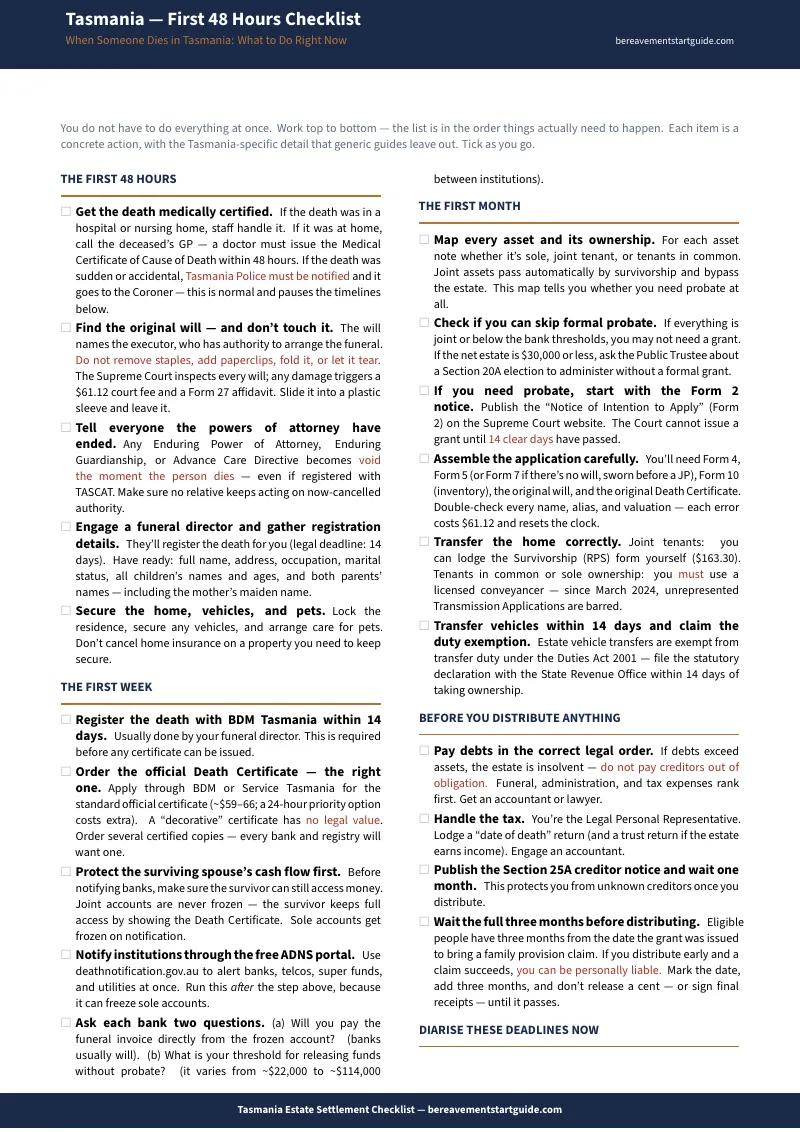
Your download includes the complete 10-chapter guide, the standalone Tasmania First 48 Hours Checklist, plus six printable reference tools: the Asset Matrix worksheet, Supreme Court Probate Procedure reference, Bank Fund Release Strategy, Real Property Transfer Guide, Three-Month Contest Window tracker, and Public Trustee Fee Breakdown with commission calculator. Eight PDFs total — instant download, no account required.
Money-back guarantee, no time limit. If the guide does not give you clarity on what to do next and confidence that you are doing it in the right order, email us for a full refund. No questions asked.
Not ready for the full guide? Download the free Tasmania First 48 Hours Checklist — covering death certificate ordering, securing the home, financial boundaries, and the critical actions that must happen in the first two days. It is enough to get through tonight and tomorrow.
You did not ask for this job. But you are the one doing it. The bank will not release the money. The Supreme Court will not explain the forms. The Land Titles Office will not warn you about the March 2024 rule change. This guide puts every Tasmania-specific step into one sequence so you can stop searching and start settling.