Someone Has Died in Tasmania. You Need to Deal with Seven Government Bodies, a Frozen Bank Account, and a Funeral Director Who Has Not Mentioned That Half Their Services Are Optional. You Have 48 Hours Before the First Deadline Hits.
You are standing in a hospital corridor, or sitting at a kitchen table, or answering a phone call that changes everything. Someone has died. Within hours, a funeral director is asking about embalming, a viewing room, and a premium casket. They have not mentioned that embalming is almost never legally required in Tasmania, that you can arrange the entire funeral yourself without their help, or that a body kept at 5°C is legally compliant without any chemical preservation at all. They will not mention these things. It is not in their interest.
Tasmania splits funeral authority across seven separate government bodies — the Registry of Births, Deaths and Marriages, the Magistrates Court Coronial Division, the Department of Premier and Cabinet, Consumer Building and Occupational Services, your local council, the Department of Health, and the Public Trustee. Each operates in its own silo. None of them tells you about the others. And the most dangerous gap is the one nobody explains: the "Senior Next of Kin" under the Coroners Act 1995 and the "Executor" named in the will are two different legal roles — and when they disagree, funerals stall, families fracture, and costs spiral.
Meanwhile, all coronial autopsies in Tasmania are centralised in Hobart. If your loved one died in Launceston, Devonport, or the Northwest Coast, the body must be transported south before the autopsy can proceed. The Coroner's office advises 2 to 4 days for release — but families who do not know this schedule funerals prematurely, publish obituaries too early, and face devastating last-minute cancellations.
The Tasmania Funeral Laws & Consumer Rights Guide is a Tasmanian Funeral Defence System — a single, chronological reference that maps every legal, financial, and administrative decision from the moment of death through to post-funeral paperwork. Not a generic Australian funeral guide. Not a funeral director's brochure dressed up as consumer advice. A structured, Tasmania-specific roadmap built around the actual laws — the Burial and Cremation Act 2019, the Coroners Act 1995, the Prepaid Funerals Act 2004 — that tells you exactly what is legally required, what is optional, who has the authority to decide, and where to go when something goes wrong.
What's Inside the Tasmanian Funeral Defence System
10 chapters plus standalone printable PDFs — covering funeral authority rights, consumer protections, permits, financial assistance, and post-funeral administration, built specifically for Tasmanian statutes and the state-specific rules that make arranging a funeral here different from anywhere else in Australia:
Who's Who in Tasmanian Funeral Law
The seven government bodies you may need to deal with, what each one controls, and the critical trap that catches nearly every family: confusing the Medical Certificate of Cause of Death (the 48-hour medical document needed to move the body) with the official BDM Death Certificate (the document banks and insurers actually require, which arrives weeks later). Take the wrong certificate to the bank and you will be turned away. This chapter plants the map before you start walking.
The First 48 Hours: What to Do and in What Order
Medical certification, coronial involvement, locating the Will, understanding why your Enduring Power of Attorney is now legally void, and the critical decision: funeral director or family-led funeral. This chapter gives you the exact sequence — because doing things out of order triggers coronial referrals, voids insurance coverage, and costs the estate thousands.
Legal Authority and Family Disputes
The two competing legal frameworks that determine who controls the funeral in Tasmania. When the Coroner is involved, only the Senior Next of Kin (determined by a strict statutory hierarchy — spouse, then adult child, then carer, then parent, then sibling) can object to an autopsy or receive the body. Once the Coroner releases the body (or if the Coroner was never involved), the executor named in the will controls arrangements. When these two roles are held by different people who disagree — and they regularly do — the chapter provides a resolution framework before anyone needs a solicitor.
When the Coroner Is Involved
Reportable death criteria, the Hobart autopsy centralisation problem (all autopsies conducted in Hobart regardless of where the death occurred), the 2-to-4-day typical release timeline, your right to object to an autopsy under the Coroners Act, and what a coronial death means for cremation permits. The chapter that prevents the most expensive mistake families make: scheduling a funeral before the body has been released.
Caring for the Body: Home Funerals, Transport, and Cremation
Tasmania allows family-led funerals — you can legally keep your loved one at home, care for the body with appropriate cooling (5°C or below), and transport the body yourself. The chapter covers the legal requirements for DIY transport, the independent Medical Referee cremation permit process (a different doctor from the one who certified the death), and the three-approval private-land burial process: written permission from the landowner, the council General Manager, and the Director of Public Health — plus the Environmental Health Officer's 1.5-metre soil test that determines whether your property qualifies.
Death Registration, Certificates, and Scam Prevention
The 7-day funeral director registration deadline, the 14-day informant deadline, BDM certificate fees ($65.96 standard, $101.23 same-day priority), and the explicit warning about third-party certificate websites that charge $160+ for a service available directly from the Tasmanian Registry — while exposing your personal data to identity theft.
Money: Paying for the Funeral and Accessing Frozen Accounts
How most banks release funds directly to a funeral director on receipt of an invoice and death certificate without probate. The informal estate threshold. Supreme Court probate filing fees on a sliding scale. And the Motor Accidents Insurance Board (MAIB) funeral expense coverage that applies when the death involved a motor vehicle — a pathway most families never discover.
Consumer Rights and Prepaid Plans
CBOS protections, the Prepaid Funerals Act 2004 requirements — independent custodian trust funds, the prohibition on post-signing price increases, the 14-day cancellation refund right — and how to file a complaint through the Magistrates Court or CBOS. The chapter that protects you from the most common tactic: being told a prepaid contract does not cover "current rates" when the law explicitly prohibits this.
Life-Planning Documents and Their Limits
Advance Care Directives, Enduring Guardianship, Enduring Power of Attorney — and why the most common mistake is assuming these documents control funeral arrangements. They do not. Health documents go to TASCAT. Financial documents go to the Land Titles Office. Neither gives anyone the authority to dictate what happens after death. This chapter prevents the cascade of errors that begins with a family member presenting the wrong document to the wrong body.
Edge Cases and When to Get Professional Help
What happens when you genuinely cannot afford a funeral (the Department of Health Essential Care Funeral Policy — a publicly funded direct committal for estates with no funds). Interstate and cross-border deaths across Bass Strait, including embalming requirements for air transport. Assets in another state. Missing or contested wills. And the clear markers for when this guide is not enough and you need a solicitor — because knowing where that line is protects you from paying legal fees when you do not need to, and from proceeding alone when you should not.
Standalone Printable PDFs
Print these and keep them on hand — each one works independently, without needing to open the full guide:
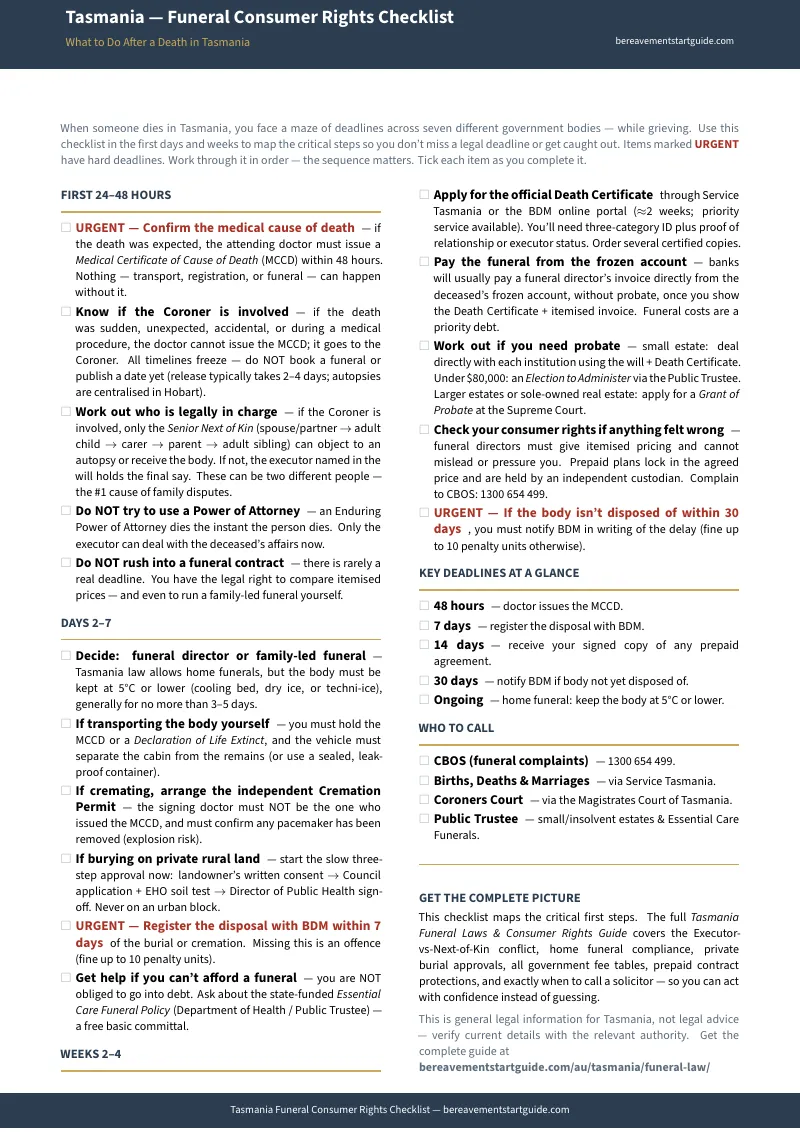
- Quick-Start Checklist — 15 critical actions for the first week, organised chronologically
- First 48 Hours Action Sequence — step-by-step from medical certification through choosing a funeral director
- Funeral Quote Comparison Worksheet — side-by-side comparison of up to three quotes, separating professional fees from disbursements
- Forms, Fees and Contacts Reference Table — every form number, fee amount, and agency contact in one printable page
Who This Guide Is For
- The overwhelmed executor who was named in a parent's Will and has 48 hours to choose a funeral director without knowing what services are legally required, what services are optional upsells, and whether a sibling or the deceased's new partner can override their decisions — this guide gives you the legal framework, the consumer checklist, and the exact regulatory protections that put you in control of the process
- The disputed next of kin — a spouse or de facto partner who needs to assert their legal standing as Senior Next of Kin during a coronial investigation, or who wants to prevent a cremation or burial they disagree with, while an estranged adult child or executor tries to take control
- The family on a tight budget who cannot afford the standard Tasmanian funeral cost but does not know that embalming is optional, that you can arrange a funeral without a funeral director, that the Essential Care Funeral Policy exists, or that the MAIB covers funeral expenses for motor vehicle deaths
- Rural families considering private burial on their own land who need to navigate the council, health, and landowner approval process and understand the permanent title encumbrance that makes a home burial effectively irreversible
- Anyone arranging a funeral in Tasmania who wants a single, independent reference instead of assembling fragments from seven government websites, funeral director brochures, and law firm blogs — each with their own agenda
Why Free Resources Leave You Exposed
- The Magistrates Court publishes coronial rights and the Senior Next of Kin hierarchy but does not explain how funeral authority works when the Coroner is not involved, how to pay for the funeral, or what to do when the executor and the next of kin disagree.
- Consumer, Building and Occupational Services explains prepaid funeral protections under the Prepaid Funerals Act 2004 but does not cover at-need funeral arrangements, burial permits, cremation processes, or coronial procedures. The prepaid information is buried inside a massive portal covering everything from gas safety to building compliance.
- The Registry of Births, Deaths and Marriages explains certificate pricing and eligibility but does not tell you which certificate is needed at which stage, how the death certificate interacts with probate, or what to do during the 2-week gap before it arrives.
- Funeral director websites explain their services in the language of care and compassion. They do not explain that you can legally arrange a funeral without their involvement, that embalming is almost never required, or that the Essential Care Funeral Policy exists for families who cannot pay — because each of these facts costs them a customer.
- The Hobart Community Legal Service covers executor duties and estate law but reads like a legal textbook. It does not address the granular logistics of the funeral itself — transport rules, embalming thresholds, cremation permits, or private burial approvals.
This guide bridges all of these sources into a single chronological reference — with every Tasmania-specific form, fee, deadline, consumer right, and escalation path in one document. Written for families, not lawyers. Written to protect you, not sell you something else.
The Guarantee
If the guide does not help you navigate your situation, email hello@bereavementstartguide.com and we will make it right.
Start With the Free Checklist
Download the Tasmania — Funeral Consumer Rights Checklist — a standalone PDF covering the 15 most critical actions for the first week after a death, including funeral authority questions, mandatory vs optional services, death registration deadlines, and financial assistance pathways. If the checklist is enough, keep it. If you need the full legal framework, consumer defence strategies, and reference tables, the complete guide is .