The Bank Won't Release the Money. The Court Wants Judge-Approved Forms Filed Perfectly. One Formatting Error Costs $61.12 and Adds Weeks. And Nobody Will Tell You What the Registrar Actually Checks.
Someone has died in Tasmania, and you've been named executor. You called the bank. They froze the sole account and asked for a "Grant of Probate" — a document you cannot produce because you have no idea how to apply for one. You downloaded the free Information Kit from the Supreme Court of Tasmania. Inside you found Form 4, Form 5, Form 10, and a warning that the court cannot give you legal advice. The forms are in legal terminology. The instructions assume you already know what the Registrar expects. And nobody mentioned that if you file a single error — an unexplained alias, an unbalanced inventory, a staple mark on the original will — the court issues a formal requisition: $61.12, a supplementary affidavit, and your application moves to the back of a 10-to-12-week processing queue.
You went looking for help online. Law firm blogs in Hobart explain executor personal liability and the three-month contest window — then end with a booking link for a $350-per-hour consultation. The Public Trustee markets itself as the easy option, but its fee schedule is buried in the fine print: 4.5% commission on the first $200,000 of gross estate value, plus 6.6% on estate income. On a $400,000 estate, that is over $12,000 before they start billing for outsourced legal work. Legal Aid's handbook defines the terms but stops well short of telling you how to fill in the forms correctly. National lead-generation sites explain just enough to make you panic, then funnel you toward their paid legal team.
Here is the gap: the Supreme Court gives you blank forms but no instructions. Law firms give you just enough anxiety to book a consultation. The Public Trustee offers convenience at a devastating commission. And free resources scatter fragments across half a dozen websites without putting them in order.
The Tasmania Probate Process Guide is the Requisition-Proof Filing System — a 17-chapter, line-by-line manual built on the Administration and Probate Act 1935, the Probate Rules 2017, and the Intestacy Act 2010 that bridges the gap between what the Supreme Court tells you to file and how to actually file it without triggering a rejection. Not a generic Australian probate overview. Not a mainland guide with "Tasmania" in the title. A guide built for the specific court, the specific forms, and the specific penalties that apply only in this jurisdiction.
What's Inside the Requisition-Proof Filing System
A 17-chapter guide plus a standalone Quick-Start Checklist — covering every stage from the decision of whether you need probate at all, through the Supreme Court filing sequence, to final distribution and property transfer:
The Probate Decision Tree
Before you spend a dollar on court fees or a lawyer, work through the decision tree that determines whether the estate actually needs a formal grant. Many Tasmanian estates are settled with no Supreme Court involvement at all — if all significant assets were held jointly, if sole-account balances fall below bank thresholds, or if the estate qualifies for the Public Trustee's Section 20A election to administer. This chapter maps every scenario so you do not apply for a grant you do not need.
The First 14 Days: Securing the Estate
Locking down the property, notifying insurers before vacancy voids the policy, locating the original will without damaging it (a single staple removal triggers a Form 27 Affidavit of Plight Condition and Finding and a $61.12 fee), and ordering the right number of death certificates through BDM Tasmania. Plus the critical fact most families learn too late: every Enduring Power of Attorney and Enduring Guardianship dies the moment the person dies.
Small-Estate Routes and Bank Thresholds
The exact threshold for every major institution operating in Tasmania — from around $22,934 at credit unions to $114,674 at Westpac. How indemnity forms work, what to bring to the branch, the two questions to ask every bank, and the tactic of requesting funeral invoice payment directly from the frozen account before probate is even considered. Plus the Public Trustee's small-estate election for estates under $30,000 — and the commission fees that come with it.
Asset Discovery and the Form 10 Inventory
Line-by-line guidance on completing the Inventory of Assets and Liabilities to the Registrar's standard. How to value real estate, vehicles, shares, superannuation, and household contents. The critical distinction between Tasmanian assets and interstate or overseas assets — because the court filing fee is calculated only on the Tasmanian component, and misclassifying assets inflates your fee or triggers a requisition for an unbalanced inventory.
Real Estate: Joint Tenancy vs Tenants in Common
The critical property transfer distinction that determines everything about your next step. Joint tenancy triggers the right of survivorship — the survivor lodges an Application by Survivorship with the Land Titles Office, no probate needed, and unrepresented individuals can lodge this form themselves. But sole ownership or tenants in common requires a Transmission Application, which needs a Grant of Probate and — since the March 2024 conveyancing reforms — must be lodged by a licensed conveyancer. There is no DIY path for Transmission Applications. The guide explains how to determine which applies, how to order a title search ($39.20) to confirm it, and the current LTO lodgement fees.
The 14-Day Notice Embargo
Before you can lodge your probate application, you must publish a Form 2 Notice of Intention to Apply on the Supreme Court of Tasmania website and wait 14 clear days. The chapter covers the exact wording, the publication process, and how to count the days correctly — because miscounting resets the clock and delays your filing.
Drafting and Lodging the Application — Line by Line
Forms 4, 5, 7, and 10 explained field by field, with the formatting requirements that prevent requisitions. Where to swear the affidavit, how to attach the original will, what the Registrar scrutinises, and the document assembly sequence that ensures nothing is missing when you lodge the hard-copy application with the Probate Registry in Hobart.
Requisitions: What Triggers Them and How to Avoid Them
The specific errors that cause the Registrar to halt your application: alias inconsistencies between the will and the death certificate, mathematical errors in the Form 10 totals, staple holes or rust marks on the original will, affidavits that do not match the required format. Each requisition costs $61.12 and delays the grant by weeks. The guide includes a pre-filing quality assurance checklist designed to catch every common trigger before lodgement.
After the Grant: The Three-Month Contest Window
Tasmania has the shortest family provision contest window in Australia — three months from the date the grant is issued, not the six or twelve months allowed elsewhere. If you distribute assets before that window closes and a successful claim lands, you can be held personally liable. The chapter maps the executor's duty sequence: estate account setup, creditor notifications under Section 54, ATO date-of-death return, debt priority under the Administration and Probate Act, and the exact distribution steps that protect you from personal liability.
Intestacy: When There Is No Will
The Intestacy Act 2010 distribution hierarchy in plain English. 100% to the surviving spouse when all children are shared. The CPI-adjusted statutory legacy (base $350,000) when children from a prior relationship exist. The full hierarchy when there is no spouse. How to apply for Letters of Administration using Form 7, and the security bond requirements that apply to administrators but not executors.
Plus: Fee Tables, Deadline Trackers, and a Contacts Directory
Every Supreme Court fee, every LTO fee, and every administration cost in one reference table. Every statutory deadline mapped to consequences. Direct contact details for the Probate Registry, Land Titles Office, BDM Tasmania, the Public Trustee, Legal Aid Tasmania, and every major bank's deceased estates team.
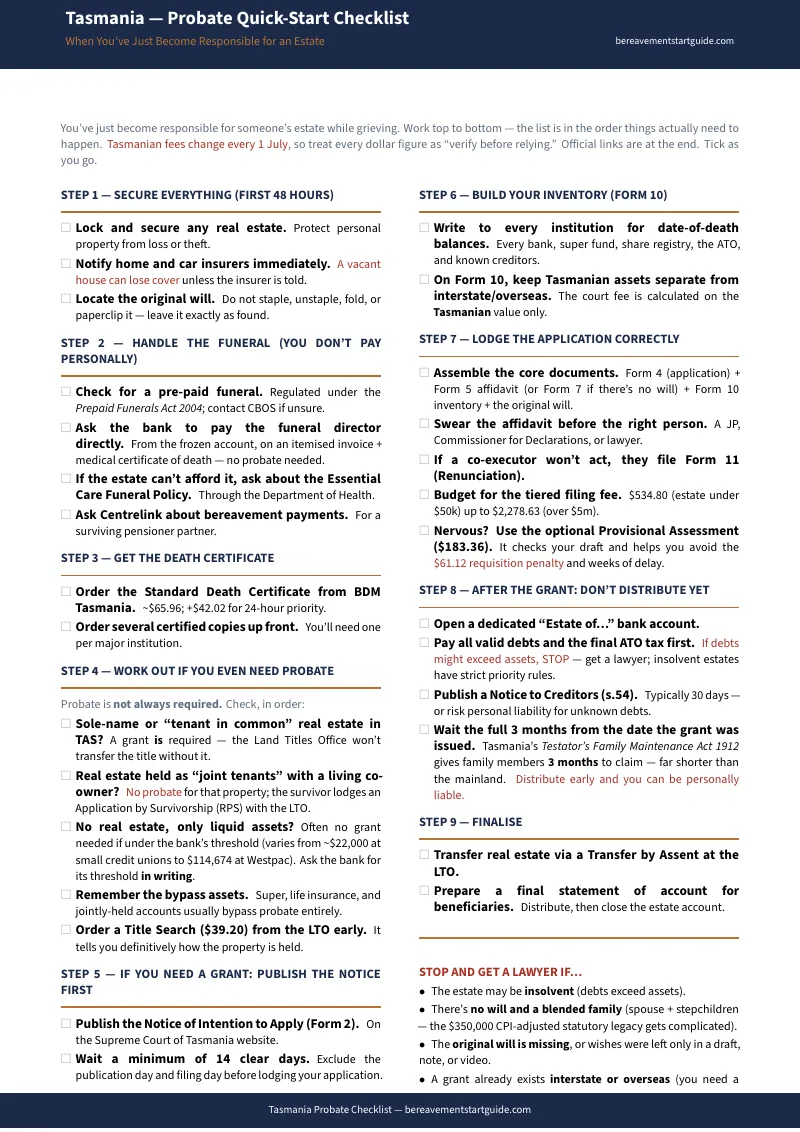
And the Quick-Start Checklist — a standalone, printable emergency reference covering the critical first actions in the right order, designed to prevent the expensive mistakes that happen in the first 48 hours.
Who This Guide Is For
- The named executor who downloaded the Supreme Court forms and immediately needed a translation. You opened Form 5 and hit a wall of legal terminology. The court says it cannot give you advice. Your options are a $2,000–$5,000 solicitor retainer or figuring it out yourself from scattered free resources. This guide gives you the line-by-line instructions for every form, the pre-filing checklist that catches the errors causing requisitions, and the decision frameworks that tell you whether you actually need a solicitor or whether you are paying thousands for administrative work you can do yourself.
- The surviving spouse who needs the bank accounts unfrozen. The joint account works fine but the sole account is locked. The funeral director needs payment. The guide maps out the exact bank thresholds, indemnity form process, and the tactic that gets the funeral paid directly from the frozen account before probate is even filed.
- The family facing intestacy with no will. Nobody has legal authority. Bills are piling up. The Public Trustee is offering to step in but the fee schedule would consume thousands from a modest estate. The guide explains the Letters of Administration process, the Intestacy Act distribution hierarchy, and the decision framework for whether the Public Trustee's involvement is avoidable.
- The interstate executor managing a Tasmanian estate from the mainland. You live in Melbourne or Sydney and the Probate Registry is in Hobart. The guide explains which steps can be done remotely, how postal lodgement works, and the conveyancing requirement that changed in March 2024.
- The budget-conscious family trying to avoid $2,000–$10,000 in legal fees. The solicitor's quote consumes a disproportionate share of a modest estate. This guide gives you the exact filing sequence, form instructions, and pre-filing quality checks that make self-represented probate viable — and flags the situations where professional help is genuinely necessary.
Why Free Resources Will Not Get You Through This
- The Supreme Court website gives you blank forms but no instructions. The Information Kit provides Form 2, Form 4, Form 5, Form 10, and a procedural outline that explicitly states it is not legal advice. It does not tell you how to fill in Form 10 correctly, what causes the Registrar to issue a requisition, or how the probate process connects to the Land Titles Office and the banks. The forms tell you what to submit. They do not tell you how to avoid having them rejected.
- Law firm blogs create anxiety to generate consultation bookings. Tasmanian firms publish accurate content about executor liability and the three-month contest window. Every article is designed to convince you the process is too dangerous to attempt alone. The tactical steps — the line-by-line form instructions, the pre-filing checklist — remain proprietary, because selling you the consultation is the point.
- The Public Trustee's "free will service" comes with commission fees that can devastate a modest estate. 4.5% on the first $200,000 of gross estate value, plus 6.6% on estate income. On a $200,000 estate, that is over $9,000 in commissions. The marketing emphasises convenience. The total cost is buried in the fee schedule.
- National lead-generation platforms explain just enough to make you enquire. Sites like Willed and Go To Court Lawyers dominate search results with polished Tasmania-specific overview pages. They provide surface-level information — then funnel you toward their paid legal services rather than empowering you to complete the process yourself.
- Bank threshold information is scattered and contradictory. One source says $50,000 without probate. Another says $22,934. A third says it depends on internal risk assessment. They are all correct — for different banks. No free resource compiles the current thresholds across every major institution operating in Tasmania into one reference.
Free resources give you fragments across a dozen government websites and law firm blogs designed to sell consultations. The Requisition-Proof Filing System puts the complete Tasmanian probate sequence into one guide — from the decision tree that tells you whether you need a grant at all, through the line-by-line form instructions, to the three-month contest window and final distribution — in the order you actually need it.
— Less Than Fifteen Minutes With a Hobart Probate Solicitor
A single consultation with a Tasmanian probate solicitor costs $300 to $500 per hour. Full probate application services run $2,000 to $5,000. The Public Trustee charges 4.5% on the first $200,000 of gross estate value — over $9,000 on a $200,000 estate before income commissions are calculated. This guide costs less than fifteen minutes of professional legal time and gives you the complete Tasmania-specific filing system — every Supreme Court form explained line by line, every bank threshold mapped, every LTO property transfer pathway documented, and the pre-filing quality assurance checklist that catches the errors triggering $61.12 requisitions before you lodge.
Your download includes the complete 17-chapter guide, the standalone Tasmania Probate Quick-Start Checklist, and six printable standalone worksheets: the Probate Decision Tree, the Pre-Lodgement Requisition-Avoidance Checklist, the Asset & Liability Tracker (feeds directly into your Form 10), the Beneficiary Communication Script, the Bank Threshold Decision Matrix, and the Fee Reference Card — 8 PDFs total.
Money-back guarantee, no time limit. If the guide does not give you clarity on what to do next and confidence that you can file correctly, email us for a full refund. No questions asked.
Not ready for the full guide? Download the free Tasmania Probate Quick-Start Checklist — covering the immediate actions, the decision tree, and the critical deadlines that carry real penalties. It is enough to get through tonight and tomorrow.
You did not ask for this job. The court will not explain its own forms. The bank will not tell you the threshold until you ask in the right way. And every week you spend searching for answers is a week the beneficiaries are waiting. This guide puts every Tasmania-specific step into one sequence so you can stop searching and start filing.