Someone You Love Just Died in Victoria. The Funeral Director Handed You a Bundled Quote for $12,000 That You Cannot Decode. The 2025 Cremation Forms Changed Six Months Ago and Nobody Told You. And the Family Is About to Tear Itself Apart Over Whether Mum Gets Buried or Cremated Because Nobody Knows Who Actually Has the Legal Right to Decide.
You are standing in a funeral director's office, or sitting at a kitchen table with a laptop open, trying to make decisions you never expected to make under a deadline you did not choose. Maybe you are the executor named in the will, and the funeral director is quoting you $12,000 for a package that includes fees you have never heard of and services you are not sure you need. Maybe there was no will, and you are the surviving spouse who assumed you had the right to arrange everything — but your partner's adult children from a first marriage are insisting on a different plan and threatening to call a solicitor. Maybe you just want to bring Mum home for a vigil before the cremation, and the funeral home is telling you that is not possible — even though it is.
Victoria's funeral laws are dense, recently overhauled, and scattered across agencies that do not talk to each other. The Funerals Act 2006 governs pricing and consumer rights, but the new Funerals Regulations 2025 rewrote the transparency rules from August 2025. The Cemeteries and Crematoria Regulations 2025 replaced every prescribed form with new versions — Forms 1 through 11 — with new checkboxes for container types, shroud burials, and foetal remains that most free resources online have not caught up to. The common law says an executor controls the body, but the Cemeteries and Crematoria Act 2003 uses a different hierarchy of "nearest surviving relative" in specific situations, and families routinely confuse the two until a Supreme Court injunction costs them $15,000 in legal fees. The BDM Victoria death registration portal has a strict 30-minute timeout that destroys your progress if you do not have the deceased's full relationship history and occupation classification ready before you log in. And if the estate is insolvent and you sign the funeral contract in your own name, you are personally liable for the full cost — even if the deceased left nothing.
The Victoria Funeral Laws & Consumer Rights Guide is a Consumer Protection Roadmap for every legal, financial, and administrative step between the moment of death and the resolution of disputes. Not a law textbook. Not generic Australian advice that does not know a Victorian cremation Form 5 from a Queensland one. A structured, Victoria-specific manual that translates the Funerals Act 2006 rights into scripts you can actually hand to a funeral director, walks the 2025 prescribed forms in plain English, and resolves who holds the legal right to decide — before the family argument escalates to court.
What's Inside the Consumer Protection Roadmap
A 12-chapter guide plus the Funeral Consumer Rights Checklist — covering every stage from the moment of death through dispute resolution, built specifically for Victorian statutes, the 2025 regulatory overhaul, and the state-specific rules that make arranging a funeral here different from anywhere else in Australia:
What Makes Victoria Different
Most funeral advice online is written for "Australia" as if the rules were the same everywhere. They are not. Victoria relies on common law — not a statutory list — to determine who controls the body. The principle from Williams v Williams is that nobody owns a dead body, which means funeral wishes in a will are not legally enforceable (though courts strongly encourage decision-makers to honour them). Funeral pricing is now strictly regulated under the Funerals Act 2006 with mandatory itemised price lists from August 2025. The body-disposal paperwork was completely overhauled in June and October 2025. And every pre-death power of attorney and Medical Treatment Decision Maker appointment ceased the moment of death. This chapter prevents the five most common and most expensive mistakes.
The First 48-72 Hours: Medical Certification and the Coroner
Everything downstream — releasing the body, the funeral, registering the death, probate — depends on one document being issued correctly first: the Medical Certificate of Cause of Death. This chapter covers when the treating doctor issues it, when the Coroners Court of Victoria takes custody of the body, and the practical consequence most families learn too late: do not book a firm funeral date until the Coroner has officially authorised release. Families who book early face lost deposits, distress, and the task of re-notifying mourners.
Who Is Legally in Charge? The Executor vs. Family Hierarchy
This is the chapter that prevents the most painful disputes. In Victoria, the executor named in the will holds the paramount right of disposal — confirmed by Supreme Court precedent in Keller v Keller. But the Cemeteries and Crematoria Act 2003 uses a separate "nearest surviving relative" hierarchy for exhumation licences and certain interment decisions. Families routinely confuse these two systems. This chapter includes a clear decision flowchart: will exists with named executor, will exists but no executor named, no will at all, and the exact hierarchy (spouse/partner, then adult children, then adoptive parents, biological parents, foster parents, extended family) so you know who holds authority before anyone picks up the phone.
Your Consumer Rights Under the Funerals Act 2006
From 1 August 2025, every Victorian funeral provider must publicly display itemised price lists and coffin/casket price ranges, both online and in their premises, and must clearly flag their cheapest package. The guide turns these rights into scripts: how to demand the itemised breakdown, how to decline embalming (which is not compulsory for standard local funerals in Victoria), how to separate the provider's fees from third-party disbursements (cemetery fees, BDM certificates, flowers), and how to enforce the "basic funeral service" requirement. Average funeral costs in Victoria can exceed $10,000 — these scripts are designed to save families thousands without damaging the relationship with the funeral director.
Cremation and Burial: The 2025 Forms Explained
The Cemeteries and Crematoria Regulations 2025 replaced every prescribed form. For cremation: Form 5 (Application for Cremation Authorisation) goes to the cemetery trust, Form 6 (Certificate of Registered Medical Practitioner) requires a second independent doctor and is waived if the Coroner investigated. For burial: Form 1 (Application for Interment of Bodily Remains) with new October 2025 checkboxes for coffin, casket, or shroud with or without backboard. For ashes: rules on collection, scattering on private property, and the rights of interment holders. For foetal remains: new dedicated Forms 4 and 8. The guide walks each form field by field in plain English.
Death Registration, BDM, and Financial Protections
The BDM Victoria portal has a strict 30-minute timeout. If you do not have the deceased's full history — marriage dates, divorce dates, occupation classification (not job title) — ready before you log in, you lose everything and start over. The guide includes an offline data-gathering template mapped to the exact BDM fields. It also covers: ordering the death certificate package ($93.30, including medical cause of death) rather than the standard certificate alone ($57.50, which will get your probate application rejected); prepaid funeral protections under the Funerals Act 2006; Centrelink and DVA Bereavement Payments; Bereavement Assistance for families who cannot afford a funeral; and the critical warning about signing funeral contracts when the estate is insolvent.
DIY Funerals, Home Vigils, and Green Burials
Engaging a funeral director is not legally required in Victoria. Families can transport a body in a private vehicle, hold a home vigil for 3-4 days with simple cooling, organise a shroud burial, and arrange a direct cremation without a traditional funeral service. The guide covers the Department of Health requirements for private transport, home cooling parameters, securing a private burial approval (Form 2), and interstate transport permits — because advocacy groups champion these options but lack the precise regulatory walkthroughs that prevent families from running afoul of public health laws.
Cultural, Religious, and Dispute Resolution
The final chapters cover religious and cultural requirements (expedited burials for Islamic and Jewish families, shroud provisions in the October 2025 regulations, Aboriginal cultural protocols), the two-tiered complaint system (Consumer Affairs Victoria for pricing and contract disputes, Department of Health for bodily disposal and cemetery issues), and the critical jurisdictional distinction most families miss: urgent funeral disputes and possession-of-body injunctions go to the Supreme Court of Victoria, not VCAT. Filing in the wrong venue wastes time and filing fees when every hour matters.
Who This Guide Is For
- The executor who just received a $12,000 bundled quote and has no idea whether those charges are legitimate — who needs the Funerals Act 2006 consumer rights scripts, the itemised pricing rules that took effect in August 2025, and the confidence to demand the basic funeral service without damaging the relationship with the funeral director
- The surviving spouse whose in-laws are insisting on cremation against their partner's wishes — who needs to understand that the executor holds the paramount right of disposal under Victorian common law, that funeral wishes in a will are not legally enforceable but courts strongly encourage compliance, and that the Supreme Court (not VCAT) is the venue for urgent injunctions
- The adult child arranging a funeral with no will and no savings — who needs to know about Bereavement Assistance, Centrelink Bereavement Payments, the destitute funeral pathway, and the critical rule that signing a funeral contract personally when the estate is insolvent makes them liable for the full cost
- The family who wants a home vigil and green burial but has been told by every funeral director that this is not possible — who needs the Department of Health rules for private transport, home cooling, shroud burial approvals (Form 2), and the legal confirmation that engaging a funeral director is not required in Victoria
- The end-of-life doula or palliative care worker helping clients prepare Advance Care Directives and Medical Treatment Decision Maker appointments — who needs a reliable, updated reference covering the 2025 regulatory changes, prepaid funeral protections, and the exact moment these pre-death instruments cease to have legal effect
Why Free Resources Will Not Get You Through This
The information exists. It is scattered across Consumer Affairs Victoria, the Department of Health, BDM Victoria, the Coroners Court, the Supreme Court, cemetery trusts, advocacy networks, and a dozen institutional portals that do not reference each other. Here is what you actually encounter when you try to arrange a funeral using free sources alone:
- Consumer Affairs Victoria tells you your rights but not how to exercise them. Their pages explain that funeral directors must provide itemised pricing under the Funerals Act 2006. They do not give you a script for what to say when the funeral director hands you a bundled quote and says "this is the standard package." They do not explain how to negotiate coffin costs, decline embalming, or enforce the basic funeral service requirement without creating an adversarial relationship.
- The Department of Health publishes the 2025 forms but does not translate them. Forms 1 through 11 are available as PDFs. The regulatory instrument text explains what each form is for. Neither resource tells a grieving family, in plain English, what each field requires, which forms apply to their specific situation, or what happens if a field is filled incorrectly.
- Law firm blogs highlight complexity to justify retainer fees. Parke Lawyers, Moores, and Curtis Parkinson publish excellent technical breakdowns of executor rights and funeral dispute precedents. All of their content is designed to convince you the situation is too dangerous to handle without a solicitor charging $350-$600 per hour. For contested estates, that may be true. For the majority of straightforward funerals, the answer costs a fraction of a solicitor's hourly rate.
- The Australian Funeral Directors Association discourages independence. AFDA guides are polished and accessible. They are also written by the industry. They heavily discourage DIY funerals, home vigils, and independent transport to protect member revenues. They will not tell you that engaging a funeral director is not legally required in Victoria.
- Advocacy groups champion DIY but lack regulatory precision. Tender Funerals, the Australian Home Funeral Alliance, and the Natural Death Advocacy Network do essential work demystifying death care. Their resources are often scattered, volunteer-maintained, and do not comprehensively cover the 2025 prescribed forms, consumer pricing rights, or dispute resolution pathways.
Free resources give you fragments from a dozen sources that do not reference each other. The Consumer Protection Roadmap puts every Victoria-specific statute, form, consumer right, and dispute pathway into one document, in the order you actually need them.
— Less Than Thirty Minutes With a Victorian Solicitor
A single consultation with a Victorian solicitor costs $350 to $600 per hour. A funeral dispute that reaches the Supreme Court starts at $5,000 in legal fees — and that assumes a straightforward application. Overpaying a funeral director by $3,000 because you did not know the Funerals Act 2006 entitles you to an itemised quote is money that never comes back. This guide costs less than thirty minutes of professional legal time and gives you the complete Victoria-specific roadmap — every consumer right, every 2025 form, every dispute pathway, and the decision flowchart that resolves who is legally in charge before the family argument escalates.
Your download includes the complete 12-chapter guide, the standalone Funeral Consumer Rights Checklist, and 8 printable standalone tools: the Executor vs Family Authority Flowchart, Funerals Act Negotiation Scripts, 2025 Forms Cheat Sheet, Quote Comparison Worksheet, BDM Pre-Login Data Sheet, DIY Funeral Compliance Kit, Financial Safety Net Map, and Dispute Jurisdiction Guide. Plus a money-back guarantee, no time limit. If the guide does not give you clarity on your rights and confidence that you are making legally sound decisions, email us for a full refund. No questions asked.
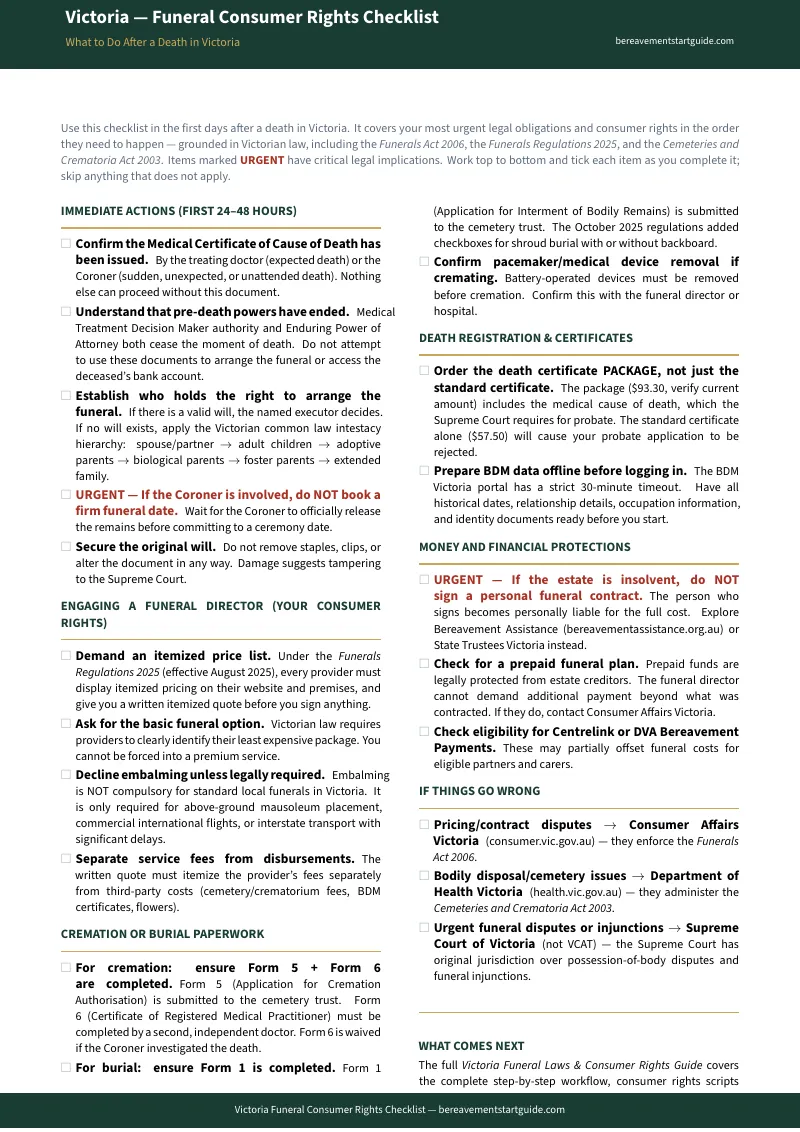
Not ready for the full guide? Download the free Victoria — Funeral Consumer Rights Checklist — 20 action items covering your most urgent consumer rights, the correct forms for cremation and burial, death registration tips to avoid the BDM portal timeout, financial protections for insolvent estates, and where to complain if things go wrong. It is enough to protect yourself in the first conversation with the funeral director.
You did not expect to be the one making these decisions. But you can make them well. The guide shows you how.