The Bank Froze the Account. RedCrest Rejected Your Upload. The Probate Office Sent Back a "Requisition" Because Someone Removed the Staples From the Will.
You thought the hard part was the funeral. Then you tried to pay the electricity bill from Mum's account and the bank said the account is frozen until you produce a Grant of Probate. You had never heard that phrase before Tuesday. You went to the Supreme Court website and found the RedCrest-Probate portal — a digital filing system that nobody warned you about — and spent an hour registering before discovering that you also need to physically mail the original will to Melbourne within 28 days of submitting online. You did not know that. You almost scanned the will and threw away the original.
Then a relative removed the staples from the will to make a photocopy. That was a mistake you will be paying for in weeks of delay, because the Supreme Court of Victoria treats staple holes as evidence that a codicil may have been attached and destroyed. When the Probate Office receives that will, they will halt your application and issue a formal requisition demanding a sworn Affidavit of Plight and Condition — a document you have never heard of, explaining under oath how the staple holes got there. Most executors discover this requirement after the damage is done. By then, the only option the internet offers is "call a lawyer," and the lawyer quotes $3,000 to $6,000 for full probate representation.
The Victoria Probate Process Guide is a RedCrest-Ready Roadmap for every filing, deadline, fee, and decision in a Victorian probate case — from the first 48 hours through final distribution and estate closing. Not a generic Australian overview. Not a blog post written by a law firm to convince you that self-representation is reckless. A plain-English, Victoria-specific manual that tells you exactly what the Supreme Court website does not: which screens to click, which documents to mail, which traps trigger requisitions, and which estates do not need probate at all.
What's Inside the RedCrest-Ready Roadmap
A 15-chapter step-by-step guide, a quick-start checklist, and an expense tracker worksheet — covering every phase of probate in Victoria from document preparation through final distribution, built on the Administration and Probate Act 1958, the Supreme Court (Administration and Probate) Rules 2023, and the current RedCrest-Probate eFiling requirements:
Before You File: Does the Estate Actually Need Probate?
This is the question that determines whether you spend months in court or weeks completing a simpler process. Victoria does not have a single probate threshold — the requirement depends on which institutions hold the deceased's assets and how much each one holds. The Commonwealth Bank generally requires probate for sole accounts above $50,000. Westpac's threshold is roughly $100,000. Suncorp triggers at $20,000. If the deceased's only significant asset is a jointly held property, you may not need probate at all — a Survivorship Application to Land Use Victoria transfers the title without touching the Supreme Court. The guide includes the bank-by-bank threshold matrix and a decision tree that maps every scenario, so you do not file a $1,028 probate application for an estate that could have been settled with a $44 survivorship lodgment.
Which Type of Grant Do You Need?
Victoria issues three distinct types of grant, and filing for the wrong one wastes months. Grant of Probate is for executors named in a valid will. Letters of Administration with Will Annexed is for estates where there is a will but the named executor cannot or will not act. Letters of Administration under intestacy rules is for estates with no will at all — and Victoria's intestacy distribution rules are rigid, formulaic, and frequently contradict what the family assumed. The guide explains the legal distinction, the different application requirements for each type, and the intestacy distribution formula so you know exactly who inherits what before you file.
The Staple Trap: Protecting the Original Will
This is the single most expensive mistake executors make in Victoria, and no government website warns you about it clearly enough. If anyone removes staples, paperclips, or bindings from the original will — even to scan it, even to make a photocopy for the bank — the Supreme Court will detect the holes and issue a requisition demanding an Affidavit of Plight and Condition. You will need to swear under oath how the marks got there, trace the document's chain of custody, and confirm that no codicil was destroyed. This delays the grant by weeks or months and frequently forces executors to hire a lawyer. The guide covers this in the first section — before you touch the will — with specific instructions on how to handle, store, and copy the original document without triggering a requisition.
The RedCrest-Probate Portal: Screen by Screen
Since July 2020, every Victorian probate application must be initiated through the RedCrest-Probate digital portal. The system enforces a rigid sequence: register, publish a Notice of Intention, wait 15 clear days, complete the Inventory of Assets and Liabilities, generate the document package, upload and pay, then physically mail the original will and Originating Motion to Melbourne within 28 days. Most executors assume the digital upload completes the process. It does not. The system auto-generates an Originating Motion that must be printed, signed, and posted to the Melbourne Probate Office alongside the original will and the original Certificates Identifying Exhibits. Miss the 28-day window and the application fails. The guide walks through every step, every screen, every document — including which ones are digital-only and which ones must be physically mailed.
Supreme Court Filing Fees
Victoria abandoned flat-fee probate in favour of steep, tiered pricing based on the gross value of Victorian assets. Estates under $250,000 pay nothing. Estates between $500,000 and $1,000,000 pay $1,028.80. Estates between $1,000,000 and $2,000,000 pay $2,400.50. Above $7,000,000, the fee reaches $16,803.60. The fees are calculated on gross value — mortgages, debts, and encumbrances are ignored. Many executors are shocked to discover they owe filing fees based on the full property value, not the equity. The guide includes the complete fee table with the July 2026 scheduled increases, explains how asset valuation determines your fee tier, and covers the practical problem of paying court fees out of pocket when the deceased's accounts are frozen.
Handling Court Requisitions
If the Probate Office finds a problem with your application, they do not reject it — they issue a requisition. This is a formal demand for additional documentation, and until you comply, your application is suspended. Common triggers include staple marks on the will, name discrepancies between the will and bank records (requiring an Affidavit of Identity), missing witness signatures, and incomplete asset inventories. The guide explains each common requisition type, what the Probate Office is looking for, and how to respond without hiring a lawyer.
Real Estate Transfers: Survivorship vs. Transmission
Property transfers in Victoria operate entirely outside the Supreme Court, through Land Use Victoria under the Transfer of Land Act 1958. If the deceased held property as a joint tenant, the surviving owner needs a Section 50 Survivorship Application — no probate required, no court involvement, just a death certificate and a lodgment fee. If the deceased was the sole owner, or held property as tenants in common, a Section 49 Transmission Application is required — and that mandates a Grant of Probate. The PEXA transaction fee for a survivorship is $44.44. The guide explains how to check your title, determine which application applies, and complete the transfer through PEXA or paper lodgment.
Contesting the Will: Family Provision Claims
Victoria's Part IV of the Administration and Probate Act allows eligible persons — including spouses, children, stepchildren, grandchildren, and registered caring partners — to contest the will if they believe they were not adequately provided for. Claims must be filed within six months of the grant being issued. As executor, you cannot safely distribute assets until this window closes. The guide explains who can claim, how the six-month window works, what happens to the estate during a challenge, and how to protect yourself from personal liability if a claim is filed after you have already distributed.
Tax, Insolvent Estates, Foreign Assets, and Final Distribution
The guide covers the executor's tax obligations (the deceased's final personal return, trust returns for income earned by the estate, and CGT events triggered by asset transfers), what to do when the estate owes more than it owns (the creditor priority order and the executor's duty to notify creditors before paying anyone), how to handle assets in other Australian states or overseas (resealing grants, ancillary probate), and the final distribution process — including record-keeping, executor reimbursement, and how to formally close the estate so your personal liability as executor ends.
Who This Guide Is For
- The executor who just found out the accounts are frozen — who needs to understand that a will is legally inert until the Supreme Court validates it, and that the process between "holding the will" and "having legal authority" involves a digital portal, a physical mailing, a mandatory waiting period, and tiered court fees that nobody mentioned at the funeral
- The surviving spouse whose only concern is keeping the family home — who may not need probate at all if the property is jointly held, and needs to know the exact difference between a $44 Survivorship Application and a $1,028+ probate filing before making the wrong choice
- The family managing a small estate under $133,090 — who needs to know whether they qualify for the Small Estates Optional Service at $314.40 total, what the strict eligibility criteria are, and what disqualifies them from using it
- The regional executor filing from outside Melbourne — who assumed the RedCrest portal meant everything was digital, and now needs to understand exactly which documents must be physically mailed to the Melbourne Probate Office and within what timeframe
- The adult child managing a parent's estate with siblings demanding updates — who needs an authoritative timeline to communicate to the family: how long the Notice of Intention takes, how long the court processes the application, what delays look like, and when distribution can legally begin
- The family trying to avoid State Trustees' 5.5% commission — who has been told the process is too complex for a layperson, and needs proof that self-representation through RedCrest is legally permitted and practically achievable with the right instructions
Why Free Resources Will Not Get You Through This
Victorian probate information exists. It is scattered across the Supreme Court website, Land Use Victoria, the Births Deaths and Marriages registry, four major bank estate departments, State Trustees marketing pages, and dozens of law firm blogs. Here is what you actually encounter when you try to navigate probate using free sources:
- The Supreme Court website is authoritative, fragmented, and deliberately unhelpful. The fee schedules are there. The RedCrest portal is there. The Small Estates thresholds are there. But they are spread across dozens of disconnected sub-pages and downloadable PDFs, with no linear sequence telling you what to do first, what to do second, and what happens after you press "submit." The Court explicitly states it cannot provide legal advice — which in practice means it will not tell you how to use the system it requires you to use.
- Law firm blogs are accurate, detailed, and designed to sell you representation. Gathered Here, Bare Law, Armstrong Legal, and Safewill all publish guides that correctly identify the RedCrest portal, the Notice of Intention, and the tiered fee structure. Every one of them stops short of the execution details. They explain the staple trap vividly — then end with "contact our office." They explain the Originating Motion — then end with "our team can lodge this for you." The goal is to make the process look dangerous enough that you pay $2,000 to $6,000 for representation.
- State Trustees offer comprehensive administration — at 5.5% of the estate's gross value. For an estate worth $800,000, that is $44,000 in commissions. Their free guides are designed to obscure how straightforward the process is for a self-represented executor with clear instructions. Every page funnels you toward appointing State Trustees as your administrator.
- Bank estate departments are excellent — for their own accounts only. The CBA will tell you exactly what they need. They will not tell you how that interacts with Land Use Victoria, the Supreme Court fee calculation, or the superannuation trustee's binding nomination requirements. You get four separate checklists from four separate institutions, and nothing that connects them.
Free resources give you fragments from a dozen sources that do not reference each other, do not sequence the steps, and do not warn you about the traps that cause requisitions. The RedCrest-Ready Roadmap puts every Victorian statute, portal step, fee schedule, and bank threshold into one document, in the order you actually need them.
— Less Than Thirty Minutes With a Melbourne Probate Solicitor
A consultation with a Victorian probate solicitor runs $300 to $500 per hour. Full probate representation costs $2,000 to $6,000 for a standard estate. State Trustees charge a 5.5% capital commission on the first $500,000 of gross assets. This guide costs less than thirty minutes of professional legal time and gives you the complete Victoria-specific probate roadmap — every RedCrest screen, every filing requirement, every fee tier, the bank threshold matrix, and the property transfer instructions that tell you whether you need the Supreme Court at all.
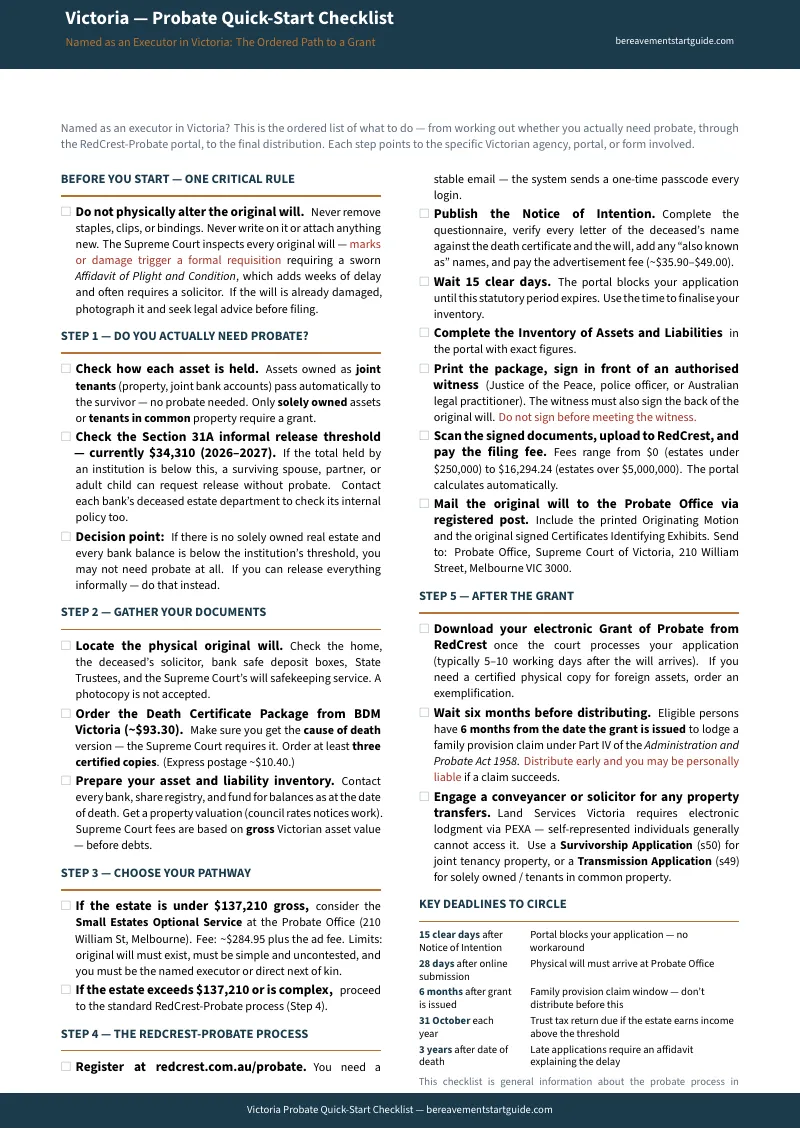
Your download includes the complete 15-chapter step-by-step guide, the standalone Victoria Probate Quick-Start Checklist with 20 action items across five stages, and a printable Expense Tracker Worksheet for monitoring every cost from filing fees to property transfer lodgments. Instant download, no account required.
Money-back guarantee, no time limit. If the guide does not give you clarity on what to file, when to file it, and what happens after you press "submit" on RedCrest — email us for a full refund. No questions asked.
Not ready for the full guide? Download the free Victoria Probate Quick-Start Checklist — an overview of the probate process, the key deadlines, the critical document warnings, and the decision tree for determining whether you need probate at all. Enough to understand what you are facing and whether you need the full guide.
Probate is not something you were trained for. But it is something you can get through with the right instructions — and without handing 5.5% of the estate to someone who will follow the same steps this guide teaches you.