Your Partner Just Died in Victoria. Centrelink Is Asking About "Bereavement Allowance" — Which Was Abolished in 2020. The Super Fund Says Your Adult Child Will Pay 32% Tax on the Death Benefit. The State Revenue Office Has a 3-Year Land Tax Deadline Nobody Told You About. And the TAC Claim Form Has a Strict Notification Window That Is Already Counting Down.
You are in the worst week of your life, and Victoria's survivor benefit system is split across six agencies that do not talk to each other. Services Australia controls the bereavement lump sum and the pension transition. The Transport Accident Commission handles road accident compensation. WorkSafe Victoria handles workplace deaths. The Department of Veterans' Affairs manages veteran funeral grants and War Widow(er)'s Pensions. The State Revenue Office enforces land tax deadlines on deceased estates. And your superannuation fund's trustee decides whether to pay the death benefit to a tax-free dependent or a 32%-taxed adult child — based on a Binding Death Benefit Nomination that may or may not still be valid.
Each agency has its own forms, its own eligibility rules, and its own deadlines. None of them tells you about the others. Centrelink does not mention the SRO's 3-year land tax concessionary window. The TAC does not explain that you can also claim the Centrelink bereavement lump sum at the same time. The super fund does not tell you that paying the death benefit to your adult child instead of your spouse triggers a tax bill that can exceed $150,000 on a large balance. And the most searched term on the internet for Victorian widows — "bereavement allowance Centrelink" — leads to pages about a payment that no longer exists, because it was folded into the JobSeeker system in March 2020 and nobody updated the public awareness.
The Victoria Survivor Benefits Navigator is a Benefits Recovery System that maps every federal and state entitlement into a single chronological pathway — from the first phone call to Centrelink through to the final ATO tax clearance. Not a generic Australian overview. Not a single-agency pamphlet. A Victoria-specific manual that covers Centrelink bereavement payments, TAC dependency lump sums (up to $229,980), WorkSafe death benefits (up to $759,510), DVA funeral grants, superannuation death benefit tax strategies, property transfers via Land Use Victoria, the SRO's punitive land tax rules for deceased estates, and the Supreme Court probate process — all in one document, in the order you actually need them.
What's Inside the Benefits Recovery System
A 16-chapter guide with an appendix and the Survivor Benefits Quick Start Checklist — covering every government payment, compensation claim, property transfer, and tax obligation that follows a death in Victoria:
Emergency Triage: The First 48 Hours
When someone dies in Victoria, the clock starts on multiple deadlines simultaneously. This chapter covers ordering the right type of death certificate from BDM Victoria (standard certificates will not work for TAC, WorkSafe, or insurance claims — you need the "cause of death" version at $57.50 each), accessing frozen bank accounts through each bank's informal release process (thresholds range from $15,000 at credit unions to $152,899 at major banks), and emergency funeral funding through Bereavement Assistance Limited — a government-subsidised not-for-profit offering funerals from $990 for families in financial hardship.
Centrelink: The Bereavement Payment Nobody Explains Properly
If both partners were receiving Centrelink income support for at least 12 months, the surviving partner is entitled to a 14-week lump sum bereavement payment — calculated as the difference between the couple rate and the single rate, paid in one sum. But Centrelink's own website still references the "Bereavement Allowance" in search results, a payment that was abolished and merged into JobSeeker in March 2020. The guide explains the current system: who qualifies for the lump sum, how the 14-week continuation works, the 28-day notification deadline, the Pension Bonus Bereavement Payment (up to $55,411.60, strict 26-week deadline), and how to apply for a crisis payment if you have no income while waiting.
TAC and WorkSafe: Compensation for Accidental and Workplace Deaths
If the death resulted from a motor vehicle accident, the Transport Accident Commission provides dependency lump sums up to $229,980, funeral expenses up to $20,520, and ongoing weekly benefits — all no-fault, meaning you do not need to prove the deceased was not responsible. If the death was work-related, WorkSafe Victoria's dependency lump sum reaches $759,510, with additional grief payments of $10,000 per family member and funeral costs up to $15,230. The guide maps the claim process for each body, the evidence you need, and the strict notification windows.
The Superannuation Death Tax Trap
This is the chapter that saves families the most money. When someone dies, their superannuation death benefit can be paid tax-free to a "tax dependant" (spouse, minor child, financial dependant). But if it goes to an adult child who is not a tax dependant, the taxable component is hit with up to 32% tax — 15% plus the 2% Medicare levy, on the taxed element, and 32% on the untaxed element. On a $500,000 super balance with a significant taxable component, this can mean a six-figure tax bill. The guide explains how Binding Death Benefit Nominations work, when they expire (typically every 3 years unless non-lapsing), how to check whether one is valid, and the strategies for structuring benefit payments to minimise tax across multiple beneficiaries.
Property Transfer, Land Tax, and the SRO's 3-Year Deadline
If the deceased owned property as a joint tenant, the surviving owner can transfer the title via a Survivorship Application through PEXA — cost is $108 to $132 in statutory fees, no probate needed. If the property was in the deceased's sole name, the executor must obtain probate first and then lodge a Transmission Application. Both paths are covered step by step, including the Verification of Identity process at Australia Post. Critically, the guide explains the State Revenue Office's 3-year land tax concessionary period: after probate is granted, the executor must lodge form LTX-Trust-18 with the SRO within one month. If the estate administration is not completed within 3 years of the date of death, the property loses its exemption and gets hit with trust surcharge land tax rates.
Probate, Intestacy, State Trustees, Appeals, and More
The remaining chapters cover the Supreme Court of Victoria's tiered probate fee structure (estates under $250,000 have no filing fee — but once you cross the threshold, fees scale up to $16,803), intestacy rules under the Administration and Probate Act 1958, when and why State Trustees gets involved (and what their 5.5% capital commission actually costs on a typical estate), the appeals process for denied Centrelink, WorkSafe, and superannuation claims, farm and regional estate considerations including the Farm Household Allowance, a consolidated deadline reference, and key contacts for every agency.
Who This Guide Is For
- The surviving spouse whose partner's Centrelink payments just stopped and who needs to know exactly how to claim the 14-week bereavement lump sum, transition to the single pension rate, and transfer joint property without paying for probate
- The adult child named as executor who just learned that the deceased's $400,000 super balance could be taxed at 32% because the Binding Death Benefit Nomination expired two years ago — and who needs to understand the options before the trustee makes an irreversible decision
- The family of someone killed in a road accident who does not know that TAC dependency benefits are no-fault (you do not need to prove the deceased was not at fault) and that you can claim up to $229,980 in addition to Centrelink payments
- The family of someone killed at work who needs to navigate WorkSafe Victoria's dependency claim process while simultaneously managing the estate through the Supreme Court
- The financially distressed family who cannot afford funeral costs and needs immediate access to Bereavement Assistance, DVA grants, or emergency bank indemnity releases
- The executor in regional Victoria managing a farm estate who needs to understand Farm Household Allowance bereavement provisions, council pension rebates, and how to handle agricultural assets during estate administration
Why Free Resources Will Not Get You Through This
Every piece of information in this guide exists online for free. It is scattered across Services Australia, the TAC, WorkSafe Victoria, DVA, the SRO, the Supreme Court of Victoria, Land Use Victoria, the ATO, and a dozen institutional portals. Here is what you actually encounter when you try to navigate survivor benefits using free sources alone:
- Government sites operate in silos. Services Australia explains the bereavement lump sum but does not mention the SRO's land tax deadline. The TAC explains its compensation structure but does not tell you to simultaneously claim Centrelink benefits. The SRO publishes form LTX-Trust-18 in language written for tax accountants. Nobody connects the agencies into a sequence — so families claiming TAC compensation miss the Centrelink lump sum, families focused on probate miss the SRO's 1-month notification deadline, and families dealing with super ignore the property transfer entirely until it becomes urgent.
- Law firm blogs stop just short of giving you the answer. Pentana Stanton, KHQ Lawyers, and HLB Mann Judd publish excellent technical breakdowns of superannuation death tax and SRO land tax rules. Every article ends with "contact us for advice" and a retainer starting at $5,000. For complex estates, that is appropriate. For the majority of straightforward Victorian estates, the answer costs a fraction of one hour's professional fee.
- The most-searched term leads nowhere useful. Thousands of Victorians search "bereavement allowance Centrelink" every month. The Bereavement Allowance was abolished in March 2020 and folded into the JobSeeker payment system. Centrelink's own website generates confusion about what replaced it, how the 14-week lump sum works, and whether carers qualify for the continuation payment. Widows and widowers waste days calling the wrong Centrelink line and requesting a payment that no longer exists under that name.
- State Trustees obscures the alternatives. State Trustees Victoria presents itself as the default option for complex estates and intestacy cases. Its 5.5% capital commission on the first $500,000 — plus hourly rates up to $563 — means a modest estate can lose $27,000 or more in administration fees. The Victorian Ombudsman and Auditor-General have documented service complaints. Free government resources do not explain when you can avoid State Trustees entirely or how to renounce their appointment.
- Super funds explain the payment but not the tax. Your super fund's "death benefit" page explains how to make a claim. It does not explain that the exact same benefit, paid to a spouse, is tax-free — but paid to an adult child, triggers up to 32% tax on the taxable component. The difference between "super dependant" and "tax dependant" is a distinction that costs families tens of thousands of dollars, and it is buried in ATO rulings that most people will never find.
Free resources give you fragments from a dozen agencies that do not reference each other. The Benefits Recovery System puts every Victorian entitlement, every form, every deadline, and every tax trap into one document, in the order you actually need them.
— Less Than Fifteen Minutes With a Victorian Estate Solicitor
A single consultation with a Victorian estate solicitor costs $350 to $600 per hour. A superannuation tax strategy review starts at $1,500. This guide costs less than fifteen minutes of professional legal time and maps every benefit you are owed across six agencies — Centrelink, TAC, WorkSafe, DVA, the SRO, and the ATO — plus the Supreme Court probate process, property transfers, and the superannuation death tax strategies that save families tens of thousands.
Your download includes 10 printable PDFs: the complete 16-chapter guide with appendix, the standalone Quick Start Checklist (18 actions across 4 time periods), and 8 standalone worksheets and reference cards — the Bank Threshold Worksheet, Benefit Sequencing Plan, Executor Compliance Timeline, TAC & WorkSafe Claim Checklist, Probate Fee Reference, Property Transfer Concessions guide, Super Tax Trap Guide, and the Intestacy Calculator for blended families. Plus a money-back guarantee, no time limit. If the guide does not give you clarity on what to claim, when to claim it, and how to avoid the tax traps that cost Victorian families thousands of dollars every year, email us for a full refund. No questions asked.
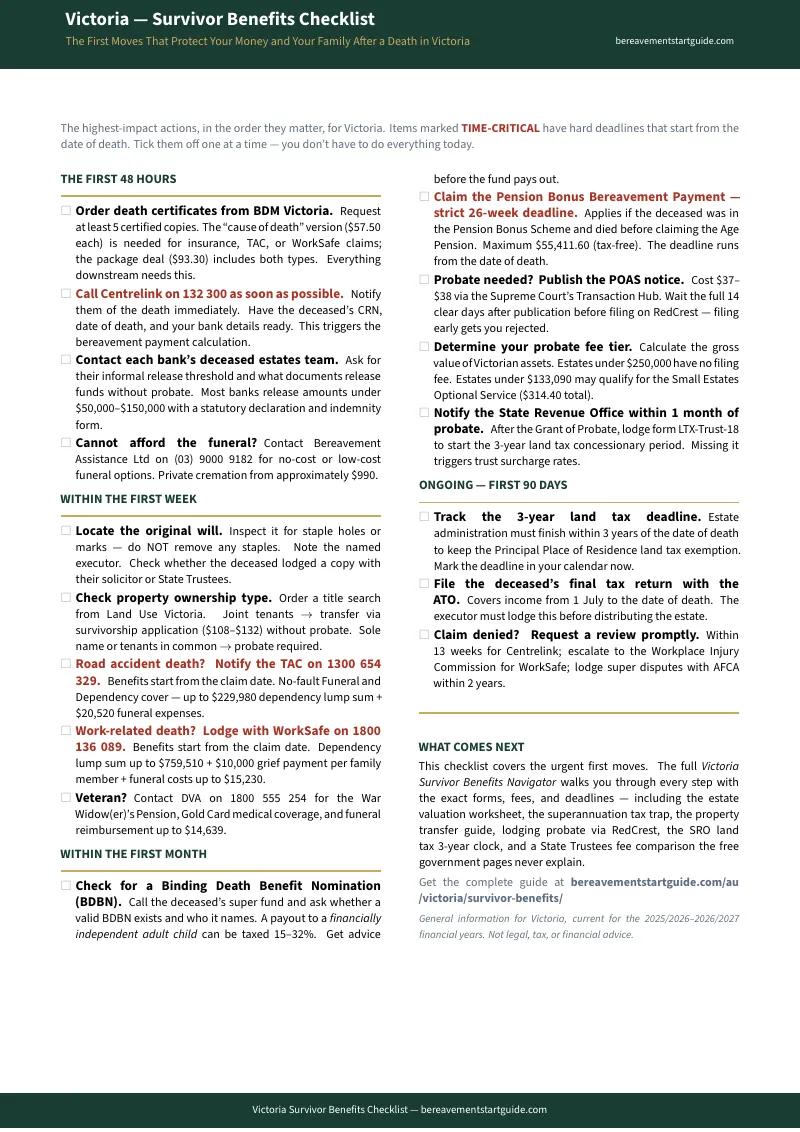
Not ready for the full guide? Download the free Victoria — Survivor Benefits Checklist — the most urgent actions covering everything that must happen in the first 48 hours and first week: death certificate types and costs, calling Centrelink, contacting banks, checking for TAC or WorkSafe eligibility, and locating the will. It is enough to get through tonight and tomorrow.
You are owed more than you think. The guide makes sure you claim every dollar.