
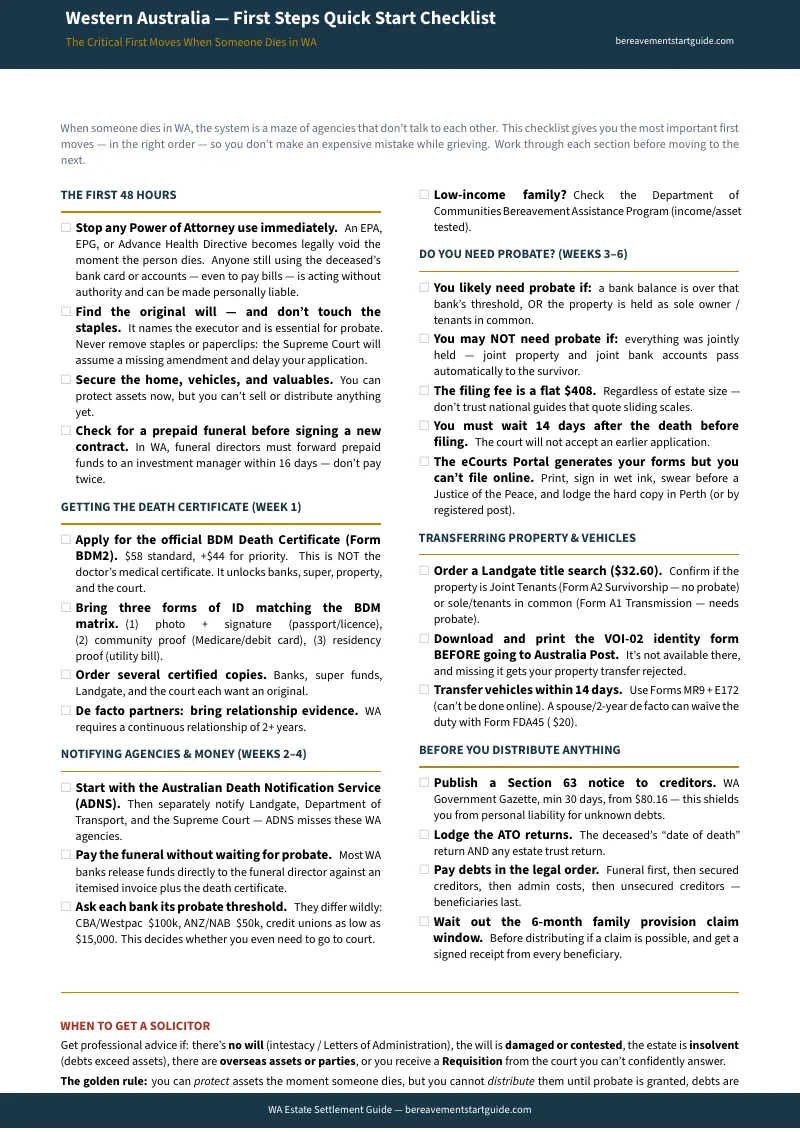
Someone You Love Just Died in Western Australia. The Bank Froze Their Accounts. The Supreme Court Will Reject Your Probate Application Over a Rusty Staple. And the One Identity Form You Need for the House Isn't Available at the Post Office Counter.
You are standing in a place nobody prepared you for. Maybe you were named executor in a will you barely glanced at years ago, and now the funeral director is asking about burial or cremation while you try to work out whether the medical "cause of death" certificate the hospital gave you is the same thing as the official Death Certificate from the Registry of Births, Deaths and Marriages. (It is not — and only the BDM one unlocks anything.) Maybe there was no will at all, and because you are the surviving spouse or the eldest child, everyone is looking at you — but under the Administration Act 1903 (WA), nobody actually has authority to do anything until the Supreme Court of WA grants it. Maybe the bank just told you the accounts are frozen and you cannot access a dollar to pay the power bill, the rates, or the funeral invoice.
You are grieving, exhausted, and sleep-deprived, but the paperwork does not wait. Every Enduring Power of Attorney the deceased signed became legally void the instant they died — so the well-meaning relative still using their bank card to "keep things ticking over" is now acting with no authority at all, and can be made personally liable. Services Australia needs notifying or the estate will owe back overpayments on the pension. The funeral director must check for a prepaid plan before you sign anything new — because in WA those funds are held by an independent investment manager and paying twice for an already-funded funeral is a common, avoidable loss. And somewhere in the back of your mind, a terrifying question keeps circling: if I distribute assets before the creditor notice period runs, or pay the wrong debts first in an insolvent estate, or accidentally trigger a court Requisition by removing a staple from the original will — am I personally on the hook?
The short answer: the estate pays its debts, not you — if you do things in the right order. The long answer is what separates families who settle in a few months from families who lose half a year to mistakes they never knew they were making. Western Australia is unusually cheap to enter — a flat $408 court filing fee no matter how large the estate, while New South Wales and South Australia charge thousands on a sliding scale — but unusually strict in execution. The registry will halt your whole application over a name that doesn't match between the will and the death certificate, or staple holes it presumes once held a missing codicil. Landgate will reject your property transfer because you didn't download the right verification-of-identity form before you walked into Australia Post. The eCourts Portal will generate your probate forms and then refuse to let you submit them online. None of this is on a single government page, because no WA agency tells you what the others need.
The When Someone Dies in Western Australia — Estate Settlement Guide is your Settlement Roadmap through every legal, financial, and administrative step between the funeral home and final distribution. Not a law textbook. Not a generic Australian checklist that doesn't know WA from Victoria. A structured, Western Australia–specific manual that separates what must happen in the first 48 hours from what legally cannot happen until the creditor notice period closes — so you stop guessing, stop panicking, and start working through this in the right order.
What's Inside the Settlement Roadmap
A 9-chapter guide, the standalone First 48 Hours Checklist, six standalone printable tools, and ready-to-use letter templates — built specifically for WA statutes, the Supreme Court of Western Australia, Landgate, the Department of Transport, and the state-specific traps that make settling an estate here different from anywhere else in Australia:
The First 48 Hours: Stop the Authority That Died With Them
The first two days are not about law — they're about three concrete things: stopping anyone from acting on powers that no longer exist, securing the property, and working out how the funeral gets paid. This chapter covers why every EPA, Enduring Power of Guardianship, and Advance Health Directive is void the moment of death, how to secure the home (you may preserve assets but cannot deal with them yet), and the prepaid-funeral check that stops you paying twice — including the rule that funeral directors must forward prepaid funds to an independent investment manager within 16 days.
The Death Certificate — and the ID Matrix That Bounces Applications
Almost nothing happens until you hold the certified BDM Death Certificate (Form BDM2, $58 standard, +$44 priority, usually about three business days). The single biggest reason applications get rejected is the strict identity matrix — you need three specific documents: one linking a photo and signature, one proving you operate in the community, and one establishing residency. The guide lays out the exact matrix, the proof-of-entitlement rules for executors and de facto partners, and why you order several certified originals up front instead of waiting weeks for extras.
Notifying Agencies and the Bank Threshold Decision
This chapter resolves the most urgent crisis. It covers the Australian Death Notification Service (ADNS) — and the three WA agencies it silently misses that matter most for the estate: Landgate, the Department of Transport, and the Supreme Court. Then the financial fork everything turns on: each bank sets its own probate threshold, and they differ wildly — CBA and Westpac around $100,000, ANZ and NAB around $50,000, and credit unions as low as $15,000–$22,900. The guide gives you the deceased-estates script to phone each one, and the mechanism every WA bank uses to pay the funeral director directly from the frozen account against an invoice — so you never put it on your own card.
The Probate Decision and the eCourts Portal Trap
This is the chapter that does not exist in any free resource. WA charges a flat $408 fee for a Grant of Probate or Letters of Administration, and you must wait 14 days after death before filing (but, unlike other states, no newspaper notice beforehand). The eCourts Portal "Probate Online Application" generates your three core documents — then comes the catch that surprises almost everyone: you cannot submit them electronically. You must print, sign in wet ink, swear the affidavit before a Justice of the Peace, and physically lodge the hard copies in Perth — or by registered post if you're regional or interstate. The guide covers the 60-day data-deletion warning, every escalation trigger, and exactly how to handle the dreaded Requisition that stretches DIY applications from 6 weeks to 16.
The Asset & Debt Inventory and the Priority Order That Shields You
Before you transfer or distribute anything, you need a complete date-of-death picture of what the estate owns and owes — and the decisive question for every asset is how it was owned. The guide covers the Landgate title search ($32.60) that can save you from applying for probate you never needed, how superannuation with a binding nomination bypasses the estate entirely, and the legal order debts must be paid in (funeral first, beneficiaries last) — the order that protects you from personal liability, plus the hard stop if the estate turns out to be insolvent.
Property Through Landgate — the VOI-02 Trap
Real property is where DIY estates most often come unstuck. Everything turns on tenancy type: Form A2 (Survivorship) for joint tenants — which bypasses the estate and needs no probate, a fact families miss while wasting $408 and months — versus Form A1 (Transmission) for sole owners and tenants in common, which needs the grant first. And the WA-specific snag that catches nearly everyone: the Verification of Identity form (VOI-02) is not available at Australia Post — you must download and print it yourself before you go, or the lodgement is rejected.
Vehicles, Tax, Creditors, and Safe Distribution
The remaining chapters cover vehicle transfers through the Department of Transport (Forms MR9 + E172, the 14-day deadline, and the spousal/de facto duty exemption via Form FDA45 that's worth real money), intestacy under the Administration Act 1903 with the statutory legacy figures updated 5 July 2025, the de facto two-year rule, the Public Trustee's Section 14 small-estate election, the Section 63 notice to creditors that shields you from unknown debts, the two separate tax returns (date-of-death individual vs estate trust), and the 6-month family provision window you must clear before distributing — with a beneficiary-update template for managing relatives who pressure you to pay out early.
Who This Guide Is For
- The surviving spouse whose partner just died and whose accounts were frozen this morning — who needs to know which jointly held assets pass automatically by survivorship, how to get the bank to pay the funeral director directly from the frozen account, and how to lodge Form A2 with Landgate to transfer the family home without going through probate at all
- The adult child named as executor who has never navigated the Supreme Court of WA and is terrified of a mistake that triggers personal liability — who needs the full eCourts Portal walkthrough, the wet-ink-before-a-JP lodgement reality, and a timeline that separates what is urgent from what must wait for the creditor notice period
- The financially constrained family who can't see how the funeral gets paid — who needs the direct bank-to-funeral-director mechanism, the prepaid-plan check, and the Department of Communities Bereavement Assistance Program eligibility rules
- The regional, remote, or interstate executor staring down 2.5 million square kilometres — who cannot walk into the Perth registry and needs the registered-post lodgement route, the local-JP witnessing rules, and the postal requirements Landgate enforces exactly
- The family with no will who just learned the Administration Act 1903 dictates everything — who needs to understand who has priority to apply for Letters of Administration, the updated statutory legacy thresholds, and why intestacy is materially harder than standard probate
Why Free Resources Will Not Get You Through This
The information exists. It is scattered across the Supreme Court of WA, the WA.gov.au BDM service, Landgate, the Department of Transport, the Public Trustee, the Australian Taxation Office, Services Australia, and a dozen bank portals that do not talk to each other. Here is what you actually hit trying to settle an estate from free sources alone:
- Government pages tell you what one counter wants — never what to get first. The eCourts Portal explains it generates a Motion, an Affidavit, and a Statement of Assets and Liabilities. It does not warn you that you can't submit them online, that the registry deletes your saved data after 60 days, or that a removed staple on the original will triggers a Requisition that adds a month. Each agency tells you its own piece; none of them sequences the whole job.
- Law firm blogs highlight complexity to justify retainers. WA estate firms publish genuinely good breakdowns of executor duties and liability risk — all of it designed to convince you the process is too dangerous to touch without engaging them at $2,500 to $5,000. For contested or insolvent estates, that's true, and this guide tells you exactly when to escalate. For the majority of straightforward estates, it isn't.
- Bank estate pages protect the bank, not you. Every institution publishes its own deceased-estate process focused on its own liability. They tell you why accounts are frozen. They do not tell you how to negotiate a direct funeral-invoice payment, or why their probate threshold sits at $100,000 while the credit union across the road demands a grant at $15,000.
- The Public Trustee markets simplicity but charges dearly. The Public Trustee WA offers accessible help — and then charges commission on a government-approved scale: up to 6.6% on income earned plus around 4.5% capital commission on the first $200,000 of estate value. Many older West Australians named it executor in exchange for a free will, and families are routinely shocked at the resulting fees. Anyone who wants to keep administration private and in the family's hands needs an alternative.
Free resources give you fragments from a dozen sources that never reference each other. The Settlement Roadmap puts every WA-specific statute, form, fee, and deadline into one document, in the order you actually need them.
— Less Than Ten Minutes With a Perth Estate Solicitor
A single consultation with a WA estate solicitor runs $300 to $600 an hour, and full probate representation typically starts at $2,500 and climbs past $5,000 once estate administration — closing accounts, transferring property, arranging tax returns — is billed on top. This guide costs less than ten minutes of that professional time, and gives you the complete Western Australia–specific roadmap: every statute, every form, every fee and deadline, the flat $408 court process the government websites assume you already understand, and the clearly flagged moments where engaging a professional is genuinely the right call.
Your download includes the complete 9-chapter guide, the standalone First 48 Hours Checklist, and six standalone printable tools: an Agency Notification Tracker, an Asset & Debt Inventory worksheet, a Probate Application Checklist, a Bank Deceased-Estates Script, a Beneficiary Update Template, and a one-page Fees, Forms & Deadlines quick-reference. Eight files total. Plus a money-back guarantee, no time limit: if the guide doesn't give you clarity on what to do next and confidence you're doing it in the right order, email us for a full refund. No questions asked.
Not ready for the full guide? Download the free Western Australia — First 48 Hours Checklist — the most urgent actions for the first two days after a death in WA: stopping power-of-attorney use, finding the will without damaging it, securing the property, checking for a prepaid funeral, and ordering the right death certificate. It's enough to get you through tonight and tomorrow.
You did not ask for this job. But you can do it. The guide shows you how, one step at a time.