Someone Just Died in Western Australia. Five Government Departments Are Waiting for You. None of Them Will Tell You What Order to Contact Them In. And a Law From 1929 Gives Your Estranged Relative the Power to Derail the Entire Funeral.
You are staring at a phone that just delivered the worst news of your life. Within hours, you need to decide who arranges the funeral, whether to bury or cremate, and how to pay for it when the bank accounts are frozen. The funeral director the hospital mentions is already asking about embalming, viewing rooms, and premium caskets. They have not mentioned that embalming is almost never legally required in Western Australia, that the casket is consumed during cremation, or that they are legally obligated to show you an itemised quote within two business days. They will not mention these things. It is not in their interest.
Western Australia's funeral process is governed by five separate laws — the Cemeteries Act 1986, the Cremation Act 1929, the Administration Act 1903, the Births, Deaths and Marriages Registration Act 1998, and the Fair Trading Act 2010 — administered by completely separate agencies that do not coordinate and assume you already know the sequence. The Department of Health handles medical certification. The Metropolitan Cemeteries Board handles burial plots, cremation chapels, and Single Funeral Permits. The Registry of Births, Deaths and Marriages handles death registration. The Supreme Court handles probate. Landgate handles property transfers. Consumer Protection enforces the Funeral Pricing Code. Not one of these agencies tells you when to contact the others, or warns you that doing things out of order can halt a funeral, void an insurance contract, or make you personally liable.
Meanwhile, Section 13(1) of the Cremation Act 1929 gives any next of kin the power to veto a cremation by submitting a written objection — regardless of what the executor or the deceased wanted. An estranged sibling, a separated spouse, or a parent who hasn't spoken to the deceased in years can legally force a burial instead, at a cost the estate may not be able to absorb. Most families discover this law only after the conflict has erupted.
The Western Australia Funeral Laws & Consumer Rights Guide is a Consumer Defence Manual — a single, chronological reference that puts all five government departments, all the permits, all the deadlines, and all your consumer rights into the order they actually happen. Not a generic Australian funeral guide. Not a funeral director's brochure. A structured, WA-specific project manager for every legal, financial, and administrative decision between the moment of death and the final estate paperwork.
What's Inside the Consumer Defence Manual
17 chapters covering funeral authority rights, consumer protections, permits, financial assistance, and post-funeral estate administration — built specifically for Western Australian statutes and the state-specific rules that make arranging a funeral here different from anywhere else in Australia:
Legal Authority and Family Disputes
Under WA common law, the executor named in the Will has the absolute right to arrange the funeral — superseding the spouse, the children, and every other family member. But the Cremation Act 1929 complicates this. Section 13(1) gives any next of kin the power to veto cremation via written objection. The Supreme Court (as in Suarez v Brunsdon) generally favours a dignified and timely funeral over prolonging disputes — but only if the executor acts quickly. This chapter maps the complete hierarchy of authority, including what happens when there is no Will, when the executor is unavailable, when siblings disagree, and when the only resolution is an urgent Supreme Court application.
The First 48 Hours: What to Do and in What Order
Medical certification, coronial involvement, locating the Will, checking for prepaid funeral contracts, and understanding why your Enduring Power of Attorney is no longer valid the moment the person dies. This chapter gives you the exact sequence — because contacting departments out of order can trigger unnecessary coronial referrals, void insurance contracts, and cost the estate thousands.
Consumer Rights Under the Funeral Pricing Code
What funeral directors must disclose by law and what they routinely fail to mention. The chapter covers the itemised price list requirement, the two-business-day written quote rule, the mandatory "basic package" disclosure, and the critical distinction between the funeral director's professional fees and third-party disbursements. It includes a quote comparison framework so you can evaluate competing quotes on an apples-to-apples basis — stripping out the bundled charges that disguise optional services as mandatory ones.
Cremation: Permits, Forms, and the Veto
The three-step cremation permit process: Form 6 (Application for Permit to Cremate, completed by you), Form 7 (Certificate of Medical Attendant, from the attending doctor), and Form 9 (the final Permit to Cremate, issued by a Medical Referee who must be completely independent of the doctor who signed the death certificate). All paperwork must be lodged with the cemetery administration at least 48 hours before the service. Plus the Section 13(1) veto framework — who can object, how to respond, and what happens when the executor and a family member disagree.
Burial: Cemeteries, Fees, and Home Burial
Metropolitan Cemeteries Board fees and procedures, the 25-year grant of right of burial, and the Section 12 Cemeteries Act 1986 restrictions on burial outside proclaimed cemeteries — which require Ministerial authorisation and are granted only in exceptional circumstances. Current MCB interment fees start at $1,698 before the plot grant ($2,726 for 25 years) or any funeral service costs.
Running a Funeral Yourself: The Single Funeral Permit
The Metropolitan Cemeteries Board issues Single Funeral Permits for families who want to bypass commercial funeral directors entirely. The requirements are substantial: $5,000,000 in public liability insurance, an enclosed vehicle (hearse or station wagon — not a ute or open vehicle), coffin materials that meet MCB specifications, and the completion of all standard cremation or burial paperwork. This chapter walks through every requirement step by step, including how to source the insurance and where families commonly fail the inspection.
Death Registration and Getting the Death Certificate
The funeral director must register the death with BDM WA within 14 days — but that registration does not produce the actual death certificate. You must separately apply and pay for each certified copy. Banks, super funds, Landgate, and the Supreme Court all require originals. Processing takes days to weeks, and during that wait, third-party scam websites charge exorbitant fees for forms that are free from the official BDM portal. This chapter gives you the direct links, the current fees, and the warning signs of certificate scams.
Transport, Embalming, and Repatriation
When embalming is genuinely legally required (interstate transport, international air repatriation, above-ground entombment — not for a standard local funeral), WA's strict watertight coffin requirements for non-funeral-director transport, and the Department of Health permits for moving a body across state lines or overseas. For ashes, a standard repatriation letter is sufficient.
When There's No Money for the Funeral
The Department of Communities' Bereavement Assistance Program (means-tested — they assess adult children's income, not just the deceased's estate), the Public Trustee's role in indigent funerals when nobody can pay, and the Aboriginal Community Funeral Assistance Program for Indigenous families. Plus every Centrelink bereavement payment and superannuation death benefit pathway.
Probate, Estate Administration, and Property Transfers
When probate is actually required (many families assume they need it when they don't), the Section 139 Administration Act 1903 bank release threshold that lets banks release funds without probate, the Landgate Survivorship Application for jointly held property, and the full Supreme Court probate process — forms, fees, the 14-day advertisement requirement, and the 6-month statutory waiting period before final distribution.
Complete Reference Tables
Every form number, every fee, every agency contact, every deadline — in one place. From the Medical Certificate of Cause of Death to the probate filing fee, from the BDM death certificate to the Funeral Pricing Code complaint pathway. Print it and keep it next to the phone.
Who This Guide Is For
- The overwhelmed executor who was named in a parent's Will and has 48 hours to choose a funeral director without knowing what services are legally required, what services are optional upsells, and whether a relative can override their decisions — this guide gives you the legal framework, the consumer checklist, and the exact regulatory protections that put you in control
- The family member in a dispute — a spouse who wants burial while the executor insists on cremation, an adult child who wants to veto a cremation, or siblings fighting over the ashes — who needs to know the exact statutory mechanisms (Section 13(1) veto, Supreme Court application) before the window closes
- The family on a tight budget who cannot afford the average WA funeral cost ($4,000–$10,000) but does not know that embalming is optional, that the "basic package" price must be advertised, that the Bereavement Assistance Program exists, or that the Public Trustee handles indigent funerals when nobody can pay
- The family arranging a DIY funeral who wants to bypass commercial funeral directors entirely and needs to navigate the Single Funeral Permit process — including the $5,000,000 insurance requirement, the vehicle inspection, and the coffin specifications
- Anyone arranging a funeral in Western Australia who wants a single, independent reference instead of stitching together advice from government portals (bureaucratic and fragmented), funeral director websites (designed to sell packages), and law firm blogs (designed to sell retainers at $400+ per hour)
Why Free Resources Leave You Exposed
- The Metropolitan Cemeteries Board publishes accurate fee schedules and permit requirements, but uses bureaucratic terminology that assumes you already understand the process. They do not explain what order to do things in, how to resolve a family dispute, or what to do when you cannot afford their fees.
- Consumer Protection (DMIRS) publishes the Funeral Pricing Code and Prepaid Funerals Code, but does not teach you how to use them as negotiation tools. They explain what funeral directors must disclose — they do not explain what funeral directors routinely charge for services that are not legally required.
- Funeral director websites explain their services in the language of care and compassion. They do not explain that embalming is almost never legally required in WA, that you can arrange a funeral without a director using a Single Funeral Permit, or that the average funeral cost includes services most families did not know they could decline.
- Law firm blogs publish detailed breakdowns of executor rights, cremation vetoes, and coronial processes. Every article is a lead-generation funnel designed to sell you a retainer. The complexity is real — the implication that you cannot navigate it without a solicitor is not.
- Community forums provide raw consumer experiences but are riddled with interstate confusion — users applying Queensland rules to WA cases, assuming Power of Attorney survives death, and conflating the medical certificate of cause of death with the BDM death certificate.
This guide bridges all of these sources into a single chronological reference — with every WA-specific form, fee, deadline, consumer right, and escalation path in one document. Written for families, not lawyers. Written to protect you, not sell you something else.
The Guarantee
If the guide does not help you navigate your situation, email hello@bereavementstartguide.com and we will make it right.
What You Get: 7 PDFs, One Download
- Western Australia Funeral Laws & Consumer Rights Guide — The complete 17-chapter guide (51 pages)
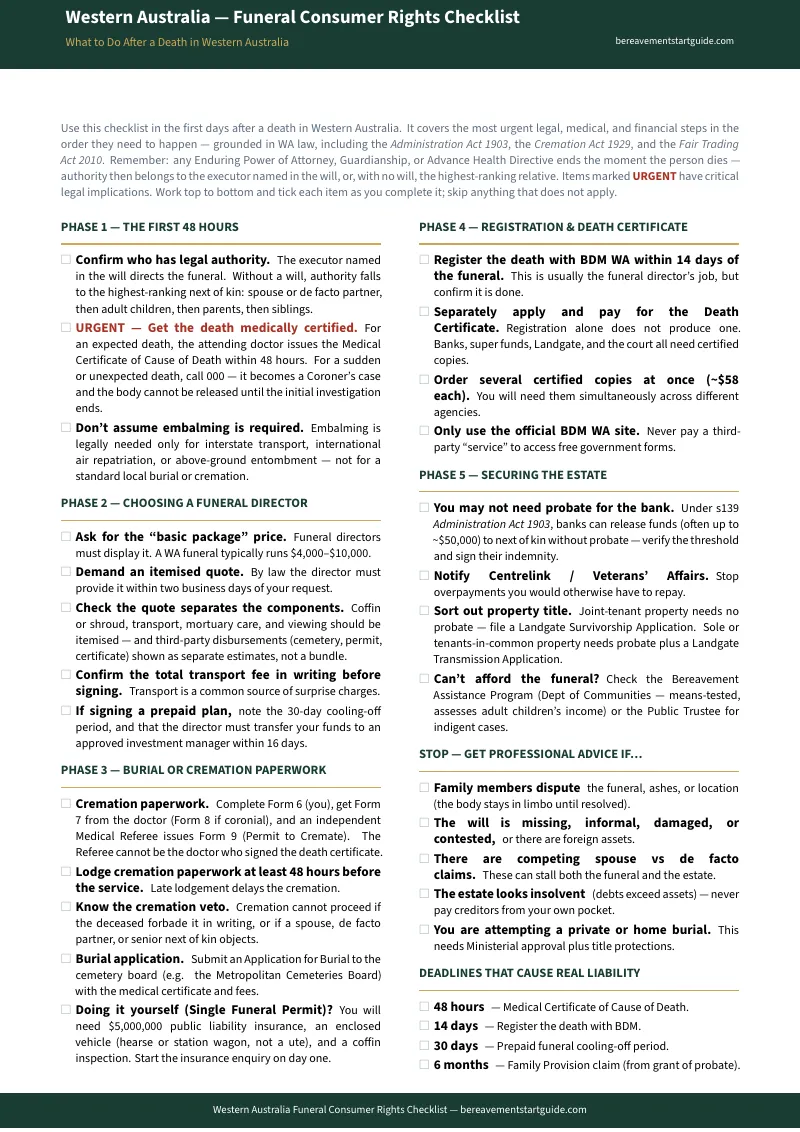
- Quick-Start Checklist — 20 critical first-week actions across five phases
- First 48 Hours Action Sequence — The exact chronological steps from the moment of death
- Funeral Quote Comparison Worksheet — Print and bring to funeral directors to compare three itemised quotes
- Financial Assistance Reference — Three pathways when the family cannot pay
- Forms, Fees & Contacts Reference — Every WA form, fee, and agency contact in one printable table
- Post-Funeral Administration Checklist — Estate, probate, and property transfer steps after the funeral
Start With the Free Checklist
Download the Western Australia Funeral Consumer Rights Checklist — a standalone PDF covering the 20 most critical actions for the first week after a death, including funeral director vetting questions, mandatory vs optional services, death registration deadlines, and financial assistance pathways. If the checklist is enough, keep it. If you need the full legal framework, consumer defence strategies, and all seven printable tools, the complete guide is .