You Were Named Executor in a Western Australia Will. The Supreme Court Registry Cannot Tell You How to Fix Your Application. Landgate Will Not Transfer the Property Without a Grant. And the Bank Will Not Release a Dollar Until You Get It Right.
You have never done this before. Nobody teaches you how to apply for probate, and now you are staring at the Supreme Court of Western Australia's eCourts Portal — a digital system that offers a "Probate Wizard" for simple cases but explicitly refuses to advise you if the original will has any irregularity, if you are not the named executor, or if anything about the application falls outside its narrow parameters. Maybe you have already phoned a solicitor and been quoted $1,500 to $3,800 for what they called a "standard grant." Maybe the Public Trustee told you they could handle everything — without mentioning that their administration fees reach 6.6% on investment income plus additional charges on asset values, systematically eroding the estate you are trying to protect.
Meanwhile, the estate is frozen. The bank locked the accounts the day they were notified. Landgate will not transfer the family home without a sealed court grant. Siblings or beneficiaries are asking when they will receive their share. The funeral invoice remains unpaid from your own pocket. And somewhere in the back of your mind is the question that keeps every first-time executor awake: if I format the affidavit wrong, or swear it before the wrong witness, or leave an unexplained staple mark on the original will — does the Supreme Court reject my application entirely? Am I personally liable for what happens next?
Here is what the free resources will not tell you: the Supreme Court of Western Australia issues requisitions on applications with formatting errors, ambiguous clauses, or incomplete asset valuations — and when it does, Registry staff are legally prohibited from telling you how to fix it. They cannot explain the error. They cannot suggest a remedy. They will tell you to hire a lawyer. You cannot respond with a phone call or a letter. You must draft a formal supplementary affidavit that exclusively addresses the requisition, have it sworn before an authorized witness under the Oaths, Affidavits and Statutory Declarations Act 2005 (WA), and resubmit it through the Electronic Case Management System. A single requisition routinely adds weeks or months to an already painful process.
The Western Australia Probate Process Guide is a Requisition Prevention System that walks you through every step of the Supreme Court application — from the moment you confirm that probate is necessary through the day you lodge the Transmission Application with Landgate and distribute the estate. Not a law textbook. Not a generic Australian probate explainer that treats Western Australia the same as Queensland or Victoria. A structured, jurisdiction-specific manual built around the forms, fees, deadlines, and institutional mechanics that are unique to the Supreme Court of Western Australia, the ECMS portal, and the WA legislative framework.
What's Inside the Requisition Prevention System
A 9-chapter guide, the Probate Quick-Start Checklist, and 6 standalone printable tools — covering every stage from the first 48 hours through final distribution, built specifically for Western Australia's Supreme Court procedures, the Administration Act 1903, the Wills Act 1970, and the institutional rules that make probate here different from anywhere else in Australia:
Do You Actually Need Probate?
This is the question that saves you the entire process — or confirms you cannot avoid it. If the deceased owned real property solely or as tenants in common, probate is almost universally required. But for bank accounts, the threshold is not a legal standard — it is internal bank policy, and the thresholds vary wildly. Some banks release up to $114,674 without probate on presentation of a death certificate and indemnity form. Credit unions may demand probate at $22,934. The guide maps the current threshold behaviour for every major institution, explains joint tenancy survivorship (which bypasses probate entirely via a Landgate Application by Survivor), and covers superannuation binding death benefit nominations — which are not estate assets at all if the nomination is valid. You may be one title search and two phone calls away from discovering you do not need the Supreme Court.
Protecting the Original Will
The Supreme Court inspects the physical condition of the original will. Removed staples, unexplained marks, missing pages, or damaged bindings trigger requisitions demanding a sworn explanation of the will's condition. This chapter covers what the court is actually looking for, how to handle the document safely (sleeve it, never unstaple or fold it, hand out certified copies only), and the circumstances under which you need an affidavit explaining the will's physical state.
Navigating the eCourts Portal and ECMS
Western Australia has gone digital-first. The Supreme Court's Electronic Case Management System handles filing, but the Probate Wizard only works for simple cases — if the will is missing, unsigned, or you are not the named executor, it cannot help you. This chapter walks through when you can use the Wizard, when you must prepare documents manually, how to set up your ECMS account and notification emails, and the 60-day draft deletion rule that catches executors who start too early.
Formatting and Swearing the Affidavit
This is where most requisitions happen. The Supreme Court mandates that affidavits be typed on white A4 paper in at least 12-point font, with numbered paragraphs, stapled exclusively in the top left corner, never handwritten. A Commonwealth statutory declaration is explicitly rejected — the Court requires a sworn affidavit under the Oaths, Affidavits and Statutory Declarations Act 2005 (WA). You and the witness must sign every page. The date of death must match the death certificate word for word. The guide covers every formatting rule, the exact list of authorised witnesses (JPs, lawyers with 2+ years' practice certificates, notaries, pharmacists), and how to arrange witnessing if you are interstate or overseas.
Filing the Application and Handling Requisitions
The chapter that does not exist in any free resource. It covers the five components you lodge — Motion, Affidavit, Statement of Assets and Liabilities, original will, original death certificate — the $408 filing fee, the Form 2 fee reduction application for financial hardship, and what happens when the Registrar issues a requisition. You cannot fix a requisition by phone or letter. You must draft a formal supplementary affidavit, sworn again before an authorised witness, addressing the specific error. The guide covers the most common requisition triggers and how to avoid every one of them before you file.
Letters of Administration, Landgate Property Transfers, Tax, and Safe Distribution
The remaining chapters cover every step after the grant is issued and the critical alternative pathway when there is no will. Letters of Administration on Intestacy under the Administration Act 1903 — the statutory priority order, the newly updated 2025 legacy amounts ($546,000 for spouses with surviving children, $815,500 without), and the requirement to obtain written consent from all entitled beneficiaries. Real property transfers through Landgate — the two-stage process (Transmission Application into your name as executor, then Transfer of Land to the beneficiary), the mandatory in-person identity verification at Australia Post, the Revenue WA stamp duty clearance, and the distinction between joint tenancy (Application by Survivor, no probate needed) and tenants in common (Transmission Application, probate required). The Section 63 creditor notice under the Trustees Act 1962. ATO obligations for the date-of-death return and estate trust return. And the safe distribution process that protects you from personal liability.
Who This Guide Is For
- The first-time executor who has been named in a parent's will and has never navigated the Supreme Court of Western Australia — who needs the complete ECMS filing walkthrough, the affidavit formatting rules explained step by step, and a filing sequence that eliminates the guesswork that causes requisitions
- The surviving spouse who needs to know whether probate is required at all — whether right of survivorship on joint tenancy means the family home transfers with a Landgate Application by Survivor and no court involvement, whether the bank threshold covers the accounts, and what happens to superannuation under a binding death benefit nomination
- The family with no will who needs to understand Letters of Administration on Intestacy — who has priority to apply under the Administration Act 1903, how the 2025 statutory legacy amounts work, and the additional beneficiary consent requirements
- The cost-conscious administrator who wants to avoid spending $1,500 to $3,800 on a solicitor for a straightforward, uncontested estate — who needs to know the Form 2 fee reduction, how to access it, and a step-by-step process that makes self-representation realistic
- The interstate or overseas executor who cannot attend the Perth Supreme Court registry in person — who needs to understand remote filing through the ECMS, how to arrange authorised witnesses interstate under the Oaths Act 2005, and the execution requirements that prevent mailed applications from triggering immediate requisitions
Why Free Resources Will Not Get You Through the Supreme Court
The information exists. It is scattered across the Supreme Court of WA website, the eCourts Portal, Landgate's policy guides, the Public Trustee, and the content marketing funnels of a dozen Perth law firms. Here is what you actually encounter when you try to apply for probate using free sources alone:
- The Supreme Court tells you what to file but legally cannot tell you how. The eCourts Portal provides the Probate Wizard for simple cases and lists the required documents. It does not explain how to construct the affidavit narrative the Registrar expects, how to format the Statement of Assets and Liabilities correctly, or what causes requisitions. Registry staff are legally prohibited from providing legal advice — if your application has a problem, they will suggest you hire a lawyer.
- Law firm blogs explain complexity to justify retainer fees. Perth Probate Centre, Perth Legal, and similar firms publish detailed technical breakdowns of executor duties and personal liability. Every one of those articles is designed to convince you the process is too dangerous to handle alone — and that you need a retainer starting at $1,495. For contested estates, that may be true. For straightforward estates with a clear will and cooperative beneficiaries, you are paying thousands for a process you can handle with the right instructions.
- National online providers are cheaper but still expensive. Making Probate Easy advertises $1,100 for Western Australia, noting that WA does not require a Notice of Intention to Apply in a newspaper — making it a simpler jurisdiction than Queensland or New South Wales. But their free content is deliberately shallow, designed to funnel you into paying the $1,100 service fee. A standalone guide does not need to withhold information to upsell a service.
- Landgate manuals are written for conveyancers, not families. Landgate publishes free Land Transaction Policy and Procedure Guides with deep technical detail on Survivorship and Transmission Applications. The documentation is extremely dense, heavily cross-referenced, and nearly impossible for a grieving spouse to interpret without legal training. The guide translates the distinction between joint tenancy and tenants in common into a plain-English decision flowchart that tells you exactly which form to lodge.
- The Public Trustee markets simplicity but charges dearly. The Public Trustee of Western Australia offers government-backed estate administration. Their fee structure reaches 6.6% on investment income alongside charges on asset capital values — a cost that compounds significantly on estates with rental properties, share portfolios, or term deposits.
Free resources give you form names from one website, affidavit rules from another, fee schedules from a third, and property transfer procedures from a fourth — with no connecting thread. The Requisition Prevention System puts every WA-specific form, fee, deadline, and formatting instruction into one document, in the exact order the Supreme Court expects to receive them.
— Less Than Fifteen Minutes With a Perth Estate Solicitor
A single consultation with a Perth estate solicitor costs $300 to $600 per hour. A standard probate retainer starts at $1,500 and only covers obtaining the grant — not the actual estate administration. The Public Trustee charges percentage-based fees that erode the estate over time. This guide costs less than fifteen minutes of professional legal time and gives you the complete filing system — every form, every deadline, every formatting instruction, and the pre-filing knowledge that catches the errors responsible for requisitions.
Your download includes the complete 9-chapter guide, the Probate Quick-Start Checklist (20 actionable items), and 6 standalone printable tools — the Anti-Rejection Checklist (tick every box before you file), the Bank Threshold Decision Map (bring it to each bank meeting), the Key Deadlines Reference Card (pin it to your fridge), the Landgate Property Transfer Guide, the Fee Schedule Quick Reference, and the Statement of Assets & Liabilities Worksheet. Plus a money-back guarantee, no time limit. If the guide does not give you clarity on what to file, when to file it, and how to format it so the Supreme Court accepts it on the first attempt, email us for a full refund. No questions asked.
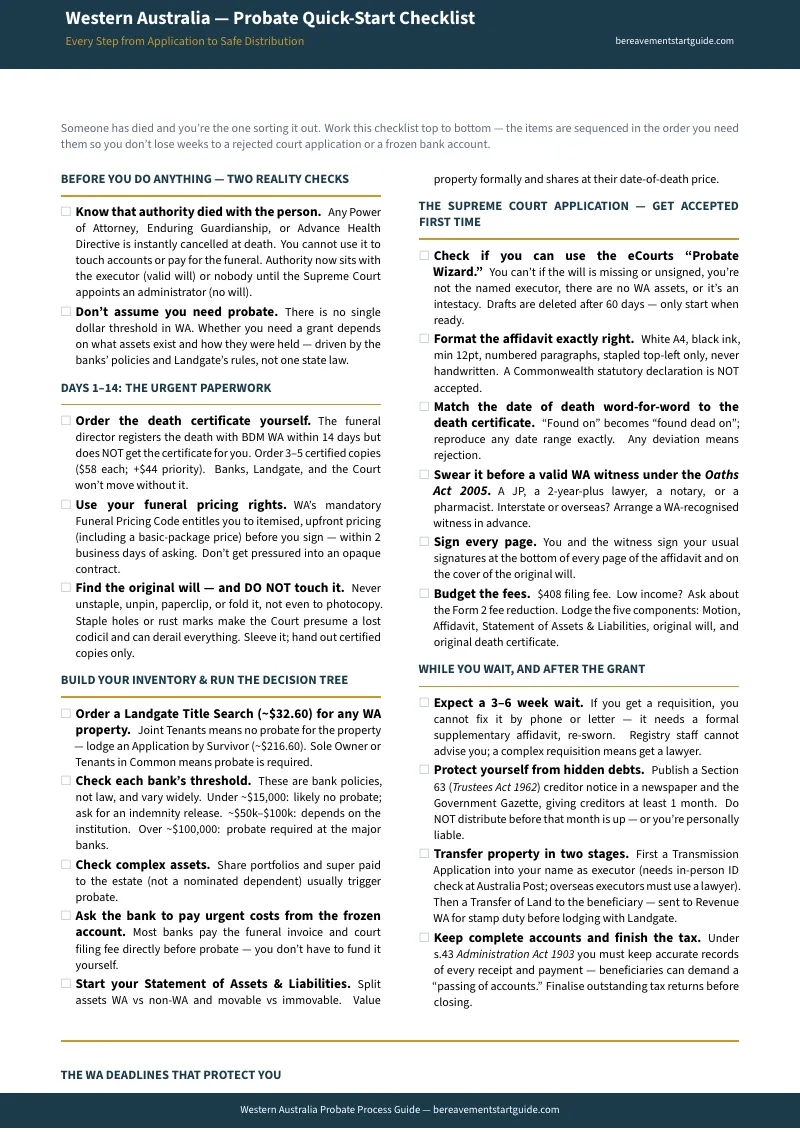
Not ready for the full guide? Download the free Western Australia — Probate Quick-Start Checklist — 20 items in the exact sequence the Supreme Court process requires, from ordering death certificates through final distribution. It tells you what to do and when. The full guide tells you how.
You did not choose to be an executor. But you can do this. The guide shows you exactly how.