
The hospital handed you a Declaração de Óbito. The bank froze every account. The funeral director is talking about burial tomorrow morning. And you do not speak Portuguese.
When someone dies in Brazil, the system does not wait. Burials routinely happen within 24 hours. The body cannot leave the hospital or the forensic institute until you contract a licensed funeral home — and the funeral home needs a decision: local burial, local cremation, or international repatriation. The Civil Registry office that issues the legal death certificate operates entirely in Portuguese. And if the death happened outside a hospital — at home, on the street, in an accident — the body is already at the Instituto Médico Legal for a mandatory autopsy you cannot refuse, delay, or opt out of on religious grounds.
Behind the immediate crisis, the financial system is locking down. Brazilian banks freeze all single-owner accounts the instant they learn of the depositor's death. They will not tell you the balance. They will not confirm the account exists. Brazilian financial privacy law prohibits disclosure to next-of-kin. To access a single real, you must formally open probate — and Brazilian law gives you exactly 60 days to do it before mandatory tax penalties start accumulating.
The free embassy pages explain what needs to happen. They do not explain how to make it happen when you are standing in a Portuguese-only government office with a 24-hour deadline and no idea which counter to approach first.
The Brazil Death Administration Roadmap — every deadline, every agency, every Portuguese term explained, in the order things actually happen
The Someone Died in Brazil: English Speaker's Emergency Guide is a chronological administrative roadmap built for the specific situation of navigating Brazilian death bureaucracy without speaking Portuguese. It follows the actual sequence — not alphabetical topics, not a glossary, but the order in which Brazilian hospitals, police, funeral directors, registries, banks, and courts expect you to act.
Every Portuguese legal term appears with its English translation the first time it is used. Every deadline is flagged with its legal basis. Every agency is identified by its official name and function. And every step tells you whether you can handle it yourself or whether this is the moment you need a lawyer, a consular officer, or a sworn translator.
What's inside
- First 24 hours protocol — who to call in what order, how to secure the Declaração de Óbito from the hospital or the Instituto Médico Legal, what documents to have ready, and the critical difference between the medical death declaration (Declaração de Óbito) and the legal death certificate (Certidão de Óbito) that the Cartório issues
- Mandatory autopsy rules — when the IML takes jurisdiction, how long forensic examinations take, the reality that religious or cultural objections are not accommodated, your rights regarding organ and tissue retention, and how to formally request the return of retained organs through consular or judicial channels
- Repatriation vs. local burial decision framework — embalming by a licensed physician, zinc-lined casket mandates, Civil Police transit documents, Federal Police export authorization, consular mortuary certificates, airline coordination, and side-by-side cost comparisons (local burial typically R$3,000–R$6,000 vs. international repatriation exceeding $4,000 USD)
- Death certificate registration walkthrough — how to navigate the Cartório de Registro Civil, the documents the registry requires (Declaração de Óbito, passport, CRNM/RNE card, marriage certificate), how the funeral director can file on your behalf, and what to do when name spellings between documents do not match
- Bank account freeze mechanics — why Brazilian banks refuse to disclose even the existence of accounts to next-of-kin, how to obtain the Termo de Inventariança, and how your attorney can petition a judge to use the Central Bank's electronic system (BACENJUD) to locate hidden accounts and retrieve statements
- The 60-day probate deadline — the ITCMD inheritance tax, state-by-state rate ranges (4%–8%), late-filing penalties (typically 10%–20% of tax owed plus accumulating interest), and how missing this window on even a modest estate can cost hundreds of dollars in avoidable surcharges
- Forced heirship and foreign wills — how Brazil's legítima rule reserves exactly 50% of the estate for mandatory heirs regardless of what any foreign will says, the exclusive territorial jurisdiction that requires parallel probate for all Brazilian assets, and the apostillation and sworn translation requirements for foreign documents
- Judicial vs. extrajudicial probate — when you qualify for the fast-track notary path (Escritura Pública de Inventário) and when you are routed to the state court system, the document requirements for each, and why a lawyer is statutorily required even for the extrajudicial option
- CPF, INSS, and ongoing tax obligations — updating the deceased's tax status to Espólio, filing annual estate tax returns, claiming survivor pension benefits (Pensão por Morte), and the vehicle title transfer process through DETRAN
- Real estate and tenancy management — the Registro de Imóveis registration requirement (ownership is not transferred until registered), lease termination and subrogation rights, security deposit recovery, and ongoing property tax obligations during probate
Plus 7 standalone printable PDFs — action timeline, cost comparison worksheet, asset inventory worksheet, document tracker, agency contact sheet, repatriation decision framework, and Portuguese-English communication templates you can hand to officials at the Cartório, at the bank, or at the funeral home.
Who this is for
- Expats in Brazil whose spouse, parent, or family member has just died — and who need to know what to do tonight, not after a week of research
- Family members abroad who just received a call from a Brazilian hospital, police station, or consulate — and have no idea where to start
- Non-resident heirs who need to settle a Brazilian estate from the US, UK, Canada, Australia, or anywhere else — and are discovering that their home-country probate does not cover Brazilian assets
- Corporate HR and global mobility managers handling the death of an employee stationed in Brazil — and facing duty-of-care obligations with no local knowledge
- Anticipatory planners with an elderly or ill family member living in Brazil — preparing now so they are not blindsided by 24-hour deadlines and Portuguese-only paperwork later
Why not just use the free resources?
The U.S. Embassy publishes a consular information page. The UK Government publishes a bereavement pack. Both explain what documents you need and which offices to contact. Neither tells you how to navigate a Portuguese-only Cartório under a 24-hour deadline, how Brazilian bank freezes work differently from Western banks, how to meet the 60-day probate deadline from abroad, or what forced heirship means for your family's inheritance.
Expat forums have threads with advice from years ago that reference procedures that have changed. The bilingual law firm blogs that rank on Google explain the problem in enough detail to create urgency — then cut off before the procedural steps and redirect to retainers charging 10% to 20% of the estate's value.
No single free source covers the full sequence from death to estate settlement in English, with current Brazilian law, in the order things happen. This guide does.
The cost of getting it wrong
- Missing the 60-day probate deadline and triggering ITCMD late-filing penalties that can exceed R$3,000 on a modest estate
- Assuming your home-country probate covers Brazilian assets — then discovering months later that Brazilian courts have exclusive jurisdiction and you need to start over
- Letting the funeral director proceed with burial within 24 hours because you did not know you could request preservation for international repatriation
- Having the Cartório reject your death registration because the passport name does not match the Declaração de Óbito — delaying the death certificate, the bank release, and every downstream process
- Paying a law firm thousands of reais in consulting fees just to understand basic steps you could have learned in advance
- Assuming your embassy will handle everything — then discovering that consular assistance is limited to reporting the death and certifying signatures
Satisfaction guarantee
If the guide does not give you a clear path through Brazilian death administration, email us for a full refund. No questions, no forms. You are dealing with enough bureaucracy already.
Get the free checklist or the full guide
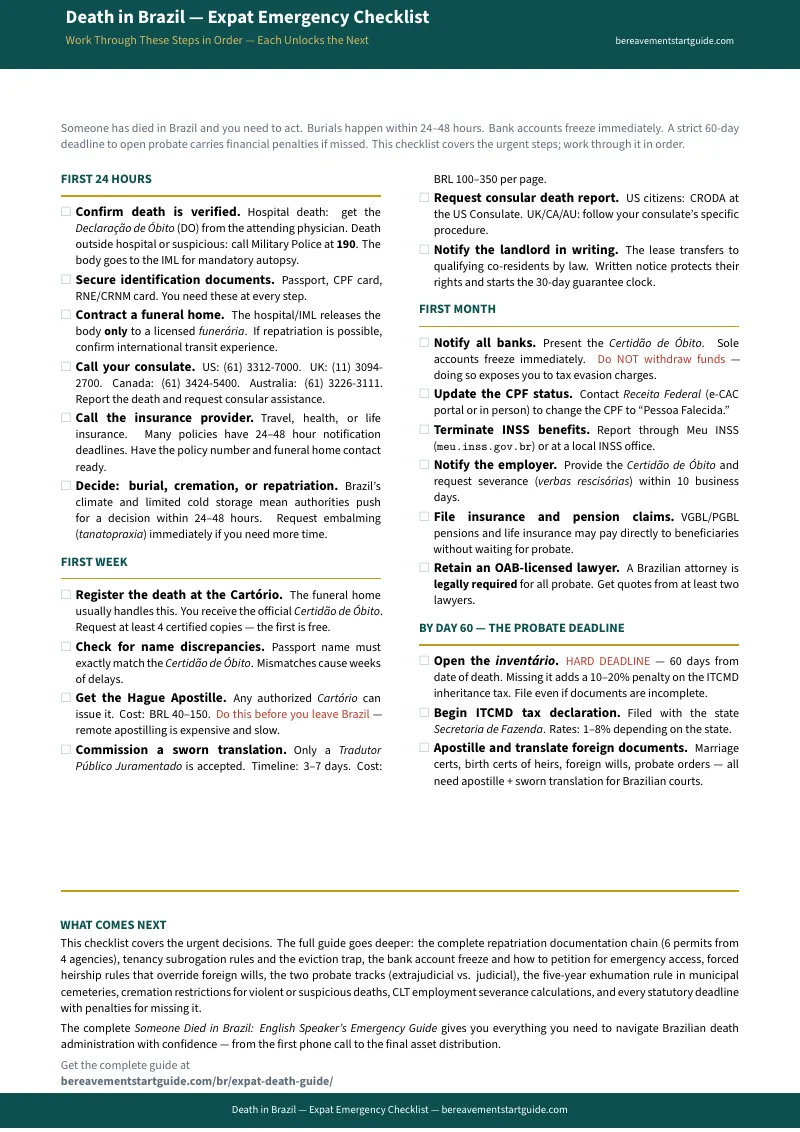
The free Emergency Checklist gives you the critical first steps — who to call, what documents to gather, and the key deadlines. It is the right starting point if you need to act tonight.
The full guide covers the complete process from death to estate settlement — bank freezes, probate deadlines, forced heirship, repatriation, tax, and real estate — with 7 standalone printable PDFs including worksheets, trackers, and Portuguese-English communication templates you can use at every stage. For , it replaces hours of fragmented research and potentially thousands of reais in avoidable professional fees and tax penalties.
Frequently Asked Questions
What if the rules change after I buy?
We update the guide when the rules change. Email us any time, even years later, and we'll send you the current edition free.