Someone You Love Just Died in Alberta. The Bank Froze Their Accounts. The Funeral Director Is Asking About Death Certificates. And You Just Found Out the Surrogate Court Requires Five Different GA Forms Filed in a Sequence Nobody Explained to You.
You are standing in a place nobody prepared you for. Maybe you were named executor in a will you barely remember reading, and now the funeral home needs you to sign forms you have never seen. Maybe there was no will at all, and because you are the eldest child or the surviving spouse, everyone is looking at you for answers you do not have. Maybe ATB Financial just told you the checking account is frozen and you cannot access a single dollar to pay the electric bill, the natural gas, or the funeral deposit — and the person who would have known what to do is the one who just died.
You are grieving and sleep-deprived, but the paperwork does not wait. The funeral director needs to know how many death certificates to order through Vital Statistics. Service Canada needs notification to stop benefit payments. Siblings are already asking about the house. The CRA will eventually demand a terminal tax return that accounts for every asset the deceased owned on the day they died. And somewhere in the back of your mind, a terrifying question keeps circling: if I pay the wrong bill, or miss a deadline I do not even know about, or distribute assets before the Clearance Certificate arrives — am I personally liable?
The short answer: the estate pays the debts, not you. But the long answer — the one that involves Alberta's 2022 Surrogate Rules overhaul that replaced every probate form with a confusing sequence of GA1 through GA5 applications, an October 2024 Land Titles levy that more than doubled property transfer fees overnight, a 2025 CPP death benefit top-up that most families apply for without realizing they are statutorily disqualified, and banking indemnity thresholds that vary wildly between ATB Financial, CIBC, TD Canada Trust, and RBC — that answer is what separates families who settle an estate in months from families who spend years and thousands of dollars untangling mistakes they did not know they were making.
The When Someone Dies in Alberta — Estate Settlement Guide is a Court-Ready Settlement System for every legal, financial, and administrative step between the funeral home and final distribution. Not a law textbook. Not a generic checklist from a national Canadian website that does not know Alberta from Ontario. A structured, Alberta-specific manual that separates what must be done in the first 48 hours from what legally cannot happen until the CRA issues a Clearance Certificate — so you stop guessing, stop panicking, and start working through this in the right order.
What's Inside the Court-Ready Settlement System
A 12-chapter guide, the First 48 Hours Checklist, and a Quick Reference appendix — covering every stage from the moment of death through final asset distribution, built specifically for Alberta statutes, the Court of King's Bench, and the province-specific rules that make settling an estate here different from anywhere else in Canada:
The First 48 Hours: The Authority Shift and Immediate Actions
The moment someone dies in Alberta, every Enduring Power of Attorney and Personal Directive they had in place is legally void. If you managed their finances under an EPA, you no longer have authority — and attempting to use it at a bank branch is a violation of financial regulations. This chapter covers the authority shift, locating the original will (a photocopy triggers a complex contentious court process), securing the home and keeping utilities running (a house without heat during an Alberta winter means burst pipes and catastrophic damage), securing vehicles and firearms, and the single most important rule in this entire guide: do not pay any of the deceased's debts with your own money.
Death Certificates: Ordering, Costs, and the Out-of-Province Trap
Alberta death certificates must be ordered through an authorized Registry Agent — not a government office, not online. Each certificate costs a $20 government fee plus the agent's service charge. The guide gives you the exact calculation based on the deceased's assets so you order the right number now. Coming back later means weeks of delay. If you are the executor and live outside Alberta, there is a separate mail-in process requiring a wet-ink notarized Statutory Declaration — no electronic signatures accepted. This chapter tells you exactly how many to order and how to avoid the delays that trap out-of-province executors.
The First Month: Inventory, Notifications, and the Probate Decision
Before you can determine whether probate is required, you need a complete picture of what the deceased owned and what they owed. This chapter walks you through building the asset and debt inventory, notifying the CRA and Service Canada, canceling Alberta Health Care coverage, placing credit bureau fraud alerts with Equifax and TransUnion, and using redirected Canada Post mail to discover accounts you did not know existed. It includes the probate decision framework: if the estate holds real property in sole ownership, or bank accounts above the institution's internal threshold, probate is almost certainly required.
Banking and Financial Accounts: Frozen Accounts, Indemnities, and the Bank Negotiation
This is the chapter that solves the most urgent crisis families face. The bank froze the accounts and you cannot pay the funeral, the mortgage, or the utilities. The guide explains which accounts stay accessible (joint accounts with right of survivorship), which transfer directly to named beneficiaries (POD and ITF accounts), and which require a Grant of Probate. For accounts that are frozen, the guide covers the banking indemnity process — the formal mechanism for requesting banks to release funds for estates under $25,000 without probate. You get the exact steps, the legal vocabulary, and the escalation path when the branch manager says no and routes you to a centralized corporate estate department in Toronto or Calgary.
The Surrogate Court: Applying for Probate Using the GA Forms
This is the chapter that does not exist in any free resource. In 2022, Alberta completely overhauled its Surrogate Rules, replacing the old non-contentious (NC) forms with a strict, sequential series of Grant Application forms. The process is counterintuitive and hostile to families without legal training. You cannot simply gather information and file. You must complete the GA1 Application and the detailed GA2 Inventory, serve the GA3 Notice to Beneficiaries on every interested party, potentially serve the GA4 Notice to the Public Trustee if any beneficiary is a minor or represented adult, and then swear the GA5 Affidavit of Service to prove compliance — all before the court will accept your application. The guide walks through every form in the sequence, explains what triggers rejection by Court of King's Bench clerks, and covers both the Surrogate Digital Service (for lawyers) and the paper filing path available to self-represented personal representatives. Alberta's maximum government probate fee is $525 for estates over $250,000 — a fraction of what Ontario or British Columbia charges.
Settling Without Probate: When It Works and When It Does Not
Not every Alberta estate requires a trip to the Surrogate Court. If the estate consists only of joint assets, beneficiary-designated accounts, and small balances that fall under individual bank indemnity thresholds, probate may not be necessary. This chapter maps the exact scenarios where probate is legally required versus where it can be avoided, and covers the Notice to Creditors process for estates settling without a court grant. The critical rule: just because assets bypass probate does not mean they bypass tax obligations.
Real Property: Houses, Condos, and Land
Real estate is typically the largest and most complex asset in an Alberta estate. The guide breaks down the critical legal distinction that determines everything: joint tenancy versus sole ownership. If the property was held in joint tenancy with right of survivorship, the surviving owner can remove the deceased from the title using a death certificate and a Statutory Declaration Regarding Proof of Death — no probate required. If the property was held in sole ownership or tenancy-in-common, a Transmission to Personal Representative is mandatory and requires a Grant of Probate. Either way, be prepared for the October 2024 Land Titles Registration Levy increase. The cost jumped from $2 per $5,000 of property value to $5 per $5,000 — plus the $50 base fee. For a $500,000 property, the transfer fee more than doubled from $250 to $550 overnight. The guide covers both paths, the exact forms, and the levy calculation so there are no financial surprises at the Land Titles Office.
Federal and Provincial Benefits
The 2025 CPP death benefit changes created widespread confusion. The base benefit is still a maximum of $2,500, but a new top-up can add another $2,500, bringing the potential total to $5,000. Here is what most government resources fail to clearly explain: the top-up is void if the deceased ever collected a CPP retirement or disability pension, or if there is a surviving spouse eligible for a CPP survivor's pension. Families waste hours applying for a top-up they are statutorily barred from receiving. This chapter includes an eligibility flowchart that tells you in five minutes whether the top-up applies, plus full coverage of the CPP Survivor's Pension, the Alberta Funeral Benefit (up to $4,601 for qualifying low-income families — but you must check eligibility before signing any funeral contracts), and AISH notification requirements.
Taxes, CRA Clearance, and Why You Cannot Distribute Until the Government Says So
This is where executor liability becomes real. The terminal T1 tax return must account for every asset the deceased owned, including deemed disposition of capital property at fair market value on the date of death. If you distribute assets to beneficiaries before the CRA issues a Clearance Certificate, and the estate later owes taxes, you are personally liable for the shortfall. The guide covers deemed disposition rules, the terminal T1 filing deadline, the Form TX19 Clearance Certificate application (allow 120 days for processing), and estate T3 returns for income earned after the date of death.
Edge Cases, the Complete Timeline, and Final Distribution
The remaining chapters cover when you need a lawyer (contested wills, minor beneficiaries, insolvent estates, complex real property), a complete chronological timeline from Day 1 through Month 12+ with every statutory deadline, the final accounting process, executor compensation under Alberta guidelines, obtaining signed ACC 12 Releases from all beneficiaries, and closing the estate. The Quick Reference appendix consolidates every Alberta form, fee, and contact number in one place.
Who This Guide Is For
- The surviving spouse whose partner just died and whose bank accounts were frozen this morning — who needs to know which accounts stay accessible, which ones require a Grant of Probate, and how to apply for the CPP Survivor's Pension and the $2,500 death benefit before deadlines pass
- The adult child named as executor who has never navigated the Court of King's Bench and is terrified of making a mistake that triggers personal liability — who needs the complete GA form sequence, every Surrogate Court filing step, and a timeline that separates what is urgent from what can wait
- The family with no will who just learned that Alberta's Wills and Succession Act dictates everything — who needs to understand who has statutory priority to apply for a Grant of Administration, what the intestacy distribution rules are, and whether the Public Trustee must be involved
- The executor living outside Alberta who cannot walk into a registry office or bank branch — who needs the mail-in process for death certificates, the paper filing path for Surrogate Court applications, and the exact documentation requirements for dealing with centralized corporate estate departments by phone and mail
- The financially constrained family who cannot afford a funeral or a lawyer — who needs to know about the Alberta Funeral Benefit ($4,601 for burial/cremation, $1,041 for a ceremony) and the $525 maximum probate fee that makes self-representation financially viable for straightforward estates
- The rural or remote family far from Edmonton or Calgary courthouses — who needs to sequence every task perfectly to minimize trips, complete all GA form paperwork accurately from their kitchen table, and deal with centralized bank estate departments that have stripped local branch managers of their discretion
Why Free Resources Will Not Get You Through This
The information exists. It is scattered across Alberta.ca, the Court of King's Bench, Service Alberta, Vital Statistics, the Land Titles Office, Service Canada, and a dozen federal agency portals that do not talk to each other. Here is what you actually encounter when you try to settle an estate using free sources alone:
- Alberta government pages are fragmented across different ministries. You need Vital Statistics for death certificates, Service Alberta for registry agents, Justice for Surrogate Court forms, Land Titles for property transfers, and Human Services for the funeral benefit. Each ministry provides accurate information about its own piece. None of them sequence the pieces together. None of them tell you that you must complete the GA2 before you can serve the GA3, or that distributing assets before receiving a CRA Clearance Certificate makes you personally liable.
- Law firm blogs highlight complexity to justify retainer fees. Alberta estate lawyers publish excellent technical breakdowns of probate fee tiers and executor duties. Their content is explicitly designed to convince you the process is too dangerous to handle alone — and that you need a retainer starting at $2,250 plus 1% of the gross estate. For contested estates, that is true. For the majority of straightforward estates, the answer costs a fraction of what an attorney charges.
- Bank estate pages protect the bank, not you. ATB Financial publishes a Personal Representative Guide. CIBC and TD have estate landing pages. Every one of them is focused on institutional liability protection. They explain why the bank freezes accounts. They do not explain how to negotiate an indemnity waiver for small estates, how to escalate when the branch manager says no, or what happens to the mortgage during probate.
- Funeral home content stops after the ceremony. Bereavement packages help with the first 48 hours. They tell you to order death certificates and notify Service Canada. They do not cover the GA form sequence, the Land Titles levy, terminal tax returns, executor liability, or the 120-day wait for a CRA Clearance Certificate. Their advice ends where the hard questions begin.
- Reddit and forums are dangerously provincial-wrong. Users on r/PersonalFinanceCanada and r/legaladvicecanada routinely apply Ontario's percentage-based probate tax to Alberta questions. Alberta's probate fee structure is completely different — a flat fee capped at $525 for estates over $250,000. Following Ontario advice for an Alberta estate can cost you thousands in unnecessary legal fees.
Free resources give you fragments from a dozen sources that do not reference each other. The Court-Ready Settlement System puts every Alberta-specific statute, form, deadline, and procedure into one document, in the order you actually need them.
— Less Than Fifteen Minutes With an Alberta Estate Lawyer
A single consultation with an Alberta estate lawyer costs $250 to $400 per hour. Standard probate representation starts at $2,250 plus 1% of the gross estate value. This guide costs less than fifteen minutes of professional legal time and gives you the complete Alberta-specific roadmap — every statute, every form, every deadline, and the GA form sequence that the Surrogate Court requires but nobody explains in plain language.
Your download includes 7 PDFs: the complete 12-chapter guide with a Quick Reference appendix, the standalone First 48 Hours Checklist, and five print-ready standalone references — the GA Form Sequence Guide, Banking and Indemnity Walkthrough, Real Property Transfer Guide, CPP Eligibility Flowchart, and CRA Clearance Timeline. Plus a money-back guarantee, no time limit. If the guide does not give you clarity on what to do next and confidence that you are doing it in the right order, email us for a full refund. No questions asked.
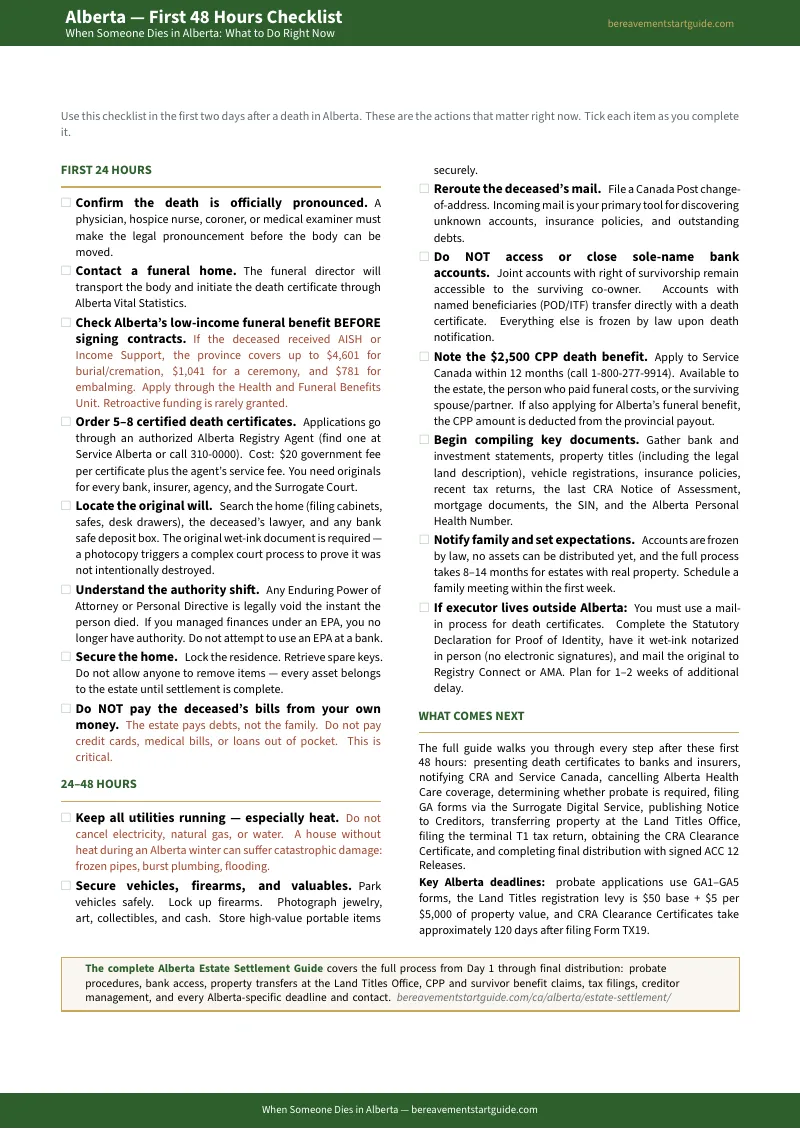
Not ready for the full guide? Download the free Alberta — First 48 Hours Checklist — 17 items covering everything that must happen in the first two days after a death in Alberta: death certificates, the authority shift, securing the home, utilities, what not to pay, and what to gather. It is enough to get through tonight and tomorrow.
You did not ask for this job. But you can do it. The guide shows you how, one step at a time.