The Funeral Director Just Handed You a Contract for $8,000. The Medical Examiner Put a Hold on Cremation. Your Brother Wants Burial, Your Sister Wants Cremation, and Nobody Told You That Section 36 of the Funeral Services Act Already Decided Who Gets to Choose.
You are standing in a funeral home office with a stack of papers you have never seen before. Maybe the attending physician has not signed the Medical Certificate of Death yet and the funeral director is telling you nothing can proceed until it arrives. Maybe your surviving parent is asking why the crematorium will not release the body, and you just learned that Alberta law requires the Office of the Chief Medical Examiner to issue a Form 4 before any cremation can happen in this province — even for a natural death. Maybe the funeral home quoted $3,500 for "basic services" and another $2,200 for a casket, and you have no idea whether those numbers are fair because nobody gave you an itemized price list until you asked for it twice.
You are grieving and exhausted, but the funeral home needs decisions now. They need to know who has legal authority to sign the service contract. They need to know whether you want embalming — and they may present it as required when Alberta law says it almost never is. They need to know whether the family has a pre-need contract on file and whether that contract's trust funds will cover the invoice. And somewhere in the back of your mind, a question keeps circling: are we being charged for things we have the legal right to refuse?
The short answer: yes, families overpay for funeral services in Alberta every day, not because funeral directors are dishonest, but because families do not know what the law actually requires versus what the industry presents as standard. The long answer — the one that involves the strict Section 36 authority hierarchy that determines who can legally authorize a cremation or burial when the family disagrees, a Medical Examiner Form 4 process that blocks every cremation in the province until administrative clearance is granted, a 30-day penalty-free cancellation window on pre-need contracts that most families never learn about, and a privatized death certificate system that charges variable service fees on top of the $20 government document fee — that answer is what separates families who arrange a funeral confidently from families who spend thousands of dollars more than they needed to because nobody explained their rights.
The Alberta Funeral Laws & Consumer Rights Guide is a Consumer Defense System for every legal right, administrative requirement, and cost-saving strategy available to families arranging a funeral in Alberta. Not a generic Canadian bereavement pamphlet. Not a funeral home brochure disguised as consumer education. A structured, Alberta-specific manual that separates what funeral homes are legally required to disclose from what they are financially incentivized to sell — so you stop guessing, stop overpaying, and start making decisions based on the actual law.
What's Inside the Consumer Defense System
A 10-chapter guide, 6 standalone printable reference sheets, and the Funeral Consumer Rights Checklist — covering every step from the moment of death through final disposition, built specifically for Alberta statutes and the province-specific rules that make funeral planning here different from anywhere else in Canada:
Chapter 1: Who Has the Legal Right to Make Funeral Decisions
The moment someone dies, the question of authority is not decided by family consensus or emotional proximity. Section 36 of the Funeral Services Act General Regulation establishes a strict descending hierarchy: executor named in a valid will first, then spouse or adult interdependent partner (only if they were living with the deceased), then adult child, then parent, and so on down a ten-level list. If two adult children disagree on cremation versus burial, the funeral home is legally barred from proceeding until they reach consensus — and the body stays in cold storage accumulating daily sheltering fees. This chapter gives you the complete hierarchy, explains exactly how to establish your authority with the funeral home, and covers the one scenario that costs families thousands: when an Enduring Power of Attorney holder assumes they still have authority after the death, not realizing that every EPA and Personal Directive is automatically void the instant the person dies.
Chapter 2: The First 48 Hours — Immediate Steps
What you do in the first two days determines how smoothly everything else proceeds. This chapter covers the critical fork: if the death was expected at home under palliative care, call the palliative care team — NOT 911 (calling 911 triggers an emergency response and potential Medical Examiner investigation). If the death was sudden or unexpected, the OCME takes jurisdiction. Either way, you need the Medical Certificate of Death completed within 48 hours, and this chapter tells you who completes it, where it goes, and what happens if the attending physician is unavailable.
Chapter 3: Death Registration and Certificates
Alberta does not let you walk into a government Vital Statistics office and order a death certificate. Instead, you must go through a privatized network of Registry Agents — AMA, Registry Connect, or another authorized agent — each of whom charges their own service fee on top of the $20 government document fee. Out-of-province executors face an entirely separate process requiring a wet-ink notarized Statutory Declaration mailed to Registry Connect. This chapter tells you exactly how many certificates to order based on the deceased's assets, how to avoid the delays that trap out-of-province applicants, and how the free one-year registration window works.
Chapter 4: Your Consumer Rights at the Funeral Home
This is the chapter that pays for the entire guide. Alberta funeral homes must provide an itemized General Price List. You have the legal right to purchase any service a la carte — you are not required to buy a bundled "package." You can bring your own casket, urn, or shroud from any third-party vendor, and the funeral home cannot refuse it or charge a handling fee. Embalming is almost never legally required — not for direct cremation, not for immediate burial, not for a standard funeral service. This chapter includes the exact scripts for declining non-mandatory services, requesting the itemized price list, and confirming in writing that no embalming charges will appear on the final contract.
Chapter 5: Cremation Rules and the Form 4 Process
Every cremation in Alberta is blocked until the Medical Examiner reviews the Medical Certificate of Death and issues a Form 4 granting administrative clearance. Families are caught off guard by this mandatory delay, especially when the physician who signed the certificate is unavailable for follow-up questions. This chapter explains exactly what Form 4 is, why the Medical Examiner must be involved even in a natural death, what triggers a longer review, and who must sign the cremation authorization form — including the specific rules when family members disagree.
Chapter 6: Burial Rules and Permits
Before any burial can proceed in Alberta, you need a Burial and Disposition Permit — issued free of charge by presenting the Medical Certificate of Death and the completed Registration of Death form. This chapter covers the permit process, cemetery plot transfers, the mandatory 50% cemetery plot discount for AISH recipients under Section 12 of the Cemeteries Act, and the single most asked question about Alberta burial law: can you bury someone on private land? The statutory answer is no — Section 5 of the Cemeteries Act restricts new cemetery establishment to municipalities, religious auxiliaries, and religious denominations only.
Chapter 7: Green Burials, Home Funerals, and Alternative Death Care
If you want a natural burial without embalming, a home vigil, or a simple shroud burial, Alberta law allows all of these — but with specific regulatory requirements that most families do not know about. The guide covers the legally compliant green burial sites in Alberta (including Meadows of Rosehill in Edmonton and Royal View Memorial in Lethbridge), the rules for conducting a home vigil, and the exact requirements for transporting a body in a private vehicle. That last point is critical: an Alberta "In-Transit Permit" is a $24 motor vehicle product for moving unregistered vehicles. Transporting human remains privately requires compliance with the Bodies of Deceased Persons Regulation — a rigid, leak-proof container, specific sanitary protocols, and the Burial/Disposition Permit. Confusing these two permits is one of the most common and potentially serious mistakes families make.
Chapter 8: Government Benefits and Low-Income Funeral Assistance
Alberta families earning below the provincial threshold can apply for up to $4,601 for burial or cremation and an additional $1,041 for a funeral ceremony through the Health and Funeral Benefits Unit. The critical rule: apply before signing any funeral contract if possible, because the benefit amount may constrain which services are covered. This chapter also covers the $2,500 CPP death benefit (which AISH recipients' families can retain without provincial clawback), the 2025 CPP top-up, and how the Public Trustee works — and does not work — for funeral funding.
Chapters 9 and 10: Prepaid Contracts, Complaints, and When You Need a Lawyer
Pre-need funeral contracts in Alberta come with a strict 30-day penalty-free cancellation window. After that, the funeral home can deduct up to 15% of principal and interest — but not a penny more. Search engines routinely surface British Columbia's 15-day cancellation window or American consumer protection rules for Alberta searches, leading families to act on completely wrong information. These chapters cover contract review, the cancellation process, transferring trust funds to another provider, the AFSRB formal complaint portal for overcharging or misconduct, and the specific scenarios where legal counsel is genuinely necessary: contested remains, disputed authority, communicable disease restrictions, and estates where the funeral invoice exceeds available liquid assets.
Who This Guide Is For
- The executor or next-of-kin sitting in a funeral home right now being asked to sign a contract — who needs to know exactly which charges are mandatory, which can be refused, and what the funeral home must disclose before you sign anything
- The family in a dispute where siblings disagree on cremation versus burial and the funeral home has frozen all arrangements — who needs the Section 36 statutory hierarchy to prove who has the legal authority to make the final decision
- The out-of-province family member managing funeral arrangements from Ontario, BC, or the United States — who needs to understand Alberta's privatized Registry Agent system, the Medical Examiner Form 4 requirement, and the out-of-province death certificate process before flying in
- The financially constrained family who received a funeral home quote that exceeds every available dollar — who needs the provincial funeral benefit application process, the AISH cemetery discount, and the cost-saving strategies that funeral homes are not incentivized to volunteer
- The eco-conscious planner who wants a green burial, a home vigil, or a simple shroud burial — who needs the specific Alberta sites, the private transport regulations, and the legal requirements that separate a compliant alternative funeral from an accidental regulatory violation
- The advance planner reviewing a loved one's pre-need contract or documenting their own end-of-life wishes — who needs to understand the 30-day cancellation window, the 15% fee cap, and how to verify that trust funds are actually being held in a compliant trust account
Why Free Resources Will Not Protect You at the Funeral Home
The information exists. It is scattered across the AFSRB regulatory website, Alberta.ca, Vital Statistics, the Office of the Chief Medical Examiner, and a dozen funeral home blogs that are designed to generate appointments, not protect your wallet. Here is what you actually encounter when you try to understand your funeral consumer rights using free sources alone:
- The AFSRB publishes the law but reads like a law textbook. The Alberta Funeral Services Regulatory Board is the official regulator, and their consumer protection information is legally accurate. It is also buried in dense PDFs, written for industry professionals, and structured as a regulatory reference — not a practical guide for a grieving family trying to understand their rights before signing a contract in 48 hours.
- Funeral home websites answer questions that serve their sales funnel. Park Memorial, Arbor Memorial, and local independents publish excellent checklists and pre-planning guides. Every one of them is designed to generate leads. They explain what embalming involves. They do not explain that you have the legal right to refuse it. They explain their casket selection. They do not explain that you can bring your own from any third-party vendor.
- Google surfaces the wrong jurisdiction constantly. Albertans searching "cancel prepaid funeral contract" or "funeral consumer rights" routinely see results from Consumer Protection BC, the US Federal Trade Commission, or generic Canadian legal sites. BC has a 15-day cancellation window with different penalty structures. The FTC Funeral Rule has zero legal force in Canada. Acting on out-of-jurisdiction advice in a time-sensitive funeral situation can cost real money.
- The AFSA is an industry trade group, not a consumer advocate. The Alberta Funeral Service Association represents funeral directors, not consumers. Their content is professionally produced and factually accurate. It is also structurally incapable of highlighting cost-saving strategies that reduce revenue for its members.
- Alternative death care resources mix provinces without clear demarcation. Organizations like CINDEA advocate for home funerals and green burials across Canada. Their guidance frequently blends Alberta rules with BC, Ontario, or Saskatchewan requirements without clearly labeling which applies where. For a family trying to legally transport a body in a private vehicle in Alberta, mixing up provincial regulations is not a minor inconvenience — it is a potential regulatory violation.
Free resources give you fragments from a regulator who writes for lawyers, funeral homes who write for sales, and search engines that do not know Alberta from British Columbia. The Consumer Defense System puts every Alberta-specific right, form, fee, and script into one document, in the order you actually need them.
— Less Than One Hour of Funeral Home Overcharges
The average Alberta funeral costs between $5,000 and $10,000. Families who do not know their rights routinely pay $500 to $2,000 more than necessary — on non-mandatory embalming, bundled "package" charges they could have purchased a la carte, and casket markups they could have avoided entirely by sourcing from a third-party vendor. This guide costs less than one item on a funeral invoice and gives you the legal knowledge to evaluate every line on that invoice before you sign.
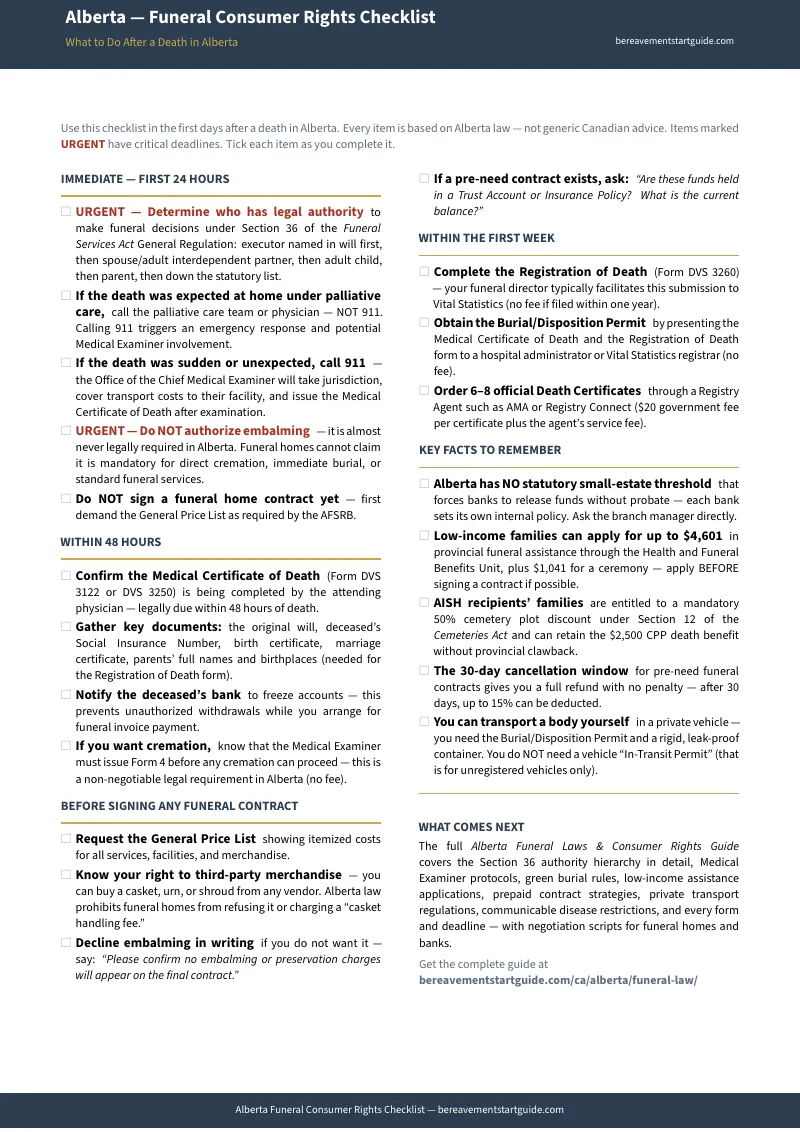
Your download includes the complete 10-chapter guide, 6 standalone printable reference sheets (Negotiation Scripts, Section 36 Authority Hierarchy, Form 4 Cremation Guide, Private Transport and Green Burial Guide, Government Benefits Reference, and Deadline Reference Table), the Alberta Funeral Consumer Rights Checklist (21 items covering the first days after a death), and a money-back guarantee, no time limit. If the guide does not give you clarity on your rights and confidence that you are making informed decisions, email us for a full refund. No questions asked.
Not ready for the full guide? Download the free Alberta Funeral Consumer Rights Checklist — 21 items covering who has legal authority, what to demand before signing any contract, when embalming can be refused, and the critical difference between mandatory permits and optional services. It is enough to walk into a funeral home tonight knowing your rights.
You should not have to become an expert in funeral law while you are grieving. But you should not have to overpay because you did not know the law was on your side.