You Were Named Executor in Someone's Will. Alberta Changed Its Entire Probate System in 2022. The Old Forms Are Gone. The New Ones Must Be Filed in a Strict Sequence Nobody Explained to You. And If You Get the Order Wrong, the Court Will Reject Your Application and You Start Over.
You did not ask for this. Someone you cared about died, and now you are holding a will that names you as executor — or there is no will at all, and because you are the surviving spouse or eldest child, everyone assumes you will figure it out. The bank has already frozen the accounts. The funeral is next week. And somewhere between the grief and the logistics, you discovered that Alberta's Surrogate Court requires a specific series of forms called GA1 through GA5, filed in a precise sequence, served on every beneficiary, sworn in an affidavit — and that if any single step is out of order, the Court of King's Bench clerk will reject the entire application.
You tried to find help. You went to albertacourts.ca. The forms are there, but there are no instructions that explain the filing sequence. You searched Reddit. The top comments confused Ontario's percentage-based probate tax with Alberta's completely different flat-fee structure. You called a law firm. They quoted $2,250 plus 1% of the gross estate value — for a process that Alberta deliberately designed to be accessible to self-represented applicants. You searched for Lynne Butler's probate kit. It was written before the 2022 overhaul that replaced every single form. The NC forms in that book no longer exist.
Here is what nobody told you: Alberta's probate fees are some of the lowest in Canada. The maximum court filing fee is $525 for estates over $250,000 — a fraction of what Ontario or British Columbia charges. The Surrogate Digital Service, which launched for self-represented applicants in April 2026, processes applications in 2 to 4 weeks instead of the 2 to 6 months that paper filing takes. And the GA form sequence, while counterintuitive, follows a strict logic that makes sense once someone lays it out for you. The problem has never been the difficulty. The problem is that nobody sequences the steps together.
The Alberta Probate Process Guide is a Court-Ready Filing System for the complete Alberta probate process — from the initial question of whether probate is even required through the final accounting and estate closure. Not a law textbook. Not a generic Canadian probate overview that does not know the difference between Alberta's Surrogate Rules and Ontario's Estate Administration Tax. A structured, 14-chapter Alberta-specific manual built around the current GA form series, the Surrogate Digital Service, and the 2024 Land Titles Registration Levy — so your application passes the clerk's review the first time.
What's Inside the Court-Ready Filing System
A 14-chapter guide and a Quick-Start Probate Checklist — covering every stage from the probate decision through executor compensation and final distribution, built specifically for Alberta's Court of King's Bench and the Surrogate Rules as they exist right now:
Chapter 1: Do You Actually Need Probate?
Not every Alberta estate requires a trip to Surrogate Court. Joint tenancy property passes automatically through the right of survivorship. RRSPs, TFSAs, and life insurance with named beneficiaries bypass the estate entirely. Joint bank accounts stay accessible to the surviving co-owner. This chapter gives you the three-step decision framework: the real property check, the financial account threshold check (each bank sets its own internal limit, typically $15,000 to $50,000 — not publicly posted), and the dispute and insolvency check. If you do not need probate, the chapter tells you what you still must do: NGA notices to interested parties, debt obligations, tax returns, and the CRA Clearance Certificate.
Chapter 2: Before You File — Preparation and Prerequisites
The most common reason applications are rejected by the Court of King's Bench is preparation failures, not form errors. This chapter covers the work that must happen before you touch a single GA form: locating the original will (a photocopy triggers an expensive, separate court process), ordering 5 to 8 death certificates through an authorized Registry Agent ($20 government fee per certificate plus the agent's service charge), building the complete asset and debt inventory that feeds directly into the GA2, verifying that the deceased's name on the death certificate matches the GA1 exactly (including all aliases — a mismatch is the single most common clerk rejection), and identifying every beneficiary and interested party who must receive notice.
Chapter 3: The GA Form Sequence — What You Need and In What Order
This is the chapter that does not exist in any free resource. In June 2022, Alberta replaced every probate form with the GA series. The sequence is strict and counterintuitive: you must complete the GA1 Application and the detailed GA2 Inventory, then serve the GA3 Notice to Beneficiaries on every interested party before you file with the court. If any beneficiary is a minor or represented adult, you must also serve the GA4 Notice to the Public Trustee. Then you swear the GA5 Affidavit of Service to prove compliance. You also need the GA8 Affidavit of Witness to a Will — and if you are the witness, it must be on the current GA form, not the retired NC form. The guide walks through every form, explains what triggers clerk rejection, and flags the sequence traps that catch first-time filers.
Chapter 4: The Surrogate Digital Service
Alberta's online filing portal — the SDS at surrogate.alberta.ca — opened to self-represented applicants in April 2026. Applications submitted through the portal process in 2 to 4 weeks versus 2 to 6 months for paper filing at the judicial centre. This chapter covers account setup through your verified Alberta.ca identity, the document upload requirements, what the portal does and does not accept, and why the SDS is not available to out-of-province executors (they must file on paper or appoint Alberta counsel).
Chapter 5: Fees and Costs — What Probate Actually Costs in Alberta
Alberta's probate fee structure is a flat schedule capped at $525 for estates over $250,000. Compare that to British Columbia, where the fee on a $500,000 estate is $3,250, or Ontario, where it would be $7,250. This chapter breaks down the filing fee tiers ($35 for estates under $10,000 up to $525 for estates over $250,000), the separate commissioner for oaths cost, and the total realistic budget for a self-represented applicant versus hiring a lawyer. It also covers the costs that are not part of probate but that executors confuse with probate: the Land Titles levy, the CRA clearance timeline, and lawyer fees for contested matters.
Chapter 6: Real Property — Transferring Houses, Condos, and Land
For most Alberta families, the house is the largest estate asset and the primary reason probate is needed. This chapter covers the two paths: the Statutory Declaration process for joint tenancy property (no probate required) and the Transmission to Personal Representative via Form TRA-1 for sole ownership or tenancy-in-common (probate mandatory). Both paths involve the October 2024 Land Titles Registration Levy that more than doubled transfer costs overnight — from $2 per $5,000 of property value to $5 per $5,000, plus the $50 base fee. For a $500,000 property, the levy jumped from $250 to $550. The guide includes the exact fee calculation and explains when the levy applies (at transfer to the beneficiary, not at transmission to the personal representative).
Chapter 7: After the Grant — Liquidation, Debts, and Distribution
The grant is not the finish line — it is the starting gate. This chapter covers the mandatory GA7 Notice of Grant Issuing (must be served within 30 days), the Notice to Creditors process (publish once for estates under $100,000, at least twice with minimum 5-day gaps for estates over $100,000, then wait 30 days for claims), gathering all assets into a dedicated estate bank account, and the debt payment priority order that Alberta law requires: funeral expenses first, then administration costs, then CRA, then secured creditors, then unsecured creditors.
Chapters 8-9: Out-of-Province Executors and Intestate Estates
If you live outside Alberta, the court requires a bond before it will process your application — unless every adult beneficiary signs a GA14 Consent to Waive Bond, or you appoint an Alberta-resident co-executor. The SDS is not accessible to out-of-province applicants. This chapter covers every workaround. If there was no will, Chapter 9 covers the Grant of Administration process, the Wills and Succession Act intestacy distribution rules, the preferential share for surviving spouses, and the parentelic system that determines inheritance order when there are no obvious next-of-kin.
Chapter 10: CRA Taxation and Why Distribution Must Wait
This is where executor liability becomes real. The terminal T1 tax return must account for every asset the deceased owned, including deemed disposition of capital property at fair market value on the date of death. If you distribute assets to beneficiaries before the CRA issues a Clearance Certificate (Form TX19 — allow 120 days for processing), and the estate later owes taxes, you are personally liable for the shortfall. The guide covers deemed disposition rules, optional tax returns (Rights or Things, T3 Trust) that can reduce the estate's tax burden, and the Form TX19 application process.
Chapters 11-14: Deadlines, Edge Cases, Incapacity Planning, and Executor Compensation
Chapter 11 consolidates every Alberta statutory deadline from Day 1 through Month 12+ into one reference table. Chapter 12 covers exactly when you need a lawyer: contested wills, minor beneficiaries, insolvent estates, complex real property, and interprovincial complications. Chapter 13 covers incapacity planning — Personal Directives and Enduring Powers of Attorney — because the people most motivated to do this planning are the ones who just went through probate without it. Chapter 14 covers executor compensation (the 3% to 5% capital guideline used by Alberta courts), expense tracking, the final accounting, and the ACC 12 Release process that officially closes the estate and protects you from future claims.
Who This Guide Is For
- The newly named executor who has never dealt with the Court of King's Bench and needs the complete GA form sequence, the filing order, and the clerk rejection traps explained in plain language — before making a mistake that costs months of delay
- The surviving spouse who needs to know whether the house, the bank accounts, and the RRSP actually require probate — or whether survivorship and beneficiary designations mean the estate can be settled without going to court at all
- The family with no will who just learned that Alberta's Wills and Succession Act controls everything — and needs to understand who has statutory priority to apply for a Grant of Administration, what the intestacy distribution rules are, and whether the Public Trustee must be notified
- The out-of-province executor who cannot walk into an Alberta courthouse or use the Surrogate Digital Service — who needs the bond waiver process, the paper filing path, and the exact documentation requirements for dealing with Alberta institutions by mail
- The executor on a budget who knows that Alberta's $525 maximum probate fee makes self-representation financially viable — and needs a guide that replaces a $2,250+ legal retainer, not one that tells them to hire a lawyer
- The executor who already started and got stuck — whose application was rejected by the Court of King's Bench clerk, whose bank account access request was denied, or who realized partway through that the process is more complex than expected and needs to get back on track
Why Free Resources Will Not Get You Through This
The information exists. It is scattered across albertacourts.ca, Alberta.ca, the Land Titles Office, Service Canada, the CRA, and a dozen other portals that do not reference each other. Here is what you actually encounter when you try to navigate probate using free sources alone:
- Alberta Courts publishes the GA forms but not the filing sequence. The forms are downloadable PDFs on albertacourts.ca. What is not on the website: the precise order in which they must be completed, the requirement to serve GA3 notices before filing the GA1, the circumstances that trigger a GA4, or the specific errors that cause clerk rejections. The forms are there. The instructions to use them correctly are not.
- Law firm blogs explain the complexity to justify retainer fees. Alberta estate lawyers publish excellent technical breakdowns of the GA form series and executor duties. Their content is explicitly designed to convince you the process is too dangerous to handle alone — and that you need a retainer starting at $2,250 plus a percentage of the estate. For contested estates, that is true. For the majority of straightforward estates with a clear will and cooperative beneficiaries, the answer costs a fraction of what an attorney charges.
- Published probate guides are outdated. The most widely available Alberta probate kit was written before the June 2022 Surrogate Rules overhaul. Every form number in that book is wrong. The NC forms it references no longer exist. The fee schedule has changed. The Surrogate Digital Service did not exist when it was published. Outdated guidance in a process where form compliance determines acceptance or rejection is worse than no guidance at all.
- Government websites are accurate but fragmented. Alberta.ca covers death certificates. The Court of King's Bench covers filing requirements. The Land Titles Office covers property transfers. Service Canada covers federal benefits. The CRA covers tax obligations. Each source is accurate about its own piece. None of them connect the pieces into a sequence. None of them tell you that the GA3 must be served before you file, or that distributing assets before receiving the CRA Clearance Certificate makes you personally liable.
- Reddit and forums apply the wrong province's rules. The most common error on r/PersonalFinanceCanada and r/legaladvicecanada is applying Ontario's percentage-based Estate Administration Tax to Alberta questions. Alberta's probate fee is a flat schedule capped at $525. Ontario charges 1.5% on estate value over $50,000. Following Ontario advice for an Alberta estate means either overpaying a lawyer for work you could do yourself, or — worse — missing Alberta-specific requirements like the GA form sequence that Ontario does not have.
Free resources give you forms without instructions, fragments without sequence, and advice from the wrong province. The Court-Ready Filing System puts every Alberta-specific form, fee, deadline, and filing step into one document, in the order the Surrogate Court actually requires them.
— Less Than Fifteen Minutes With an Alberta Estate Lawyer
A single consultation with an Alberta estate lawyer costs $250 to $400 per hour. Standard probate representation starts at $2,250 plus 1% of the gross estate value. For a $500,000 estate, that is $7,250 in legal fees alone. This guide costs less than fifteen minutes of professional legal time and gives you the complete Alberta-specific filing system — every GA form in sequence, every clerk rejection trap flagged, every fee calculated, and the Surrogate Digital Service walkthrough that can cut your processing time from months to weeks.
Your download includes 8 PDFs: the complete 14-chapter guide, the standalone Alberta Probate Quick-Start Checklist, and 6 printable reference cards — the GA Form Sequence Guide, Surrogate Digital Service Walkthrough, Real Property Transfer Guide, Out-of-Province Executor Strategies, CRA Clearance and Tax Timeline, and Executor Compensation and Final Accounting. Each reference card covers one key topic you can print and bring to the bank, the courthouse, or your accountant. Plus a money-back guarantee, no time limit. If the guide does not give you clarity on what to do next and confidence that your application will pass the clerk's review, email us for a full refund. No questions asked.
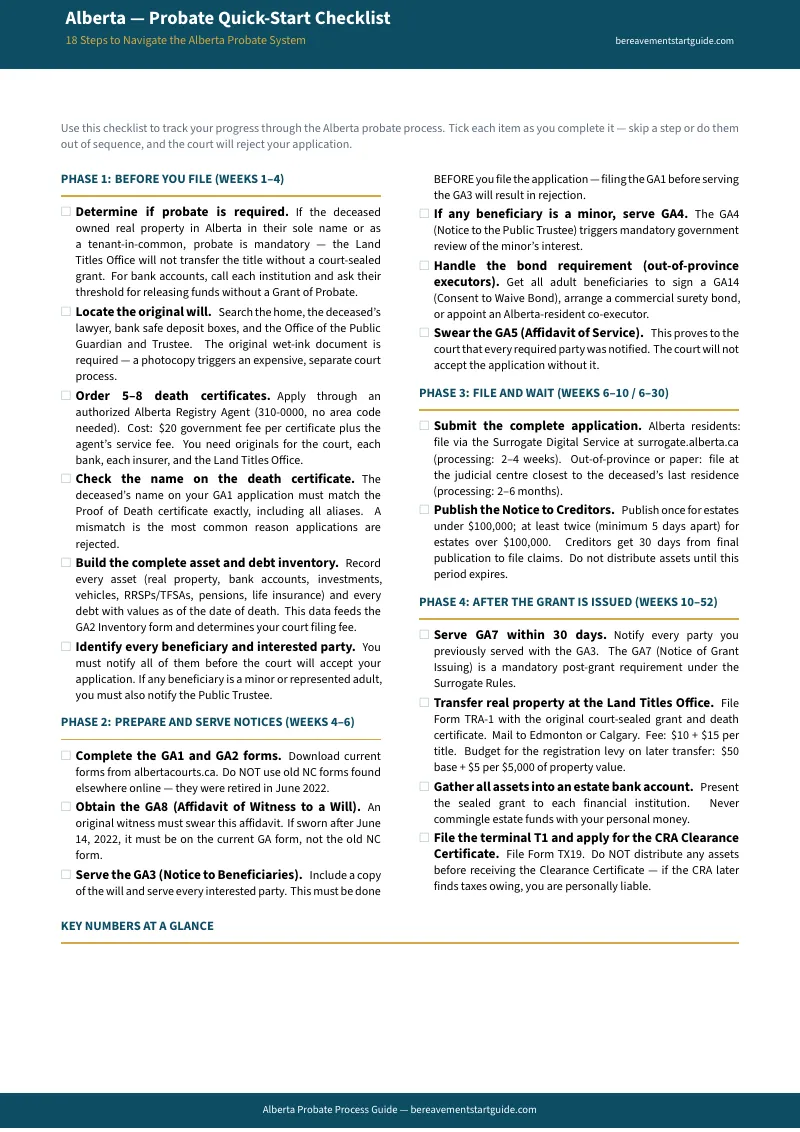
Not ready for the full guide? Download the free Alberta — Probate Quick-Start Checklist — 18 items covering every phase of the probate process, from the initial probate decision through post-grant requirements. It is enough to see the full picture and start gathering what you need.
You did not choose to be the executor. But the court does not wait, the bank does not wait, and the deadlines do not wait. The guide makes sure you do not miss any of them.