Your Spouse Just Died in Alberta. CPP Says You Might Get $5,000 — But Nobody Told You the Top-Up Is Void If They Ever Collected a Pension. Meanwhile the Bank Froze the Joint Account and Your Next Mortgage Payment Is Due in Nine Days.
You are in the worst week of your life, and the financial paperwork has already started. Service Canada needs a death notification to stop OAS payments before overpayments accumulate against the estate. The CPP Death Benefit application has a 60-day recommended window. Your surviving children may each qualify for $307.81 per month — but only if you apply separately from the adult pension. Alberta Health Care needs to know whether to switch your coverage from family to individual. And someone just told you the Seniors Property Tax Deferral loan gets recalled when the borrower dies — except it does not, if you are 55 or older and still living in the home. But nobody put that in the letter the program sent last year.
The information you need exists. It is scattered across Service Canada, Alberta Human Services, the Workers' Compensation Board, Alberta Blue Cross, the Alberta Seniors Benefit program, the Office of the Public Guardian and Trustee, and a dozen agency portals that do not reference each other. Each one explains its own piece accurately. None of them explain the sequencing — which benefit to apply for first, which applications interact, and which combinations can actually disqualify you from programs you desperately need. The survivor who applies for the $2,500 CPP Death Benefit before checking Alberta Funeral Benefit eligibility may have just surrendered provincial funeral assistance worth $4,601 — because the provincial program requires the federal benefit to be signed over as an offset.
The Alberta Survivor Benefits Navigator is a Benefits Sequencing System for every federal, provincial, and municipal financial entitlement available to surviving families in Alberta. Not a generic "after a death" checklist. Not a funeral home pamphlet that covers the first 48 hours and then leaves you on your own. A structured, Alberta-specific manual that maps the exact sequence of benefit applications — CPP Death Benefit, CPP Survivor's Pension, CPP Children's Benefit, WCB fatality benefits, Section B auto insurance death benefits, Victims of Crime compensation, Alberta Funeral Benefits, AISH survivor provisions, Alberta Seniors Benefit, Seniors Property Tax Deferral continuity, health coverage transitions, and surrogate court cost recovery — so you claim every dollar you are entitled to, in the right order, without accidentally disqualifying yourself from the programs that matter most.
What's Inside the Benefits Sequencing System
A 9-chapter guide and the Survivor Benefits Checklist — covering every benefit source from the moment of death through final estate distribution, built specifically for Alberta statutes and the province-specific rules that make claiming survivor benefits here different from anywhere else in Canada:
Cause-of-Death Funding: The First Question Nobody Asks
Before you pay a single dollar toward the funeral, this chapter makes you ask the question that determines everything: how did the person die? A workplace fatality unlocks up to $19,800 in WCB funeral coverage plus an immediate $2,652 incidental lump sum. A motor vehicle accident triggers Section B auto insurance death benefits up to $6,150. A violent crime activates the Victims of Crime program for up to $12,500 in funeral reimbursement. A veteran's death qualifies for $7,376 through the Last Post Fund. A low-income family or AISH recipient qualifies for the Alberta Funeral Benefit. The guide maps every cause-of-death funding source with eligibility criteria, dollar amounts, and the exact application sequence so you do not pay out of pocket when a government program should be covering the cost.
CPP Benefits: The Death Benefit, the Survivor's Pension, and the Cap Nobody Understands
The CPP Death Benefit is a lump sum of $2,500. A 2025 top-up can double it to $5,000 — but only if the deceased never received a CPP retirement or disability pension and has no eligible survivor. Most families apply for the top-up without realizing they are statutorily disqualified. The CPP Survivor's Pension pays up to $803.54/month (under 65) or $904.59/month (65+) — but if you are already collecting your own CPP retirement pension, the combined total is capped at the maximum single retirement pension. If both spouses received maximum CPP, the death of one spouse can result in zero additional survivor benefit. The guide includes the eligibility flowchart that tells you in five minutes whether the top-up applies, what the survivor pension cap means for your specific income, and the CPP Children's Benefit for dependents under 18.
Provincial Benefits: The Programs That Fall Through the Cracks
Alberta has survivor-specific programs that most families never discover because they sit in different government departments that do not cross-reference each other. The Seniors Property Tax Deferral Program lets a surviving spouse aged 55+ continue the deceased's property tax loan without repayment — preventing a forced sale during bereavement. The Alberta Seniors Benefit provides up to $1,200 in funeral expense assistance through Special Needs Assistance, but the application has a hard 12-month statutory deadline with no extensions. Coverage for Seniors gives automatic premium-free prescription drug, diabetic supply, and ambulance coverage to anyone 65+. The Alberta Adult Health Benefit covers survivors under 65 who fall below income thresholds. The guide maps every provincial program, its eligibility threshold, and the application deadline.
AIP Rights: The Common-Law Problem That Costs Families Thousands
Alberta uses the term "Adult Interdependent Partner" instead of common-law spouse — and the definition creates a trap. Federal CPP requires only one year of cohabitation to qualify for survivor benefits. Alberta provincial law requires three continuous years (or a child of the relationship). You may qualify for the federal pension but not the provincial intestate preferential share of $150,000, or vice versa. If the deceased died without a will and the biological family disputes your relationship, you need a statutory declaration backed by documentary proof — shared leases, joint accounts, shared utility bills. This chapter covers the exact documentation checklist and the legal distinction that separates families who receive their full entitlement from those who are shut out entirely.
Health Coverage, Creditors, Probate Cost Recovery, and Distribution
The remaining chapters cover AHCIP notification and the transition to individual coverage, Alberta Blue Cross cancellation or transfer, the complete surrogate court cost schedule (Alberta's probate fees are capped at $525 — far lower than Ontario or British Columbia), the GA15 creditor notice process that protects you from personal liability, the CRA Clearance Certificate timeline (allow 120 days for Form TX19), and the safe distribution sequence — the three conditions that must all be met before you pay a single beneficiary. Plus edge cases: the Dower Act conflict when the deceased owned a home and died without a will, Indigenous estates governed by the Indian Act, and executor incapacity provisions.
Who This Guide Is For
- The surviving spouse whose partner just died and whose household income was cut in half overnight — who needs to know every federal and provincial benefit they qualify for, the exact application sequence, and the CPP combined pension cap that will determine their actual monthly income going forward
- The Adult Interdependent Partner who was not legally married and is now facing questions about whether they qualify for survivor benefits at all — who needs the federal vs. provincial eligibility breakdown and the documentation checklist to prove AIP status
- The adult child managing a parent's estate who wants to make sure the surviving parent gets every benefit they are entitled to — who needs to apply for CPP Death Benefit, CPP Survivor's Pension, and provincial programs on their behalf without accidentally disqualifying them from funeral assistance
- The low-income family that cannot afford a $5,000+ funeral and needs to know that Alberta Funeral Benefits cover up to $4,601 for burial/cremation, $1,041 for the ceremony, and $781 for embalming — but that applying for the CPP Death Benefit first can offset the provincial amount
- The family of a worker killed on the job who does not realize that WCB provides up to $19,800 for funeral expenses, an immediate $2,652 incidental payment, a monthly survivor pension, vocational support, and 10 sessions of bereavement counseling per family member — all from a single WCB claim
Why Free Resources Will Not Get You Through This
The federal and provincial government pages each explain their own programs accurately. Here is what they do not do:
- Service Canada explains CPP but not Alberta. The CPP pages cover the Death Benefit, Survivor's Pension, and Children's Benefit. They do not mention WCB fatality benefits, the Alberta Funeral Benefit, the Seniors Property Tax Deferral continuity provision, or the AISH interaction. If WCB should be paying the funeral costs, applying to CPP first is the wrong sequence.
- Alberta.ca explains provincial programs in separate silos. The Alberta Funeral Benefit is on the Human Services page. The Seniors Property Tax Deferral is under Municipal Affairs. The Surrogate Court forms are on the Justice page. AHCIP is under Health. None of these pages link to each other or explain how the programs interact.
- Law firm blogs emphasize complexity to justify retainers. Alberta estate lawyers publish excellent breakdowns of executor duties and fiduciary liability. Their content is designed to convince you the process is too dangerous to handle alone — so you hire them at $250+ per hour.
- Funeral home pamphlets stop at the ceremony. They help with the first 48 hours. They do not cover CPP pension caps, property tax deferral transfers, AIP verification requirements, or the CRA Clearance Certificate timeline that determines when you can actually distribute the estate.
Free resources give you fragments from a dozen agencies that do not cross-reference each other. The Benefits Sequencing System puts every Alberta-specific benefit, deadline, and application sequence into one document, in the order you actually need them.
— Less Than One Hour of a Grief Counselor's Time
A single consultation with an Alberta estate lawyer costs $250 to $400 per hour. A financial planner charges $150+ to review your survivor income options. This guide costs less than one session and covers every federal, provincial, and municipal benefit available to Alberta survivors — the CPP Death Benefit, the Survivor's Pension cap calculation, WCB fatality benefits, auto insurance death benefits, Victims of Crime compensation, the Alberta Funeral Benefit, the Seniors Property Tax Deferral, health coverage transitions, and the creditor notification process that protects you from personal liability.
Your download includes the complete 9-chapter guide, the Survivor Benefits Checklist, and 6 standalone reference sheets — the Cause-of-Death Funding Map, CPP Eligibility Flowchart, AIP Verification Checklist, Provincial Benefits Directory, Health Coverage Transition Guide, and Safe Distribution Sequence. Print the ones you need and bring them to meetings with Service Canada, Alberta Supports, or your bank. Plus a money-back guarantee, no time limit. If the guide does not give you clarity on which benefits you qualify for and confidence that you are applying in the right order, email us for a full refund. No questions asked.
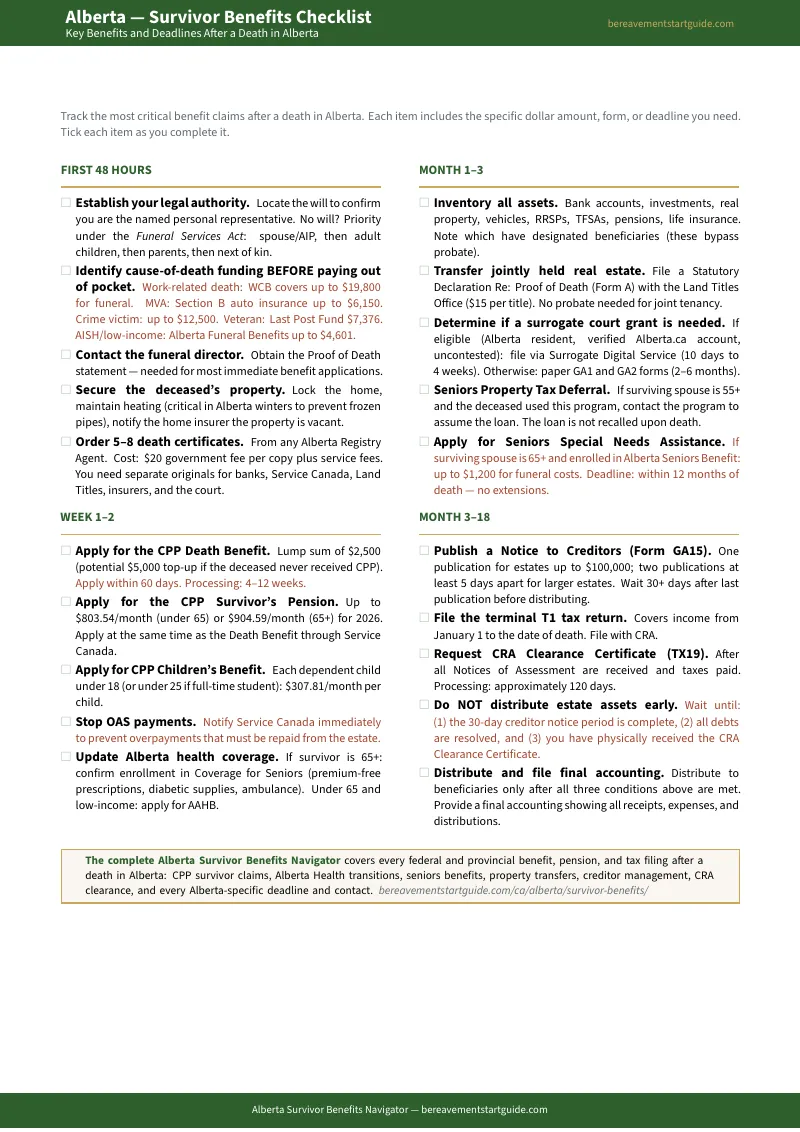
Not ready for the full guide? Download the free Alberta — Survivor Benefits Checklist — the 20-item action list covering CPP Death Benefit, Survivor's Pension, Children's Benefit, OAS notification, health coverage updates, property tax deferral continuity, surrogate court fees, creditor notices, and CRA Clearance. It is enough to see what lies ahead and start working through the most urgent steps tonight.
The benefits exist. The deadlines are real. The guide makes sure you claim every one of them, in the right order, before the windows close.