The Crematorium Will Not Release the Body. The Wills Notice Search Takes 20 Business Days. Your Siblings Cannot Agree on Burial or Cremation. And Nobody Told You That CIFSA Section 5 Already Decided Who Gets to Choose.
You are standing in a funeral home in British Columbia with a body in refrigeration, a stack of forms you have never seen before, and a clock that started the moment your family member died. The funeral director is asking who has the legal authority to sign the service contract. Your brother says he does because he was the closest. Your sister says she does because she is the eldest. The funeral director says nobody does until someone produces the will — and if the Wills Notice Search through BC Vital Statistics takes the standard 20 business days to process, the body stays in cold storage the entire time, accumulating daily sheltering fees that nobody warned you about.
Meanwhile, the funeral home has quoted $7,500 for a "standard" service. They have presented embalming as a regulatory requirement — it is not. They have offered a casket starting at $3,200 — you have the legal right to supply your own. They have not mentioned that you can request an itemized price list before signing any contract, or that Consumer Protection BC requires them to give you one. And somewhere underneath the grief and the paperwork and the family arguments, one question keeps circling: are we paying for things the law says we can refuse?
The answer, in most BC funeral arrangements, is yes. Not because funeral directors are acting in bad faith, but because families do not know what the Cremation, Interment and Funeral Services Act actually requires versus what the industry presents as standard practice. The gap between what you are legally obligated to pay and what you end up paying — on non-mandatory embalming, bundled service packages you could purchase a la carte, and casket markups you could avoid entirely — is routinely $500 to $2,000. And that gap only exists because nobody explained your rights during the 48 hours when every decision felt urgent.
The British Columbia Funeral Laws & Consumer Rights Guide is a Provincial Rights Defense System — one document that bridges the gap between BC's legal protections and the practical steps you need to exercise them. Not a generic Canadian pamphlet. Not a funeral home brochure dressed up as consumer education. A structured, BC-specific manual covering every right, form, fee, deadline, and negotiation tactic available under CIFSA, WESA, and Consumer Protection BC regulations — so you stop guessing, stop overpaying, and start making decisions based on the actual law.
What's Inside the Provincial Rights Defense System
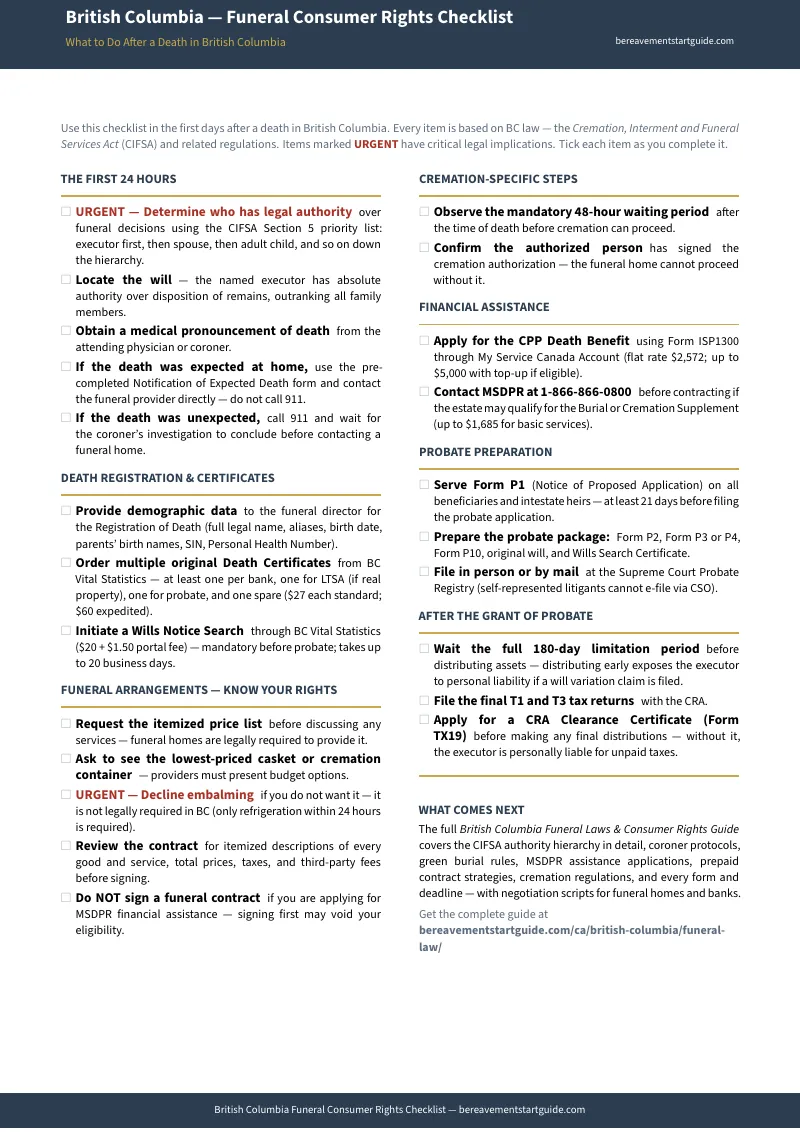
A 14-chapter guide and the Funeral Consumer Rights Checklist — covering every step from the moment of death through probate, LTSA property transfers, and CRA clearance, built specifically for British Columbia's unique regulatory framework:
Chapter 1: Who Has the Legal Right to Make Funeral Decisions
Section 5 of CIFSA establishes a strict ten-level hierarchy: executor first, then spouse, then adult child, then adult grandchild, and so on down the list. Funeral providers are legally barred from proceeding when family members dispute authority. If three adult siblings disagree on cremation versus burial, BC law assigns sole authority to the eldest — a tie-breaker most families never learn about until thousands of dollars in sheltering fees have accumulated. This chapter gives you the full hierarchy, explains how "spouse" is defined under WESA (two years of continuous marriage-like cohabitation — not one year like the CRA definition), and covers the critical mistake that costs families the most: assuming an Enduring Power of Attorney or Representation Agreement gives you authority over funeral arrangements after the person has died. It does not.
Chapter 2: The First 48 Hours
Whether the death was expected at home under palliative care (call the care team, not 911) or sudden and unexpected (the BC Coroners Service takes jurisdiction), everything that follows hinges on what you do in these first two days. This chapter covers the Medical Certificate of Death, how many original death certificates to order and at what cost ($27 standard, $60 expedited), and the one action that prevents the most expensive mistake families make: choosing a funeral home under time pressure without requesting the itemized price list first.
Chapter 3: The Wills Notice Search — The Timeline That Nobody Warns You About
Before probate can proceed, BC requires a formal Wills Notice Search through the Vital Statistics Agency. Cost: $20 plus the $1.50 portal fee. Processing time: up to 20 business days. This creates a direct collision with families who want cremation as soon as the mandatory 48-hour post-death waiting period expires — because funeral homes need proof of executor authority before proceeding. This chapter explains how to sequence the search, what to do if a second will surfaces, and how to manage refrigeration costs during the waiting period.
Chapter 4: Your Consumer Rights at the Funeral Home
This is the chapter that pays for the entire guide. BC funeral homes must provide an itemized price list. You have the legal right to purchase any service a la carte — bundled "packages" are a business decision, not a legal requirement. You can bring your own casket, urn, or shroud from any third-party vendor, and the funeral home cannot legally refuse it or charge a handling fee. Embalming is not required by BC law — only refrigeration within 24 hours of receipt is mandatory. This chapter includes exact scripts for declining non-mandatory services, requesting itemized pricing, confirming no handling fees on third-party merchandise, and exercising your right to see the lowest-priced options for every category.
Chapter 5: Preneed Contracts — The 15-Day Window Most Families Miss
BC preneed funeral contracts come with a mandatory 15-day cooling-off period for a full refund. Funeral homes must deposit prepaid funds into a trust account within 20 to 21 days. After the cooling-off period, the rules around cancellation fees change significantly. This chapter covers how to review a preneed contract left by the deceased, how to cancel or transfer one, and how to verify that the trust funds are actually being held in a compliant account — not commingled with the funeral home's operating revenue.
Chapter 6: Private Transfers, Home Funerals, and Alternative Disposition
You can legally transport a body in a private vehicle in British Columbia. The permit is free. You need a rigid, leak-proof container and the body must not be visible to the public during transport — but you do not need to hire a funeral home for this service. If you want a home funeral, a vigil, or a natural burial, BC law allows all of these under specific conditions. Private cemeteries require a Certificate of Public Interest from Consumer Protection BC, costing $1,552 to $1,645 — with a permanent covenant restricting future land development. This chapter covers every alternative disposition option with the specific BC regulations that apply to each.
Chapter 7: Financial Assistance
The MSDPR Burial or Cremation Supplement covers up to $1,685 for basic services — but you must apply before signing a funeral contract. The CPP Death Benefit is a flat $2,572, with a new $2,500 top-up (maximum $5,000) available since January 2025 if the deceased never collected CPP retirement or disability benefits. The April 2026 MSDPR policy update removed separate embalming funding while increasing transport reimbursement to $1.25/km. This chapter walks through every application step, every eligibility criterion, and the exact sequence that preserves your eligibility for provincial assistance.
Chapters 8–14: Probate, LTSA Transfers, Tax Obligations, Insolvent Estates, Edge Cases, Deadlines, and Key Contacts
The guide continues well beyond the funeral itself. Chapter 8 covers the Supreme Court of BC probate process — Form P1 service requirements, the 21-day waiting period, filing at the Probate Registry, and the 180-day limitation period before safe asset distribution. Chapter 9 covers real property transfers through the Land Title and Survey Authority. Chapter 10 covers CRA tax obligations and the Clearance Certificate process. Chapter 11 covers insolvent estates where funeral expenses take statutory priority over most creditors. Chapter 12 covers edge cases: coroner investigations, religious timeline accommodations, deaths of minors, and Indigenous community protocols. Chapter 13 is a complete deadline summary. Chapter 14 is a contacts reference for every agency you may need to reach.
Who This Guide Is For
- The executor or next-of-kin sitting in a funeral home right now being asked to sign a contract — who needs to know exactly which charges are mandatory, which can be refused, and what Consumer Protection BC requires the funeral home to disclose before you sign anything
- The family in a dispute where siblings or relatives disagree on cremation versus burial and the funeral home has frozen all arrangements — who needs the CIFSA Section 5 statutory hierarchy and the eldest-child tie-breaker rule to establish who has the legal authority to make the final decision
- The common-law partner who may not qualify as a "spouse" under WESA's strict two-year cohabitation requirement — who needs to understand their actual legal standing before the deceased's estranged family members assume authority
- The financially constrained family who received a funeral home quote exceeding every available dollar — who needs the MSDPR application process, the CPP death benefit top-up eligibility check, and the cost-saving strategies that funeral homes are not financially incentivized to volunteer
- The out-of-province family member managing funeral arrangements from Alberta, Ontario, or outside Canada — who needs to understand BC's Wills Notice Search timeline, the 48-hour cremation waiting period, and how the death certificate process works before coordinating remotely
- The advance planner reviewing a loved one's preneed contract or documenting their own end-of-life wishes — who needs to understand the 15-day cancellation window, the trust fund deposit rules, and how to verify that prepaid funds are protected
Why Free Resources Will Not Protect You at the Funeral Home
The information exists. It is scattered across Consumer Protection BC, the Vital Statistics Agency, the BC Coroners Service, MSDPR, the Peoples Law School, and a dozen funeral home blogs designed to generate appointments rather than protect your wallet. Here is what you actually encounter when you try to piece together your consumer rights from free sources alone:
- Consumer Protection BC publishes the regulations but reads like a legal reference manual. Accurate and authoritative — and buried in dense, cross-referenced sections written for industry compliance officers, not for a grieving family trying to understand their rights before signing a contract in 48 hours.
- Funeral home websites answer questions that funnel you toward their services. They explain what embalming involves. They do not explain that you have the legal right to refuse it. They display their casket selection. They do not explain that you can bring your own from any third-party vendor. Every article is designed to demonstrate expertise and generate leads.
- Google surfaces the wrong jurisdiction constantly. British Columbians searching "funeral consumer rights" or "cancel prepaid funeral contract" routinely see Alberta's 30-day cancellation window (BC's is 15 days), the US Federal Trade Commission's Funeral Rule (which has zero legal force in Canada), or Ontario's Bereavement Authority rules. Acting on out-of-jurisdiction advice in a time-sensitive funeral situation costs real money.
- The Memorial Society of BC connects you to contracted providers, not independent advocacy. Their pre-negotiated rates are genuinely helpful — if you happen to use one of their partner funeral homes. Their $50–$60 lifetime membership fee and $35 record fee fund a sophisticated industry partnership, not consumer defense against aggressive pricing.
- Legal non-profits offer excellent summaries but stop at the funeral home door. Peoples Law School and Clicklaw BC provide clear plain-language overviews of CIFSA and WESA. They do not provide negotiation scripts, cost-saving strategies, or the practical step-by-step guidance for challenging a funeral director who insists on bundled services you do not want.
Free resources give you fragments from a regulator who writes for compliance officers, funeral homes who write for sales, and search engines that cannot tell BC from Alberta. The Provincial Rights Defense System puts every BC-specific right, form, fee, and script into one document, in the order you actually need them.
— Less Than One Line Item on a Funeral Invoice
The average BC funeral costs between $5,000 and $12,000. Families who do not know their rights routinely pay $500 to $2,000 more than necessary — on non-mandatory embalming, bundled service charges they could have purchased a la carte, casket markups they could have avoided by sourcing from a third-party vendor, and daily sheltering fees that accumulated while nobody explained the Wills Notice Search timeline. This guide costs less than one item on a funeral invoice and gives you the legal knowledge to evaluate every line on that invoice before you sign.
Your download includes the complete 14-chapter guide, the British Columbia Funeral Consumer Rights Checklist (20 items covering the first days after a death), and 6 standalone reference sheets you can print individually — negotiation scripts, the CIFSA authority hierarchy, the Wills Notice Search timeline, the private transfer guide, the financial assistance reference, and the preneed contract defense sheet. Plus a money-back guarantee, no time limit. If the guide does not give you clarity on your rights and confidence that you are making informed decisions, email us for a full refund. No questions asked.
Not ready for the full guide? Download the free British Columbia Funeral Consumer Rights Checklist — 20 items covering who has legal authority, what to demand before signing any contract, when embalming can be refused, the 48-hour cremation waiting period, and the critical difference between mandatory permits and optional services. It is enough to walk into a funeral home tonight knowing your rights.
You should not have to become an expert in CIFSA and WESA while you are grieving. But you should not have to overpay because nobody told you the law was already on your side.