You Were Named Executor. The BC Supreme Court Requires Ten Forms Filed in a Sequence Nobody Publishes. The Registry Rejects Applications for a Wrong Date Format. And Even After the Grant Is Issued, WESA Prohibits You From Distributing a Single Dollar for 210 Days.
Someone you loved has died, and now you are holding a stack of Supreme Court forms — P1 through P10 — that reference legislation you have never read and demand a filing sequence that is not explained anywhere on the BC government website. Form P1 must be delivered to every beneficiary and intestate heir exactly 21 days before Form P2 can be submitted. Form P10 requires you to swear the total value of the estate under oath, but the rules for what counts as gross value versus what you can deduct are buried across the Probate Fee Act, WESA, and the Land Title Act. You missed a beneficiary on the P1 notice. The registry clerk rejected the entire application. You are now eight weeks further from a resolution than you were this morning.
You searched for help. The BC government website has the forms, but no instructions that explain the filing order. People's Law School has excellent plain-English summaries, but no annotated form examples, no asset valuation worksheets, and no fee calculator. Law firm blogs explain the complexity — then quote $300 per hour for a process the Supreme Court explicitly designed for self-represented applicants. You checked Reddit. The top comment applied Ontario's estate administration tax rules to your British Columbia question. Self-Counsel Press sells a probate kit, but the delivery format is a ZIP file of Word documents and the text reads like a legal textbook, not an operational filing guide.
Here is what nobody connects for you: British Columbia's probate fee structure is tiered and the math directly rewards accurate valuations — registered mortgages on real property are deductible, but unsecured debts are not. The mandatory 21-day notice period has strict rules about who qualifies as a "person entitled" under WESA, and missing a single required recipient resets the clock. Virtual commissioning lets you swear affidavits remotely via video conference, but the Law Society requires a specific jurat modification that registries will reject if the wording is wrong. And WESA Section 155 prohibits distributing estate assets for 210 days after the Grant is issued — a rule that exists to protect the wills variation claim window but that no free resource explains in terms of what it actually means for your family's timeline.
The British Columbia Probate Process Guide is a Registry-Ready Filing System for the complete BC probate process — from the initial question of whether probate is even required through the CRA clearance certificate and final distribution. Not a generic Canadian probate overview that confuses Ontario's percentage-based tax with BC's tiered fee structure. Not a law textbook. A 12-chapter, BC-specific manual built around the current Supreme Court Civil Rules form series, the WESA notice requirements, and the Land Title and Survey Authority transmission process — so your application passes the registry clerk's review the first time.
What's Inside the Registry-Ready Filing System
A 12-chapter guide with 3 appendices and a standalone Probate Quick-Start Checklist — covering every stage from the probate decision through final distribution, built specifically for the BC Supreme Court as the forms and rules exist right now:
Chapter 1: Do You Actually Need Probate?
Not every BC estate needs a trip to the Supreme Court. Joint tenancy property passes automatically to the surviving owner. RRSPs, TFSAs, and life insurance with named beneficiaries bypass the estate entirely. This chapter gives you the decision framework: the real property check (the LTSA will unconditionally require a grant for solely owned property), the financial account threshold check (each bank sets its own internal limit — some release up to $50,000 with an indemnity agreement, others demand a grant for accounts as small as $15,000), and the $25,000 threshold myth. The Probate Fee Act exempts estates under $25,000 from percentage fees. But the bank's risk department, not the law, makes the final call on releasing funds.
Chapter 2: Immediate Actions — Days 1 to 14
Funeral arrangements and your consumer rights under the Cremation, Interment and Funeral Services Act. Low-income funeral assistance from the BC Ministry of Social Development and Poverty Reduction (pre-approval required before contracting with a funeral provider). Securing the residence and the vacant-property insurance trap — most standard policies void coverage after 30 days of vacancy without a permit. First notifications to the CRA, Service Canada for the CPP Death Benefit, and BC Vital Statistics for certified death certificates.
Chapter 3: The Wills Notice Search
The search most executors do not discover until it delays their timeline. Form VSA 532 must be submitted to BC Vital Statistics with a certified death certificate copy. Cost: approximately $20 per name plus $5 per alias. Processing: up to 20 business days by mail from Victoria, and most Service BC locations cannot process it. The Wills Notice Search certificate is required before the probate application can be filed — and the wait time is non-negotiable.
Chapter 4: Building the Estate Inventory
The asset and debt inventory that feeds directly into Form P10 — the most complex and consequential form in the entire application. How to contact each financial institution for fair market values as of the exact date of death. Running LTSA title searches to confirm property ownership structure. How to handle banks that refuse to release even account balance information without a grant (Form P18 compels disclosure). The distinction between probate assets and non-probate assets that determines both what appears on P10 and what your fee calculation is based on.
Chapter 5: The P-Form Filing Sequence
This is the chapter that does not exist in any free resource. The BC Supreme Court requires Forms P1 through P10 in a strict chronological sequence. Form P1 — the Notice of Proposed Application — must be delivered to every beneficiary, alternate executor, intestate successor, and the Public Guardian and Trustee if any beneficiary is a minor or incapable adult. Then you wait 21 clear days. Only after the waiting period expires can you complete and file Form P2 (Submission for Estate Grant), Form P3 or P4 (Affidavit of Applicant), Form P9 (Affidavit of Delivery proving P1 service), and Form P10 (Affidavit of Assets and Liabilities). Filing early or missing a required P1 recipient sends the entire application to the back of the processing queue — months of additional delay.
Chapter 6: Fee Calculation Under the Probate Fee Act
The exact tiered math: $0 on the first $25,000. Then $6 per $1,000 (0.6%) on the portion between $25,000 and $50,000. Then $14 per $1,000 (1.4%) on everything above $50,000. Plus a flat $200 court filing fee. Registered mortgages on real property are deducted before calculating the fee. Unsecured debts — credit cards, lines of credit, personal loans — are not deductible. On a typical Lower Mainland estate with a $1.2 million home and a $400,000 mortgage, the probate fee on the real estate alone is approximately $10,780. The guide includes a worksheet for calculating the exact fee for any estate composition.
Chapter 7: Virtual Commissioning
The Law Society of BC permits affidavits (Forms P3 and P10) to be sworn via video conference rather than requiring physical presence. The commissioner must modify the standard jurat to state the deponent was in their "electronic presence." The specific language matters — an improperly worded jurat will cause the registry to reject the affidavit. This chapter provides the exact wording, explains which BC notary services handle remote probate commissioning, and covers what identification the commissioner must verify on camera.
Chapter 8: Filing and Processing
How to file through Court Services Online (CSO) using a Basic BCeID, or in person at a Supreme Court registry. Even with electronic filing, the original paper will must be physically submitted. Current processing times by registry: Vancouver routinely takes 8 to 16 weeks for a complete, error-free application. Smaller regional registries (Victoria, Kelowna, Prince George) may process in 2 to 6 weeks. What causes applications to be sent to the back of the queue, and how to check status.
Chapter 9: Real Property and the Land Title Office
For most BC families, the house is the largest estate asset and the primary reason probate is needed. Two paths: joint tenancy property transfers automatically via a death certificate filed with the LTSA (no probate required). Sole-ownership property requires a formal Transmission to Personal Representative after the Grant is issued. The Property Transfer Tax exemption for related individuals. The LOTA Transparency Declaration that catches executors by surprise. And the critical rule most families learn too late: you can list the property for sale before probate, but you cannot close the sale or transfer title to the buyer until the Grant is received and the transmission is registered.
Chapter 10: The 210-Day Distribution Lock
Section 155 of WESA prohibits distributing any estate assets for 210 days after the Grant of Probate is issued. This protects the 180-day limitation period for Wills Variation claims under Part 4 of WESA, plus 30 days for service. If you distribute early and a successful claim is later filed, you are personally liable for recovering the funds. The exception: distribution is permitted only if every beneficiary and every person who would inherit on intestacy provides written consent, and no variation claim has been filed or threatened. The guide includes template consent letters and a pre-written family communication letter explaining why the seven-month wait is legally mandated — not a result of your negligence.
Chapters 11–12: CRA Obligations and Final Distribution
The terminal T1 return, deemed disposition of capital property at fair market value on the date of death, the T3 trust return if the estate earns income during administration, and the Form TX19 Clearance Certificate application (allow 120 days for processing). Why distributing before clearance makes you personally liable for the estate's tax debt. Creditor notice requirements under BC Gazette publication rules, the minimum 30-day claim period, the debt payment priority order, and the final statement of accounts that must balance to the penny before beneficiaries receive their distributions.
Appendices: Intestate Estates, Contested Wills, and Resources
If there was no will: the WESA intestacy distribution rules, who has priority to apply for a Grant of Administration, the preferential share for surviving spouses, and the parentelic system for determining inheritance order. When you need a lawyer: contested wills, Wills Variation claims, estates with minor or incapable beneficiaries requiring PGT involvement, and insolvent estates. Plus the complete contact directory for every registry, government agency, and resource referenced in the guide.
Who This Guide Is For
- The newly named executor who has never filed a court document and needs the Supreme Court P-form sequence translated into plain language with the filing order, the 21-day notice rules, and the common rejection triggers explained step by step — before making an error that costs months of delay
- The surviving spouse who needs to know whether joint tenancy, named beneficiaries, and the $25,000 threshold mean the estate can be settled without going to court — and what still must be done even if probate is not required
- The DIY executor on a budget who knows that BC's Supreme Court does not require legal representation for uncontested estates — and needs a guide that replaces a $300-per-hour lawyer for routine procedural questions, while clearly identifying the complications that genuinely require professional help
- The out-of-province executor managing a BC estate from another province or country who needs to know which steps can be completed remotely through virtual commissioning and courier, and which require physical attendance at the Supreme Court registry
- The executor under family pressure who needs an authoritative, standardized timeline to show impatient beneficiaries that the 21-day notice period, the 8-to-16-week registry processing, and the 210-day distribution lock are legal requirements — not evidence of delay or negligence
Why Free Resources Will Not Get You Through This
The information exists. It is scattered across the BC Supreme Court website, the provincial government portal, the Land Title and Survey Authority, People's Law School, Clicklaw, MyLawBC, Service Canada, and the CRA. Here is what you encounter when you try to assemble the process from free sources alone:
- The Supreme Court publishes the forms but not the filing sequence. Forms P1 through P10 are downloadable PDFs. What is not published: the exact order in which they must be completed, the requirement to serve P1 notices 21 days before filing P2, the specific circumstances that trigger a PGT notification, or the common errors — wrong date formats, missing exhibit stamps, cached outdated form versions — that cause clerk rejections. The forms are there. The instructions to use them correctly are not.
- People's Law School and Clicklaw explain the law, not the workflow. These are excellent, plain-English legal education resources. They tell you what WESA requires. They do not provide annotated form examples, editable asset valuation worksheets, fee calculation tools, or operational templates for the 21-day notice process. They educate. They do not operate.
- Law firm blogs explain the complexity to justify retainer fees. Probate lawyers publish SEO-optimized articles answering specific questions — fee calculators, timeline expectations, form overviews. Each article concludes with a call to book a consultation. For contested estates, that advice is appropriate. For uncontested estates with a clear will and cooperative beneficiaries, the same answers cost a fraction of a legal retainer.
- Reddit applies the wrong province's rules. The most common error on r/PersonalFinanceCanada and r/legaladvicecanada is applying Ontario's 1.5% Estate Administration Tax to British Columbia questions. BC uses a tiered percentage structure that starts at 0.6% and caps at 1.4%. Ontario advice applied to a BC estate means either overpaying a lawyer for work you could handle yourself, or missing BC-specific requirements like the Wills Notice Search and the 210-day distribution lock that Ontario does not have.
- Bank and trust company checklists are national, not provincial. Scotiatrust, RBC Wealth Management, and TD Trust all publish executor checklists. They are generic pan-Canadian documents that do not reference BC's specific P-form sequence, the tiered fee structure under the Probate Fee Act, the 21-day WESA notice period, the LTSA transmission process, or the 210-day distribution rule. They are marketing collateral for wealth management services, not filing instructions.
Free resources give you forms without filing instructions, legal education without operational tools, and advice from the wrong province. The Registry-Ready Filing System puts every BC-specific form, fee, deadline, and filing step into one document, in the order the Supreme Court registry actually requires them.
— Less Than Fifteen Minutes With a BC Probate Lawyer
A single consultation with a BC probate lawyer costs $250 to $400 per hour. Standard probate representation starts at $2,500 plus a percentage of the gross estate value. For a $1 million estate in the Lower Mainland, that is thousands in legal fees — for a process the Supreme Court designed to be accessible to self-represented applicants. This guide costs less than fifteen minutes of professional legal time and gives you the complete BC-specific filing system — every P-form in sequence, every registry rejection trigger flagged, every fee calculated, and the virtual commissioning procedure that lets you swear affidavits without leaving your home.
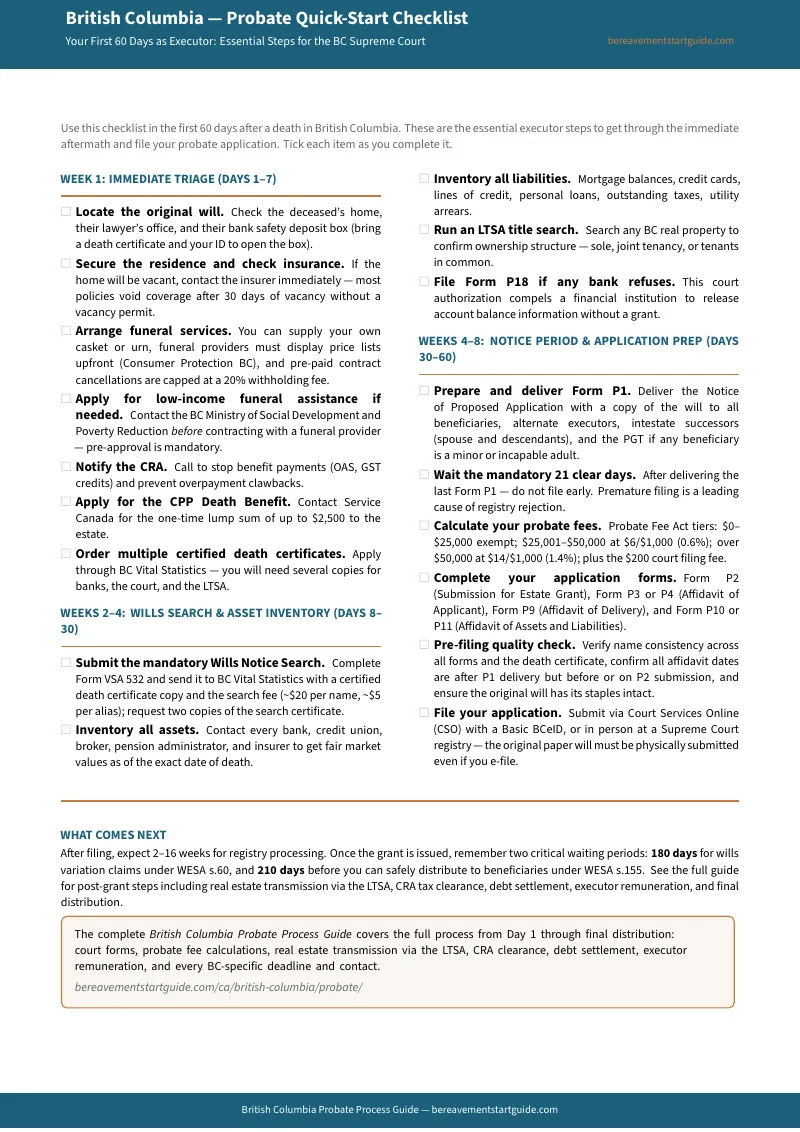
Your download includes 8 PDFs: the complete 12-chapter guide with 3 appendices, the standalone Probate Quick-Start Checklist (20 items across 3 phases), plus 6 printable standalone reference sheets — the P-Form Filing Sequence, Fee Calculation Worksheet, Real Property Transfer Guide, Virtual Commissioning Procedure, 210-Day Distribution Lock (with a template family letter), and CRA Clearance Timeline. Plus a money-back guarantee, no time limit. If the guide does not give you clarity on what to do next and confidence that your application will pass the registry clerk's review, email us for a full refund.
Not ready for the full guide? Download the free British Columbia — Probate Quick-Start Checklist — 20 items covering the first 60 days, from securing the residence and ordering death certificates through calculating your probate fees and filing your application. It is enough to see the full picture and start gathering what you need.
You did not choose to be the executor. But the registry does not wait, the 21-day notice period does not pause, and the carrying costs on an empty house do not stop. The guide makes sure you do not miss any of it.