Service Canada Will Take 6 to 12 Weeks to Process Your CPP Death Benefit. The Funeral Home Wants Payment in 30 Days. And if You Distribute Estate Assets Before the CRA Clearance Certificate Arrives, You Become Personally Liable for Every Dollar of Undiscovered Tax Debt.
Your spouse or parent has just died in British Columbia, and you are now standing at the intersection of three bureaucracies that were not designed to work together. Service Canada handles the CPP Death Benefit and survivor pensions — but will not tell you that receiving the survivor pension changes your BC Seniors Supplement calculation. The BC Supreme Court runs probate through a rigid sequence of forms P1 through P11 — but will not explain that unstapling the original will to make copies creates a legal presumption of tampering that forces you into an entirely different affidavit process. The CRA requires a TX19 Clearance Certificate before you can distribute a single dollar to beneficiaries — but the processing time is 4 to 6 months for domestic estates and up to 17 months when non-resident beneficiaries trigger the Section 116 clearance.
Meanwhile, the funeral director needs a deposit. The mortgage payment is due. The property taxes are accumulating. Your siblings are asking when they get their share. The bank has frozen the accounts. And every government website you visit gives you technically accurate information about its own piece of the puzzle while failing to mention any of the others.
The free resources are not wrong. They are incomplete. Service BC covers provincial programs but ignores how they interact with federal benefits. Legal blogs explain probate forms with meticulous precision — because their business model depends on you feeling overwhelmed enough to call for a $300-per-hour consultation. Financial advisors explain how survivor pensions affect retirement income — but will not tell you how to fill out Form APV9T to transfer a vehicle at ICBC or where to file an LTSA joint tenancy transmission to update the property title. Nobody connects the federal layer to the provincial layer to the institutional layer in the order you actually need to execute it.
The British Columbia Survivor Benefits Navigator is a Cross-System Administration Bridge — one document that integrates federal, provincial, and institutional processes into a single chronological workflow. Not a government pamphlet repackaged with better formatting. Not a law firm blog designed to generate anxiety and billing hours. A structured, BC-specific operations manual that tells you exactly which form to file, which agency to contact, which deadline will cost you thousands if you miss it, and which bureaucratic sequence to follow so that one application does not accidentally disqualify another.
What's Inside the Cross-System Administration Bridge
A 13-chapter guide with benefit claim tracker and deadline reference — organized chronologically from the first 48 hours through final estate closure, built specifically for British Columbia's unique intersection of federal, provincial, and institutional systems:
The First 48 Hours
Secure the residence, locate the original will (and understand why scanning an eWill to PDF creates a legal problem that requires a Form P45 affidavit), order 6 to 8 death certificates from BC Vital Statistics ($27 standard, $60 courier), search the BC Wills Registry ($17 notice fee plus $20 search fee), and call Service Canada immediately to halt CPP and OAS payments before overpayments accumulate. This chapter covers the critical sequence that most families get wrong: which notifications must happen first to prevent downstream problems with every other application.
Funding the Funeral
The CPP Death Benefit is $2,572 flat — but it takes 6 to 12 weeks to arrive. If you need funds immediately: the BCEA funeral supplement covers up to $1,685 for basic services, but only if you apply before signing a funeral contract. If the death was a motor vehicle collision, ICBC reimburses up to $10,839 in funeral expenses. If it was occupational, WorkSafeBC covers funeral costs up to an annually adjusted maximum. If the deceased was a veteran, the Last Post Fund provides additional coverage. This chapter maps every available source and the exact sequence that preserves eligibility for each one — because the Ministry of Social Development will automatically deny retroactive claims.
Federal Survivor Pensions and Benefits
The CPP Survivor's Pension, the CPP Children's Benefit ($307.81/month per child), the OAS Allowance for the Survivor (up to $1,682.15/month for spouses aged 60 to 64 with annual net income below $30,336), and the 2025/2026 CPP Death Benefit top-up rules that have already confused thousands of families. The research found widespread misunderstanding about the top-up: the additional $2,500 is only available if the deceased never collected a retirement or disability pension AND no survivor pension is payable. Most surviving spouses reading headlines about a "$5,000 death benefit" will qualify for only the base amount. This chapter sets correct expectations and walks you through Forms ISP1200 and ISP1300 with the specific documentation requirements for each.
Provincial Benefits and Supplements
The BC Seniors Supplement (an automatic top-up whose calculation changes when the CPP Survivor Pension kicks in — timing matters), the BC Property Tax Deferment Program (surviving spouses of any age qualify, not just those over 55), the BC Home Owner Grant (up to $1,045 that you can retroactively claim on behalf of the deceased), and the BC Family Benefit for families with children under 18. This is the chapter that no federal resource covers and no provincial resource connects to the federal layer.
BC Probate — Forms P1 Through P11
A complete plain-English walkthrough of the Supreme Court probate process: serving Form P1 (Notice of Proposed Application) to every beneficiary and the PGT, observing the mandatory 21-day waiting period, assembling the filing package (Forms P2, P3/P4/P5, P9, P10/P11), and calculating probate fees on BC's tiered schedule — $0 on the first $25,000, 0.6% on the next $25,000, and 1.4% on everything above $50,000, plus a $200 court filing fee. Where to file in person (Vancouver, New Westminster, Victoria, Kamloops, Kelowna, Prince George, and 37 other locations) and how to e-file via Court Services Online. What happens if someone files a Form P29 Notice of Dispute. When and why to file Form P17 to renounce executorship entirely.
Property and Vehicle Transfers
LTSA joint tenancy transmission using Property Transfer Tax Exemption 08 (10 to 14 days, no property transfer tax). ICBC vehicle transfers using Form APV9T and Form MV1476 for estates under $25,000 (no probate required). What happens when the estate exceeds $25,000 and ICBC demands a Grant of Probate. How to retain a license plate as a keepsake. The common mistake that stalls everything: assuming joint tenancy means the property title updates automatically. It does not.
Tax Obligations and CRA Clearance
The final T1 return, the strategic value of Optional Returns for Rights or Things under Section 70(2) that can save the estate thousands by splitting income across tax brackets, and the TX19 Clearance Certificate that takes 4 to 6 months (or 14 to 17 months with non-resident beneficiaries who trigger the Section 116 T2062 process). The single most important rule in this chapter: distributing estate assets before the clearance certificate arrives makes the executor personally liable for any undiscovered tax debts, up to the full value of the distributed assets.
WorkSafeBC and ICBC Death Benefits
How to determine which jurisdiction applies when someone dies in an accident. WorkSafeBC lump sums and monthly survivor pensions for occupational fatalities. ICBC Enhanced Care's minimum $79,525 spousal death benefit and dependent payouts ranging from $37,771 to $71,229. What to do when a claim is denied — the WorkSafeBC Review Division and WCAT appeal path versus ICBC's internal review and the Civil Resolution Tribunal.
Minor Beneficiaries and the Public Guardian and Trustee
Under WESA Section 153, if a minor child inherits money and the will does not create a specific trust, the executor must transfer the funds to the PGT. The PGT holds them until the child turns 19. Parents cannot access this money for household expenses. The only alternative: a court application under Section 179 of the Family Law Act to be appointed as trustee — which is not automatic and not free. This chapter explains the PGT rules, the court application process, and why beneficiary designations on life insurance and RRSPs can bypass the PGT entirely.
Edge Cases
Intestacy under WESA (the $300,000 or $150,000 preferential share formula that frequently forces the sale of the family home). Section 60 wills variation claims (the 180-day window during which a spouse or child can ask the Supreme Court to rewrite a valid will). Indigenous estates governed by the Indian Act instead of WESA. Insolvent estates and the Bankruptcy and Insolvency Act priority cascade. CRA optional returns that can save thousands in taxes — and the deadline that permanently destroys the opportunity if missed.
Benefit Claim Tracker and Deadline Reference
A printable tracker template for every agency application (Service Canada, CRA, BC Vital Statistics, LTSA, ICBC, WorkSafeBC, MSDPR, BC Ministry of Finance) with columns for submission dates, tracking numbers, processing times, and status. A complete deadline reference covering the 60-day CPP executor priority, the 21-day probate waiting period, the 180-day wills variation window, the 12-month retroactive CPP limit, the 90-day reconsideration deadline, CRA filing deadlines, and the BCEA pre-approval requirement.
Who This Guide Is For
- The surviving spouse whose household income just dropped and who needs to know exactly which pensions, supplements, and deferment programs are available — and the precise sequence to apply so that one benefit does not reduce another
- The adult child named as executor who has never filed a Supreme Court form in their life and is now personally liable for every administrative decision they make — from probate fees calculated incorrectly to estate assets distributed before the CRA clearance certificate arrives
- The family with minor children who just discovered that the Public Guardian and Trustee will seize their child's inheritance unless a specific trust was created in the will — and who needs to understand the court application alternative before funds are transferred
- The cross-border executor managing a BC estate from Alberta, Ontario, or outside Canada — who needs to understand the Section 116 clearance process, the 25% withholding tax risk, and the 14-to-17-month timeline before making any distribution commitments to non-resident beneficiaries
- Any family trying to avoid $300-per-hour legal fees for routine estate administration — who wants the clarity of professional guidance without the hourly billing that most simple, uncontested estates do not require
Why Free Resources Leave You Exposed
Every fact in this guide exists somewhere on a government website. The problem is not accuracy — it is integration. Here is what you encounter when you try to assemble BC survivor benefits guidance from free sources alone:
- Service Canada explains the CPP Death Benefit and survivor pensions in detail — but does not mention that receiving the survivor pension changes the BC Seniors Supplement calculation, or that the executor has only 60 days of priority before other family members can apply
- People's Law School BC provides excellent plain-English probate guides — but their site has broken links, outdated financial thresholds, and no downloadable tracking tools for managing the multi-month application process
- Law firm blogs dominate long-tail search results with meticulous legal analysis — written in a tone designed to make estate administration feel so dangerous that you book a consultation. Their business model is the opposite of your interest.
- Financial advisors explain how survivor pensions affect retirement planning — but will not tell you how to file an LTSA joint tenancy transmission or which ICBC form to use for a vehicle transfer in a small estate
- ICBC and WorkSafeBC each explain their own death benefits accurately — but neither mentions the other, leaving you to determine jurisdictional primacy on your own when both might apply to the same fatal accident
The result: families either miss benefits they are legally entitled to, make sequencing errors that disqualify them from time-sensitive programs, or pay thousands in legal fees for administrative tasks they could have handled with proper instructions.
What You Get
The British Columbia Survivor Benefits Navigator includes:
- The complete guide (guide.pdf) — 13 chapters covering every federal, provincial, and institutional benefit, every Supreme Court probate form, every property and vehicle transfer process, every tax obligation, and every edge case specific to British Columbia
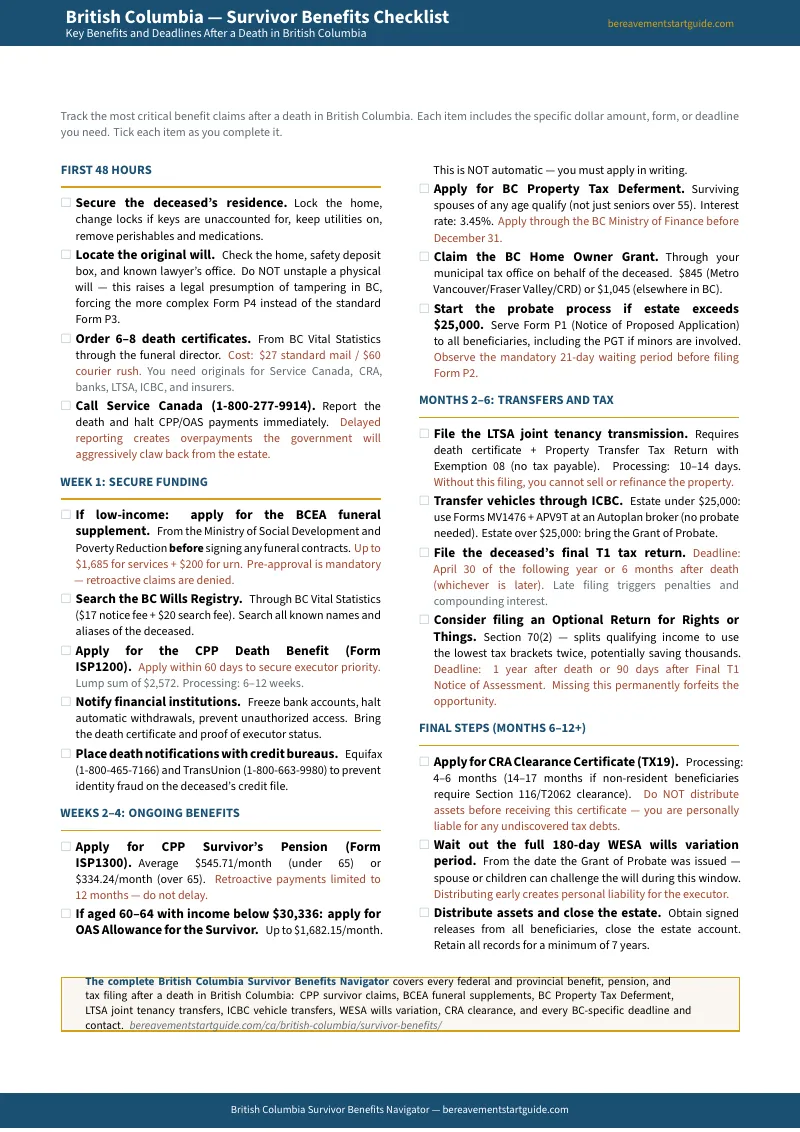
- The Quick Start Checklist (checklist.pdf) — a printable, chronological action list covering the first 48 hours through final estate closure, with specific forms, deadlines, and agency contacts for each step
- The Benefit Claim Tracker (benefit-claim-tracker.pdf) — a printable standalone worksheet for tracking every application across every agency, with pre-filled agency details and fillable columns for submission dates, tracking numbers, processing times, and follow-up reminders
- The Deadline Reference (deadline-reference.pdf) — every statutory deadline on one printable page, from the 60-day CPP priority window to the 180-day wills variation period, with consequences for missing each one
- The Forms Quick Reference (forms-quick-reference.pdf) — every probate form (P1–P45), federal form (ISP1200, ISP1300, TX19, T2062), and ICBC form (APV9T, MV1476) on one printable page with when to use each
For , you get the equivalent of what an estate lawyer would charge multiple billable hours to explain — organized in the order you actually need it, written in plain English, and specific to British Columbia's unique combination of federal, provincial, and institutional rules.
100% Satisfaction Guarantee
If the guide does not help you navigate BC survivor benefits with more confidence and clarity than any combination of free resources, email hello@bereavementstartguide.com for a full refund. No questions, no forms, no waiting period.