Manitoba Eliminated Probate Fees in 2020. Lawyers Still Charge 3% on the First $100,000 Under Rule 74.14. And if You Distribute Estate Assets Before the CRA Clearance Certificate Arrives, You Become Personally Liable for Every Dollar of Undiscovered Tax Debt.
Your spouse or parent has just died in Manitoba, and you are now responsible for settling their estate through a system that most families misunderstand from the very first phone call. Manitoba became the first province in Canada to eliminate government probate fees — but the process that surrounds those fees did not simplify at all. The Court of King's Bench still requires precise Rule 74 forms. Teranet Manitoba still demands a formal Grant of Probate before transferring solely-owned real estate. The CRA still issues clearance certificates on its own timeline. And lawyers still charge percentage-based tariffs under Rule 74.14(6) that can reach $5,000 on a $300,000 estate — even though the government fee is gone.
Meanwhile, banks freeze the accounts. The funeral home needs a deposit. Manitoba Vital Statistics takes 6 to 8 weeks to process standard death certificates. Your family is asking when the house can be sold. And every free resource you find covers one piece of the puzzle — the Court of King's Bench forms, or the CPP death benefit, or the EIA funeral assistance threshold — without connecting them into the sequence you actually need to follow.
The Manitoba Estate Settlement Guide is a Provincial Administration Blueprint — a single document that integrates the Court of King's Bench, Manitoba Vital Statistics, Teranet Manitoba, the CRA, Service Canada, and every financial institution into one chronological workflow. Not a government pamphlet that stops at definitions. Not a law firm blog designed to make you feel too overwhelmed to proceed without a retainer. A structured, Manitoba-specific operations manual that tells you exactly which form to file, which agency to contact, which deadline will cost you money if you miss it, and which bureaucratic sequence to follow so that one step does not accidentally derail the next.
What's Inside the Provincial Administration Blueprint
A 13-chapter guide with checklist and complete procedural coverage — organized chronologically from the first 48 hours through final distribution, built specifically for Manitoba's unique combination of provincial legislation and federal requirements:
The First 48 Hours
Secure the residence, locate the original will, contact a funeral home, and make the critical funding decision before signing any contracts. If the deceased was low-income, EIA may cover basic funeral costs — but only if you contact the District Office before finalizing arrangements. If the death resulted from a crime, the CVCP provides up to $5,400. If it was a motor vehicle accident, MPI covers up to $9,293. This chapter explains which funding source applies and the exact sequence that preserves eligibility for each one.
Death Certificates and Vital Statistics
Manitoba Vital Statistics processes standard certificates in 6 to 8 weeks at $30 each. Rush service delivers in 3 business days with an additional courier fee. But the timeline does not start until the funeral director has fully registered the death event without errors. This chapter covers how many certificates to order (at least 5 to 6 — banks, Teranet, MPI, and the CRA all require originals), the interim certificate workaround, and which institutions accept certified copies versus which demand originals.
Triage: Joint vs. Sole Assets
The asset inventory that determines whether you need the Court of King's Bench at all. Joint bank accounts, life insurance with a named beneficiary, RRSPs with a beneficiary designation — these bypass probate entirely. Solely-owned bank accounts, real estate in the deceased's name alone, and policies payable to "the estate" require court involvement. The guide walks you through categorizing every asset so you can identify the fastest path to resolution.
The Probate Decision
If the probate estate totals $10,000 or less, Manitoba's simplified small estate process applies — Forms 74FF and 74GG, $100 filing fee. If the estate exceeds $10,000 or includes solely-owned real property, you need a full probate application at the Court of King's Bench. This chapter covers the exact forms (Form 74A, 74B, 74C, 74D), the $150 filing fee, and the iterative review process that causes most self-filing executors to give up — a court examiner may reject your application for a minor clerical error, and when you resubmit, find a different error further down the page.
Liability Protection: The Manitoba Gazette
If you distribute estate assets and a legitimate creditor surfaces afterward, you can be held personally liable for the full amount. Publishing a Notice to Creditors in The Manitoba Gazette ($20 to $50) establishes a definitive 6-week limitation period. The Trustee Act, Section 41, makes this the executor's strongest shield against future claims. This chapter explains the exact process, costs, and timing.
Real Property and the Homesteads Act
Teranet Manitoba will not transfer solely-owned real property without a formal Grant of Probate — regardless of what the bank agreed to release. If the deceased owned the marital home, the surviving spouse holds a life estate under The Homesteads Act: the right to remain in the home even if the will attempts to leave the property to someone else. This chapter covers the intersection of probate, Homesteads Act rights, and Land Titles transfers.
Vehicles and MPI
How to notify MPI, transfer vehicle registrations, cancel or reassign Autopac coverage, and handle the specific forms required for estates under and over the simplified threshold. The common mistake: assuming the vehicle transfer follows the same rules as the bank account release. It does not.
Intestacy: The Intestate Succession Act
If there is no will, Manitoba's statutory distribution formula applies. The surviving spouse receives $50,000 (or half the estate, whichever is greater) plus one-half of the remainder. The rest goes to children equally. In blended families, this formula creates outcomes that shock most people — and the guide walks through the exact math with worked examples so you know precisely what each family member is entitled to before any disputes begin.
Holograph Wills
Manitoba validates entirely handwritten wills without witnesses under The Wills Act. But proving a holograph will at the Court of King's Bench requires affidavits from people who can identify the deceased's handwriting and attest to their testamentary capacity. If the court questions whether the document represents a "fixed and final expression of intent," you face judicial review. This chapter covers the proving requirements, the common pitfalls, and when a holograph will creates more problems than it solves.
Tax Obligations and CRA Clearance
The final T1 return, the T3 trust return if the estate earns income after death, and the TX19 Clearance Certificate that must arrive before you distribute a single dollar. The processing timeline: 4 to 6 months for domestic estates. Distributing assets before the clearance certificate arrives makes the executor personally liable for any undiscovered tax debt — up to the full value of the distributed assets.
Final Distribution and Accounting
How to prepare a final accounting, obtain releases from beneficiaries, and close the estate. The specific steps that protect the executor from future claims, including the legal effect of beneficiary releases and the holdback strategy for estimated tax liabilities.
Who This Guide Is For
- The surviving spouse whose bank accounts are frozen, whose pension payments have stopped, and who needs to know exactly what to do first — from securing EIA funeral assistance before signing a contract to understanding Homesteads Act protections that preserve the right to remain in the marital home
- The adult child named as executor who has never filed a Court of King's Bench form and is now personally liable for every administrative decision — from calculating estate value for Rule 74 forms to distributing assets before the CRA clearance certificate arrives
- The out-of-province executor managing a Manitoba estate from Winnipeg, Toronto, or Vancouver — who needs the complete procedural sequence without flying back for each institution's requirements
- The family dealing with intestacy where there is no will, no named executor, and the Intestate Succession Act formula is about to divide assets in ways nobody expected — especially in blended families where the $50,000 spousal entitlement meets competing claims from children of a prior marriage
- Any family trying to reduce legal costs by organizing the estate inventory, completing Rule 74 forms, and handling institutional notifications independently — saving potentially thousands against the percentage-based tariffs that lawyers charge under Rule 74.14(6)
Why Free Resources Leave You Exposed
Every fact in this guide exists somewhere on a government website or legal blog. The problem is not accuracy — it is integration. Here is what you encounter when you try to assemble Manitoba estate settlement guidance from free sources alone:
- The Public Guardian and Trustee Handbook comprehensively covers intestate distribution and legal terminology — but reads like a statutory reference manual, provides no chronological checklist, and offers no guidance on the first 48 hours when most families need it most
- CLEA's Manitoba Probate Guide is excellent on court forms — and explicitly states it does not cover collecting assets, paying debts, or filing tax returns, abandoning you at the exact moment the real work begins
- Law firm blogs explain probate with meticulous precision — in a tone designed to make estate administration feel so dangerous that you book a consultation. Their business model depends on the percentage-based tariffs they charge under Rule 74.14(6)
- Funeral home checklists tell you to "apply for CPP death benefits" and "determine whether probate is necessary" — without any instruction on how to actually do either of those things
- Credit union workbooks focus on pre-death planning and asset organization — then route you to wealth management subsidiaries for post-death administration
The result: families either miss critical deadlines, make sequencing errors that create personal liability, or pay thousands in legal fees for administrative tasks they could have handled with proper instructions.
What You Get
The Manitoba Estate Settlement Guide includes 8 PDFs:
- The complete guide (guide.pdf) — 13 chapters covering every step from the first 48 hours through final distribution, with Manitoba-specific forms, fees, thresholds, and deadlines throughout
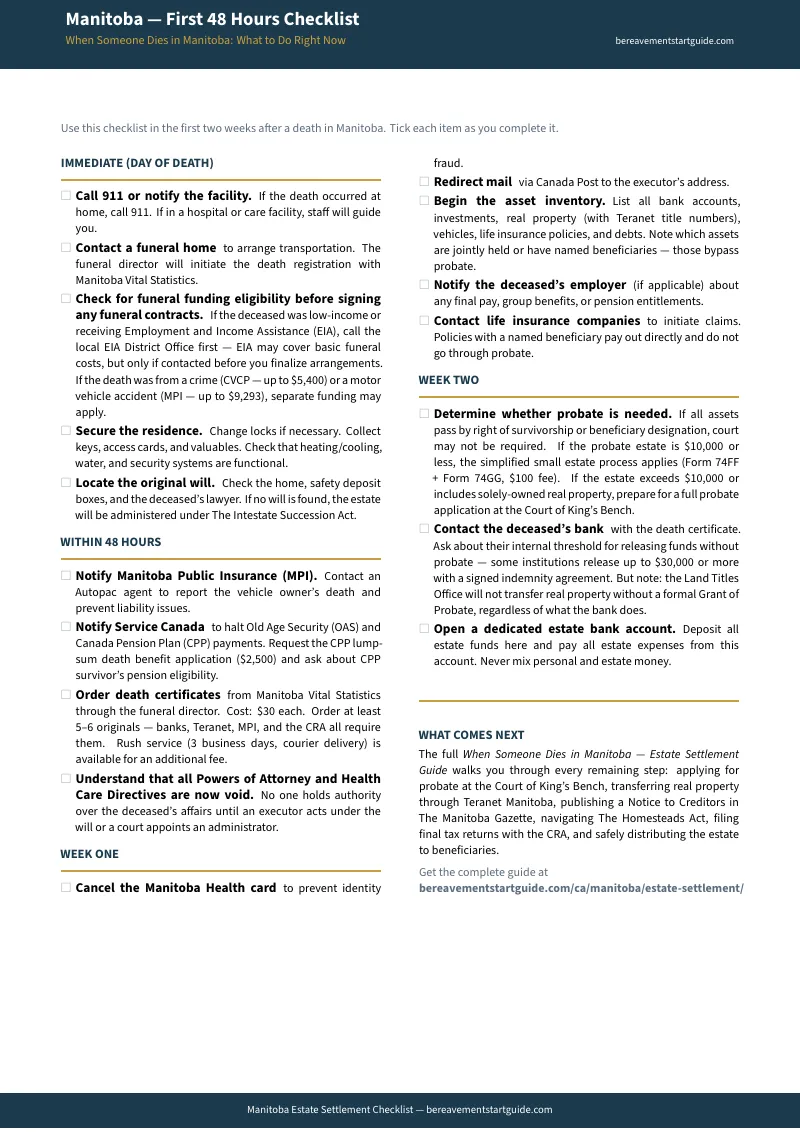
- The First 48 Hours Checklist (checklist.pdf) — a printable, chronological action list covering the immediate decisions, notifications, and institutional contacts that cannot wait
- Estate Asset Inventory Worksheet (asset-inventory-worksheet.pdf) — fillable worksheet matching the Form 74B categories required by the Court of King's Bench, with sections for real property, bank accounts, investments, life insurance, and debts
- Court Forms Reference (court-forms-reference.pdf) — quick-reference card for every Rule 74 form, filing fee, and document requirement — Forms 74A through 74D for full probate and 74FF/74GG for small estates
- Creditor Protection Timeline (creditor-protection-timeline.pdf) — step-by-step Manitoba Gazette advertising process with the Trustee Act Section 41 protection that shields executors from personal liability
- Probate Decision Flowchart (probate-decision-flowchart.pdf) — printable decision tree covering the $10,000 threshold, bank indemnity limits, and whether the estate needs full probate, the simplified process, or no court involvement at all
- Property Transfer Guide (property-transfer.pdf) — Teranet Manitoba procedures for joint tenancy survivorship and sole-ownership transmission, Land Transfer Tax rates, exemptions, and Homesteads Act life estate protections
- Intestacy Distribution Reference (intestacy-distribution.pdf) — The Intestate Succession Act distribution formulas with worked examples for blended families, common-law partner eligibility, and the process for applying as Administrator
For , you get the equivalent of what an estate lawyer would charge multiple billable hours to explain — organized in the order you actually need it, written in plain English, and specific to Manitoba's unique combination of provincial legislation, Court of King's Bench procedures, and federal requirements.
100% Satisfaction Guarantee
If the guide does not help you navigate Manitoba estate settlement with more confidence and clarity than any combination of free resources, email hello@bereavementstartguide.com for a full refund. No questions, no forms, no waiting period.