Your Father Died Tuesday. By Wednesday, Your Brother Claimed Authority Over the Funeral, the Funeral Home Said Embalming Was Required, and Nobody Could Tell You Whether Manitoba Even Has a Law That Says Who Gets to Make These Decisions.
Someone you love has died in Manitoba, and the decisions are already being made around you — by people who may not have the legal right to make them. Your brother walked into the funeral home and signed a contract. Your mother asked if embalming was mandatory and was told it was "standard procedure." The funeral director handed over a General Price List with a $7,800 traditional service package circled in pen. Nobody told your family that Manitoba does not have a statutory next-of-kin priority list for funeral authority — that unlike British Columbia or Ontario, the right to control arrangements here is governed by common law precedent from Hunter v Hunter and The Intestate Succession Act. Nobody told you that embalming is almost never legally required under Manitoba law unless the body will not reach its destination within 72 hours. And nobody mentioned that the Consumer Protection Office requires every funeral home to provide an itemized written estimate before any contract is signed.
You searched for answers. The Funeral Board of Manitoba explains complaint procedures but does not explain who has legal authority over the funeral when there is no will. The Vital Statistics Branch — which historically took up to eight months to process death certificates — has a phone system that routinely disconnects callers. The Employment and Income Assistance (EIA) manual runs hundreds of pages of policy language explaining how the government tests every financial resource before paying a fixed-fee funeral agreement. The Public Utilities Board warns that burying a body on private land creates a perpetual legal liability under The Cemeteries Act — but the warning is buried in a PDF notice that nobody reads until after the hole is dug. And the funeral home websites that rank on Google? They cover casket options and cremation pricing. They do not cover your right to refuse embalming, the $250 maximum cancellation fee for prepaid plans, or the fact that EIA claws back the entire CPP death benefit before releasing a dollar toward the funeral.
The Manitoba Funeral Laws & Consumer Rights Guide is a Consumer Defence System for every legal, financial, and logistical decision families face in the Manitoba deathcare process — from the question of who has authority to sign the contract through alternative disposition options, government benefit claims, and formal complaints against providers. Not a generic Canadian funeral overview that confuses FTC rules with Manitoba's Consumer Protection Office regulations. Not a funeral home website that explains their packages while omitting your right to refuse them. A Manitoba-specific manual built around the actual statutes — The Funeral Directors and Embalmers Act, The Cemeteries Act, The Prearranged Funeral Services Act, The Vital Statistics Act, and The Public Health Act — so you know exactly what the law requires, what it does not require, and what the funeral home cannot legally pressure you into.
What's Inside the Consumer Defence System
A 12-chapter guide and a standalone Funeral Consumer Rights Checklist — covering every stage from the first phone call to the funeral home through complaints, benefits claims, and alternative disposition, built specifically for Manitoba law as it exists right now:
Chapter 1: Who Has Legal Authority Over the Funeral
Manitoba's critical gap: no statutory priority list telling you who gets to decide. How common law precedent and The Intestate Succession Act degrees of consanguinity determine authority when there is no will. What happens when the will names an executor but a family member disagrees with the arrangements. The distinction between the right to arrange and the obligation to pay — and what to do when the person making decisions is not the person who will be paying for them.
Chapter 2: The First 48 Hours
Who to call first when someone dies at home versus in hospital. How the medical certificate of death works and why the funeral director acts as event registrar for Vital Statistics. The immediate steps that protect you from making irreversible financial commitments before you understand the full cost picture. And the five documents you need to bring to the funeral arrangement meeting.
Chapter 3: Your Consumer Rights Under Manitoba Law
The legal requirement for itemized written estimates before any contract is signed. Why the General Price List exists and what funeral homes must disclose on it. The explicit Consumer Protection Office rule that embalming is not legally required under standard circumstances — and what to say when a funeral director implies otherwise. How to compare quotes across providers without being pressured into a same-day commitment.
Chapter 4: Death Registration and the Certificate
The statutory 5-day registration deadline, the Electronic Death Registration System (EDRS) rollout, and the realistic timeline for receiving physical certificates. Why you need 5-6 certified copies at $30 each. What to do when Vital Statistics is backlogged and you need documentation immediately for banks and insurance.
Chapter 5: Disposition Options — Burial, Cremation, and Alternatives
The full range of legal disposition methods in Manitoba: traditional burial, cremation, aquamation (water cremation), and green burial. Cremation authorization requirements and the mandatory 48-hour waiting period. Municipal cemetery fees at City of Winnipeg sites and what "opening and closing" charges actually cover. The price comparison framework that shows how direct cremation at $1,295 compares to a full-service package at $7,800+.
Chapter 6: Private Burial and Ash Scattering
The rule that transforms your farm into a regulated cemetery: The Cemeteries Act perpetual care liability for private land burial — mandatory maintenance, fencing, drainage, and a permanent property title encumbrance. Scattering ashes legally on unoccupied Crown land and provincial waters without government consent. The restrictions that apply to occupied land, municipal parks, and private property. And the transport rules under The Public Health Act that determine whether a body must be embalmed or placed in a hermetically sealed container.
Chapter 7: Financial Resources and Government Benefits
The EIA funeral benefit — exact eligibility criteria, the fixed-fee agreement with the Manitoba Funeral Services Association, what is covered (basic removal, standard casket, municipal fees) and what is excluded (obituaries, extra vehicles, clergy, memorial books). Why you must apply before signing any contract. The CPP death benefit ($2,500) and the government's right to claw it back. MPI fatality claims (up to $9,293 for motor vehicle deaths). WCB and the Compensation for Victims of Crime Program (up to $5,400). And the EIA transport mileage caps: $1.25/km south of the 53rd parallel, $1.39/km north of it.
Chapter 8: Prepaid Funeral Contracts
The 10-day cooling-off period for cancellation with a full refund. The maximum $250 administration fee for cancellations after the cooling-off period. Trust fund security requirements under The Prearranged Funeral Services Act. How to audit a deceased parent's prepaid contract and what to do when the funeral home that sold it has been sold or is offering different services than what was prepaid.
Chapters 9-12: Edge Cases, Coroner Investigations, Complaints, and Deadlines
What happens when the Chief Medical Examiner takes control of the body under the Fatality Inquiries Act. Unclaimed bodies and The Anatomy Act — the 48-hour window, the 28-day holding period, and the Public Guardian and Trustee's role. How to file a formal complaint with the Funeral Board of Manitoba and the Consumer Protection Office. Religious and cultural accommodation rights. And every critical deadline consolidated into one reference — from the 5-day registration window through the EIA application timeline.
Who This Guide Is For
- The family member who just got "the call" and needs to know — tonight, before the funeral home opens tomorrow — who actually has the legal right to make arrangements in Manitoba, what embalming really costs versus what the law requires, and how to demand an itemized estimate instead of accepting a bundled package price
- The executor paying funeral costs from the estate who needs to understand which expenses are legitimate claims against the estate, which are optional, and how to ensure the funeral director is not inflating the bill with services the family never requested
- The low-income family or social worker facing a funeral with no savings and no life insurance, who needs the exact EIA application process, CPP and MPI benefit amounts, and the fixed-fee funeral structure — before the funeral home starts a contract the family cannot afford
- The family considering alternatives — aquamation, green burial, private land burial, or ash scattering in a provincial park — who needs to know which options are legal in Manitoba, which create permanent property liabilities, and which require no government permission at all
- The person auditing a prepaid funeral plan for a living parent or deceased relative, who needs to know the exact cancellation rules, the maximum fee the provider can charge, and what protections the trust fund regulations provide if the funeral home changes ownership
Why Free Resources Will Not Protect You
The information exists. It is scattered across the Funeral Board of Manitoba, the Consumer Protection Office, the Vital Statistics Branch, the Public Utilities Board, the Department of Families, and the websites of individual funeral homes. Here is what happens when you try to assemble it yourself:
- Government agencies operate in silos. The Funeral Board handles licensing. The Consumer Protection Office handles pricing complaints. Vital Statistics handles death certificates. The Public Utilities Board handles cemeteries. The Department of Families handles EIA benefits. No single government page connects these into a chronological process — you are expected to contact each agency separately, on their schedule, during business hours, while grieving.
- Funeral home websites explain their services, not your rights. Eirene, Bardal, Tillwell, and other Manitoba providers publish transparent pricing for their own packages. What they do not publish: the Consumer Protection Office rules that require itemized estimates, the embalming disclosure that must appear on every General Price List, or the maximum cancellation fee for prepaid plans. Their content is helpful for choosing their services. It is not helpful for knowing what you can legally refuse.
- Legal blogs focus on probate, not funeral logistics. TLR Law and Mills & Mills provide excellent content on the $30,000 bank threshold and estate administration. They do not cover the 48-hour period when the funeral contract must be signed, the transport rules under the Public Health Act, or the EIA financial testing process that determines whether the government will help pay.
- The EIA policy manual is written for caseworkers, not families. The Department of Families' Employment and Income Assistance manual explains fixed-fee coverage, CPP clawbacks, and transport mileage caps in dense administrative language. A grieving family trying to determine whether they qualify will not decode Section 23 of the EIA manual under a 48-hour deadline.
Free resources give you consumer rights without the funeral timeline, funeral pricing without the legal context, and government benefits buried in policy manuals designed for bureaucrats. The Consumer Defence System puts every Manitoba statute, every consumer protection rule, every benefit program, and every deadline into one document — in the order a family actually encounters them.
— Less Than the Markup on One "Required" Service That Is Not Actually Required
The average Manitoba funeral costs between $5,000 and $12,000. A single embalming service — which funeral homes routinely present as mandatory but which Manitoba law does not require for most situations — adds $800 to $1,500 to the bill. A casket upgrade sold during an emotional arrangement meeting adds another $1,000 to $3,000. This guide costs less than the markup on one optional service and gives you the legal knowledge to evaluate every line item on the General Price List, refuse what the law does not require, and claim every government benefit your family is entitled to.
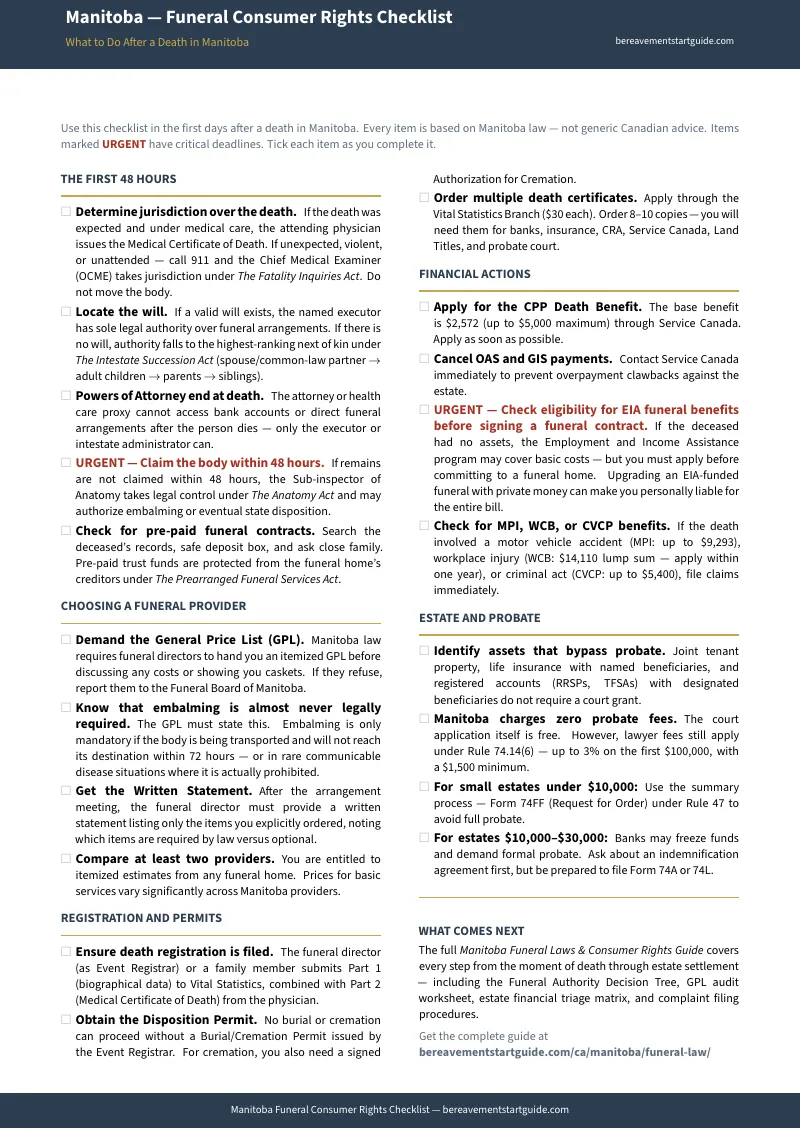
Your download includes the complete 12-chapter guide, the standalone Funeral Consumer Rights Checklist (20 items covering authority verification, mandatory disclosures, cost protection, disposition requirements, and benefit claims), plus three printable reference cards: the Funeral Authority Determination hierarchy, the Government Benefits & Funeral Assistance summary, and the Prepaid Contract Audit checklist. Plus a money-back guarantee, no time limit. If the guide does not give you clarity on your legal rights and confidence in your funeral decisions, email us for a full refund.
Not ready for the full guide? Download the free Manitoba — Funeral Consumer Rights Checklist — a one-page summary of your core consumer rights, the key questions to ask every funeral director, and the government benefits you may be eligible to claim. It is enough to walk into a funeral arrangement meeting informed.
You did not choose this timeline. But the funeral home's clock is running, the contract will be presented within 48 hours, and every service on that General Price List will feel urgent and mandatory. This guide makes sure you know which ones actually are — and which ones are not.