Manitoba Eliminated Probate Fees. You Assumed That Meant Probate Was Free. Then the Bank Froze the Account, the Court Demanded Form 74B Valued to the Dollar, and Teranet Told You Only a Lawyer Can Submit the Land Transfer.
Someone you loved has died, and you are holding paperwork you have never seen before — Form 74A, Form 74B, Form 74D — each referencing legislation you cannot find explained in plain English anywhere. You searched "Manitoba probate fees" and learned that the province eliminated its percentage-based probate tax in November 2020. You assumed the hard part was over. Then you called the bank. The account has $35,000 in it. The bank will not release a dollar without a Grant of Probate from the Court of King's Bench. The court's small estate threshold is $10,000. The bank's internal threshold is $30,000. Your loved one's estate is too large for the cheap court process and too small to justify thousands in legal fees. You are locked out of money the entire family agrees belongs to them.
You searched for help. The Manitoba Courts website has blank forms but no filing instructions — no explanation of the order they must be completed, the exact formatting requirements (single-sided, 8.5" × 11", size 14 font for affidavits, numbered pages, tabbed exhibits), or the $10.00 rejection fee triggered when a single element is wrong. The Community Legal Education Association (CLEA) publishes free PDF guides that are excellent on court procedure — but explicitly exclude taxes, creditor management, and CRA clearance. Law firm blogs from TDS Law and MLT Aikins explain the complexity in authoritative detail, then quote the standard legal fee: 3% on the first $100,000 of the estate. Reddit users apply Ontario's Estate Administration Tax to your Manitoba question. And nobody — not the court, not the law firms, not the free resources — connects the court filing process with the CRA tax clearance process that comes after it.
Here is what falls through the gap: Manitoba's probate tax is zero, but the court still charges a $250 Statement of Claim fee, death certificates cost $30 each (and you need five or six), and Teranet Manitoba charges separate fees for every land transfer. Form 74B requires you to value "rights of action" at exactly $1.00 and file a letter promising to amend the inventory once final values are known — a requirement buried in CLEA's guide that the court website does not mention. And after you receive the Grant, the CRA takes up to 45 weeks to issue a Clearance Certificate — during which time you cannot safely distribute a single dollar to beneficiaries without risking personal liability for the estate's unpaid taxes. Your siblings are asking when they get their share. You do not have a timeline to give them.
The Manitoba Probate Process Guide is an Executor's Administrative Roadmap for the complete Manitoba estate administration process — from the question of whether probate is even required through CRA clearance and final distribution. Not a generic Canadian probate overview that confuses Ontario's percentage-based tax with Manitoba's abolished fee structure. Not a law firm blog that explains the complexity and then quotes a retainer. A 13-chapter, Manitoba-specific manual built around the current Court of King's Bench form series, the Surrogate Practice Act thresholds, and the Teranet eRegistration requirements — so you know exactly what to file, in what order, and what traps to avoid.
What's Inside the Executor's Administrative Roadmap
A 13-chapter guide and a standalone Probate Quick-Start Checklist — covering every stage from the first 48 hours through final distribution, built specifically for Manitoba's Court of King's Bench as the forms and rules exist right now:
Chapter 1: Understanding Probate in Manitoba
The critical distinction between "no probate fee" and "free probate." Why your Enduring Power of Attorney and Health Care Directive extinguished the moment the person died. How executor authority works immediately versus the court appointment process for intestate estates. And the realistic budget for what Manitoba probate actually costs when you add up court fees, death certificates, Teranet charges, and the legal fees you may still need for specific steps.
Chapter 2: The First 48 Hours
Locating the will — including the PGT will registry search. Ordering 5-6 certified death certificates from Manitoba Vital Statistics ($30 regular, $65+ rush). Manitoba-specific funeral assistance: Employment and Income Assistance (EIA), Manitoba Public Insurance (MPI) for vehicle deaths, Workers Compensation Board (WCB), and the Compensation for Victims of Crime Program (CVCP). Securing the home, the vacant-property insurance trap, and the five key institutions to notify before you touch a single court form.
Chapter 3: Do You Actually Need Probate?
The decision framework that could save you months. Joint tenancy property passes via right of survivorship — no court required. RRSPs, TFSAs, and life insurance with named beneficiaries bypass the estate entirely. How bank-specific thresholds actually work: some institutions release accounts under $10,000 with an indemnity agreement, others demand a Grant for any amount. And the scenarios where probate is legally required even when the estate seems straightforward — sole-ownership real property being the most common.
Chapter 4: Taking Inventory — Form 74B
The asset and liability inventory that determines everything: whether you qualify for the small estate process, which court forms you need, and ultimately how every dollar gets distributed. How to contact each institution for fair market values as of the exact date of death. The "right of action" valuation rule — list it at $1.00 with a promise to amend. The distinction between probate assets (sole-name accounts, solely owned property) and non-probate assets (joint tenancy, designated beneficiaries) that determines what appears on your inventory and what bypasses the estate entirely.
Chapter 5: Choosing Your Path
Three routes through the system, and the thresholds that determine which one applies. Estate ≤ $10,000: Small Estate Summary Administration using Forms 74FF and 74GG under Section 47 of the Surrogate Practice Act — faster, cheaper, and no lawyer required. Valid will with a named executor: Request for Probate using Form 74A. No will: Letters of Administration using Form 74L, with the Intestate Succession Act priority hierarchy and the nomination and renunciation process for family members with equal or superior rights. And the "small estate trap" — what to do when the estate is worth $25,000 and the bank demands a Grant that the court's simplified process will not cover.
Chapter 6: Preparing Your Court Application
Line-by-line instructions for every form in the probate set: Form 74A (Request for Probate), Form 74B (Inventory and Valuation), Form 74D (Affidavit of Execution of Will), Form 74L (Request for Administration), Form 74N (Nomination of Administrator), and Form 74P (Renunciation). The exact formatting requirements the court enforces — single-sided printing, 8.5" × 11" paper, size 14 font for affidavits, numbered pages, tabbed exhibits. Why a single formatting error triggers a $10.00 rejection fee and sends you to the back of a queue that takes 9-12 weeks.
Chapter 7: Filing at the Court of King's Bench
Where to file: Winnipeg (408 York Avenue, Room 100C — look for "Wills and Estates"), Brandon, Portage la Prairie, The Pas, Dauphin, and Thompson. What to bring. What the clerk checks. Current processing times: 9-12 weeks for a standard application at the Winnipeg registry. What happens if your application is rejected — the specific errors that cause it and how to fix them without starting over. And out-of-province filing for executors who do not live in Manitoba.
Chapter 8: After the Grant — Assets, Creditors, and Real Estate
Collecting assets by presenting the Grant to every institution. The creditor notification process: Manitoba Gazette publication ($20.07) plus a local newspaper, with a 6-week claim window. Debt priority order: funeral expenses first, then administration costs, taxes, secured debts, and unsecured debts last. And the real estate chapter — Teranet Manitoba's eRegistration system, why laypeople cannot submit property transfers directly (a lawyer must witness and submit under The Real Property Act), and how to hire a lawyer on a limited retainer strictly for the Teranet transmission while handling the rest yourself.
Chapter 9: Taxes, Final Accounting, and Distribution
The terminal T1 return for the deceased. The T3 Trust Return if the estate earns income during administration. The TX19 Clearance Certificate application — and why the CRA's current processing time of up to 45 weeks means you cannot safely distribute assets until roughly a year after the Grant is issued. Executor compensation under Rule 74.14(6): the "fair and reasonable" standard, the 3% benchmark the courts reference, and how to get beneficiary approval without a formal court application. The final accounting that must balance before any beneficiary receives their share.
Chapters 10-13: Edge Cases, Forms Reference, Timeline, and Costs
When to stop and call a lawyer: contested wills, Indigenous estates on reserve land under federal jurisdiction, insolvent estates, spousal property claims under The Family Property Act, and minor or incapable beneficiaries requiring PGT involvement. The complete forms reference table with every form number, purpose, and filing sequence. A consolidated timeline from death through final distribution. And a full costs summary — every fee you will encounter from death certificates through Teranet transmission, so there are no financial surprises.
Who This Guide Is For
- The newly named executor who has never filed a court document and needs every Manitoba court form — 74A, 74B, 74D, 74FF, 74GG, 74L, 74N, 74P — explained in plain English with the exact formatting requirements and filing sequence, before making a $10.00 rejection error that costs another 9-12 weeks
- The surviving spouse whose bank just froze a sole-name account and who needs to know whether joint tenancy, named beneficiaries, and the $10,000 small estate threshold mean the estate can be settled without going to court — and what must still be done even if probate is not required
- The DIY executor on a budget who knows Manitoba eliminated probate fees and wants to handle as much as possible without a lawyer — while understanding exactly when professional help is legally required (Teranet land transfers, contested situations, PGT involvement)
- The out-of-province executor managing a Manitoba estate from Ontario, British Columbia, or another province, who needs to know which steps can be completed remotely, how to handle the witnessing of affidavits from outside Manitoba, and which Court of King's Bench registry to file with
- The executor under family pressure who needs a concrete, authoritative timeline showing that 9-12 weeks of court processing plus up to 45 weeks for CRA clearance is a legal reality — not evidence of negligence — and who wants a pre-written explanation to give impatient siblings
Why Free Resources Will Not Get You Through This
The information exists. It is scattered across the Manitoba Courts website, CLEA's free PDF guides, Teranet Manitoba's professional portal, Service Canada, law firm blogs, and the CRA. Here is what happens when you try to assemble the process from free sources alone:
- The Manitoba Courts website has forms but no filing instructions. Forms 74A, 74B, 74D, 74FF, 74GG, 74L, 74N, and 74P are downloadable. What is not published: the chronological order for completing them, the exact formatting requirements that trigger rejection, how to value "rights of action" at $1.00, or the distinction between the $10,000 court threshold and the $30,000 bank threshold that traps mid-sized estates. The forms are there. The instructions to use them correctly are not.
- CLEA publishes excellent guides — that explicitly exclude taxes and creditor management. The Community Legal Education Association's "Probate Guide — Read This First," "For Executors," and "For Administrators" are the strongest free resources available. They cover court forms in detail. They explicitly state they do not cover paying debts, filing tax returns, or CRA clearance. The moment the Grant arrives and the real financial complexity begins, CLEA's coverage ends.
- Law firm blogs explain the complexity to justify retainers. TDS Law, MLT Aikins, and Chicken Law provide accurate, current legal content. Every article positions the complexity as a reason to hire full-service representation at 3% of the estate. For contested estates, that advice is appropriate. For uncontested estates with a clear will and cooperative beneficiaries, the same administrative work costs a fraction of the legal fee.
- Teranet's portal is built for lawyers, not executors. The eRegistration system and its user guides are explicitly designed for legal professionals and land surveyors. An executor trying to understand property transmission is met with dense institutional documentation written for people who already hold a practicing certificate.
- Reddit applies the wrong province's rules. The most common error on r/PersonalFinanceCanada is applying Ontario's Estate Administration Tax to Manitoba questions. Manitoba has no percentage-based probate tax. Ontario charges 1.5% on estates over $50,000. The advice is well-meaning, the jurisdiction is wrong, and the financial implications of following it are severe.
Free resources give you forms without filing instructions, legal education without tax coverage, and advice from the wrong province. The Executor's Administrative Roadmap puts every Manitoba-specific form, fee, deadline, and filing step into one document, in the order the Court of King's Bench actually requires them — and then covers the CRA clearance and distribution process that no free resource addresses.
— Less Than Fifteen Minutes With a Manitoba Probate Lawyer
A single consultation with a Manitoba probate lawyer costs $200 to $350 per hour. Standard probate representation starts at 3% of the first $100,000 of the estate. For a $300,000 estate — a modest Winnipeg home and a few bank accounts — that is $3,000 or more in legal fees for a process the Court of King's Bench designed to be accessible to self-represented applicants. This guide costs less than fifteen minutes of professional legal time and gives you the complete Manitoba-specific filing system — every form in sequence, every formatting trap flagged, the small estate threshold strategy, the Teranet real estate process, and the CRA clearance timeline that determines when you can safely distribute.
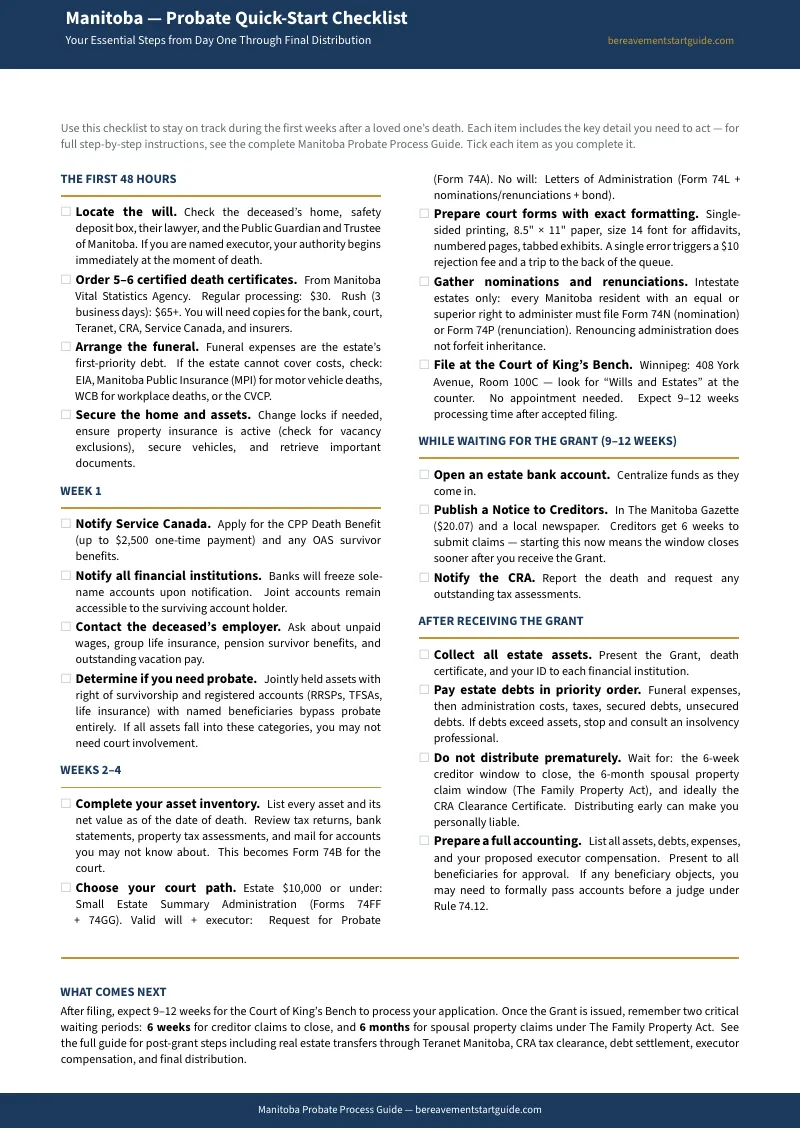
Your download includes 8 PDFs: the complete 13-chapter guide, the standalone Probate Quick-Start Checklist (20 items across 5 phases), plus 6 standalone worksheets and reference cards — an Asset Discovery Worksheet for Form 74B, a Pre-Filing Quality Checklist, a Probate Decision Flowchart, a Forms Reference Card, a Timeline and Deadlines tracker, and a Fees and Costs Summary. Print the ones you need and work through them as you go. Plus a money-back guarantee, no time limit. If the guide does not give you clarity on what to do next and confidence that your court application will be accepted, email us for a full refund.
Not ready for the full guide? Download the free Manitoba — Probate Quick-Start Checklist — 20 items covering the first weeks, from locating the will and ordering death certificates through filing at the Court of King's Bench. It is enough to see the full picture and start gathering what you need.
You did not choose to be the executor. But the bank will not release the funds, the court queue does not pause, and the CRA clearance clock does not start until you file. The guide makes sure you do not miss any of it.