You Were Named Executor. The Probate Court Requires Forms You Have Never Seen, the Province Just Tripled Its Tax Rate on Estates Over $100,000, and If You File in Moncton Without a "Record on Application" Clipped in Exact Order, the Clerk Rejects Everything on the Spot.
Someone you loved has died, and the New Brunswick Probate Court now expects you to file Form 2A or Form 2E with the correct affidavits, a sworn estate valuation, and a cheque for probate taxes calculated under a fee structure that changed mid-2026. The bank froze the accounts the day they learned about the death. The funeral was $8,000. You need access to the deceased's funds to pay for it, but the institution demands a Grant of Letters Probate before releasing a dollar. You searched for instructions on what to file. The official NB Courts website has the forms. It does not explain how to fill them out, what order they go in, or which affidavits accompany which application.
You found PLEIS-NB. Their pamphlets are legally accurate, but they are dense, text-heavy PDFs with no editable forms, no workflow, and no guidance on the 2026 changes. Law firm blogs in Fredericton and Moncton explain the risks of DIY probate — then quote the Regulation 84-9 solicitor tariff: 3% on the first $10,000, 0.5% on the next $90,000, 0.33% on the next $200,000. For a $380,000 estate with a house, an RRSP, and basic savings, professional fees alone consume thousands. Reddit has threads about New Brunswick probate. The top comment applied Ontario's estate administration tax rules to your question.
Here is what nobody connects for you: Bill 30 received Royal Assent on June 12, 2026, expanding the small estate threshold from $3,000 to $25,000 — meaning thousands of modest estates no longer require formal probate at all, but the mechanism for bypassing the court through the Public Trustee remains almost entirely undocumented in plain English. The same bill restructured the probate tax brackets, imposing a flat $200 base fee on estates up to $20,000 and tripling the marginal rate to $15 per $1,000 on everything above $100,000. And if you are filing in the judicial districts of Moncton, Bathurst, or Edmundston, a local practice directive requires a formally indexed "Record on Application" — unbound, secured with a large clip, with numbered documents in exact order. A generic Canadian probate guide will not mention this. The clerk will reject your filing without it.
The New Brunswick Probate Process Guide is a Court-Ready Filing System for the complete NB probate process — from the question of whether probate is even required for your estate through the CRA Clearance Certificate and final distribution. Not a generic Canadian overview that confuses Ontario's percentage-based tax with New Brunswick's restructured brackets. Not a law firm blog designed to scare you into a retainer. A 13-chapter, New Brunswick-specific manual built around the current Probate Court Act forms, the Bill 30 amendments, and the regional filing requirements for every judicial district — so your application passes the court clerk's review the first time.
What's Inside the Court-Ready Filing System
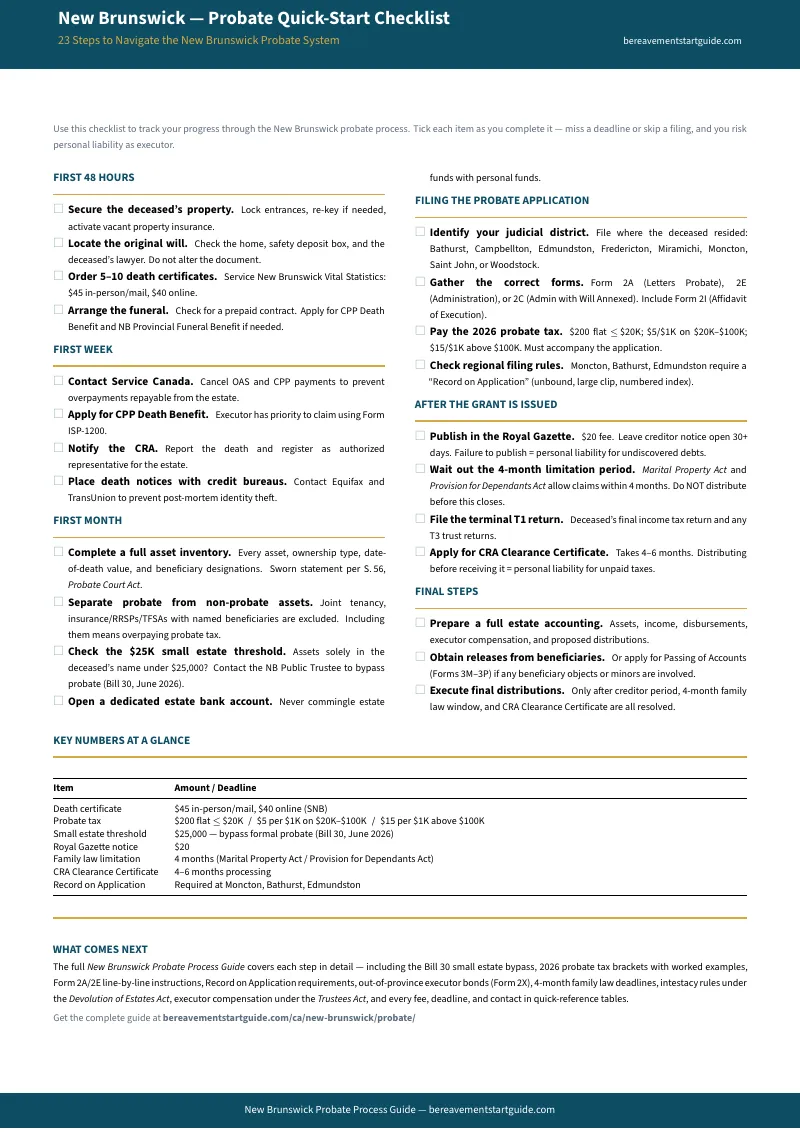
A 13-chapter guide and a standalone Probate Quick-Start Checklist — covering every stage from the probate decision through final distribution, built specifically for New Brunswick's Probate Court as the law and forms exist right now:
Chapter 1: Do You Actually Need Probate?
Not every New Brunswick estate needs a trip to the Probate Court. Joint tenancy property passes automatically to the surviving owner. RRSPs, TFSAs, and life insurance with named beneficiaries bypass the estate entirely. This chapter gives you the decision framework: the real property check (the Service New Brunswick Land Registry requires a grant for solely owned property), the financial account threshold check (each bank sets its own internal limit for releasing funds without a court order), and the new $25,000 small estate threshold under Bill 30 — including exactly how to contact the Public Trustee and what proof of entitlement you need to bypass formal probate entirely.
Chapter 2: Immediate Actions — The First 48 Hours
Securing the residence and activating vacant property insurance before the standard policy voids coverage. Ordering 5 to 10 original long-form Death Certificates from Service New Brunswick ($45 in-person, $40 online). Locating the original will — not a photocopy, which triggers a separate, more complex court process. The CPP Death Benefit (up to $5,000 for eligible contributors) and the New Brunswick Provincial Funeral Benefit through the Department of Social Development for families facing financial hardship.
Chapter 3: Government Notifications and Benefits
Cancelling CPP and OAS payments through Service Canada before overpayments accrue that the estate must repay. Notifying the CRA and establishing yourself as authorized representative. Placing death notices with Equifax and TransUnion to prevent post-mortem identity theft. The precise sequence matters because some notifications unlock access to benefits while others prevent estate liabilities from growing.
Chapter 4: The 2026 Probate Tax Structure
The exact math under the restructured fee brackets. Estates up to $20,000: flat $200. Estates between $20,000 and $100,000: $5 per $1,000. Estates above $100,000: $15 per $1,000 on everything over that threshold. For a $380,000 estate, the probate tax is $4,400 plus the $200 base — compared to roughly $1,900 under the old system. The guide includes a calculation worksheet for any estate composition and explains which assets must be included in the valuation and which can be excluded to lower the bill.
Chapter 5: Building the Estate Inventory
The sworn statement of total estate value required under Section 56 of the Probate Court Act. How to get date-of-death valuations from each financial institution. Running title searches through the Service New Brunswick Land Registry. The critical distinction between probate assets (solely owned property, bank accounts without joint ownership) and non-probate assets (joint tenancy, beneficiary-designated accounts) — because including non-probate assets in the sworn valuation means overpaying probate taxes by thousands of dollars.
Chapter 6: Choosing and Completing the Right Forms
Form 2A for Letters Probate when there is a valid will. Form 2E for Letters of Administration when there is no will. Form 2C for Administration with Will Annexed when the named executor cannot or will not serve. The Affidavit of Execution (Form 2I) — which must not be sworn before the other witness to the will. Form 2X for the administration bond required of out-of-province executors, and the specific affidavits needed to petition the court to waive it. Every form explained in plain English with the common errors that cause clerk rejections flagged.
Chapter 7: Regional Filing Rules
New Brunswick is divided into eight judicial districts, and the filing requirements are not identical across them. This chapter covers the specific requirements for Fredericton, Saint John, Moncton, Bathurst, Edmundston, Campbellton, Miramichi, and Woodstock — including the "Record on Application" formatting required in Moncton, Bathurst, and Edmundston (unbound, secured with a large clip, with a numbered document index). Filing in the wrong district or with the wrong formatting results in immediate rejection.
Chapter 8: Out-of-Province Executors
If you live outside New Brunswick but were named executor, this chapter addresses the specific complications. The requirement to post an administration bond (Form 2X) to protect local creditors. The multi-beneficiary affidavits required to petition the court to waive the bond. Remote witnessing options — permanently permitted in New Brunswick provided at least one attesting witness is a practicing member of the Law Society of New Brunswick. Which steps require physical presence at the court registry and which can be handled remotely or by courier.
Chapter 9: After the Grant — Creditor Notices and the Royal Gazette
Publishing a Notice to Creditors in the Royal Gazette — the official weekly publication of the Government of New Brunswick. The $20 submission fee, the exact formatting required, the mailing address, and the minimum 30-day period the notice must remain open. Failure to properly advertise for creditors leaves you personally liable for undiscovered estate debts indefinitely. The guide provides the exact submission template and step-by-step instructions for the Royal Gazette process.
Chapter 10: Real Estate and Land Registry Transfers
For most New Brunswick families, the house is the largest estate asset and the primary reason probate is needed. Joint tenancy property transfers automatically via a death certificate filed with the Service New Brunswick Land Registry. Solely owned property requires the Grant of Letters Probate and specific land registry filings to transfer title. The guide walks through both paths and covers the critical rule that many families learn too late: you can list a property for sale before probate, but you cannot close the sale or transfer title until the Grant is in hand.
Chapters 11-13: Taxes, Distribution, and Closing the Estate
The terminal T1 return and the RRSP tax trap — an RRSP with no surviving spouse or financially dependent child collapses onto the deceased's final return, generating tax at combined federal and New Brunswick marginal rates. The 4-month limitation period under the Marital Property Act and Provision for Dependants Act — during which you must not distribute any assets. The CRA Clearance Certificate (allow 4 to 6 months for processing). The Passing of Accounts process (Forms 3M through 3P) when beneficiaries object to the accounting. Executor compensation rules. Final distribution — only after the creditor notice period has closed, the family law window has expired, the Clearance Certificate is in hand, and all debts are paid.
Who This Guide Is For
- The newly named executor who has never filed a court document and needs Form 2A, the Affidavit of Execution, the probate tax calculation, and the regional filing requirements explained in plain English — before making an error that causes the clerk to reject the entire application and costs weeks of delay
- The surviving spouse who needs to know whether joint accounts, named beneficiaries, and the new $25,000 small estate threshold mean the estate can be settled without going to court — and what obligations remain even if probate is not required
- The budget-conscious executor who knows the Probate Court does not require legal representation for uncontested estates and needs a guide that replaces the Regulation 84-9 solicitor tariff for routine procedural work, while clearly identifying the complications that genuinely require a lawyer
- The out-of-province executor managing a New Brunswick estate from Ontario, Alberta, or another province who needs to understand the administration bond (Form 2X), the waiver process, and which steps can be completed remotely
- The executor under family pressure who needs an authoritative timeline to show impatient beneficiaries that the creditor notice period, the 4-month family law window, and the CRA clearance process are legal requirements — not evidence of delay or negligence
Why Free Resources Will Not Get You Through This
The information exists. It is scattered across the NB Courts website, Service New Brunswick, PLEIS-NB, Service Canada, and the CRA. Here is what you encounter when you try to assemble the process from free sources alone:
- The NB Courts website publishes the forms but not the instructions. Forms 2A, 2E, 2C, and the supporting affidavits are downloadable. What is not published: how to fill them out, which affidavits accompany which form, the specific errors that cause clerk rejections, or the regional filing rules that differ by judicial district. The forms are there. The guidance to complete them correctly is not.
- PLEIS-NB explains the law, not the workflow. Their pamphlets are free, authoritative, and legally accurate. They define probate, explain the Devolution of Estates Act, and cover executor duties. They do not provide annotated form examples, fee calculation worksheets, editable checklists, or the 2026 Bill 30 changes. They educate. They do not operate.
- Law firm blogs explain the complexity to justify retainer fees. Local probate lawyers publish articles answering specific questions — then quote the Schedule B tariff. For contested estates, professional representation is essential. For uncontested estates with a clear will and cooperative beneficiaries, the same procedural answers cost a fraction of a legal retainer.
- Reddit applies the wrong province's rules. The most common error on r/legaladvicecanada is applying Ontario's estate administration tax to New Brunswick questions. New Brunswick uses a completely different bracket structure that changed mid-2026. Ontario advice applied to a New Brunswick estate means either overpaying probate taxes or missing NB-specific requirements like the Royal Gazette notice and the regional Record on Application rules that Ontario does not have.
- National bank checklists are generic, not provincial. RBC, TD, and NBC all publish executor checklists. They are pan-Canadian documents that do not reference New Brunswick's specific court forms, the Bill 30 threshold change, the $15-per-$1,000 tax rate on larger estates, the judicial district filing differences, or the Royal Gazette creditor notice process. They market wealth management services, not filing instructions.
Free resources give you forms without filing instructions, legal education without operational tools, and advice from the wrong province. The Court-Ready Filing System puts every NB-specific form, fee, deadline, and filing step into one document, in the order the Probate Court actually requires them.
— Less Than Fifteen Minutes With a New Brunswick Probate Lawyer
A single consultation with a New Brunswick probate lawyer costs $200 to $400 per hour. Full-service probate representation follows the Regulation 84-9 tariff: 3% on the first $10,000, 0.5% on the next $90,000, and sliding percentages beyond that. For a $380,000 estate, professional fees and probate taxes together consume thousands of dollars — for a process the Probate Court designed to be accessible to unrepresented applicants. This guide costs less than fifteen minutes of professional legal time and gives you the complete NB-specific filing system — every form explained, every regional filing rule covered, every 2026 fee change calculated, and the Royal Gazette creditor notice process laid out step by step.
Your download includes the complete 13-chapter guide, the standalone Probate Quick-Start Checklist (20 items across 5 phases), plus 4 standalone printable worksheets: a 2026 Probate Tax Calculation Worksheet, a Judicial District Filing Reference card, a Royal Gazette Notice to Creditors template, and an Executor Self-Protection Checklist. 6 PDFs total. Plus a money-back guarantee, no time limit. If the guide does not give you clarity on what to do next and confidence that your application will pass the court clerk's review, email us for a full refund.
Not ready for the full guide? Download the free New Brunswick — Probate Quick-Start Checklist — 20 items covering the critical actions from securing the residence through filing your application. It is enough to see the full picture and start gathering what you need.
You did not choose to be the executor. But the Probate Court does not wait, the bank will not release funds without a grant, and the carrying costs on an empty house do not stop. The guide makes sure you do not miss any of it.