Someone You Loved Died in Newfoundland and Labrador. The Bank Froze the Accounts. The Supreme Court Requires a Stack of Forms Filed in a Strict Sequence. The Province Has No Small Estate Exemption. And Nobody Gave You Instructions.
You were named executor in someone's will. Or there is no will, and you are the surviving spouse or the eldest child, so the expectation landed on you. The funeral home needs payment. The bank told you the accounts are frozen until they see Letters of Probate. You went to the Supreme Court website and found Form 56.04A, Form 56.05A, Form 56.10A, Form 56.11A, and Form 56.33B -- blank PDFs with no instructions explaining when to file them, in what order, or what happens if you get the sequence wrong.
You searched for a small estate exemption. In Ontario, estates under $150,000 qualify for a simplified process. In Saskatchewan, the threshold is $25,000. In Newfoundland and Labrador, there is no statutory small estate threshold. The only carve-out is the Public Trustee's authority to distribute estates under $10,000 -- and that only applies when there is no willing next of kin. For everyone else, the Supreme Court is the only path, no matter how small the estate.
Then you found something worse: the family home. You assumed the Grant of Probate would let you transfer or sell it. But Newfoundland and Labrador has the Chattels Real Act, a historical property law that treats real estate as chattel interests. Transferring a house requires a specific document called a Deed of Assent, registered at the Registry of Deeds. The Grant of Probate alone does not transfer property. Without that Deed, the title stays clouded -- and families in rural Newfoundland have been dealing with clouded titles from estates settled decades ago because nobody told the executor about this step.
Here is what the free resources do not tell you: the process follows a strict chronological sequence, and once you understand it, it is manageable. Form 56.04A (Notice of Application) must be posted at the Supreme Court Registry for at least 5 working days before you can file Form 56.05A (Petition for Probate). If you file the Petition early, the application is rejected. If you wait more than 6 months after posting the Notice, it lapses and you restart. The probate fee is mathematically unusual -- $60 flat for the first $1,000, then $0.60 for every additional $100 of estate value -- but it is among the lowest in Canada. And Newfoundland and Labrador courts are accessible to self-represented applicants. The problem has never been the difficulty. The problem is that nobody sequences the steps together.
The Newfoundland and Labrador Probate Process Guide is a Rule 56 Filing System for the complete probate process in this province -- from the first 48 hours after death through final distribution and estate closure. Not a generic Canadian probate overview. Not a law firm blog designed to convince you the process is too dangerous to handle alone. A structured, 16-chapter Newfoundland and Labrador-specific manual built around the current Supreme Court forms, the actual court registries, the Chattels Real Act, and the provincial fee schedule -- so your application passes the registry clerk the first time.
What's Inside the Rule 56 Filing System
A 16-chapter guide and a Quick-Start Probate Checklist -- covering every stage from the probate decision through final distribution, built specifically for the Supreme Court of Newfoundland and Labrador and Rule 56 as it exists right now:
Chapter 1: Do You Actually Need Probate?
Not every estate requires a trip to the Supreme Court. Joint tenancy property passes automatically through the right of survivorship. RRSPs, TFSAs, and life insurance with named beneficiaries bypass the estate entirely. This chapter gives you the decision flowchart: the real property check, the financial account threshold check (each bank sets its own internal limit -- there is no provincial standard), and the dispute check. If the estate is under $10,000 with no willing next of kin, the Public Trustee can handle distribution without a court appointment. If probate is not required, the chapter covers what you still must do: debt obligations, tax returns, and the CRA Clearance Certificate.
Chapter 2: The First 48 Hours
The immediate priorities: securing death certificates from Vital Statistics (the first is free within year one, additional copies cost $35 each, allow 5-10 business days), applying for SSWB Funeral Assistance (up to $5,000 for basic funeral costs plus $1,500 supplementary -- applications more than 60 days after the funeral require Regional Manager approval), locating the original will, and securing the deceased's property. Covers the critical distinction between standard witnessed wills, holograph wills, and the remote witnessing rules under the Temporary Alternate Witnessing of Documents Act -- including the strict requirement that at least one witness must be a licensed lawyer.
Chapter 3: Mapping the Estate
The asset inventory that feeds directly into Form 56.10A. How to separate probate assets from non-probate assets -- joint tenancy, designated beneficiaries, and out-of-province property are excluded from the probate valuation. Including them means overpaying court fees. Covers date-of-death valuation methods, how to handle real property appraisals, and the dedicated estate bank account requirement.
Chapters 4-5: The Supreme Court Filing Sequence and Form-by-Form Walkthrough
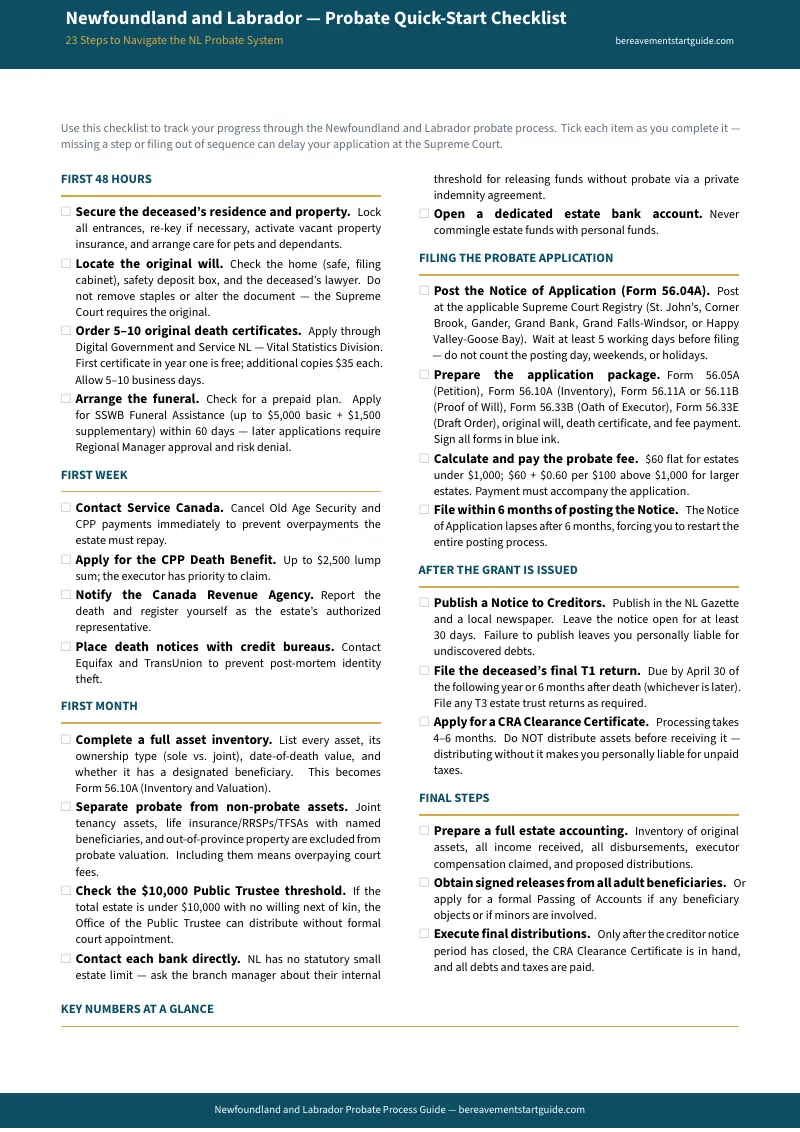
This is the content that does not exist in any free resource. The mandatory 5-working-day posting period for Form 56.04A (Notice of Application) -- do not count the posting day, weekends, or holidays. The 6-month lapse rule that voids your Notice if you have not filed. The complete Petition package: Form 56.05A (Petition), Form 56.10A (Inventory and Valuation), Form 56.11A or 56.11B (Proof of Will in Solemn Form or Common Form), Form 56.33B (Oath of Executor), Form 56.33E (Draft Order), the original will, the original death certificate, and the fee payment. What triggers clerk rejections: unsigned forms, missing originals, name mismatches between the death certificate and the application, and inventory errors. Which registry to file at -- St. John's, Corner Brook, Gander, Grand Bank, Grand Falls-Windsor, or Happy Valley-Goose Bay.
Chapter 6: Fees and Costs
The exact fee structure: $60 flat for estates under $1,000, then $60 plus $0.60 for every additional $100 of estate value. For a $250,000 estate, that works out to $1,554. Pre-built calculation tables for common estate values so you do not get the math wrong on your application. Comparison with other provinces to show where Newfoundland and Labrador falls in the national fee landscape. The total realistic budget for self-represented applicants versus hiring a lawyer (local firms typically quote a minimum of $4,000 plus court fees).
Chapter 7: Real Property and the Deed of Assent
The chapter that saves families from clouded titles. The Chattels Real Act treats real property as chattel interests -- the Grant of Probate alone does not transfer property. You must execute and register a Deed of Assent (also called an Executor's Deed) at the Registry of Deeds to formally transfer title from the estate to the beneficiary. Without it, the property title remains clouded indefinitely. Covers the Registry of Deeds filing process, the land registration system in Newfoundland and Labrador, and why this step is the most commonly missed requirement in the province.
Chapter 8: Intestate Estates and Letters of Administration
When there is no will, the court issues Letters of Administration instead of a Grant of Probate. The Intestate Succession Act controls distribution. This chapter covers who has priority to apply, the statutory distribution formula for surviving spouses and children, and the Administration Bond requirement -- Rule 56 generally requires two personal sureties who are Newfoundland and Labrador residents with sufficient unencumbered assets to guarantee the estate value. Covers how to file an Affidavit to Dispense with Bond when all adult beneficiaries consent.
Chapters 9-16: After the Grant, Federal Benefits, Taxes, Special Circumstances, and Estate Closure
The Notice to Creditors in the Newfoundland and Labrador Gazette (minimum 30-day open period -- skip this and you are personally liable for undiscovered debts). CPP Death Benefit claims. CRA Clearance Certificate (Form TX19 -- allow 4-6 months, and do not distribute assets before receiving it). Out-of-province executor challenges. Labrador Inuit Land Claims considerations. Executor compensation guidelines. The formal Passing of Accounts process. And the final distribution steps that close the estate and protect you from future claims.
Who This Guide Is For
- The newly named executor who has never dealt with the Supreme Court and needs the complete Rule 56 form sequence, the filing order, and the registry clerk rejection traps explained in plain language -- before making a mistake that costs months of delay
- The surviving spouse who needs to know whether the house, the bank accounts, and the RRSP actually require probate -- or whether survivorship and beneficiary designations mean the estate can be settled without going to court at all
- The family with no will who just learned that the Intestate Succession Act controls everything -- and needs to understand who has priority to apply for Letters of Administration, what the distribution rules are, and how to handle the Administration Bond requirement
- The out-of-province executor who moved away from Newfoundland and Labrador years ago and is now trying to settle a parent's estate from Alberta or Ontario -- who needs the paper filing path, the affidavit authentication process, and the logistical workarounds for managing court filings from across the country
- The executor on a budget who received a $4,000 minimum legal quote from a St. John's firm and knows the estate is straightforward enough to handle without a lawyer -- and needs a guide that replaces that retainer, not one that tells them to hire an attorney
- The executor dealing with real property who discovered that the Grant of Probate does not automatically transfer the family home -- and needs to understand the Chattels Real Act, the Deed of Assent, and the Registry of Deeds filing to avoid a clouded title
Why Free Resources Will Not Get You Through This
The information exists. It is scattered across the Supreme Court website, Digital Government and Service NL, the Registry of Deeds, Service Canada, the CRA, and a half-dozen other portals that do not reference each other. Here is what you actually encounter when you try to navigate probate using free sources alone:
- The Supreme Court publishes the forms but not the filing sequence. Every Rule 56 form is available as a downloadable PDF. What is not on the website: the precise order in which they must be completed, the requirement to post Form 56.04A and wait 5 working days before filing Form 56.05A, the 6-month lapse rule that voids your Notice, or the specific errors that cause registry clerks to reject applications. The forms are there. The instructions to use them correctly are not.
- PLIAN's guide covers the law but not the implementation. The Public Legal Information Association of Newfoundland and Labrador publishes the best free resource in the province -- a plain-English guide for executors and administrators. It explains what the law requires. It does not provide fill-in-the-blank form completion guidance, fee calculators, bank negotiation scripts, or step-by-step implementation tools. It is reading material, not a filing system.
- Law firm websites explain complexity to justify retainer fees. Local estate lawyers publish helpful overviews, but their content is designed to convince you the process is too dangerous to handle alone. For contested estates or complex trust structures, that is true. For the majority of straightforward estates with a clear will and cooperative beneficiaries, the answer costs a fraction of what a lawyer charges.
- National platforms apply the wrong province's rules. Willful, EstateExec, and Atticus provide general Canadian probate overviews that rank well in search results. But they consistently gloss over the Chattels Real Act, the Deed of Assent requirement, the absence of a small estate threshold, the specific Supreme Court registries, and the Rule 56 form sequence that is unique to this province. Following Ontario or British Columbia advice for a Newfoundland and Labrador estate means missing critical requirements.
- Government websites are accurate but siloed. Vital Statistics covers death certificates. The Supreme Court covers filing requirements. The Registry of Deeds covers property transfers. Service Canada covers federal benefits. The CRA covers tax obligations. Each source is correct about its own piece. None connect the pieces into a sequence. None tell you that the Notice must be posted before the Petition, or that distributing assets before receiving the CRA Clearance Certificate makes you personally liable.
Free resources give you forms without instructions, fragments without sequence, and advice from the wrong province. The Rule 56 Filing System puts every Newfoundland and Labrador-specific form, fee, deadline, and filing step into one document, in the order the Supreme Court actually requires them.
-- Less Than Fifteen Minutes With a St. John's Estate Lawyer
A single consultation with an estate lawyer in Newfoundland and Labrador costs $250 to $400 per hour. Standard probate representation starts at a $4,000 minimum fee plus court costs. For a $250,000 estate, that is $4,000 or more in legal fees for a process the Supreme Court deliberately designed to be accessible to self-represented applicants. This guide costs less than fifteen minutes of professional legal time and gives you the complete province-specific filing system -- every Rule 56 form in sequence, every clerk rejection trap flagged, every fee calculated, and the Deed of Assent process that most executors do not discover until the property transfer stalls.
Your download includes 8 PDFs -- the complete 16-chapter guide, the Probate Quick-Start Checklist (20 items across 6 phases), and 6 standalone reference cards you can print and use independently: Rule 56 Form Sequence (the complete filing process at a glance), Chattels Real Act and Deed of Assent Guide (the property transfer process), Probate Fee Calculator (pre-built tables plus a fillable worksheet), Administration Bond and Intestate Estate Guide (bond requirements and the ISA distribution formula), Out-of-Province Executor Strategies (remote filing logistics and affidavit authentication), and CRA Clearance Timeline (tax deadlines and the personal liability rule). Plus a money-back guarantee, no time limit. If the guide does not give you clarity on what to do next and confidence that your application will pass the registry clerk, email us for a full refund. No questions asked.
Not ready for the full guide? Download the free Newfoundland and Labrador -- Probate Quick-Start Checklist -- 20 items covering every critical action from the first 48 hours through estate closure. It is enough to see the full picture and start gathering what you need.
You did not choose to be the executor. But the court does not wait, the bank does not wait, and the 6-month Notice lapse deadline does not wait. The guide makes sure you do not miss any of them.