Someone You Love Just Died in the Northwest Territories. The Bank Froze Their Accounts. Vital Statistics Is in Inuvik. The Supreme Court Is in Yellowknife. And Nobody Has Explained How to Settle an Estate When Every Office Is a Thousand Kilometres Away.
You are standing in a place nobody prepared you for. Maybe you were named executor in a will you barely remember reading, and now the funeral home needs decisions while the bank tells you every account is frozen. Maybe there was no will at all, and because you are the surviving spouse or the eldest child, everyone is looking at you for answers you do not have. Maybe you live in Alberta or Ontario and just learned that you are responsible for settling an estate in a territory where the Supreme Court registry is in Yellowknife, Vital Statistics operates out of Inuvik, the Land Titles Office has its own rules, and nobody at any of those places will walk you through the process from start to finish.
You are grieving and sleep-deprived, but the paperwork does not wait. The funeral director needs to know how many death certificates to order from Vital Statistics in Inuvik at $26 each. Service Canada needs notification to stop CPP and OAS payments before overpayment clawbacks begin. The bank will not release a dollar from the deceased's sole accounts. Siblings or extended family members are already asking about the house. And if there are minor children among the beneficiaries, the Public Trustee can step in and take over administration entirely — charging a $200 file-opening fee, 3% of every property transferred, and 5% of all cash received, stretching the process to two or three years.
Meanwhile, the question that keeps circling in the back of your mind: if I pay the wrong bill, or distribute assets before a CRA Clearance Certificate arrives, or miss a court deadline I did not even know existed — am I personally on the hook?
The short answer: the estate pays its own debts, not you. But the long answer — the one that involves the NWT's $35,000 small estate threshold under Rule 10 of the Estate Administration Rules, a probate fee schedule that tops out at $435, the $100,000 preferential spousal share under the Intestate Succession Act, Land Titles transfer fees of $2 per $1,000 of property value, the fact that real estate transfers almost always require formal probate regardless of estate size, and the network of twenty-two Government Service Officers across the territory who can commission oaths and help with forms but whose existence is barely documented on any government website — that answer is what separates families who settle an estate in months from families who spend years and thousands of dollars fixing mistakes they did not know they were making.
The When Someone Dies in Northwest Territories — Estate Settlement Guide is a Northern Executor System for every legal, financial, and administrative step between the funeral home and final distribution. Not a law textbook. Not a generic checklist from a national Canadian website that does not know the NWT from New Brunswick. A structured, territory-specific manual that separates what must be done in the first 48 hours from what legally cannot happen until the CRA issues a Clearance Certificate — so you stop guessing, stop panicking, and start working through this in the right order.
What's Inside the Northern Executor System
A complete guide, the First 48 Hours Checklist, and standalone reference documents — covering every stage from the moment of death through final asset distribution, built specifically for NWT statutes, the Supreme Court of the Northwest Territories, and the territory-specific rules that make settling an estate here different from anywhere else in Canada:
The First 48 Hours: Securing the Estate in the North
The moment someone dies in the Northwest Territories, every Power of Attorney they had in place is legally void. If you managed their finances under a POA, your authority ended at the moment of death. This chapter covers securing the deceased's home and property — critical in a territory where an unheated house in winter means burst pipes and catastrophic damage within hours — locating the original will, notifying the funeral home, and the single most important rule in this entire guide: do not pay any of the deceased's debts with your own money. It also covers the immediate decision that most families do not realize they face: whether a body in a remote community needs to be transported to Yellowknife or Hay River, who arranges that transport, and what it costs.
Death Certificates: Inuvik, Fees, and the Distance Problem
NWT death certificates are processed exclusively through Vital Statistics in Inuvik — not Yellowknife, not your local community health centre. Each certificate costs $26. Applications can be submitted by mail, fax, or email, but the process takes time and you need multiple originals. Every bank, insurance company, court, and government agency will require one. The guide gives you the exact calculation based on the deceased's assets so you order the right number now. Coming back later means weeks of delay. If you are an out-of-territory executor, this chapter covers the remote application process so you do not waste time contacting the wrong office.
The Rule 10 Small Estate Bypass: Estates Under $35,000
This is the chapter that saves families the most time and money. If the net value of the estate is under $35,000, you can apply for a Declaration of Small Estate using Forms 2, 3, and 4 under Rule 10 of the Estate Administration Rules — bypassing the standard probate process entirely. The critical knowledge most families lack: assets that pass outside the estate — life insurance with named beneficiaries, RRSPs with named beneficiaries, jointly held bank accounts with right of survivorship — do not count toward the $35,000 threshold. Families routinely overestimate their estate's value by including these assets, subjecting themselves to months of unnecessary probate. This chapter walks you through the exact calculation, the forms, and the filing process. One major exception: if the estate includes real property, you almost certainly need formal probate regardless of total value, because the Land Titles Office requires it for title transfers.
Standard Probate: The Supreme Court Filing Process
When the estate exceeds $35,000 or includes real property in sole ownership, standard probate through the NWT Supreme Court is required. The guide walks through the Grant of Probate application (Form 6), the required schedules and supporting documents, the fee calculation (tiered from $25 for estates under $10,000 up to $435 for estates over $250,000), and the serving and filing sequence. If there was no will, this chapter covers the Grant of Administration process — who has statutory priority to apply, what happens when multiple family members disagree, and the specific requirements for Letters of Administration. Every form reference points to the exact document on the NWT court website so you are never guessing which PDF to download.
Banking and Frozen Accounts: Getting Access When You Need It Most
This is the chapter that solves the most urgent crisis families face. The bank froze the accounts and you cannot pay the funeral, the mortgage, or the utilities. The guide explains which accounts stay accessible (joint accounts with right of survivorship), which transfer directly to named beneficiaries (RRSPs, TFSAs, life insurance), and which require a Grant of Probate. For accounts that are frozen, the guide covers the bank's internal process for releasing funds for small estates without probate — the formal mechanism that branch staff rarely volunteer. You get the exact steps, the documentation to bring, and what to say when the branch manager routes you to a centralized corporate estate department in Toronto or Calgary that has no understanding of NWT-specific rules.
Government Service Officers: Your Lifeline Outside Yellowknife
This is the chapter that does not exist in any other resource. Over half the NWT population lives outside Yellowknife, far from the Supreme Court registry, lawyers, and notaries. But the territorial government operates twenty-two Single Window Service Centres — from Aklavik to Fort Smith to Wekweeti — staffed by Government Service Officers who are authorized to act as Commissioners for Oaths, assist with form completion, and provide services in Indigenous languages. The guide maps every GSO location, lists which services each centre provides, and integrates them directly into the estate settlement workflow so you know exactly when to visit your local GSO instead of trying to reach Yellowknife.
Intestacy: What Happens When There Is No Will
When someone dies without a valid will in the Northwest Territories, the Intestate Succession Act dictates everything. The surviving spouse receives a preferential share of the first $100,000 of the estate's net value, plus the option to receive the matrimonial home as part of that share. The residue is then divided between the spouse and children according to statutory fractions. This chapter explains the exact formulas, covers the intersection with the Family Law Act (which gives a surviving spouse six months to elect equalization of net family property instead of taking under intestacy), and addresses the Dependants Relief Act provisions that allow dependents to petition the court if the distribution is inadequate. These overlapping statutes are where family conflicts start — the guide separates each entitlement clearly so you can explain the rules to beneficiaries before disputes escalate.
Real Property, Land Titles, and Indigenous Land
The transfer of real property is the most rigid bureaucratic step in NWT estate settlement. The Land Titles Office charges $2 per $1,000 of property value for transfers, with a $100 minimum. Joint tenancy with right of survivorship allows the surviving owner to transfer title using a death certificate and supporting documentation — no probate required. Sole ownership or tenancy-in-common requires a Transmission application with a Grant of Probate. This chapter covers both paths, the exact forms, and the fee calculation. It also addresses the critical issue that no generic Canadian guide covers: land in regions governed by comprehensive land claim agreements — Tlicho, Inuvialuit, Gwich'in, Sahtu — where unsurveyed or settlement-area land follows different rules and may require engagement with the relevant land administration body rather than the territorial Land Titles Office.
Indigenous Funeral Benefits and Emergency Financial Assistance
The NWT has funding sources that do not exist anywhere else in Canada, and no generic estate guide mentions any of them. The Inuvialuit Regional Corporation provides up to $5,000 in funeral assistance for eligible beneficiaries. The Gwich'in Tribal Council offers $2,500 in bereavement support. The Sahtu Secretariat provides $2,000 in emergency assistance. The GNWT Health and Social Services operates a burial program for individuals whose estates cannot cover funeral costs. This chapter centralizes every Indigenous and territorial benefit — eligibility criteria, application procedures, required documentation, and contact information — so you know within minutes whether financial assistance is available and how to apply before funeral costs become a crisis.
Federal Benefits, Taxes, and Final Distribution
The remaining chapters cover CPP death benefit applications ($2,500 maximum), CPP Survivor's Pension eligibility, canceling OAS to prevent overpayment clawbacks, the Northern Residents Deduction on the terminal T1 return, deemed disposition of capital property at fair market value, the CRA Clearance Certificate application (Form TX19 — allow 120 days), and estate T3 returns for income earned after the date of death. The guide closes with the complete chronological timeline from Day 1 through Month 12+, the final accounting process, executor compensation, and the critical rule: do not distribute assets to beneficiaries before the CRA Clearance Certificate arrives, because if the estate later owes taxes, you are personally liable for the shortfall.
Who This Guide Is For
- The surviving spouse whose partner just died and whose bank accounts were frozen this morning — who needs to know which accounts stay accessible, how to apply for the $100,000 preferential spousal share under the Intestate Succession Act, and how to access emergency funeral funding before the funeral director requires a deposit
- The executor living outside the NWT who has been named personal representative in a will and must now navigate the Supreme Court in Yellowknife and Vital Statistics in Inuvik from a different province — who needs the remote filing process, exact form references, and a month-by-month project management timeline
- The community caregiver or extended family member helping a bereaved family in a remote community — who needs to know how to use Government Service Officers at the nearest Single Window Service Centre for oaths and form completion, and how to access services in Indigenous languages
- The financially constrained or Indigenous family facing immediate funeral costs without liquid funds — who needs the complete directory of IRC ($5,000), Gwich'in ($2,500), Sahtu ($2,000), and GNWT burial assistance programs, with eligibility criteria and application steps that could unlock funding worth hundreds of times the cost of this guide
Why Free Resources Will Not Get You Through This
The information exists. It is scattered across the GNWT Health and Social Services website, the Department of Justice, the Supreme Court registry, the Land Titles Office, Vital Statistics in Inuvik, the Public Trustee's office, Service Canada, the CRA, and the individual websites of every Indigenous regional organization. Here is what you actually encounter when you try to settle an estate using free sources alone:
- GNWT pages are accurate but legalistic and unsequenced. You can find the Estate Administration Rules and download Form 6 for a Grant of Probate. What you cannot find is a plain-English explanation of how to complete the schedules, which supporting documents to attach, or what order to tackle the dozens of steps between death and final distribution. The forms assume you already know the process. If you already knew the process, you would not be reading government PDFs at midnight.
- Law firm blogs in Yellowknife explain the theory to generate retainers. Dragon Toner and other firms publish precise breakdowns of the Intestate Succession Act and the $100,000 spousal share. Their content is designed to convince you the process is too dangerous to handle alone — and that you need a retainer starting at $300 per hour. For contested estates, that is true. For straightforward estates, the answer costs a fraction of what one meeting with a lawyer costs.
- Funeral home content stops after the burial. McKenna Funeral Home in Yellowknife provides excellent, culturally sensitive guidance for the first few days — including Tlicho-specific protocols and body transport logistics. Their support ends after the funeral and the initial CPP application. They do not cover probate, the Rule 10 small estate bypass, Land Titles transfers, tax clearance, or executor liability. Their help ends where the hardest questions begin.
- EstateExec and national platforms lack NWT depth. Software tools understand the $35,000 small estate threshold and provide generic Canadian tax tracking. They completely miss the Government Service Officers, the Indigenous funeral benefits, the remote-community logistics, and the land claim complexities that define estate settlement in the North. They are built for Ontario and British Columbia, with a territorial flag pasted on top.
- Indigenous organization websites cover their own benefits but nothing else. The IRC, Gwich'in Tribal Council, and Sahtu Secretariat each publish their funeral assistance policies. None of them explain how those benefits fit into the broader estate settlement process — when to apply relative to probate, how to coordinate with the CPP death benefit, or what happens if the estate also qualifies for GNWT burial assistance. You need all of these sources combined and sequenced, not scattered across a dozen tabs.
Free resources give you fragments from a dozen sources that do not reference each other. The Northern Executor System puts every NWT-specific statute, form, deadline, benefit, and procedure into one document, in the order you actually need them — including the remote-community resources that no other guide covers.
— Less Than One Hour With a Yellowknife Lawyer
A single consultation with an NWT estate lawyer costs $300 or more per hour — if you can get an appointment. There are fewer than thirty lawyers in the entire territory. This guide costs less than one hour of professional legal time and gives you the complete NWT-specific roadmap — every statute, every form, every deadline, and the territory-specific rules that the Supreme Court requires but nobody explains in plain language.
Your download includes the complete guide with the First 48 Hours Checklist and standalone reference documents covering the Rule 10 Small Estate Bypass, the GSO Directory, the Indigenous Benefits Application Guide, and the CRA Clearance Timeline. Plus a money-back guarantee, no time limit. If the guide does not give you clarity on what to do next and confidence that you are doing it in the right order, email us for a full refund. No questions asked.
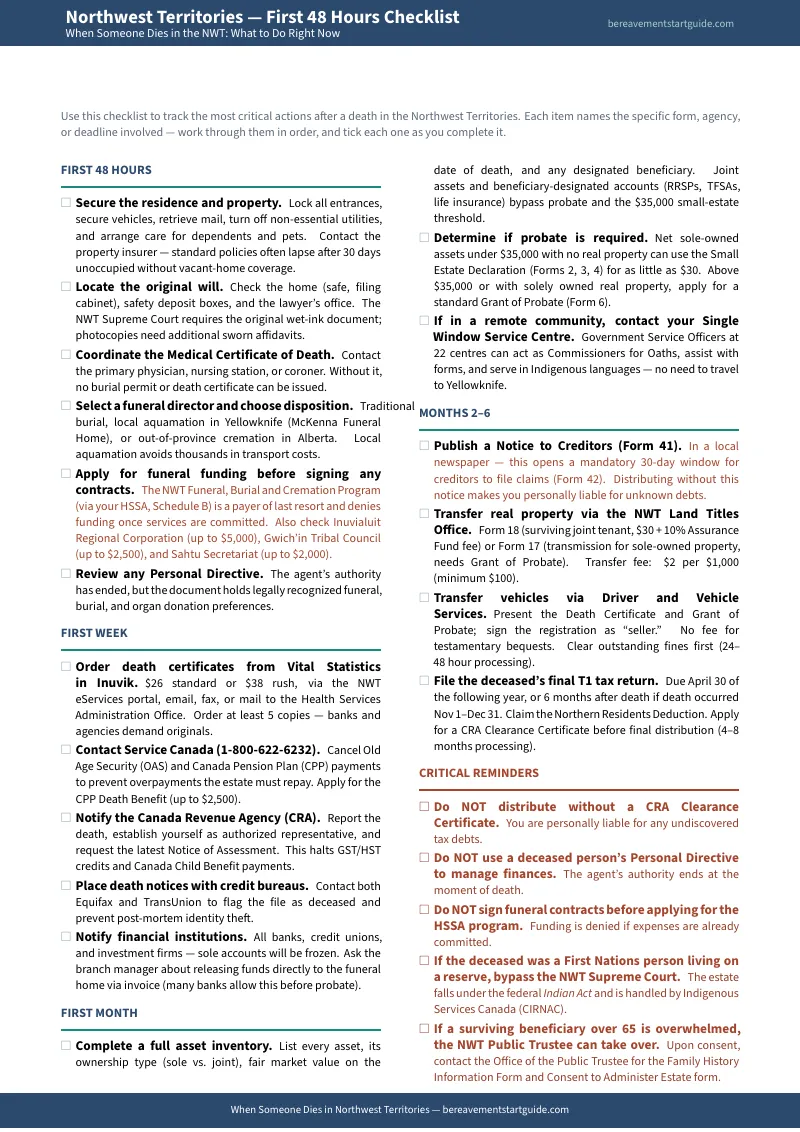
Not ready for the full guide? Download the free Northwest Territories — First 48 Hours Checklist — covering everything that must happen in the first two days after a death in the NWT: death certificates from Inuvik, securing the home, emergency funeral funding, what not to pay, and what to gather. It is enough to get through tonight and tomorrow.
You did not ask for this job. But you can do it. The guide shows you how, one step at a time.