The Coroner Just Seized the Body and Told You It's Being Flown to Edmonton for an Autopsy. The Funeral Home Quoted $5,000 for Aquamation but Won't Explain Why Cremation Costs Twice That. Your Family Is Scattered Across Three Provinces. And Nobody Mentioned That the Northwest Territories Has No Funeral Regulatory Board to Protect You.
You are standing in a funeral home in Yellowknife — or you are a thousand kilometres away, managing this by phone from Edmonton, Toronto, or Vancouver — and the decisions are piling up faster than you can process them. Maybe the Coroner Service has taken legal possession of the body because the death was sudden, and you just learned that autopsies are not performed in the Northwest Territories at all. The body is being flown to the Chief Medical Examiner in Edmonton, Alberta, and nobody can tell you how long that will take or who pays for the return flight. Maybe the funeral home mentioned "aquamation" as an option and you have never heard that word before, or they quoted a cremation price that seems impossibly high until you realize that flame cremation does not exist in the NWT — the body has to be shipped to Alberta for that too.
You are grieving and overwhelmed, but the funeral home needs answers. They need to know who has legal authority to sign the contract. They need to know whether the family wants a local aquamation, an out-of-territory flame cremation, or a burial — and they need that answer before storage fees start accumulating. And somewhere in the background, a question keeps circling: are we paying for things we have the right to refuse, and would we even know?
The short answer: families in the Northwest Territories overpay for funeral services regularly, not because funeral directors are dishonest, but because there is no dedicated funeral regulatory board in the territory, the information families need is scattered across dozens of government PDFs and departmental websites, and search engines keep surfacing the American "FTC Funeral Rule" — which has absolutely zero legal force in Canada. The long answer — the one involving the Coroner's mandatory autopsy-in-Edmonton pipeline, the 48-hour waiting period before any cremation or aquamation can proceed, the DHSS Funeral, Burial and Cremation Program that will cover basic costs for verified indigent families but requires precise paperwork filed before you sign any contract, the $35,000 small estate shortcut that lets you bypass full probate, and the Consumer Protection Act provisions administered by MACA that are your actual consumer rights — that answer is what separates families who arrange a funeral confidently from families who spend thousands more than necessary because nobody explained the rules.
The Northwest Territories Funeral Laws & Consumer Rights Guide is a Northern Consumer Defense System built for the unique realities of arranging a funeral in Canada's most logistically challenging jurisdiction. Not a generic Canadian bereavement pamphlet. Not a funeral home brochure designed to sell you services. A structured, NWT-specific manual that covers every territorial statute, every form, and every financial assistance program — so you stop guessing, stop overpaying, and start making decisions based on the actual law.
What's Inside the Northern Consumer Defense System
An 11-chapter guide and the Funeral Consumer Rights Checklist — covering every step from the moment of death through final disposition, built specifically for NWT statutes and the territory-specific realities that make funeral planning here unlike anywhere else in Canada:
Chapter 1: Who Has the Legal Right to Make Funeral Decisions
The moment someone dies, the question of authority is not decided by family consensus or who lives closest. The Estate Administration Rules and the Intestate Succession Act establish a strict descending hierarchy: Executor named in a valid will first, then surviving legally married spouse or common-law partner, then adult children, then adult grandchildren, then parents, then adult siblings. If siblings disagree on cremation versus burial, the funeral home cannot proceed until they reach consensus — and the body stays in cold storage accumulating daily fees. This chapter gives you the complete hierarchy and covers the critical detail most families miss: every Personal Directive and Power of Attorney is automatically void the instant the person dies. They cannot be used to control funeral decisions.
Chapter 2: The First 48 Hours — Immediate Steps
What you do in the first two days determines how smoothly everything else proceeds. If the death was expected under palliative care, contact the care team — NOT 911. Calling 911 for an expected death triggers RCMP and Coroner involvement, adding days of delay and potential autopsy transport to Edmonton. If the death was sudden or unexpected, the NWT Coroner Service takes legal possession of the body. This chapter walks you through both scenarios step by step, including the critical actions most families forget: stopping CPP, OAS, and GIS payments immediately through Service Canada, because overpayments deposited after death must be repaid from the estate.
Chapter 3: Death Registration, the Burial Permit, and Death Certificates
The Burial Permit is the master document in the Northwest Territories — no burial, cremation, aquamation, or air transport can proceed without it. The funeral director files the Registration of Death Statement and Medical Certificate of Death with Vital Statistics in Inuvik or a district registrar, and the Burial Permit is issued immediately upon registration. This chapter covers the entire registration process, how many certified death certificates to order ($26 each through the eServices portal), and why you need 3 to 5 copies — banks, the Supreme Court, and insurance companies each require their own original.
Chapter 4: Consumer Rights — How to Avoid Being Overcharged
This is the chapter that pays for the entire guide. The Northwest Territories has no dedicated funeral regulatory board like Alberta's AFSRB or Ontario's BAO. Instead, your consumer protections come from the Consumer Protection Act, administered by the MACA Consumer Affairs Office. You have the right to itemized pricing. You have the right to decline embalming — NWT law does not require it for standard local burial, cremation, or aquamation. You can bring your own casket, urn, or shroud. And the FTC Funeral Rule you keep finding on Google? It is an American federal regulation with zero application in Canada. This chapter gives you the actual NWT consumer rights and the scripts for exercising them.
Chapter 5: Disposition Options — Cremation, Aquamation, Burial, and Embalming
This is where the NWT diverges from every other province. Traditional flame cremation does not exist within the territory — bodies must be flown to Alberta, adding substantial cargo and preparation costs. Aquamation (alkaline hydrolysis) is now available at McKenna Funeral Home in Yellowknife, providing a local alternative. But both cremation and aquamation require a mandatory 48-hour waiting period after death registration before the procedure can begin. This chapter covers every option, every cost factor, and the coroner clearance that must be obtained before any procedure.
Chapter 6: Transporting Remains Within and From the Northwest Territories
The NWT's vast distances and limited infrastructure make body transport one of the most complex and expensive parts of funeral planning. Whether you are repatriating an elder to a remote settlement, shipping remains to a southern province for burial, or receiving a body back from the Edmonton autopsy, this chapter covers the exact documentation required: the Burial Permit affixed to the shipping container, the embalming or hermetic seal requirements, the airline cargo booking process with Canadian North, and the difference between cremated remains transport and full-body shipment. Every step is specific to northern air logistics.
Chapter 7: Low-Income Funeral Assistance — The DHSS Program
The DHSS Funeral, Burial and Cremation Program will cover basic funeral costs for families who qualify — but the government acts strictly as a "payer of last resort." Before any territorial funds are released, the Benefit Administrator must verify that the estate has no assets, that CPP death benefits have been seized, that all band council and regional corporation funding has been exhausted, and that the family has been confirmed as "Verified Indigent" through the ECE Income Assistance Program. The critical rule: submit your application BEFORE signing any funeral contract, because the DHSS will likely deny your claim if you pay out of pocket first. This chapter gives you the complete application process, what the program covers (basic transport, minimal casket, cemetery plot) and what it does not (obituaries, catering, upgraded caskets).
Chapter 8: Estate Basics — The Small Estate Shortcut
If the deceased's NWT assets total less than $35,000 net, you can bypass full probate by filing a Declaration of Small Estate with the Supreme Court of the Northwest Territories using Form 2 and Form 3. Court fees range from $30 to $215. This chapter covers the eligibility calculation, the filing process, and the one requirement that catches out-of-territory executors: the NWT prohibits remote or virtual commissioning of affidavits. You must swear the document in person before a Commissioner for Oaths, Notary Public, Government Service Officer, circuit court judge, or RCMP officer.
Chapter 9: When to Get a Lawyer — Escalation Triggers
Most funeral planning does not require legal counsel. But there are specific scenarios where proceeding without a lawyer creates real financial or legal risk: contested remains between family members at the same priority level, estates where the funeral invoice exceeds available liquid assets, communicable disease restrictions, and Indigenous estates governed by the Indian Act where CIRNAC administers the estate on reserve land. This chapter identifies the exact escalation triggers so you know when you have crossed the line from "manageable with a guide" to "get a lawyer today."
Chapters 10 and 11: Prepaid Contracts, and Religious and Cultural Considerations
Chapter 10 covers prepaid funeral contracts — your rights regarding cancellation, trust fund protections, and what happens when the prepaid amount does not cover the final costs at the time of death. Chapter 11 addresses the intersection of religious and cultural traditions with NWT law, including rapid-burial requirements for Islamic and Jewish families, the embalming exemptions available under public health law, and the specific considerations for Indigenous families coordinating community-based funeral practices in remote settlements.
Who This Guide Is For
- The executor or next-of-kin managing a death in the NWT — who needs to know which charges are mandatory, which can be refused, and what the funeral home must disclose before you sign any contract
- The out-of-territory family member coordinating funeral arrangements from Alberta, BC, Ontario, or further away — who needs to understand the Coroner's autopsy-in-Edmonton process, the Vital Statistics eServices portal, and the small estate declaration before flying in
- The family facing a coroner investigation after a sudden or unexpected death — who needs clarity on why the body is being flown to Edmonton, how long it takes, and what happens when it comes back
- The financially constrained family who received a funeral home quote exceeding every available dollar — who needs the DHSS assistance application, the CPP death benefit process, and the Indigenous assistance programs through IRC, GTC, and band councils
- The Indigenous family coordinator managing funeral logistics across remote communities — who needs to understand the territorial and band-level funding programs, the air transport requirements, and the intersection of the Indian Act with NWT funeral law
- The advance planner reviewing a loved one's prepaid contract or documenting their own wishes — who needs the cancellation rights, trust fund rules, and how to verify that prepaid funds are being held properly
Why Free Resources Will Not Protect You at the Funeral Home
The information exists. It is scattered across the GNWT Health and Social Services portal, the Department of Justice website, Vital Statistics in Inuvik, the MACA Consumer Affairs Office, and funeral home websites designed to generate appointments, not protect your wallet. Here is what you encounter when you try to piece together your rights from free sources alone:
- The GNWT publishes the law but reads like raw legislation. The Health and Social Services portal and the Department of Justice have the correct legal information. It is buried in dense PDFs, structured as regulatory reference material, and assumes you already know which of the dozen different statutes applies to your situation. A grieving family trying to understand their rights before signing a contract in 48 hours does not have time to cross-reference the Coroners Act, the Vital Statistics Act, and the Public Health Act.
- Funeral home websites answer questions that serve their sales funnel. McKenna Funeral Home and Inuvik Funeral Services publish useful information about their services. Every page is designed to convert readers into clients. They explain what aquamation involves. They do not explain that you have the legal right to decline services you do not want or bring your own casket.
- Google surfaces the wrong jurisdiction constantly. NWT residents searching "funeral consumer rights" or "cremation rules" routinely see results from Consumer Protection BC, Alberta's AFSRB, or the American FTC Funeral Rule. Acting on out-of-jurisdiction advice in a time-sensitive funeral situation can cost real money — especially when it involves transport logistics unique to northern Canada.
- Aggregator sites publish dangerously inaccurate information. Platforms like DFS Memorials rank well on search engines by creating programmatic pages for every jurisdiction. Their NWT page advertises "low cost cremation services" — but flame cremation does not exist within the territory. Families who budget based on aggregator information face a financial shock when they learn the body must be shipped to Alberta.
- Indigenous assistance programs are buried in administrative PDFs. The IRC Funeral Assistance Program, the GTC Bereavement Assistance Program, and other regional corporation funding programs each have specific eligibility requirements, documentation deadlines, and application protocols that are not consolidated anywhere a family can find during the critical first 48 hours.
Free resources give you fragments from a government that writes for bureaucrats, funeral homes that write for sales, search engines that cannot tell NWT from BC, and aggregator sites that do not know flame cremation does not exist here. The Northern Consumer Defense System puts every NWT-specific right, form, fee, deadline, and financial assistance program into one document, in the order you actually need them.
— Less Than One Hour of Funeral Home Overcharges
Funeral costs in the Northwest Territories routinely exceed $5,000 for a basic arrangement — and climb significantly higher when out-of-territory transport is involved. Families who do not know their rights pay for non-mandatory embalming, accept bundled pricing when a la carte service selection would save hundreds, and miss the DHSS assistance window because they signed a funeral contract before applying. This guide costs less than a single unnecessary line item on a funeral invoice and gives you the legal knowledge to evaluate every charge before you sign.
Your download includes the complete 11-chapter guide plus 7 standalone printable references you can bring to the funeral home, the HSSA office, or the cargo terminal: the Funeral Consumer Rights Checklist (19 items), the Deadline Reference Table (every statutory deadline on one page), the Disposition Authority Hierarchy (who controls funeral decisions), Negotiation Scripts (word-for-word language for exercising your rights), the Coroner Investigation Guide (the Edmonton autopsy pipeline), the Air Transport Guide (step-by-step protocol with pre-flight checklist), and the DHSS Assistance Guide (financial assistance programs including IRC and GTC). All backed by a money-back guarantee, no time limit. If the guide does not give you clarity on your rights and confidence that you are making informed decisions, email us for a full refund. No questions asked.
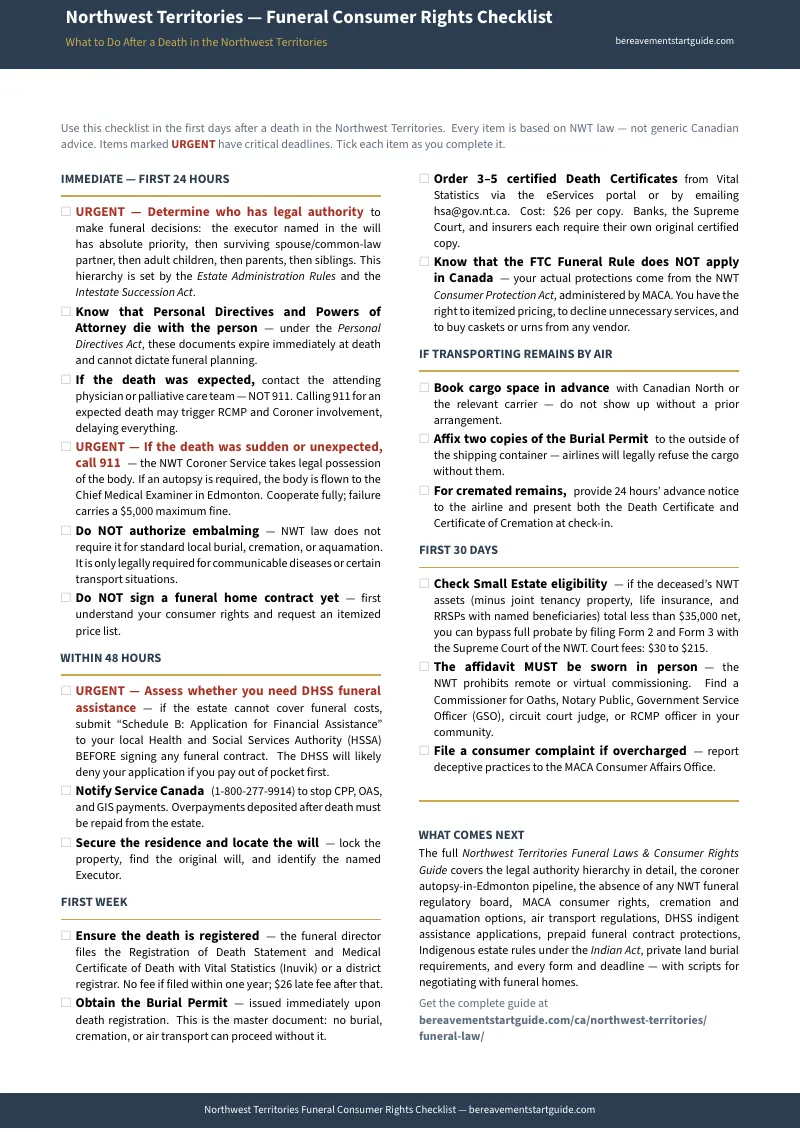
Not ready for the full guide? Download the free Northwest Territories Funeral Consumer Rights Checklist — 19 items covering who has legal authority, what to demand before signing any contract, the critical difference between mandatory permits and optional services, and the air transport documentation you need if remains are being flown anywhere. It is enough to walk into a funeral home tonight knowing your rights.
You should not have to become an expert in territorial funeral law while you are grieving. But you should not have to overpay because nobody told you the law was on your side.