You Were Named Executor of an Estate in the Northwest Territories. The Court Forms Are Legalistic, the Small Estate Threshold Is Unusually Low, and Nobody Will Walk You Through the Process From Start to Finish.
You just learned that you are responsible for probating an estate in the Northwest Territories. Maybe you were named executor in the will and assumed someone would tell you what to do. Maybe there was no will at all, and because you are the surviving spouse or the eldest child, the responsibility defaults to you. Either way, you are now facing a Supreme Court filing system that operates out of Yellowknife, Hay River, or Inuvik, requires sworn affidavits before a Commissioner for Oaths, and demands forms filled out with a precision that would challenge a paralegal.
Here is what you are actually dealing with. The NWT's small estate threshold is $35,000 under Rule 10 of the Estate Administration Rules. That figure is extraordinarily low compared to most Canadian provinces. A single vehicle can push you past it and into formal probate. If the estate includes real property in sole ownership, you almost certainly need a Grant of Probate regardless of total value, because the Land Titles Office will not transfer title without one. The forms themselves are a cascade of cross-referenced schedules: Form 6 (Application for Grant), Form 7 (Affidavit in Support), Schedules 1 through 5. Fill in the wrong schedule, attach the wrong supporting document, and the Supreme Court clerk returns the entire package weeks later. Meanwhile, the bank accounts stay frozen.
If you live outside the territory, the logistical friction multiplies. Death certificates come exclusively from Vital Statistics in Inuvik. The court registries operate on territorial hours with limited phone availability. Bond requirements for non-resident executors can add another layer of paperwork unless every beneficiary signs a Consent to Waive Bond (Form 39). And if the Public Trustee determines the estate involves minors or incapable adults, they can intervene entirely, charging a $200 file-opening fee, 3% of property transfers, and 5% of cash receipts.
You do not need a law degree. But you need a system that tells you exactly which forms to file, in what order, with what supporting documents, before any deadline passes or any court clerk returns your application with a rejection stamp.
The Northwest Territories Probate Process Guide is a Supreme Court Filing System for every executor and administrator settling an estate under NWT law. Not a collection of links to government PDFs. Not a generic Canadian probate overview with territorial names swapped in. A step-by-step filing manual that covers the small estate bypass, the standard Grant of Probate process, intestacy rules, bond requirements, the Land Titles transfer process, and the final accounting that closes the estate, built entirely around the NWT's Estate Administration Rules, the Intestate Succession Act, and the actual forms the Supreme Court requires.
What's Inside the Supreme Court Filing System
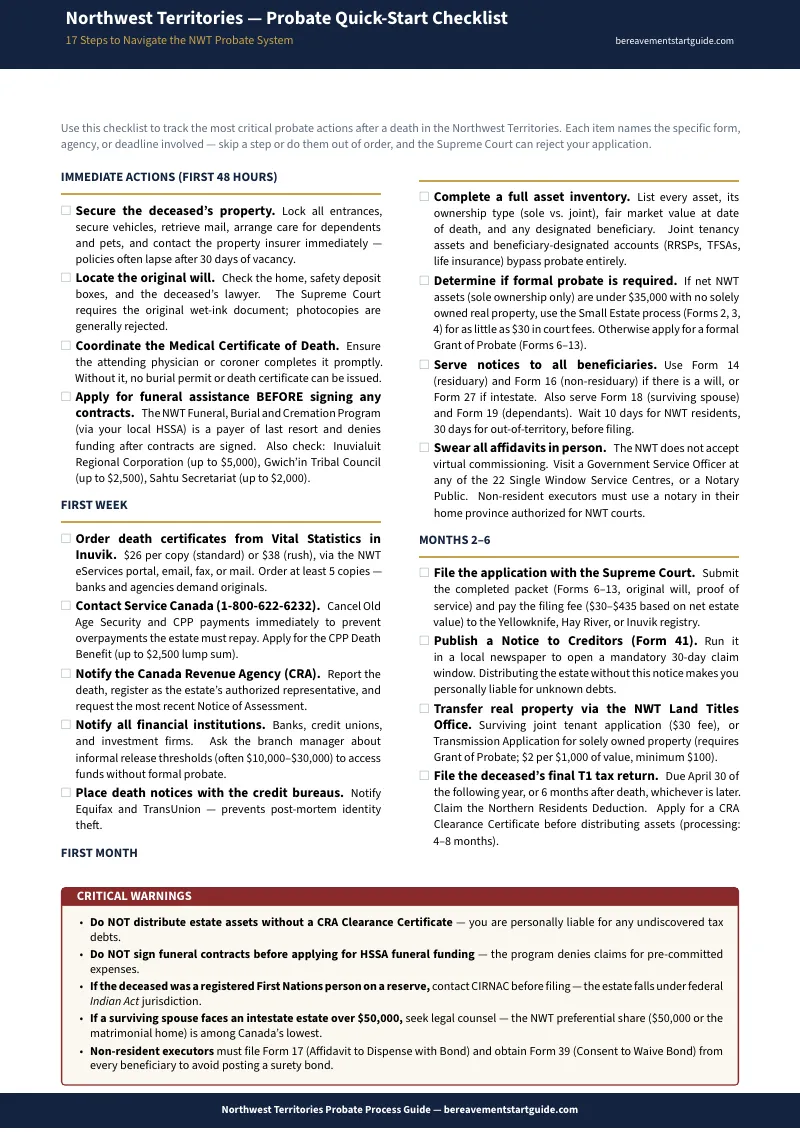
A complete guide, a Probate Quick-Start Checklist, and standalone reference documents covering every stage from determining whether probate is required through the passing of accounts that closes the estate, built specifically for NWT statutes and the Supreme Court of the Northwest Territories:
The $35,000 Question: Small Estate or Full Probate?
This is the decision that shapes everything. If the net estate value is under $35,000, you can use the streamlined small estate process under Rule 10, filing Forms 2, 3, and 4 instead of navigating the full Grant of Probate application. The critical knowledge most executors lack: assets that pass outside the estate do not count toward the threshold. Life insurance with named beneficiaries, RRSPs with designated beneficiaries, jointly held bank accounts with right of survivorship, and CPP death benefits are all excluded. Families routinely overestimate their estate's value by including these assets and subject themselves to months of unnecessary full probate. This chapter walks you through the exact calculation, explains the one major exception (real property in sole ownership almost always requires formal probate regardless of total value), and covers the complete Form 2, Form 3, and Form 4 filing sequence with plain-English explanations of every sworn statement.
Standard Probate: Application to Grant
When the estate exceeds $35,000 or includes real property, you file for a Grant of Probate through the NWT Supreme Court. This chapter walks through Form 6 (Application for Grant), Form 7 (Affidavit in Support), and Schedules 1 through 5 in the order you actually complete them. Schedule 1 captures the deceased's information. Schedule 2 covers the will. Schedule 3 names the personal representatives. Schedule 4 lists the beneficiaries. Schedule 5 is the estate inventory with values. The guide explains what the Supreme Court clerk actually looks for when reviewing your application, the supporting documents that must accompany each schedule, and the common reasons applications are returned. Probate fees are tiered from $25 for estates under $10,000 to a maximum of $435 for estates over $250,000. This chapter covers the exact fee calculation so you include the right cheque.
No Will: Letters of Administration and Intestacy
When someone dies without a valid will in the Northwest Territories, the Intestate Succession Act determines who inherits and who has priority to apply for Letters of Administration. The surviving spouse receives a preferential share of the first $100,000 of the estate's net value. The residue is divided between the spouse and children according to statutory fractions that change based on the number of children. This chapter covers the priority hierarchy for applicants, the Form 6 application process for intestate estates, and the interaction with the Family Law Act, which gives a surviving spouse six months to elect equalization of net family property instead of taking under intestacy. It also addresses the Dependants Relief Act provisions that allow financial dependants to petition the court if the statutory distribution is inadequate.
Bond Requirements and the Waiver Process
The NWT Supreme Court can require executors to post a bond as security against mismanagement of the estate. This is especially common for non-resident executors and administrators of intestate estates. The bond amount typically equals the value of the estate. Securing one from an insurance company costs a premium. But beneficiaries can waive this requirement by signing Form 39 (Consent to Waive Bond), and the executor then files Form 17 (Affidavit to Dispense with Bond). This chapter explains exactly when a bond is required, how to calculate the amount, how to get beneficiaries to sign the waiver, and the filing process to get the court to dispense with the bond entirely.
Real Property and the Land Titles Office
Transferring real property is the most rigid bureaucratic step in NWT probate. Joint tenancy with right of survivorship allows the surviving owner to transfer title using a death certificate and a statutory declaration. No probate required. Sole ownership or tenancy-in-common requires a Transmission application with a certified copy of the Grant of Probate. The Land Titles Office charges $2 per $1,000 of property value for transfers, with a $100 minimum. This chapter covers both paths, the exact forms, the fee calculation, and the critical distinction between joint tenancy and tenants-in-common that determines whether you need probate for the property at all. It also addresses the issue unique to the North: property in regions governed by comprehensive land claim agreements where territorial land titles rules may not apply in the same way.
Notice to Creditors: Publication Requirements
Under Rule 40 and Form 41 of the Estate Administration Rules, executors must publish a Notice to Creditors in a newspaper circulating in the area where the deceased resided. In southern Canada, this is straightforward. In the NWT, identifying an acceptable publication for a remote community, understanding the timing requirements, and drafting the notice correctly is a source of real confusion. This chapter provides the exact wording template, identifies acceptable NWT publications, and explains the timeline from publication through the expiration of the creditor notification period.
The Public Trustee: When They Intervene and How to Avoid It
The Public Trustee can take over administration of an estate when the sole beneficiaries are minors, when there are incapable adults, or when no suitable administrator comes forward. They charge a $200 file-opening fee, 3% on property transfers, and 5% on cash receipts. Most families do not realize a proactive Will Search Form submission is the first step. This chapter covers the exact criteria for Public Trustee intervention, how to submit the Will Search Form, the fee structure, and the circumstances where the Public Trustee's involvement is actually beneficial rather than costly.
Passing of Accounts and Final Distribution
Form 56 is the finish line. The executor submits a complete accounting of every dollar received, every expense paid, and every asset distributed. The court reviews it, and once approved, the executor is discharged from liability. This chapter covers how to format the accounting to satisfy the Supreme Court clerk, the difference between formal and informal passing of accounts, how to handle executor compensation, and the one rule that governs everything: do not distribute assets to beneficiaries before the CRA Clearance Certificate arrives, because if the estate later owes taxes, you are personally liable for the shortfall.
Who This Guide Is For
- The executor named in a will who is facing a stack of Supreme Court forms and has no idea which schedule attaches to which application, whether the estate qualifies as small under the $35,000 threshold, or how to calculate probate fees on the NWT's tiered scale
- The surviving spouse applying for Letters of Administration when there was no will, who needs to understand the $100,000 preferential share under the Intestate Succession Act, their priority to apply, and the six-month equalization election under the Family Law Act
- The out-of-province executor living in Alberta, British Columbia, or Ontario who must navigate the NWT Supreme Court remotely, satisfy bonding requirements for non-resident personal representatives, and coordinate with Vital Statistics in Inuvik for death certificates without flying north
- The family trying to avoid the Public Trustee who needs to understand exactly when and why the Public Trustee intervenes, what they charge, and how to complete the Will Search Form and estate administration requirements to keep control of the process
Why Free Resources Will Not Get You Through This
The information exists. It is scattered across the NWT Department of Justice, the Supreme Court registry, the Land Titles Office, Vital Statistics in Inuvik, the Public Trustee's office, and various law firm websites. Here is what you actually encounter when you try to probate an estate using free sources alone:
- The NWT Courts website provides raw forms without instructions. You can download Form 6, Form 7, and Schedules 1 through 5 as blank PDFs. What you cannot find is a plain-English explanation of how to complete each schedule, which supporting documents the clerk expects alongside each one, or what mistakes cause applications to be returned. The forms assume you already understand estate administration law. If you already understood estate administration law, you would not be reading government PDFs at midnight.
- EstateExec and Atticus break down the process to sell software subscriptions. These platforms accurately list the $35,000 threshold and the probate fee schedule. Their content is designed to convince you to adopt their proprietary software. They completely miss the Government Service Officers who can commission oaths in remote communities, the NWT-specific land claim complications, and the Public Trustee's intervention criteria. They are built for Ontario and British Columbia with a territorial flag pasted on top.
- Yellowknife law firms publish content to generate retainers. Dragon Toner and other NWT firms provide accurate legal analysis of the Intestate Succession Act and the Estate Administration Rules. Their pages are designed to convince you the process is too dangerous to handle alone, leading to a retainer starting at $300 per hour. For contested estates, legal representation is worth every dollar. For straightforward, uncontested estates, a step-by-step guide covers the same ground for a fraction of one billable hour.
- The Public Trustee's website explains their own role but not yours. You can learn when the Public Trustee will intervene and what they charge. You cannot learn how to avoid their involvement, how to complete the Will Search Form that is required before they take over, or how to satisfy the court that you are a suitable administrator so the Public Trustee steps aside.
Free resources give you fragments from a dozen sources that do not reference each other. The Supreme Court Filing System puts every NWT-specific form, statute, deadline, and procedure into one document, in the order the court actually requires them, with plain-English explanations that turn legalistic schedules into a filing checklist you can follow without a law degree.
— Less Than One Hour With a Yellowknife Lawyer
A single consultation with an NWT estate lawyer costs $300 or more per hour, if you can get an appointment. There are fewer than thirty lawyers in the entire territory. This guide costs less than one hour of professional legal time and gives you the complete NWT-specific filing system for every probate form, every schedule, every deadline, and the procedural rules that the Supreme Court requires but nobody explains in plain language.
Your download includes the complete guide with the Probate Quick-Start Checklist and four standalone reference documents: the Rule 10 Small Estate Decision Tree, the Supreme Court Filing Checklist, the Notice to Creditors Template, and the Estate Inventory Worksheet. Six PDFs total. Plus a money-back guarantee, no time limit. If the guide does not give you clarity on which forms to file and confidence that you are filing them correctly, email us for a full refund. No questions asked.
Not ready for the full guide? Download the free Northwest Territories — Probate Quick-Start Checklist covering everything an executor needs to determine in the first week: whether the estate qualifies as small, which court registry to file with, what documents to gather, and which assets bypass probate entirely. It is enough to get oriented and take your first steps.
You did not ask for this responsibility. But you can handle it. The guide shows you exactly how, one form at a time.