The Funeral Director Knows Nova Scotia's Rules. You Don't. That Information Gap Costs Grieving Families Hundreds of Dollars in Services They Had Every Legal Right to Decline.
Someone you love has died, and the funeral home is already on the clock. The body must be transported by a licensed provider -- Nova Scotia law prohibits you from moving your own family member in a private vehicle. Within hours of the death, you are sitting in an arrangement room being presented with packages, upgrades, and services that sound mandatory but are not. You are exhausted, grieving, and making irreversible financial decisions about a process you have never navigated before.
You were told embalming is "standard procedure." It is not legally required in Nova Scotia if burial or cremation happens within 72 hours. You were shown three caskets starting at CAD 3,500. Provincial law requires the funeral home to display its lowest-priced option -- but nobody pointed you to it. You were quoted a bundled package price. Nova Scotia law entitles you to an itemized price list with every service and product priced individually. And when you asked what happens if the estate cannot cover the bill, nobody mentioned that the Department of Community Services offers up to CAD 3,800 in funeral assistance -- or that paying the funeral home out of pocket before applying permanently disqualifies you from that funding.
You searched for help. Service Nova Scotia publishes the Cemetery and Funeral Services Act in dense legislative language nobody reads during a crisis. The Legal Information Society of Nova Scotia has a helpful seniors' guide -- written for pre-planning, not for a family making decisions this week. The Funeral Service Association of Nova Scotia protects its members, not your wallet. Eirene Cremations publishes transparent pricing -- for their own direct cremation packages only. Reddit has advice, but the top answer applied the U.S. FTC Funeral Rule to a Canadian province where that law does not exist.
The Nova Scotia Funeral Laws & Consumer Rights Guide is an Informed Buyer System for every funeral decision Nova Scotia law requires you to make -- from who has the legal authority to direct the funeral through cremation authorization, financial assistance, complaint resolution, and the edge cases that trip people up. Not a generic Canadian funeral overview. Not a brochure from a funeral home with a financial interest in your choices. A province-specific consumer protection manual that puts the actual rules, scripts, and checklists in your hands before you sign a contract.
What's Inside the Informed Buyer System
An 18-chapter guide with a glossary, plus a standalone Funeral Consumer Rights Checklist -- covering the complete regulatory framework from the moment of death through estate administration and dispute resolution, built specifically for Nova Scotia's statutes:
Chapter 1: Who Has the Legal Authority to Direct the Funeral?
The executor named in the will has absolute legal authority over the remains -- confirmed by the Nova Scotia Supreme Court in Krauch v Degen Estate, 2021 NSSC 108. If there is no will, the Intestate Succession Act dictates a strict priority hierarchy: legally married spouse first, then adult children, parents, siblings. Common-law partners who did not register a domestic partnership have no automatic statutory right to make funeral decisions. This chapter gives you the legal authority framework so the funeral home takes instructions from the right person -- and so family disputes do not stall the process while refrigeration fees accumulate.
Chapter 2: The First 24 Hours
Medical certification at hospitals, care facilities, and at home. When the Medical Examiner must take jurisdiction under the Fatality Investigations Act. The transport rule that creates an immediate commercial engagement. Every piece of data the funeral director needs for the Electronic Death Registration system -- full name, SIN, Health Card number, parents' names, marital status -- gathered before you sit down in the arrangement room.
Chapter 3: The 72-Hour Embalming Rule
Embalming is not legally required in Nova Scotia unless disposition takes longer than 72 hours or the death involved a designated communicable disease under the Health Protection Act. The guide explains the rule, the financial impact of missing the 72-hour window, the refrigeration alternative, and gives you a decision table for every common scenario -- direct cremation, closed-casket burial, open-casket viewing -- so you know exactly when you can decline and when the law says you cannot.
Chapter 5: Your Consumer Rights at the Funeral Home
The chapter that saves families the most money. Five specific legal rights under Nova Scotia's Cemetery and Funeral Services Act: itemized pricing, the right to decline embalming, the right to the lowest-cost container, the anti-solicitation rule, and pre-arranged contract protections. Common upselling tactics identified and countered. A cost breakdown showing every line item that appears on a typical funeral invoice. A consumer rights checklist to review before signing anything. And three word-for-word scripts for the arrangement meeting -- declining embalming, requesting the lowest-priced options, and demanding itemized pricing instead of bundled packages.
Chapter 7: Cremation Authorization
Every cremation in Nova Scotia requires explicit authorization from the Medical Examiner Service -- not just suspicious deaths, all cremations. The guide walks through the six-step documentation chain, realistic timelines (48 to 72 hours minimum even when everything goes smoothly), common causes of delay, container requirements, and your options after cremation.
Chapter 10: Financial Assistance
The DCS funeral assistance program (up to CAD 3,800 plus taxes), the CPP Death Benefit (up to CAD 2,500), the Last Post Fund for veterans, and Indigenous Services Canada programs. The timing trap that disqualifies families who pay the funeral home before applying. The exact sequence: DCS first, CPP second, funeral arrangements third. The liquidity crisis when an estate is asset-rich but cash-poor, and how joint tenancy and beneficiary designations provide immediate access to funds without waiting for probate.
Chapters 11-18: The Complete Picture
Green burials and private land burial regulations. Religious and cultural accommodations -- rapid burial requirements for Jewish and Islamic traditions, ritual washing protocols, and accommodations for Indigenous communities. Transporting remains within, out of, and into Nova Scotia. Medical Examiner investigations and managing family expectations during unexpected delays. Complaint and dispute resolution pathways -- the Board of Registration for professional misconduct, Consumer Services for pricing violations, and the Supreme Court for family disputes. Cross-border estates, unclaimed remains, every statutory deadline consolidated, and a complete forms and fees reference.
Who This Guide Is For
- The executor or next of kin walking into a funeral home this week who needs to know -- before the arrangement meeting -- which services are legally required, which are optional, and exactly how to decline what the family does not want or cannot afford
- The surviving spouse managing a death without a will who needs the legal authority hierarchy, the financial assistance rules, and a clear sequence for the dozens of decisions that must happen in the correct order
- The family that cannot afford a funeral that needs to navigate DCS assistance and the CPP Death Benefit without making the one mistake -- paying out of pocket first -- that permanently disqualifies them from government funding
- The adult child coordinating from out of province who needs to understand remote management of a Nova Scotia death: the Proof of Death versus the official Death Certificate, ordering certificates by mail, arranging funeral services by phone, and when a local contact or lawyer becomes necessary
- The family considering alternatives -- direct cremation, green burial, home funeral care, private land burial -- who needs the specific Nova Scotia regulations, not general Canadian advice, to know what is legally permitted and what is not
Why Free Resources Will Not Protect You at the Funeral Home
The information exists. It is scattered across four provincial statutes, three government agencies, two professional regulatory bodies, and a handful of funeral home marketing blogs. Here is what you encounter when you try to assemble your rights from free sources alone:
- Service Nova Scotia publishes the statutes, not the consumer playbook. The Cemetery and Funeral Services Act and the Embalmers and Funeral Directors Act are available online. They are written in legislative language for lawyers and regulators. They contain no scripts for declining services, no cost comparison frameworks, and no step-by-step checklists for the first 72 hours. They tell you what the law says. They do not tell you how to use it in the arrangement room.
- The Legal Information Society educates, but for pre-planners. The LISNS "It's In Your Hands" guide is an excellent seniors' resource for estate pre-planning. It is not designed for a family making funeral decisions this week under a 72-hour embalming deadline, with a frozen bank account and a CAD 3,800 DCS application that must be filed before the funeral home gets paid.
- Funeral industry associations protect the profession. The Funeral Service Association of Nova Scotia and the Board of Registration exist to regulate funeral directors, not to arm consumers with negotiation tactics. Their published materials explain the rules funeral homes must follow -- not the specific ways those rules protect you from overspending.
- Cremation providers publish their own prices, not your rights. Eirene and similar direct-cremation providers offer transparent pricing for their specific services. That transparency ends at the boundary of their business. They do not cover your rights with other funeral homes, the legal framework for declining services, or the government assistance programs that could cover the entire cost.
- Online forums apply the wrong country's rules. The U.S. FTC Funeral Rule -- requiring itemized price lists and banning tying arrangements -- does not apply in Canada. Nova Scotia has its own equivalent consumer protections embedded in provincial legislation. Advice based on American funeral consumer rights is inapplicable and potentially misleading for a Nova Scotia family.
Free resources give you statutes without scripts, education without urgency, industry guidance without consumer advocacy, and advice from the wrong jurisdiction. The Informed Buyer System puts every Nova Scotia-specific right, fee, deadline, and negotiation script into one document -- in the order the decisions actually arrive.
-- Less Than a Single Line Item on the Funeral Invoice
The average funeral in Nova Scotia exceeds CAD 10,000. Even a direct cremation runs CAD 2,500 or more. Declining a single unnecessary service -- embalming you had the legal right to refuse, a premium casket when a basic container was available, a bundled package that obscured individual charges -- saves multiples of this guide's cost. DCS funeral assistance alone is worth up to CAD 3,800 -- but only if you apply before paying the funeral home. One timing mistake eliminates that funding permanently.
Your download includes the complete 18-chapter guide with glossary, the standalone Funeral Consumer Rights Checklist, and seven printable reference tools: arrangement meeting scripts, a consumer rights audit checklist, the financial assistance timing sequence, the cremation authorization walkthrough, the legal authority framework, a key deadlines summary, and the complaint and dispute pathways guide. Plus a money-back guarantee, no time limit. If the guide does not give you the clarity and confidence to walk into a funeral home knowing your rights, email us for a full refund.
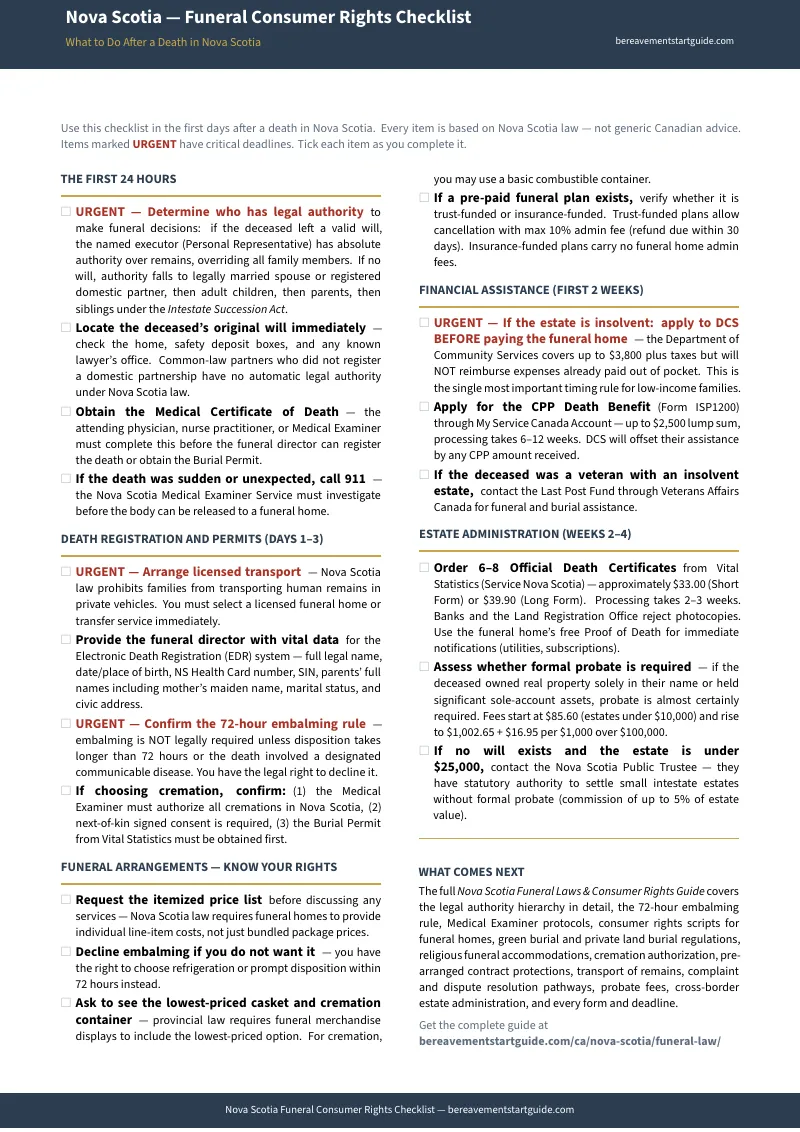
Not ready for the full guide? Download the free Nova Scotia -- Funeral Consumer Rights Checklist -- 18 items covering the legal authority hierarchy, the 72-hour embalming rule, your right to itemized pricing, financial assistance timing, and the critical first steps for death registration and permits. It is enough to see the full picture and know what to ask before you sign anything.
The funeral home already has the information. This guide makes sure you do too.