You Were Named Executor. The Nova Scotia Probate Court Requires a Specific Set of Forms Filed With a Cheque for a Tiered Tax Nobody Explains How to Calculate. The Bank Froze the Accounts. The Real Estate Cannot Be Sold Until the Grant Is Issued. And the Royal Gazette Advertising Period Adds Six Months Before You Can Distribute a Single Dollar.
Someone you cared about has died, and now you are holding a responsibility you never trained for. The bank told you the accounts are frozen — they will not release a cent without a Grant of Probate, even though the balance is less than the probate fees you will owe. The family home cannot be listed, shown, or sold until the Probate Court confirms your authority, and the wait for that confirmation in Halifax can stretch three to six months. The mortgage, insurance, property taxes, and utilities do not pause while you wait. You are funding estate carrying costs out of your own pocket, and the beneficiaries are calling to ask when they will see their inheritance.
You searched for help. The Courts of Nova Scotia website has the official fill-in-the-blank forms — Form 8 for Probate, Form 9 for Administration, Form 2 for the Affidavit Proving Execution — but no instructions explaining when to use which form, what order to file them in, or what triggers a rejection from the court registry. The Legal Information Society of Nova Scotia has excellent plain-English definitions, but no checklists, no form selection flowcharts, and no templates for the final accounting. Law firm websites explain the complexity — then quote $2,500 for Phase One of a four-phase engagement. Reddit has answers, but the top comment applied Ontario's Estate Administration Tax rules to your Nova Scotia question.
Here is what nobody connects for you: Nova Scotia's probate fee structure is tiered and the math directly determines whether your application is accepted — under CAD 10,000 costs CAD 85.60, but anything over CAD 100,000 costs a base of CAD 1,002.65 plus CAD 16.95 for every additional CAD 1,000. Miscalculate the overage and the court sends your entire application back. The intestacy rules require you to gather witnessed renunciations from every person with equal or higher priority — and heirs frequently refuse to sign because they confuse renouncing administration with renouncing their inheritance. The security bond for intestate estates must equal 1.5 times the estate value, and the sureties must be Nova Scotia residents. And after the grant finally arrives, you still cannot distribute: the Royal Gazette advertising period runs for six months, and distributing before it closes exposes you to personal liability for any creditor claims that surface later.
The Nova Scotia Probate Process Guide is a Court-Ready Filing System for the complete Nova Scotia probate process — from the initial question of whether probate is even required through the CRA clearance certificate and final passing of accounts. Not a generic Canadian probate overview that confuses Ontario's tax rate with Nova Scotia's tiered structure. Not a law textbook. An 11-chapter, Nova Scotia-specific manual built around the current Probate Act, the Probate Court Practice, Procedure and Forms Regulations, and the Land Registration Act — so your application passes the court registry review the first time.
What's Inside the Court-Ready Filing System
An 11-chapter guide with 3 appendices and a standalone Probate Quick-Start Checklist — covering every stage from the probate decision through final distribution, built specifically for Nova Scotia Probate Court as the forms and rules exist right now:
Chapter 1: Do You Actually Need Probate?
Not every Nova Scotia estate needs a trip to Probate Court. Joint tenancy property passes automatically to the surviving owner. RRSPs, TFSAs, and life insurance with named beneficiaries bypass the estate entirely. This chapter gives you the decision framework: the real property check (the Land Registration Office requires a grant for solely owned property, regardless of value), the financial account threshold check (each bank sets its own internal limit, commonly CAD 25,000 to CAD 50,000, and approval for a bond of indemnity release is entirely at the bank's discretion), and the Public Trustee's Section 22A election for intestate estates under CAD 25,000 that bypasses formal administration altogether.
Chapter 2: Immediate Actions — Days 1 to 14
Funeral arrangements and your consumer rights under the Cemetery and Funeral Services Act — pre-paid trust protections, the 10-day cooling-off period, and regulatory oversight through the Board of Registration. Low-income funeral assistance from the Department of Community Services (up to CAD 3,800 plus taxes) and the CPP Death Benefit (CAD 2,500 lump sum). Securing the residence, the vacant-property insurance trap, first notifications to the CRA and Service Canada, and ordering multiple certified death certificates from Nova Scotia Vital Statistics.
Chapter 3: Asset Inventory and the Probate Tax Decision
The complete asset and debt inventory that feeds directly into your probate tax calculation and court filing. How to contact each financial institution for fair market values as of the exact date of death. Separating probatable from non-probatable assets — joint tenancy, beneficiary-designated accounts, and trust property that must be excluded from the inventory. The distinction that determines both what appears in your court filing and what your fee calculation is based on.
Chapter 4: Calculating Nova Scotia Probate Tax
The exact tiered math: CAD 85.60 for estates under CAD 10,000. CAD 215.20 for CAD 10,001 to CAD 25,000. CAD 358.15 for CAD 25,001 to CAD 50,000. CAD 1,002.65 for CAD 50,001 to CAD 100,000. CAD 1,002.65 plus CAD 16.95 per CAD 1,000 above CAD 100,000 for everything larger. The guide includes a worksheet for calculating the exact fee for any estate composition, worked examples showing how accurate valuation controls the total payment, and the common miscalculation that causes court rejections.
Chapter 5: Assembling the Court Application
This is the chapter that does not exist in any free resource. The Nova Scotia Probate Court requires specific forms depending on your exact circumstances — Form 8 (Grant of Probate with a will), Form 9 (Grant of Administration without a will), Form 10 (Administration with Will Annexed), or Form 11A/11B (Extra-Provincial Grant). Plus Form 2 or 2A (Affidavit Proving Execution), Form 12 or 13 (Renunciations), Form 18 or 19 (Security Bonds for intestate estates). Which forms you need, what order to prepare them, what the court checks for on each page, and the errors — name mismatches, missing witness signatures, incorrect estate valuations — that cause the registry to reject the entire package.
Chapter 6: After the Grant Is Issued — Statutory Deadlines
The grant is in your hands. But you are not done — you have just entered a series of non-negotiable statutory deadlines. Serve Notice of Grant to all beneficiaries and heirs within 20 days by registered mail using the correct notice forms. Submit Form 31 to the Royal Gazette Part I with a CAD 68.15 cheque. File the Affidavit of Service (Form 28) within 60 days. These are not optional administrative steps — missing them exposes you to personal liability and can delay the estate by months.
Chapter 7: Real Estate and the Land Registration Act
For most Nova Scotia families, the house is the largest estate asset and the primary reason probate is needed. The critical distinction most executors never discover: is the property registered under the modern Land Registration Act (requiring Form 24) or the legacy Registry of Deeds system (requiring Form 44)? Getting this wrong halts the entire transfer. This chapter covers both paths, the chronological sequence from grant to listing agreement to closing, and the multi-generational title issues affecting communities across the province. Until the grant is issued and the correct Land Registration form is processed, you cannot list, sell, or transfer the property.
Chapter 8: Debt Settlement, Taxation, and CRA Clearance
The Royal Gazette advertising period, the creditor claim process, the debt payment priority order for insolvent estates. The terminal T1 income tax return, deemed disposition of capital property at fair market value on the date of death, and the Form TX19 Clearance Certificate application (allow 120 days for CRA processing). Why distributing assets before clearance makes you personally liable for the estate's tax debt.
Chapters 9-11: Passing the Accounts, Intestacy, and Edge Cases
The final accounting using Form 39 (with a hearing) or Form 40 (without a hearing) — five distinct schedules covering Inventory Adjustments, Income Earned, Disbursements, Assets Distributed, and Assets Remaining. Without organized bookkeeping from day one, this phase becomes a nightmare of reconciliation. If there was no will: the Nova Scotia intestacy rules, the priority hierarchy for administration, the renunciation trap (and a plain-English communication template explaining that renouncing administration does not mean renouncing your inheritance), and the security bond requirement. When you need a lawyer: contested wills, insolvent estates, minor beneficiaries, and multi-jurisdictional assets.
Appendices: Forms Reference, Key Contacts, and Deadlines
The complete form-to-circumstance mapping for every Probate Court form referenced in the guide. Contact information for every court office, government agency, and resource. And a consolidated deadline reference that shows every critical date from the day of death through estate closing — print it and pin it to your wall.
Who This Guide Is For
- The newly named executor who has never filed a court document and needs the Nova Scotia Probate Court forms translated into plain language with the filing requirements, the form selection logic, and the common rejection triggers explained step by step — before making an error that costs months of delay
- The surviving spouse who needs to know whether joint tenancy, named beneficiaries, and the Public Trustee's CAD 25,000 threshold mean the estate can be settled without going to court — and what still must be done even if probate is not required
- The DIY executor on a budget who knows that law firms charge $2,500 or more for Phase One alone — and needs a guide that replaces hourly consultations for routine procedural questions, while clearly identifying the complications that genuinely require professional help
- The out-of-province executor managing a Nova Scotia estate from Ontario, Alberta, or British Columbia who needs to know which steps can be handled remotely and which require presence in the province — including the Extra-Provincial Grant process for non-resident applicants
- The executor under family pressure who needs an authoritative, standardized timeline to show impatient beneficiaries that the three-to-six-month grant wait, the six-month Royal Gazette advertising period, and the CRA clearance processing time are legal requirements — not evidence of delay or negligence
Why Free Resources Will Not Get You Through This
The information exists. It is scattered across the Courts of Nova Scotia website, the Legal Information Society of Nova Scotia, Access Nova Scotia, the Land Registration Office, Service Canada, and the CRA. Here is what you encounter when you try to assemble the process from free sources alone:
- The Court publishes the forms but not the filing instructions. Forms 8, 9, 10, 11A, and 11B are downloadable fill-in-the-blank PDFs. What is not published: the exact order of preparation, which supporting forms are required for each grant type, the circumstances that trigger a security bond, or the common errors — name inconsistencies between the will and the death certificate, incorrect estate valuations, missing witness affidavits — that cause the court to reject the entire package. The forms are there. The instructions to use them correctly are not.
- The Legal Information Society explains the law, not the workflow. LISNS provides outstanding plain-English legal education. They tell you what the Probate Act requires. They do not provide form selection flowcharts, probate tax calculation worksheets, renunciation letter templates, or bookkeeping trackers for the final passing of accounts. They educate. They do not operate.
- Law firm blogs explain the complexity to justify retainer fees. Probate lawyers publish articles answering specific questions — fee calculators, timeline expectations, form overviews. Each article concludes with a call to book a consultation at rates that start at $2,500 for the initial application phase alone. For contested estates, that advice is appropriate. For uncontested estates with a clear will and cooperative beneficiaries, the same answers cost a fraction of a legal retainer.
- Reddit applies the wrong province's rules. The most common error on Canadian personal finance forums is applying Ontario's flat Estate Administration Tax percentage to a Nova Scotia question. Nova Scotia uses a tiered fee structure with a base-plus-overage calculation above CAD 100,000. Ontario advice applied to a Nova Scotia estate means either overpaying for unnecessary legal help, or missing Nova Scotia-specific requirements like the Royal Gazette advertising and the Land Registration Act form distinction that Ontario does not have.
- National estate platforms lack local depth. Willful, EstateExec, and Atticus provide modern workflows for executors across Canada. They are helpful for general orientation. But they gloss over the specific intersection of the Nova Scotia Land Registration Act (Form 24 vs. Form 44), the exact Royal Gazette submission address and fee, the Public Trustee's Section 22A election for small estates, and the security bond requirement for intestate administrations. A Nova Scotia executor following national-level guidance risks filing an application that the local court returns for provincial-specific errors.
Free resources give you forms without filing instructions, legal education without operational tools, and advice from the wrong province. The Court-Ready Filing System puts every Nova Scotia-specific form, fee, deadline, and filing step into one document, in the order the Probate Court actually requires them.
— Less Than Thirty Minutes With a Nova Scotia Probate Lawyer
A single consultation with a Nova Scotia probate lawyer costs $250 to $400 per hour. Standard probate representation runs $2,500 for the initial application phase and $1,000 to $2,000 for each subsequent phase — easily $5,000 to $6,000 for the complete process. For a modest estate, that represents a significant portion of the value being passed to the family. This guide costs less than thirty minutes of professional legal time and gives you the complete Nova Scotia-specific filing system — every form mapped to its circumstance, every probate tax tier calculated, every statutory deadline flagged, and every common rejection trigger identified.
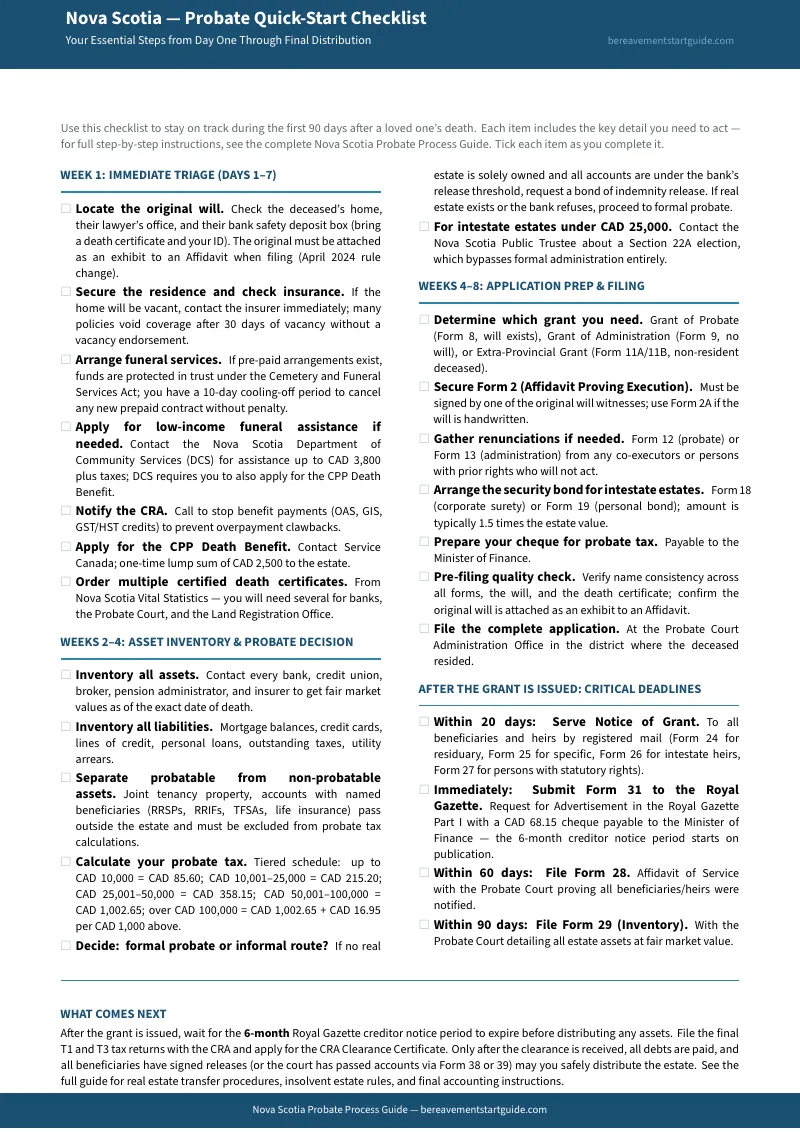
Your download includes the complete 11-chapter guide with 3 appendices, the standalone Probate Quick-Start Checklist (20 items across 4 phases covering your first 90 days), and 7 standalone reference tools — the Form Selection Flowchart, Probate Tax Calculation Worksheet, Post-Grant Deadline Tracker, Royal Gazette Advertising Protocol, Real Estate and Land Registration Guide, Final Accounting Templates, and Intestacy and Renunciation Guide. Plus a money-back guarantee, no time limit. If the guide does not give you clarity on what to do next and confidence that your application will pass the court registry review, email us for a full refund.
Not ready for the full guide? Download the free Nova Scotia — Probate Quick-Start Checklist — 20 items covering the first 90 days, from securing the residence and ordering death certificates through calculating your probate fees and filing your application. It is enough to see the full picture and start gathering what you need.
You did not choose to be the executor. But the court does not wait, the Royal Gazette period does not pause, and the carrying costs on an empty house do not stop. The guide makes sure you do not miss any of it.