The DCS Funeral Assistance Program Deducts the $2,500 CPP Death Benefit From Your Grant. If You Pay the Funeral Home Out of Pocket Before Applying, DCS Will Not Reimburse You. And if Your Common-Law Partner of 20 Years Died Without a Will, Nova Scotia's Intestate Succession Act Gives Them Absolutely Nothing.
Your spouse or parent has just died in Nova Scotia, and you are now caught between three bureaucracies that were not designed to work together. Service Canada processes the CPP Death Benefit and survivor pensions — but will not tell you that the $2,500 lump sum gets deducted from your DCS funeral grant if you apply in the wrong order. The Nova Scotia Probate Court requires the original will to be attached as an exhibit to an affidavit under the April 2024 regulations — but will not explain how to secure executor authority for a small estate when no will exists. The CRA demands a TX19 Clearance Certificate before you distribute a single dollar — but processing takes 4 to 6 months, and distributing assets before it arrives makes the executor personally liable for every dollar of undiscovered tax debt.
Meanwhile, the funeral home wants payment. The bank has frozen the accounts. The property tax bill arrived. Your siblings are asking when they get their share. And every government website you visit gives you technically accurate information about its own piece of the puzzle while failing to mention how it connects to any of the others.
The free resources are not wrong. They are siloed. Service Canada covers federal pensions but ignores how they interact with provincial grants. The Legal Information Society of Nova Scotia lists contact numbers for Vital Statistics and Pharmacare but does not explain when a free Funeral Director's Proof of Death is sufficient versus when you need the $33 official Vital Statistics certificate — a distinction that can save you over $150 in unnecessary fees. Law firm blogs explain the Intestate Succession Act with meticulous precision because their business model depends on you feeling overwhelmed enough to call for a $300-per-hour consultation. Nobody connects the federal layer to the provincial layer to the municipal layer in the order you actually need to execute it.
The Nova Scotia Survivor Benefits Navigator is a Benefit Integration Roadmap — one document that connects federal, provincial, and municipal systems into a single chronological workflow. Not a government pamphlet reformatted with better typography. Not a law firm blog designed to generate anxiety and billing hours. A structured, Nova Scotia-specific operations manual that tells you exactly which form to file, which agency to contact, which deadline will cost you thousands if you miss it, and which sequence to follow so that one application does not accidentally disqualify another.
What's Inside the Benefit Integration Roadmap
A 14-chapter guide with 4 appendices — organized chronologically from the first 48 hours through final estate closure, built specifically for Nova Scotia's unique intersection of federal, provincial, and municipal systems:
The First 48 Hours
Secure the residence, locate the original will (and understand why the April 2024 probate regulations now require it as an affidavit exhibit — do NOT unstaple it), order 6–8 death certificates from Nova Scotia Vital Statistics through your funeral director (Short Form: $33.00, Long Form: $39.90, processing: 4–6 weeks), and call Service Canada immediately to halt CPP and OAS payments before overpayments accumulate. This chapter covers the one decision that saves you over $150: knowing exactly when the free Funeral Director's Proof of Death is sufficient versus when you need the paid Vital Statistics certificate.
Funding the Funeral
The CPP Death Benefit is a flat $2,500 — but it takes 6 to 12 weeks to arrive. If you need help immediately: the Department of Community Services covers up to $3,800 plus taxes, but only if you apply before signing a funeral contract or paying out of pocket. DCS deducts the CPP Death Benefit from the grant, creating a sequencing trap that costs families thousands when they get the order wrong. If the death was workplace-related, WCB provides a separate $15,000 burial benefit plus $15,000 immediate support. If the deceased was a veteran, the Last Post Fund covers qualifying families. This chapter maps every available source and the exact sequence that preserves eligibility for each one.
Federal Survivor Pensions and Benefits
The CPP Survivor's Pension (up to $904.59/month for survivors over 65, up to $803.54/month under 65), the CPP Children's Benefit ($307.81/month per eligible child), the Allowance for the Survivor (up to $1,682.15/month for low-income surviving spouses aged 60–64 with annual net income below $30,336), and the 60-day executor priority window for filing the CPP Death Benefit that most families miss. This chapter walks you through Forms ISP1200 and ISP1300 with the specific documentation requirements for each — and explains the appeal process if a claim is denied.
Provincial Benefits and Programs
The Property Tax Rebate for Seniors (50% of municipal property taxes up to $800 — but only for recipients of the federal GIS or Allowance for the Survivor), the Nova Scotia Seniors Care Grant (up to $1,045.02 annually), the NS Affordable Living Tax Credit (up to $255 per family), Seniors' Pharmacare premium refunds through Medavie Blue Cross, and the HEAT Fund for home energy assistance. This is the chapter no federal resource covers and no provincial resource connects to the federal layer.
Nova Scotia Probate — The Full Process
A complete plain-English walkthrough: determining whether probate is needed, the difference between probate and administration for intestate estates, the full step-by-step filing process including the April 2024 requirement to attach the original will as an affidavit exhibit, probate tax calculations ($1,002.65 on the first $100,000 plus 1.695% on everything above), security bond requirements for intestate estates, and a complete forms reference. Where to file in person versus by mail, and what happens if a beneficiary or creditor contests the estate.
Property and Vehicle Transfers
Nova Scotia's dual land registry system (the Land Registration Act system versus the Registry of Deeds — and why knowing which one covers your property determines your entire workflow). Joint tenancy transfers that pass title outside probate. Vehicle transfers using the Sworn Statement for the Inheritance of a Used Motor Vehicle (Form SNS-IS-NSST-EST-V.30.06.21) — and the common problem: the form requires a legally recognized executor's signature, but if the estate has no will and no court-appointed administrator, the vehicle is trapped in legal limbo. This chapter explains how to resolve that.
Common-Law Partners — The Critical Gap
Nova Scotia has one of the most exclusionary intestacy frameworks for common-law partners in Canada. If your partner died without a will and you did not formally register a Domestic Partnership with Vital Statistics, you receive absolutely nothing under the Intestate Succession Act — regardless of how many years you lived together. But the federal government recognizes common-law partnerships after just one year for CPP survivor benefits. This chapter untangles the contradiction: how you can be fully entitled to federal survivor pensions while being completely shut out of provincial property rights, and what legal options remain (including the Testators' Family Maintenance Act and the Evans Estate precedent).
WCB Death Benefits
If the death was work-related or caused by an occupational illness: a $15,000 immediate support payment, a $15,000 burial benefit, and an ongoing monthly survivor pension at 85% of the deceased worker's earnings — vastly more than the $2,500 CPP Death Benefit. Who qualifies as a survivor (including common-law and same-sex partners), how to file, the 2026 legislative changes to the appeal window, and the full review and appeal process if a claim is denied.
Tax Obligations and CRA Clearance
Filing the final T1 return, optional returns that can split income across tax brackets to save the estate thousands, and the TX19 Clearance Certificate that takes 4 to 6 months to process. The single most important rule: distributing estate assets before the clearance certificate arrives makes the executor personally liable for any undiscovered tax debts, up to the full value of the distributed assets.
Plus: Public Service Superannuation, Edge Cases, and Estate Closure
Provincial employee survivor pensions through the PSSP, intestacy formulas under the $50,000 preferential share (notoriously low compared to Ontario's $350,000 or BC's $300,000), estates with debts exceeding assets, contested wills, and the complete final distribution process. Four appendices: a Benefit Claim Tracker Template, Key Deadlines at a Glance, a Probate Tax Calculator, and a Key Contacts directory for every agency.
Who This Guide Is For
- The surviving spouse whose household income just dropped and who needs to know exactly which pensions, grants, and tax rebates are available — and the precise sequence to apply so that one benefit does not reduce or disqualify another
- The adult child named as executor who has never navigated the Nova Scotia Probate Court and is now personally liable for every administrative decision — from the April 2024 affidavit requirements to estate assets distributed before the CRA clearance certificate arrives
- The common-law partner who just discovered that Nova Scotia does not recognize unregistered common-law relationships under the Intestate Succession Act — and who needs to understand what federal benefits they can still claim and what provincial legal options remain
- The low-income family trying to navigate the DCS funeral assistance sequencing trap — where applying for the CPP Death Benefit at the wrong time reduces the $3,800 grant, and paying the funeral home before DCS approves your application permanently voids your reimbursement
- Any family trying to avoid $300-per-hour legal fees for routine estate administration — who wants the clarity of professional guidance without the hourly billing that most simple, uncontested estates do not require
Why Free Resources Leave You Exposed
Every fact in this guide exists somewhere on a government website. The problem is not accuracy — it is integration. Here is what you encounter when you try to assemble Nova Scotia survivor benefits guidance from free sources alone:
- Service Canada explains the CPP Death Benefit and survivor pensions in detail — but does not mention that the $2,500 lump sum gets deducted from DCS funeral assistance, or that the executor has only 60 days of priority before other family members can apply
- The Legal Information Society of Nova Scotia (LISNS) provides a widely distributed "After the loss of a loved one" pamphlet — but it is a passive directory that tells you who to call without explaining what to ask, which form to use, or which free documents are sufficient versus which require paid certificates
- Law firm blogs dominate search results with meticulous legal analysis — written in a tone designed to make estate administration feel so dangerous that you book a consultation. Their business model is the opposite of your interest.
- Access Nova Scotia provides the forms for vehicle transfers and property transactions — but does not explain how to get the executor authority required to sign them when the estate is small and unprobated
- Financial advisors and wealth managers produce polished checklists tailored to high-net-worth estates — but completely ignore the DCS funeral assistance program, the Seniors Care Grant, the HEAT Fund, and the municipal property tax exemptions that low-and-middle-income families need most
The result: families either miss benefits they are legally entitled to, make sequencing errors that disqualify them from time-sensitive programs, or pay thousands in legal fees for administrative tasks they could have handled with proper instructions.
What You Get
The Nova Scotia Survivor Benefits Navigator includes 10 printable PDFs:
- The complete guide (guide.pdf) — 14 chapters plus 4 appendices covering every federal, provincial, and municipal benefit, every probate step, every property and vehicle transfer process, every tax obligation, the common-law gap, WCB death benefits, PSSP pensions, and edge cases specific to Nova Scotia
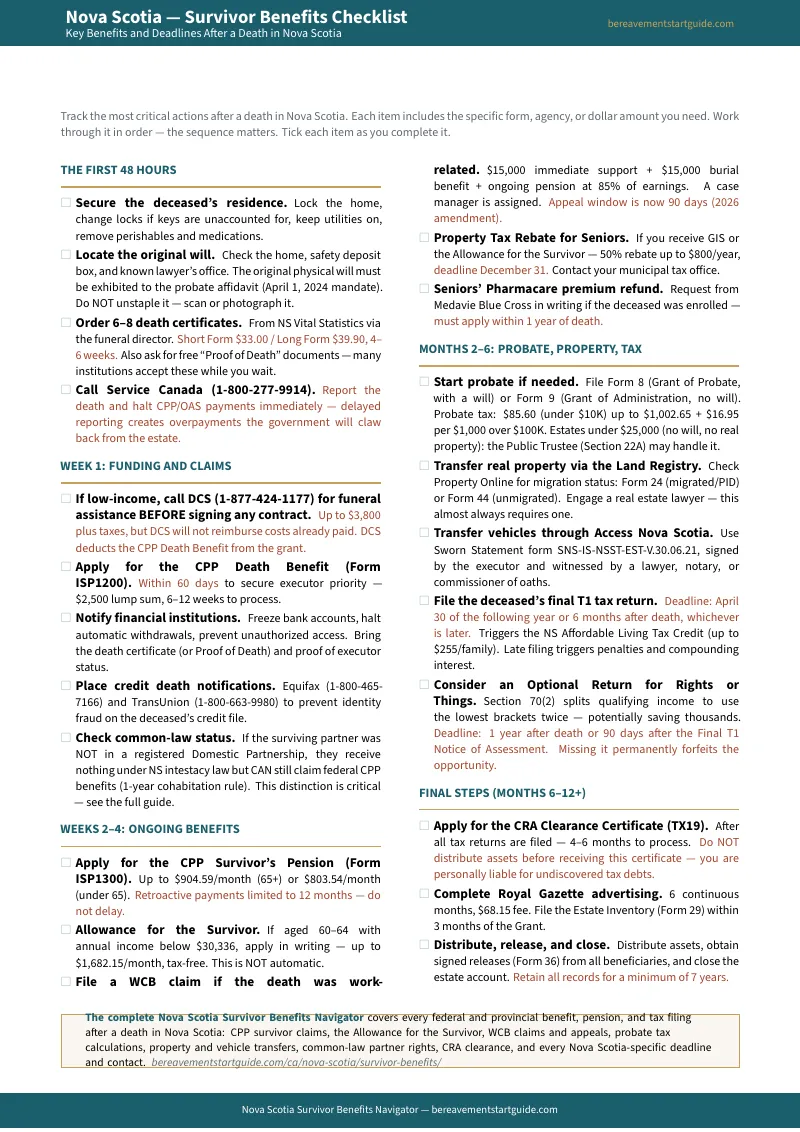
- Quick Start Checklist (checklist.pdf) — a printable, chronological action list with 20 items covering the first 48 hours through final estate closure, with specific forms, deadlines, dollar amounts, and agency contacts for each step
- Benefit Claim Tracker (benefit-claim-tracker.pdf) — a fillable tracker for managing all 16 concurrent benefit applications across every agency, with pre-filled deadlines and required documents
- Key Deadlines at a Glance (key-deadlines.pdf) — every critical deadline on one page, with hard deadlines flagged so you never miss a filing window
- Probate Tax Calculator (probate-tax-calculator.pdf) — Nova Scotia probate tax brackets, a worked example, and a fill-in worksheet for calculating your estate's probate tax
- Key Contacts Directory (key-contacts.pdf) — every agency phone number and purpose on one page, ready to pin by the phone
- Notification Tracker (notification-tracker.pdf) — who to contact in the first week versus weeks 2–4, with checkboxes and a date-completed column
- CPP Decision Worksheet (cpp-decision-worksheet.pdf) — a quick-reference card for determining how the CPP Survivor's Pension interacts with your own retirement benefits
- Funeral Funding Sequence (funeral-funding-sequence.pdf) — the correct application order for DCS, CPP, WCB, and Last Post Fund, with the DCS sequencing trap prominently flagged
- Common-Law Rights Card (common-law-rights-card.pdf) — federal versus provincial eligibility comparison for unregistered common-law partners, with your legal options
For , you get the equivalent of what an estate lawyer would charge multiple billable hours to explain — organized in the order you actually need it, written in plain English, and specific to Nova Scotia's unique combination of federal, provincial, and municipal rules.
100% Satisfaction Guarantee
If the guide does not help you navigate Nova Scotia survivor benefits with more confidence and clarity than any combination of free resources, email hello@bereavementstartguide.com for a full refund. No questions, no forms, no waiting period.