The Bank Said to Visit Your Local Branch. The Nearest Branch Is a $1,200 Flight Away. The Public Trustee Said They Will Handle It in Two to Three Years. You Are Grieving in a Community of 1,500 People, and Every System Assumes You Live in Southern Canada.
You called CIBC to ask about releasing funds from the deceased's account. They told you to bring an original death certificate and identification to your local branch. You live in Arviat. The nearest CIBC branch is in Rankin Inlet, accessible only by chartered aircraft or scheduled flight. The representative did not have a process for executors who cannot physically visit a branch. They suggested you call back.
You called the Government of Nunavut to ask about estate settlement. You were transferred to the Office of the Public Trustee, who explained that they can administer the estate for you. They mentioned a timeline of two to three years, a $400 file opening fee, a 5% commission on all cash receipts, and a 3% levy on the gross value of any real property transferred. They did not mention that you could settle the estate yourself. They did not explain how to file for probate at the Nunavut Court of Justice, which forms to use, or that court fees are capped at roughly $400 for a $500,000 estate. They sent you a Family History Form and told you to mail it to Iqaluit.
Meanwhile, the Local Housing Organization contacted the surviving household members about the public housing lease. The primary leaseholder is deceased, and the tenancy must be formally transferred or terminated under the Residential Tenancies Act. Rent is being recalculated based on remaining household income. No one explained the process for requesting a lease transfer, and no one told the family they had rights.
You searched online and found a Legal Aid PDF that explained wills in general terms but contained no instructions for executors. You found Atticus, a national estate platform that estimated probate costs at $15,000 and told you to contact a local estate attorney. You found ClearEstate, which discussed strategies for avoiding probate but said nothing about the Nunavut Housing Corporation, the Aboriginal Custom Adoption Recognition Act, or the fact that the Intestate Succession Act gives a surviving spouse only $50,000 before adult children are entitled to a share of everything else. You do not know what applies, what is accurate, or what to do first.
The Nunavut Estate Settlement Guide is the Northern Estate Settlement System for families who need to settle an estate across a territory where banks have no branches, housing is government-controlled, death certificates must be mailed from Rankin Inlet, and generic Canadian advice will steer you into procedures that do not work above the 60th parallel. Not a repurposed southern Canadian checklist. Not a law firm blog that ends with a consultation number for a firm in Toronto. A plain-language, Nunavut-specific manual built on the territorial statutes, the court forms, the regional Inuit organization programs, and the remote-access workarounds that make estate settlement in the North fundamentally different from anywhere else in Canada.
What's Inside the Northern Estate Settlement System
A step-by-step guide, an estate settlement checklist, and standalone reference tools covering every phase of estate administration in Nunavut, built on the Intestate Succession Act, the Nunavut Court of Justice rules, the Public Trustee fee schedule, and the territorial infrastructure that makes this process unlike any other jurisdiction in Canada:
Remote Banking Protocols for Communities Without Branches
This is the chapter that solves the problem no national bank website acknowledges. Only three communities in all of Nunavut have physical bank branches: Iqaluit, Rankin Inlet, and Cambridge Bay. Executors in the remaining twenty-two communities must freeze accounts, request fund releases, and close accounts entirely by telephone, mail, and fax. The guide provides the exact documentation packages that CIBC and RBC require for remote estate processing, the notarization workarounds available through local Justices of the Peace, the telebanking scripts for reaching estate services departments directly, and the step-by-step process for using Northern Store service points when ATM access is the only available banking infrastructure.
The $50,000 Spousal Share Trap and How to Protect Your Family
This is the chapter that prevents the single most dangerous outcome in Nunavut intestacy. When someone dies without a will, the Intestate Succession Act gives the surviving spouse a preferential share of only $50,000 before the remainder is divided among surviving children. In British Columbia, that threshold is $300,000. In Ontario, it is $350,000. In Nunavut, an estate containing a snowmobile, a boat, hunting equipment, and a modest private dwelling can easily exceed $50,000, forcing the surviving spouse to liquidate critical assets to satisfy the statutory entitlements of adult children. The guide explains the preferential share calculation, the legal mechanisms for disclaimers and family agreements, and the steps to prevent forced liquidation of survival equipment and essential property.
Bypassing the Public Trustee: DIY Probate at the Nunavut Court of Justice
The Public Trustee charges a $400 file opening fee, takes 5% of all cash receipts, levies 3% on the gross value of transferred real property, and officially estimates a two-to-three-year timeline for estate completion. The guide walks you through the alternative: filing for probate yourself at the Nunavut Court of Justice in Iqaluit. It provides plain-language annotations for Form 14 (Grant of Probate), Form 16 (Letters of Administration No Will), Form 17 (Letters of Administration With Will), and Form 8 (Schedule of Assets and Liabilities). Court fees are tiered starting at $25 for the first $10,000 of estate value and cap at roughly $400 for a $500,000 estate. The guide explains every form, every fee, and every filing step so you can complete the process without surrendering three years and thousands of dollars to the Public Trustee.
Funeral Logistics and Travel Subsidies: Who Pays for What
Transporting remains between Nunavut communities by air can cost $6,000 or more for casket shipping alone. Flying family members to the funeral adds thousands more. Families routinely conflate the programs available to them, applying to the wrong agency or missing funding entirely. The guide separates the three distinct funding streams: the NTI Bereavement Travel Program and Regional Inuit Association compassionate travel programs (which pay strictly for airfare for family members), the Department of Family Services Income Support burial assistance (which covers burial costs but only for individuals who were receiving Income Support or had virtually no assets), and the CPP Death Benefit (a one-time $2,500 federal payment). Each program has different eligibility rules, different application processes, and different coverage. The guide maps every program with application steps and eligibility criteria so you claim everything available without missing any source.
Public Housing Lease Transfers and the Residential Tenancies Act
A substantial portion of Nunavut residents live in public housing administered by the Nunavut Housing Corporation through Local Housing Organizations. When the primary leaseholder dies, surviving household members face lease termination, rent recalculation based on new household income, and potential eviction if the transfer process is not initiated promptly. The guide covers the formal lease transfer request process, the rights of surviving occupants under the Residential Tenancies Act, the rent-geared-to-income reassessment timeline, and the specific steps for communicating with the Local Housing Organization to protect the family's housing.
Custom Adoption and Inheritance Rights
The Aboriginal Custom Adoption Recognition Act grants children adopted through Aboriginal customary adoption identical inheritance rights to biological children under Nunavut law. When an intestate estate includes both biological children and custom-adopted children, the statutory distribution must treat them equally. The guide explains how to obtain the Aboriginal customary adoption certificates required by the Nunavut Court of Justice, how custom adoption interacts with the intestacy distribution rules, and how to document these relationships for probate applications to prevent disputes and delays.
Death Certificates, Vital Statistics, and the Rankin Inlet Bottleneck
Local health centres and coroners issue a Medical Certificate of Death, but financial institutions and government agencies require the official Registration of Death issued by Nunavut Vital Statistics in Rankin Inlet. The guide explains the difference between these documents, provides the exact mailing address and application process for ordering certified copies from Vital Statistics, covers the fee structure, and identifies which institutions will accept a medical certificate as an interim document while you wait for the official registration to arrive by mail.
Who This Guide Is For
- The executor in a fly-in community with no bank branch -- who needs to freeze the deceased's CIBC or RBC accounts, release funds for funeral costs, and eventually close accounts, all without the ability to walk into a physical branch. The guide provides the remote banking protocols, document packages, and telebanking scripts that the bank's website does not offer.
- The surviving spouse in public housing -- who just received a call from the Local Housing Organization about the lease, does not know whether they can stay, and needs to understand the lease transfer process and their rights under the Residential Tenancies Act before the tenancy is terminated.
- The family member coordinating funeral logistics across communities -- who needs to fly remains from one hamlet to another, bring family in from multiple communities, and cannot figure out which organization pays for flights versus burials. The guide separates NTI travel funding, Regional Inuit Association compassionate travel, Income Support burial assistance, and the CPP Death Benefit into distinct application pathways.
- The administrator of an intestate estate with a blended family -- who needs to understand the $50,000 preferential spousal share, how custom-adopted children inherit equally under the Aboriginal Custom Adoption Recognition Act, and how to file for Letters of Administration at the Nunavut Court of Justice without hiring a lawyer in Iqaluit.
- The community health worker or social worker -- who regularly assists families after a death and needs a reliable, printable desk reference covering the territorial court forms, the housing lease process, the benefit programs, and the step-by-step sequence that they can hand directly to grieving families.
Why Free Resources Will Not Get You Through This
Estate settlement information for Nunavut exists. The Government of Nunavut publishes court forms, the Legal Services Board publishes educational material, and national platforms produce content about every Canadian jurisdiction. Here is what you actually encounter when you try to settle a Nunavut estate using free sources:
- The Government of Nunavut publishes court forms with zero instructions. Forms 14, 16, 17, and 8 are available as raw PDFs from the Nunavut Court of Justice. The forms contain no plain-language guidance, no workflow diagrams, no explanations of which form applies to which situation, and no indication of how to complete them without a lawyer. They assume you have retained counsel in Iqaluit.
- The Public Trustee explains how to surrender your estate -- not how to settle it yourself. The Office of the Public Trustee provides detailed information about their own administration process, including the Family History Form and fee schedule. They do not provide any guidance on private administration. Their materials are designed to onboard your estate into their two-to-three-year pipeline, not to help you bypass it.
- The Legal Services Board publishes a wills primer -- not an executor's toolkit. The Legal Aid "Wills and Estates" PDF is excellent for understanding what a will is and why you need one. It contains no templates, no banking scripts, no court form annotations, and no instructions for what an executor actually does after the death has occurred. It is a proactive planning document, not a reactive settlement guide.
- National platforms give you southern Canadian advice with a Nunavut label. Atticus estimates probate costs at $15,000 -- a figure that has no basis in Nunavut, where court fees cap below $500. ClearEstate discusses strategies for avoiding probate without mentioning the Nunavut Housing Corporation or the Aboriginal Custom Adoption Recognition Act. These platforms template their content from larger provinces and publish it with minimal localization. Following their advice in Nunavut leads to critical procedural errors.
- Banks tell you to visit your local branch -- which does not exist. CIBC and RBC publish detailed estate settlement pages directing executors to book branch appointments, meet estate advisors, and bring documents in person. For executors in twenty-two of Nunavut's twenty-five communities, there is no branch to visit. The banks provide no alternative workflow for remote executors, no mail-in procedures, and no telebanking protocols for estate processing.
Free resources give you court forms without instructions, a Public Trustee that wants your estate, a legal aid primer about writing wills, national platforms that assume you live in Toronto, and banks that assume a branch exists in your community. The Northern Estate Settlement System puts every Nunavut-specific procedure, form, workaround, and funding source into one document, sequenced in the order you actually need them.
-- Less Than One Hour With the Public Trustee's File Opening Fee
The Public Trustee charges a $400 file opening fee before any work begins, then takes 5% of every dollar that flows through the estate and 3% of any real property transferred. On a $100,000 estate, the Public Trustee's fees exceed $5,000 -- and you wait two to three years for the process to finish. A probate attorney in Iqaluit charges $300 to $450 per hour. This guide costs less than a single hour of either option and gives you the complete Nunavut-specific settlement roadmap: every court form annotated, every remote banking protocol documented, every travel subsidy mapped, and every statutory deadline sequenced.
Your download includes the complete step-by-step guide, the standalone Nunavut First 48 Hours Checklist, and printable reference tools: the Probate Decision Flowchart, the Remote Banking Document Package Checklist, the Travel and Funeral Subsidy Comparison Table, the Public Housing Lease Transfer Guide, the Intestacy Distribution Calculator, the Court Fee Schedule, and an Agency Contact Directory covering territorial, federal, and Inuit organization contacts. Instant download, no account required.
Money-back guarantee, no time limit. If this guide does not save you hours of phone calls to agencies that cannot advise you and make the estate settlement process immediately clearer, email us for a full refund. No questions asked.
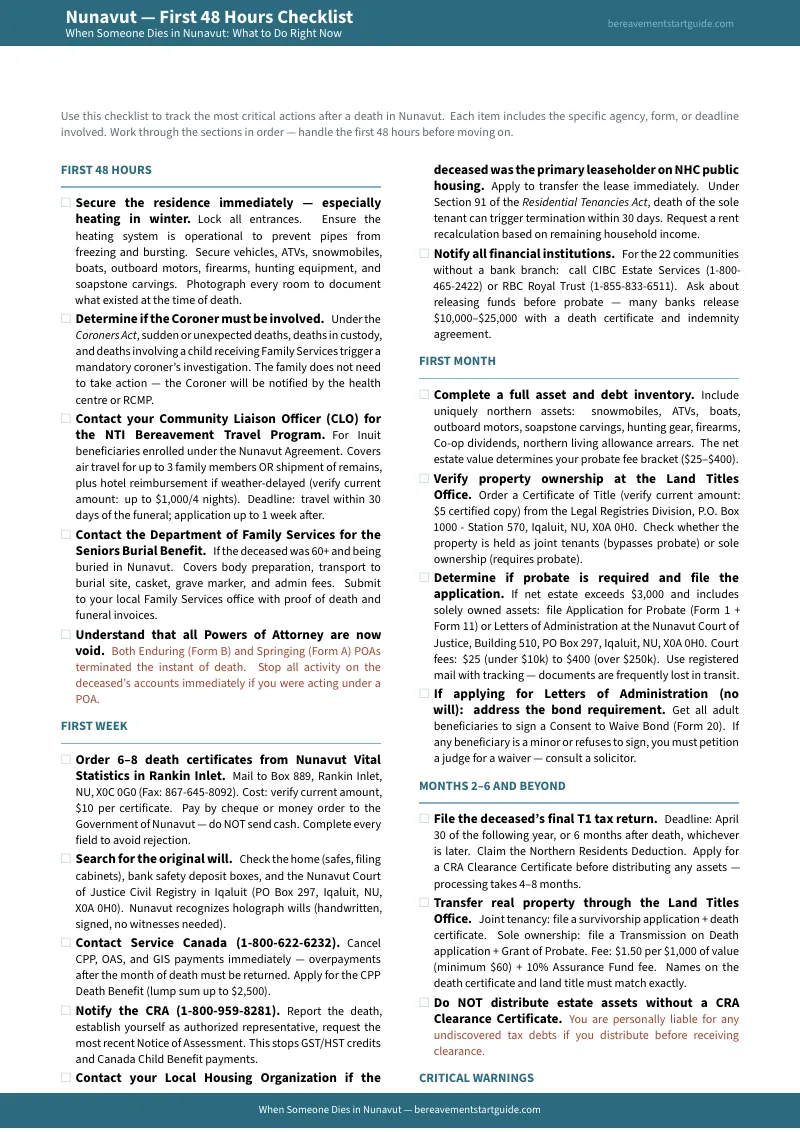
Not ready for the full guide? Download the free Nunavut -- First 48 Hours Checklist -- an overview of the most urgent tasks, the key agencies, the critical deadlines, and the mistakes that cost families the most in the first two days. Enough to get organized and determine whether you need the full guide.
Nobody trained you for this. The bank assumes you have a branch. The Public Trustee assumes you want to wait three years. The court assumes you hired a lawyer. The national websites assume you live in the south. You have something none of them provide -- a settlement system built entirely for the realities of Nunavut, by someone who mapped every territorial statute, every remote-access workaround, and every funding source that exists above the 60th parallel.