Your Loved One Died in a Fly-In Community, There Is No Funeral Director Within 800 Kilometres, and the Hamlet Office Just Told You That You Are Now Responsible for Completing the Registration of Death Before Anyone Can Be Buried.
You are sitting in a community with no road out, no funeral home, and no one whose job it is to tell you what to do next. Maybe the body needs to fly to the home community and you have just learned that air cargo for a casket can exceed $6,000. Maybe the family wants cremation and someone finally explained that there is not a single crematorium anywhere in Nunavut — the body has to be embalmed, sealed, and flown thousands of kilometres south before it can happen. Maybe you are the person who has to fill out the Registration of Death form yourself, every field matching the Health Care Card exactly, because in your community there is no funeral director and the registrar will not issue a burial permit until that paper is correct.
You are grieving, the weather is closing in, and the clock is already running on deadlines nobody warned you about. The Bereavement Travel program that could reimburse the flights and the shipment of remains has a hard 30-day cutoff — miss it and the family eats the entire bill. The Seniors Burial Benefit that covers the casket, the body preparation, and the grave marker has to be approved before you sign anything, because retroactive applications after 60 days are routinely denied. And the one commercial funeral home in the entire territory is in Iqaluit, which means for most families there is no professional to lean on at all — you are acting as your own funeral director, in the middle of one of the most logistically extreme funeral environments on earth.
Here is the truth that no government PDF will tell you plainly: families in Nunavut routinely lose thousands of dollars and days of precious time — not because anyone is dishonest, but because the information is scattered across regional Inuit associations, Vital Statistics in Rankin Inlet, airline cargo desks, the Coroner's office, and a dozen federal benefit forms, with no one resource that connects them. Southern Canadian funeral advice is worse than useless here. It tells you to call a funeral home that does not exist, to expect a crematorium that is not there, and to rely on advance-directive laws that Nunavut is the only jurisdiction in Canada not to have.
The Nunavut Funeral Laws & Consumer Rights Guide is a Northern Funeral Navigation System — the operational manual that replaces fragmented government pages, airline cargo rules, and benefit application forms with one consolidated, step-by-step roadmap built for the reality of a death in Nunavut. Not a generic Canadian bereavement pamphlet. Not a funeral home brochure. A territory-specific guide that walks you, in chronological order, from the first hours after a death through burial or out-of-territory cremation, with every Nunavut form, fee, deadline, agency, and phone number you need at each step.
What's Inside the Northern Funeral Navigation System
A 15-chapter guide, the standalone Quick Start Checklist, and eight printable standalone references — organized along the exact chronological path a family follows after a death in Nunavut, built for the territory's geography, its single funeral home, its zero crematoria, and the Inuit-specific funding programs no southern guide mentions:
Chapter 1: Why Nunavut Funeral Planning Requires Its Own Guide
Zero crematoria. Twenty-five communities across two million square kilometres connected only by air. One commercial funeral home for the entire territory. No dedicated Funeral Services Act and no "funeral police" to call. This chapter lays out exactly why following southern advice can leave you stranded with an unburied loved one — and frames the six structural realities that make every decision in this guide different from anywhere else in Canada.
Chapter 2: Who Has Legal Authority Over the Remains
Before a casket is ordered or a flight is booked, someone must have the legal right to decide. This chapter lays out the strict authority hierarchy — executor first, then legally married spouse, then adult children, then parents — and the dispute that tears Nunavut families apart: the deceased lived in Iqaluit or a regional centre for work or medical care but came from a different hamlet, and now two communities each want the body. It also carries a critical warning for common-law partners, whose authority can be challenged under the Intestate Succession Act by a legally married spouse who was never formally divorced.
Chapter 3: The First Hours After Death
What you do first depends entirely on how the death happened. An expected death under medical care releases the body quickly. A sudden, unexpected, or unattended death triggers the Office of the Chief Coroner under the Coroners Act — and the family has no legal right to move, wash, or alter the body until the Coroner releases it. This chapter explains the Coroner's sweeping powers, the autopsy timeline (preliminary findings within 24 hours, full toxicology around 3 months), and the fact that the Coroner pays for the initial transport of the body — but you pay for everything after release.
Chapter 4: Funeral Funding — Accessing Every Dollar Available
This is the chapter that pays for the guide many times over. It gives you a funding decision tree to work through before you sign anything: the NTI Bereavement & Compassionate Travel Program (through QIA, KIA, or KitIA) covering shipment of remains, flights for up to three family members, hotel up to $1,000 for weather delays, and gas up to $6,000 over land or ice; the Seniors Burial Benefit for those 60 and older covering body preparation, transport, casket, and grave marker; Income Assistance funeral support; and the CPP Death Benefit. With every email address, every required document (Proof of Death plus the Airwaybill number), and the deadlines that make or break a claim.
Chapter 5: Your Consumer Rights — Pricing, Embalming, and Prepaid Funerals
Nunavut has no Bereavement Authority and no funeral regulator — which means no one enforces your rights but you. This chapter arms you with the right to a written, itemized price list (refuse "package only" quotes), the right to supply your own casket from a local carpenter or southern supplier with no handling fee, and the truth about embalming: it is not legally required for a local burial, though airlines require it (or a hermetically sealed container) for air transport. Includes the 10-day cooling-off period on prepaid contracts and how to verify your money is actually held in trust.
Chapter 6: Burial in Nunavut — Permits, Cemeteries, and Home Funerals
Burial in Iqaluit runs through Apex Cemetery, where the City provides a pre-dug plot and burial box free of charge while you pay the funeral director for preparation and coordination. Burial in a remote hamlet runs through the Senior Administrative Officer, where grave digging is weather-dependent and permafrost can stall everything in winter. And for the many communities with no funeral director, this chapter is your home-funeral manual — the exact Vital Statistics Act paperwork the family must complete to act as funeral director, plus the Cemetery Regulations (Nu Reg 038-2019) governing private-land burial.
Chapter 7: Cremation — Why It Requires Leaving the Territory
There is not one crematorium in Nunavut. This chapter is the full out-of-territory cremation playbook: engaging a southern funeral home to receive the body, preparing it for air transport, obtaining the transit permit from Vital Statistics, shipping it by commercial airline, and getting the ashes home — with every cost you must budget for so the final bill does not blindside you.
Chapter 8: Transporting Human Remains by Air
The single most complex logistical challenge in Nunavut funeral planning, broken into a step-by-step checklist. Airline requirements (embalming or a hermetically sealed container, a CATSA-compliant air tray, the right documentation), how remains travel as cargo rather than luggage, and the one detail families forget that costs them their reimbursement: recording the Airwaybill number the NTI Bereavement Travel claim requires.
Chapter 9: Death Registration and Obtaining Death Certificates
Nothing — no estate, no bank closure, no benefit, no burial permit — moves until the death is registered with Vital Statistics in Rankin Inlet. This chapter walks you through the Registration of Death (no fee, but biographic data must match the Health Care Card exactly or it is rejected), ordering certified death certificates at $10 each (order 3 to 5 immediately), delayed registration, and replacing lost SIN, Health Care Card, or pre-1999 birth records held by NWT Vital Statistics.
Chapter 10: The CPP Death Benefit and Other Federal Benefits
The $2,572 CPP Death Benefit (Form ISP1200), who receives it, and how to file. Plus the urgent calls to Service Canada to cancel OAS, CPP, and GIS before overpayments pile up into a clawback — because every benefit payment received after the month of death must be returned.
Chapter 11: Advance Directives and End-of-Life Decision Making
Nunavut is the only jurisdiction in Canada with no advance-directive legislation. A document you believe is a binding "living will" is treated only as an expression of wishes. This chapter explains what that gap means in a hospital room, why formal authority requires a guardianship order from the Nunavut Court of Justice under the Guardianship and Trusteeship Act, and the practical steps that still give documented wishes real weight.
Chapter 12: Disputes, Complaints, and Escalation Pathways
Where to turn when something goes wrong: pricing disputes with a funeral provider (Consumer Affairs under Community and Government Services), disputes over control of the body (the Nunavut Court of Justice Civil Registry), and benefit denials (appeal directly to the Director of the Regional Inuit Association, with airwaybills and proof of death attached).
Chapters 13–15: Forms, Edge Cases, and the Agency Directory
Chapter 13 consolidates every form, fee, and filing method into one reference table. Chapter 14 handles the edge cases that derail families — death outside the territory during medical travel, missing identifying documents, insolvent estates and personal liability for a signed funeral contract, language barriers and the Community Liaison Officers who help, and traditional Inuit and religious practices. Chapter 15 is a complete agency contact directory, from Vital Statistics to the Legal Services Board of Nunavut, plus a one-page Timeline Summary of every action and deadline.
Who This Guide Is For
- The grieving next-of-kin in a remote community with no funeral director and no road out — who suddenly has to act as their own funeral director, complete the Registration of Death correctly, and coordinate burial with the Hamlet SAO while the weather decides the timeline
- The adult child managing arrangements from the south — in Ottawa, Edmonton, Winnipeg, or anywhere below the treeline — who needs to understand air cargo for remains, the transit permit, and the Inuit funding programs before booking a single flight
- The enrolled Inuk family entitled to NTI Bereavement & Compassionate Travel funding — who needs to activate the right Regional Inuit Association, gather the Proof of Death and Airwaybill, and file before the hard 30-day deadline that has cost so many families thousands
- The family facing cremation who has just learned there is no crematorium in the territory — and needs the complete out-of-territory shipping, embalming-or-sealed-container, and southern-funeral-home playbook
- The executor or intestate beneficiary worried about who has authority, about being personally liable for a funeral contract on an insolvent estate, or about a common-law authority dispute — who needs the hierarchy and the escalation pathways in writing
- The professional helper — a hamlet SAO, health centre staffer, social worker, or Community Liaison Officer — who supports bereaved families and needs one accurate, consolidated reference instead of a dozen scattered government pages
Why Free Resources Will Not Get You Through a Nunavut Funeral
The information technically exists. It is just scattered across agencies that do not talk to each other, written for everyone except a grieving family in a fly-in community trying to bury someone before the next storm. Here is what you actually run into when you try to do this with free sources alone:
- Southern Canadian funeral guides describe a world that does not exist here. They tell you to choose a funeral home, expect a local crematorium, and rely on advance-directive law. Nunavut has one commercial funeral home for the whole territory, zero crematoria, and no advance-directive legislation at all. Following that advice wastes days you do not have.
- The funding programs are siloed and easy to miss. NTI Bereavement Travel lives with the Regional Inuit Associations. The Seniors Burial Benefit lives with Family Services. Income Assistance funeral support is a separate stream again, and the CPP Death Benefit is federal. No single page tells you which one you qualify for, what each covers, or — critically — that you must apply before signing a funeral contract. Miss the 30-day Bereavement Travel deadline or the 60-day Seniors Burial window and the money is simply gone.
- The air transport rules sit with the airlines, not the government. Embalming versus a hermetically sealed container, CATSA-compliant air trays, remains moving as cargo, the Airwaybill number you need for reimbursement — none of this is in a government funeral pamphlet. You find it out the hard way, at the cargo desk, when it is too late to plan around the cost.
- There is no regulator to protect you. No Bereavement Authority, no Funeral Services Act, no industry watchdog. Your consumer rights come from general territorial law, and no one enforces them on your behalf. If you do not know you can demand itemized pricing, supply your own casket, or refuse embalming for a local burial, you simply pay more.
- The paperwork is unforgiving and the registrar is in Rankin Inlet. A single mismatched spelling between the Registration of Death and the Health Care Card gets the form rejected — and the burial permit with it. When you are acting as your own funeral director, there is no professional to catch the error before it costs you days.
Free resources hand you fragments from agencies that never coordinate, written for professionals who do not exist in your community. The Northern Funeral Navigation System puts every Nunavut-specific right, form, fee, deadline, and phone number into one document, in the exact order you will need them.
— Less Than a Tenth of One Casket's Airfare
A standard funeral in Iqaluit averages around $4,635 before transport. Casket transportation by air routinely adds $1,200 — and shipping remains between communities can exceed $6,000. The families who lose the most are not the ones who overspend on a service; they are the ones who miss a 30-day funding deadline, sign a contract before approval, or pay for air transport they could have had reimbursed. This guide costs less than a fraction of a single airline cargo invoice and gives you the knowledge to capture every dollar of funding you are owed and avoid the mistakes that cost thousands.
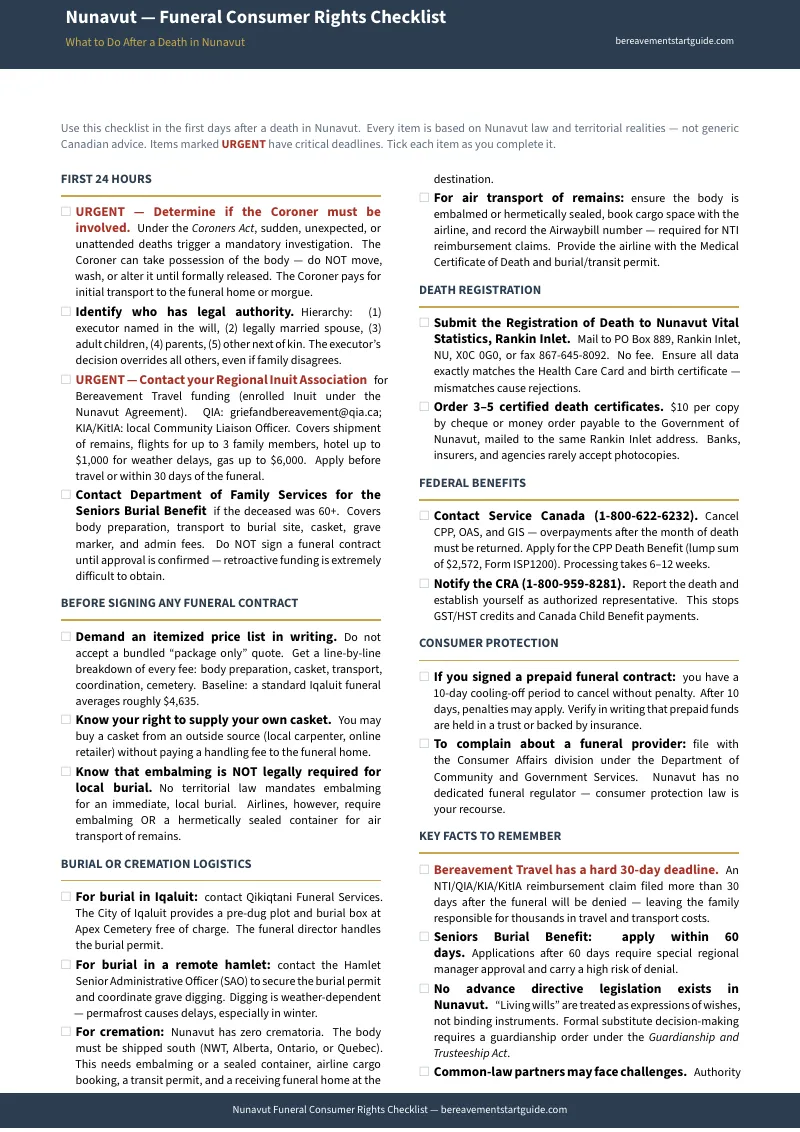
Your download includes the complete 15-chapter guide, the standalone Nunavut Funeral Consumer Rights Checklist, and eight printable standalone references — the Funding Decision Tree, Air Transport of Remains Checklist, Out-of-Territory Cremation Guide, Home Funeral & Burial Manual, Consumer Rights Reference, Forms, Fees & Agency Directory, Disposition Authority Hierarchy, and Timeline Summary — plus a money-back guarantee, no time limit. If the guide does not give you clarity and confidence about what to do next, email us for a full refund. No questions asked.
Not ready for the full guide? Download the free Nunavut Funeral Consumer Rights Checklist — the most urgent actions and rights for the first days after a death, from determining who has legal authority and which funding deadlines are running to what to demand before you sign anything. It is enough to make the first calls tonight knowing what matters.
You should not have to become your own funeral director, benefits caseworker, and air cargo coordinator while you are grieving. But if the work falls to you, you should at least know exactly which call to make first — and which deadline you cannot afford to miss.