You Were Named Executor of an Estate in Nunavut. The Court Registry Is in Iqaluit. Your Community Has No Bank Branch. The Forms Are Blank PDFs With No Instructions. And You Are Supposed to File Everything by Fax From 2,000 Kilometres Away.
Someone in your family died, and now you are the person the bank, the court, and the Land Titles Office are all waiting on. Maybe you were named in the will. Maybe there was no will at all, and because you are the surviving spouse or the eldest child, the responsibility falls to you by default. Either way, the funeral is barely over, the bank account is frozen, and you are staring at a set of court forms that assume you already know which ones to use.
Here is what you are actually dealing with. The Nunavut Court of Justice operates as a single unified court in Iqaluit. Every probate filing in the territory — whether the deceased lived in Arviat, Pond Inlet, Cambridge Bay, or Kugluktuk — must be submitted to the Civil Registry there. If you do not live in Iqaluit, you file by fax or email at $1 per page, using a system that requires your sworn affidavits, your estate inventory, and your probate fee payment to arrive as a flawless package. If the clerk finds a single error — a name mismatch between the death certificate and the will, a missing affidavit of execution, an incorrect fee calculation — the entire application comes back, and you start over. Meanwhile, the bank accounts stay frozen and the beneficiaries keep asking when they will receive their inheritance.
If the estate is intestate — no will — the complications multiply. Nunavut's Intestate Succession Act gives the surviving spouse a preferential share of only $50,000, one of the lowest thresholds in Canada. Everything above that is divided between the spouse and children according to rigid statutory fractions. Common-law partners receive nothing under intestacy — they are entirely excluded from automatic inheritance. And if any beneficiaries are minors, the Public Trustee can intervene, a process that explicitly takes an average of two to three years to resolve.
The Nunavut Probate Process Guide is a Remote Filing System for every executor and administrator settling an estate under Nunavut law. Not a collection of links to blank court PDFs. Not a generic Canadian probate overview with territorial names swapped in. A step-by-step filing manual built for the reality of probating an estate from a fly-in community with no bank branch, no local lawyer, and no in-person access to the court registry — covering every form from Form 1 through Form 32, the exact probate fees ($25 to $400), the remote fax filing process, the bond waiver workaround for intestacy, custom adoption inheritance rules, and the banking desert strategies that no other resource in Canada addresses.
What's Inside the Remote Filing System
A complete guide, a Probate Quick-Start Checklist, and standalone printable worksheets — covering every stage from ordering death certificates through the final Release (Form 32), built specifically for Nunavut's centralized court system and the logistical realities of the North:
Every Court Form Explained in Plain English: Form 1 Through Form 32
The Nunavut Court of Justice provides over thirty probate-related forms as blank PDFs with no filling instructions. Form 1 is the Application for Probate. Form 2 is the Affidavit on Application. Form 4 is for intestate estates. Form 5 lists beneficiaries. Form 8 inventories assets and liabilities. Form 11 proves the will was properly witnessed. Form 13 handles Inuktitut or Inuinnaqtun translations. Form 14 is the Grant of Probate itself. Form 16 is Letters of Administration for intestate estates. Form 32 is the Release that closes the file. The guide walks through every form you need, explains what the court clerk actually looks for when reviewing your submission, and identifies the specific mistakes that cause applications to be returned weeks later.
Remote Filing: How to Probate an Estate From 2,000 Kilometres Away
Because physical access to the Iqaluit court registry is impossible for most Nunavummiut, the Civil Registry accepts filings by fax and email. But the process is not as simple as scanning and sending. You must complete the Electronic/Fax Filing Request form specifying the number of pages and payment details, pay $1 per page in transmission fees on top of the probate fees, and ensure every affidavit has been sworn before a Commissioner for Oaths in Nunavut or a Notary Public if you are outside the territory. The guide covers the exact submission process, the payment methods accepted (cheque or money order to the Government of Nunavut), and how to avoid the common packaging errors that trigger rejections from the registry clerk.
The $50,000 Spousal Threshold: What Intestacy Actually Means in Nunavut
When someone dies without a valid will in Nunavut, the surviving legally married spouse receives only $50,000 as a preferential share. If the estate is worth $150,000, the spouse takes the first $50,000, and the remaining $100,000 is split between the spouse and children according to statutory fractions that change based on the number of children. Common-law partners are completely excluded from automatic inheritance — they must pursue a separate dependant's relief claim through the courts. In a territory where the cost of living is among the highest in Canada and a modest house can exceed $300,000, this $50,000 limit can force the sale of the family home to satisfy the statutory shares owed to children. The guide covers the complete intestacy distribution rules, the election between the preferential share and the matrimonial home, and the exact forms required to apply for Letters of Administration.
Bond Waiver for Intestate Estates
When someone dies without a will in Nunavut, the court can require the administrator to post a probate bond to the Sheriff — a financial guarantee protecting creditors and beneficiaries. Obtaining a commercial surety bond in a remote northern community is frequently prohibitively expensive or practically impossible. But there is a workaround: if all adult beneficiaries provide unanimous, sworn written consent waiving the bond, the judge can dispense with the requirement entirely. The guide walks through the exact process for obtaining these consent waivers, the form to file with the court, and how to handle situations where one beneficiary refuses to sign.
Custom Adoption Inheritance
In Inuit culture, children are frequently adopted by grandparents or other relatives under customary practice rather than western judicial processes. The Aboriginal Custom Adoption Recognition Act gives these adoptions full legal standing — a custom-adopted child holds the exact same inheritance rights as a biological child for probate purposes. But proving this to the court requires documentation that many families do not realize they need. The guide covers how custom adoption intersects with the Intestate Succession Act, how to gather the necessary certificates from community commissioners, and the specific complications that arise when a custom-adopted child is also a minor beneficiary.
Banking Desert Strategies: When Your Community Has No Bank Branch
Only four communities in Nunavut have physical bank branches — Iqaluit, Rankin Inlet, Cambridge Bay, and Igloolik. Residents of the remaining twenty-one municipalities rely on ATMs inside the Northern Store or local Co-op. Standard banking procedure requires the executor to open a dedicated estate account in person at a branch. When no branch exists within a thousand kilometres, this creates an impossible bottleneck. The guide provides specific strategies for opening estate accounts remotely with major Canadian banks, scripts for dealing with southern call centres that do not understand northern geography, and the informal release thresholds that banks use internally to release funds without a court order for small estates.
Probate Fees: Among the Lowest in Canada
Nunavut's probate fees are capped at a maximum of $400 for estates over $250,000. The full schedule: $25 for estates under $10,000, $100 for $10,000 to $25,000, $200 for $25,000 to $125,000, $300 for $125,000 to $250,000, and $400 for everything above. Only registered mortgages on real property may be deducted from the gross estate value for fee calculation purposes. The guide covers the exact calculation, the payment method (cheque or money order — no cash, no credit card), and how to include the correct fee with your remote filing package so it is not returned for an underpayment.
Notice to Creditors in a Territory With Limited Print Media
After receiving the Grant of Probate, the executor must publish a Notice to Creditors in a newspaper of general circulation where the deceased resided. In most of Canada, this is straightforward. In Nunavut, identifying an acceptable publication for a hamlet of 1,500 people is a genuine source of confusion. The guide provides a directory of acceptable territorial publications, a pre-drafted notice template, the exact timeline from publication through the four-week creditor waiting period, and the personal liability consequences if you distribute assets before that period expires.
Real Property Transfers and the Land Titles Office
Transferring title to real property requires filing a Transmission Application (Form 21) with the Nunavut Land Titles Office, accompanied by the Grant of Probate and the original death certificate. The fee is $1.50 per $1,000 of property value, with a $60 minimum. Joint tenancy with right of survivorship bypasses this process entirely — a death certificate and statutory declaration transfer title directly. The guide covers both paths, the fee calculation, and the critical distinction between joint tenancy and tenants-in-common that determines whether probate is needed for the property at all.
The Public Trustee: When They Intervene and What It Costs
The Office of the Public Trustee steps in when there is no next of kin willing or able to act, when beneficiaries are minors without a designated trustee, or when the estate is abandoned. They charge a $200 file-opening fee, 3% on property transfers, and 5% on cash receipts, and their administration averages two to three years. The guide explains the exact intervention criteria, how to demonstrate that you are a suitable administrator to keep control, and the scenarios where the Public Trustee's involvement is actually beneficial — particularly for complex, contested, or insolvent estates.
Who This Guide Is For
- The executor in a remote community who just learned that the bank froze the deceased's account and the court registry is in Iqaluit — who needs to know how to file every form by fax, get affidavits sworn locally, and open an estate account when the nearest bank branch is a $1,200 flight away
- The surviving spouse discovering the $50,000 limit who assumed they would inherit everything — who just learned that Nunavut's intestacy law gives them only the first $50,000 and divides the rest with the children, and who needs to understand the election between the preferential share and the matrimonial home before making an irreversible decision
- The southern-based adult child named executor living in Ontario, Alberta, or British Columbia — who must settle a parent's Nunavut estate remotely, navigate territorial court rules that bear no resemblance to provincial probate, and satisfy bond requirements for non-resident personal representatives
- The family with custom-adopted children who needs to document Inuit customary adoptions for the court — who does not know what paperwork to gather, how custom adoption intersects with the Intestate Succession Act, or what happens when a custom-adopted minor is entitled to a share of the estate
- The community helper or social worker at the Hamlet office, Co-op, or legal aid clinic — who assists local families with frozen accounts and court paperwork multiple times a year and needs a reliable, accurate reference manual instead of piecing together answers from scattered government PDFs
Why Free Resources Will Not Get You Through This
The information exists. It is scattered across the Nunavut Court of Justice, the Office of the Public Trustee, Vital Statistics in Rankin Inlet, the Land Titles Office, three regional Inuit associations, and a handful of legal aid booklets. Here is what you encounter when you try to probate an estate using free sources alone:
- The NCJ website provides blank form PDFs with no instructions. You can download Form 1, Form 2, Form 14, and the rest of the probate forms as blank PDFs. What you cannot find is a plain-English explanation of which forms apply to your situation, how to complete each one, what supporting documents the clerk expects alongside each form, or what mistakes cause applications to be returned. The forms assume you already know estate administration law. If you did, you would not be reading government PDFs at midnight.
- EstateExec and Atticus copy their US frameworks and paste "Nunavut" on top. EstateExec references "EINs" — an American tax concept that does not exist in Canada. Atticus explicitly admits it lacks "specific calendar timelines" for Nunavut. Neither platform mentions custom adoption, the banking desert, the $1-per-page fax filing process, or the bond waiver workaround. They are built for Ontario with a territorial flag applied as an afterthought.
- Legal aid produces excellent primers on why you should write a will — not how to settle one. Maliiganik Tukisiiniakvik publishes a clear booklet explaining what an executor is, what assets are, and why intestacy is dangerous. It stops before the actionable steps. It does not walk you through Form 1, Form 8, or Form 14. And legal aid in Nunavut is overwhelmed by criminal and family law — routine probate assistance is extremely limited.
- Banks tell you to "visit your local branch" to open an estate account. RBC, CIBC, and TD all publish national estate checklists that assume in-person branch access. Their advice is useless in twenty-one of Nunavut's twenty-five communities, where the only financial infrastructure is an ATM inside the Northern Store.
- Iqaluit law firms guard their expertise behind billable hours. Private practitioners deeply understand Nunavut's probate rules. They rarely publish how-to content online, preferring to convert inquiries into retainers starting at $300 per hour. For contested estates, that representation is worth every dollar. For straightforward, uncontested estates, a step-by-step guide covers the same ground for a fraction of one billable hour.
Free resources give you fragments from a dozen sources that do not reference each other. The Remote Filing System puts every Nunavut-specific form, statute, fee, and deadline into one document, in the order the court actually requires them — built for the reality of filing from a community with no bank, no lawyer, and no road to the courthouse.
— Less Than One Hour With an Iqaluit Lawyer
A single consultation with an Iqaluit estate lawyer costs $300 or more per hour — if you can get an appointment, given the handful of lawyers serving the entire territory. National estate settlement platforms charge $149 to $199 per year in subscription fees. This guide costs less than one hour of professional legal time and gives you the complete Nunavut-specific filing system for every probate form, every schedule, every deadline, and the remote filing procedures that nobody explains in plain language.
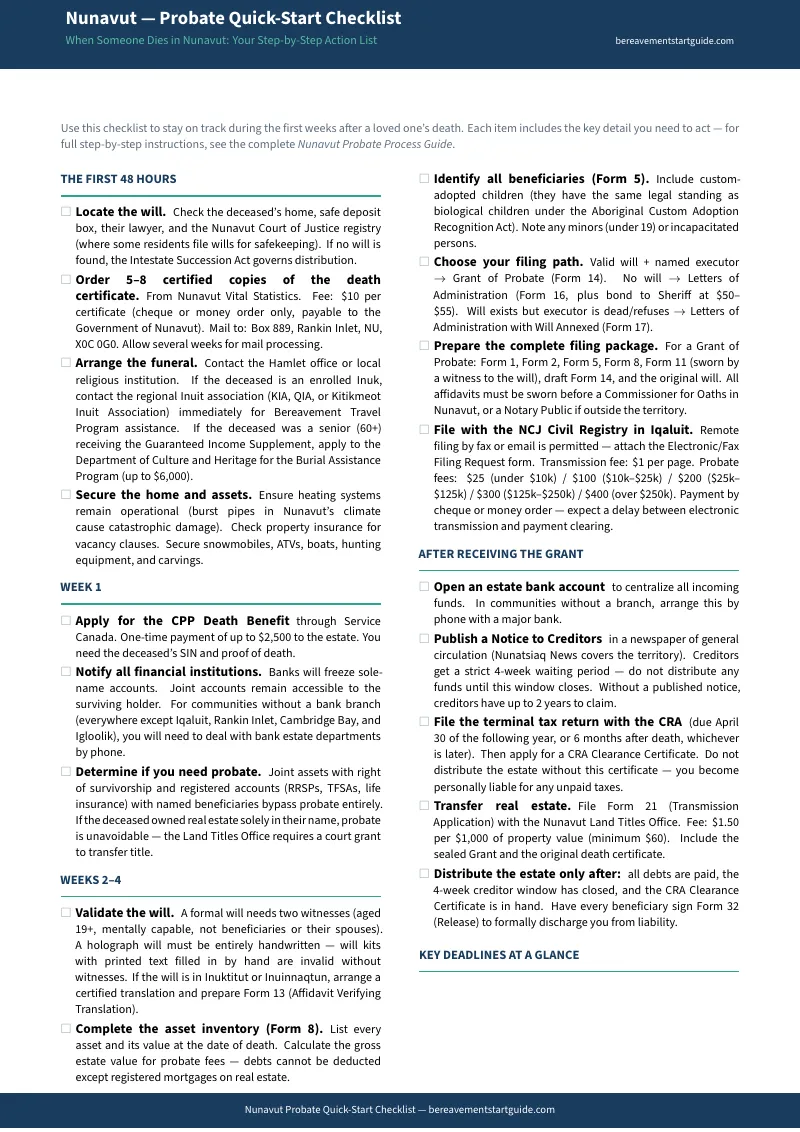
Your download includes the complete guide with the Nunavut Probate Quick-Start Checklist and standalone printable worksheets — a probate decision flowchart, a court filing package checklist, a notice to creditors template, an estate inventory worksheet, and a fee calculation reference card. Plus a money-back guarantee, no time limit. If the guide does not give you clarity on which forms to file and confidence that you are filing them correctly, email us for a full refund. No questions asked.
Not ready for the full guide? Download the free Nunavut — Probate Quick-Start Checklist covering everything an executor needs to determine in the first week: whether the estate requires formal probate, which forms apply to your situation, what documents to gather, and how to order death certificates from Vital Statistics in Rankin Inlet. It is enough to get oriented and take your first steps.
You did not ask for this responsibility. But Nunavut's probate system is knowable, the forms are finite, and the fees are among the lowest in Canada. The guide shows you the path through it — one form at a time, from wherever you are.