Someone You Love Just Died in Ontario. The Bank Froze the Accounts. The Probate Court Wants Forms You Have Never Seen. And You Just Found Out About a 180-Day Ministry of Finance Deadline That Nobody Mentioned at the Funeral Home.
You are standing in a place nobody prepared you for. Maybe you were named executor in a will you barely remember reading years ago, and now the bank is telling you they cannot release funds without a "Certificate of Appointment of Estate Trustee" — even though you thought joint accounts meant automatic access. Maybe there was no will at all, and because you are the surviving spouse or the eldest child, everyone is looking at you for answers you do not have. Maybe the funeral director is waiting for a decision, the mortgage payment is due next week, and the one person who always handled the finances is the one who just died.
You are grieving and exhausted, but the bureaucracy does not wait. ServiceOntario needs a death registration. Service Canada needs notification to stop CPP and OAS payments before the government claws back overpayments. You searched for probate forms online and found Form 74A and Form 74.1A on the Ontario Superior Court of Justice website with no instructions on which one applies to your situation, or why the $150,000 Small Estate threshold changes the entire process. Then you read something about the Estate Information Return — a mandatory filing with the Ministry of Finance due exactly 180 days after your Certificate of Appointment is issued — and realized that missing it triggers penalties starting at $1,000 and potentially reaching double the tax payable, or even imprisonment. That timeline was not in any funeral home brochure.
And in the back of your mind, the question that will not stop: if I distribute too early, miss a deadline I did not know about, or fail to get the CRA Clearance Certificate before paying out beneficiaries — am I personally liable?
The short answer: the estate pays its own debts, not you. But the long answer — the one that involves an Estate Administration Tax with a $50,000 exemption and then $15 per $1,000 on the remainder rounded up to the nearest thousand, a court system that distinguishes Rule 74 (standard) from Rule 74.1 (small estates under $150,000), a federal Canada Revenue Agency that does not recognize Ontario's "Estate Trustee" terminology without proof, a Survivorship Application under Section 123 of the Land Titles Act that still requires $60–$80 in Land Registry fees even though the joint property technically bypasses probate, and a First Dealings Exemption that can save families thousands in EAT on property registered under the Land Titles Act — that answer is what separates families who settle an estate in months from families who spend years untangling mistakes they did not know they were making.
The When Someone Dies in Ontario — Estate Settlement Guide is a Provincial Settlement Roadmap for every legal, financial, and administrative step between the funeral home and final distribution. Not a law textbook. Not a generic Canadian checklist that does not know Ontario from Nova Scotia. A structured, Ontario-specific manual that separates what must be done in the first 48 hours from what legally cannot happen until the CRA issues its Clearance Certificate — so you stop guessing, stop panicking, and start working through this in the right order.
What's Inside the Provincial Settlement Roadmap
A 10-chapter guide, the First 48 Hours Checklist, and five standalone printable worksheets — covering every stage from the moment of death through final asset distribution, built specifically for Ontario's Estates Act, Succession Law Reform Act, Estate Administration Tax Act, and the province-specific rules that make settling an estate here different from anywhere else in Canada:
The First 48 Hours: Securing the Estate and Understanding Authority
The moment someone dies in Ontario, every Power of Attorney for Property and Personal Care is legally void under the Substitute Decisions Act. If you managed their finances under a POA, that authority ended instantly. This chapter covers locating the original will (Ontario courts reject photocopies), securing the residence, engaging the funeral director, understanding the critical difference between the Proof of Death issued by the funeral director within days (free, and legally sufficient for most early tasks) and the official provincial Death Certificate from ServiceOntario (currently a 16-week registration backlog), and the single most important rule in this entire guide: do not pay any of the deceased's debts with your own money.
Week One: Notifications That Cannot Wait
Service Canada must be notified immediately to stop CPP and OAS payments — these are only payable for the month of death, and every later payment must be repaid in full and clawed back from the estate. The CRA needs Form RC552 to recognize you as the estate's authorized representative. The CPP Death Benefit (Form ISP1200) is up to $2,500 lump sum, with a possible $2,500 top-up for 2025+ deaths if the deceased never collected CPP. Surviving spouses can receive the CPP Survivor's Pension — up to $904.59/month over 65 in 2026. And if money is tight, the Ontario Works or ODSP funeral benefit covers up to $2,250 toward basic funeral costs, based on the estate's finances, not the deceased's prior enrollment.
The Probate Decision: Small Estate vs. Standard
Before you can determine whether probate is required, you need a complete picture of what the deceased owned and how they owned it. This chapter walks through building the asset inventory, separating probate from non-probate assets (joint accounts, named-beneficiary RRSPs and TFSAs, and life insurance all pass outside the estate), and the critical threshold that changes everything: estates valued at $150,000 or less qualify for the Small Estate Certificate under Rule 74.1 (Form 74.1A), while anything above requires the standard Certificate of Appointment under Rule 74 (Form 74A). Both cost $138 in court filing fees. The guide explains exactly when you need probate — banks usually demand it for sole-owner accounts above $25,000–$50,000 — and when you can avoid it entirely.
The Estate Administration Tax and the 180-Day Deadline
This is the chapter that does not exist in any free resource in plain language. The EAT calculation: $0 on the first $50,000 of estate value, then $15 per $1,000 on the remainder — with the critical, often-missed rule that the estate value must be rounded up to the nearest thousand dollars. An estate valued at $239,250 pays tax on $240,000, not $239,250. After the Certificate of Appointment is issued, you have exactly 180 days to file the Estate Information Return (Form 9955) with the Ontario Ministry of Finance — online only. Missing this deadline triggers penalties starting at $1,000 and reaching up to twice the tax payable. And here is the part that catches executors of small estates: even if the estate is under $50,000 and owes zero EAT, you must still file the Estate Information Return.
Real Estate, Banking, Taxes, and Everything Else
The remaining chapters cover property transfers (the Survivorship Application under Section 123 of the Land Titles Act for joint property, and the First Dealings Exemption that can save thousands in EAT on real estate registered under the Land Titles Act), banking blockades and how families access funds before probate (including asking the bank branch to pay the funeral invoice directly from a frozen account — they routinely do this), the Notice to Creditors, vehicle transfers through ServiceOntario, the terminal T1 tax return and T3 trust returns, the CRA Clearance Certificate (Form TX19 — about 120 days processing), intestacy under the Succession Law Reform Act (the preferential share and distribution hierarchy), non-resident executor bonding requirements under the Estates Act, insolvent estates, the Office of the Public Guardian and Trustee, Indigenous estates under the Indian Act, executor compensation, and the complete timeline from Day 1 through final distribution and estate closure.
Who This Guide Is For
- The surviving spouse whose partner just died and whose bank account was frozen this morning — who needs to know which accounts stay accessible, which ones require a Certificate of Appointment, how to apply for the CPP Survivor's Pension, and why the 180-day EIR deadline means the timeline is longer than anyone warned you about
- The adult child named as executor who has never navigated the Ontario Superior Court of Justice and is terrified of making a mistake that triggers personal liability — who needs the complete form sequence, the EAT calculation explained, and a timeline that separates what is urgent from what legally cannot happen yet
- The executor deciding between Rule 74 and Rule 74.1 who just learned that the $150,000 Small Estate threshold changes the entire filing process — and that newly discovered assets pushing the estate over $150,000 mean abandoning the small estate track entirely and starting a standard application
- The family with no will who just learned that the Succession Law Reform Act dictates everything — who needs to understand who has statutory priority to apply for a Certificate of Appointment of Estate Trustee Without a Will, what the preferential share means for the surviving spouse, and how the distribution hierarchy works when there are children
- The financially constrained family who cannot afford a funeral or a lawyer — who needs to know about the Ontario Works / ODSP funeral benefit ($2,250), the CPP Death Benefit ($2,500), the OPGT option for estates of last resort, and how to keep legal costs to a minimum by doing the administrative work themselves
- The out-of-province or non-resident executor who just learned about the administration bond requirement under the Estates Act — posting security calculated at double the gross value of the estate — and needs the bypass mechanisms (Commonwealth exemption, written beneficiary consent, or judicial dispensation) explained step by step
- The former Power of Attorney whose authority ended the instant the death occurred and who needs to re-establish their legal standing as executor — transition from POA to estate trustee, re-register with the CRA via Form RC552, and understand how their actions as attorney might be scrutinized during the Passing of Accounts
Why Free Resources Will Not Get You Through This
The information exists. It is scattered across the Ontario Superior Court of Justice, ServiceOntario, the Ontario Ministry of Finance, Service Canada, the CRA, the Ontario Land Registry, and a dozen portals that do not talk to each other. Here is what you actually encounter when you try to settle an estate using free sources alone:
- Government pages are legally accurate but operationally useless. The Superior Court provides Form 74A and Form 74.1A as blank PDFs. It does not explain the difference between the two streams, does not walk through the EAT calculation with the rounding-up rule, does not mention that newly discovered assets can force you off the small estate track entirely, and does not connect the provincial filing to the federal CRA obligations that follow. Each department covers its own piece. None of them sequence the pieces together.
- Law firm blogs highlight complexity to justify retainer fees. Ontario estate lawyers publish excellent technical breakdowns of Rule 74.1, the Survivorship Application, and executor liability. Their content is explicitly designed to convince you the process is too dangerous to handle alone — and that you need representation starting at several thousand dollars. For contested estates, that is true. For the majority of straightforward estates, the answer costs a fraction of what an attorney charges.
- National estate platforms sell will-creation software, not settlement tools. Companies like ClearEstate and Willful publish clean Ontario probate content. They accurately recite the probate fee tiers but entirely omit the 180-day EIR filing requirement, the 60-day amendment window for newly discovered assets, the First Dealings Exemption, and the federal-provincial disconnect where the CRA rejects Ontario's "Estate Trustee" terminology without legislative proof. They genericize the provincial experience to fit a national product model.
- Bank estate pages protect the bank, not you. Every major bank has an estate landing page explaining why accounts are frozen. None explain how families negotiate early fund releases, what the inconsistent internal thresholds are across institutions ($25,000 at some, $50,000 at others), or why the surviving spouse's joint account might still be frozen despite right of survivorship.
- Community forums are emotionally honest but legally dangerous. Reddit's r/PersonalFinanceCanada has raw accounts of CRA delays stretching past 18 months and bank freezes devastating families. The advice is frequently outdated regarding the 2021 Small Estate limit and the 2020 EAT exemption changes, and often legally incorrect regarding non-resident bonds and tax clearances.
Free resources give you fragments from a dozen sources that do not reference each other. The Provincial Settlement Roadmap puts every Ontario-specific statute, form, deadline, and procedure into one document, in the order you actually need them.
— Less Than Fifteen Minutes With an Ontario Estate Lawyer
A single consultation with an Ontario estate lawyer costs $300 to $500 per hour. Standard probate representation starts at several thousand dollars plus a percentage of the gross estate. This guide costs less than fifteen minutes of professional legal time and gives you the complete Ontario-specific roadmap — every statute, every form, every deadline, and the probate filing sequence that nobody explains in plain language.
Your download includes the complete 10-chapter guide covering every stage from death through final distribution, the First 48 Hours Checklist with 18 critical actions, and five standalone printable worksheets — the Asset & Debt Inventory Worksheet, the EAT Calculation Worksheet, the Agency Notification Tracker, the Deadline Calendar, and the Estate Closing & Liability Shield Checklist. Print the one you need and bring it to the bank, the Superior Court, or ServiceOntario. Plus a money-back guarantee, no time limit. If the guide does not give you clarity on what to do next and confidence that you are doing it in the right order, email us for a full refund. No questions asked.
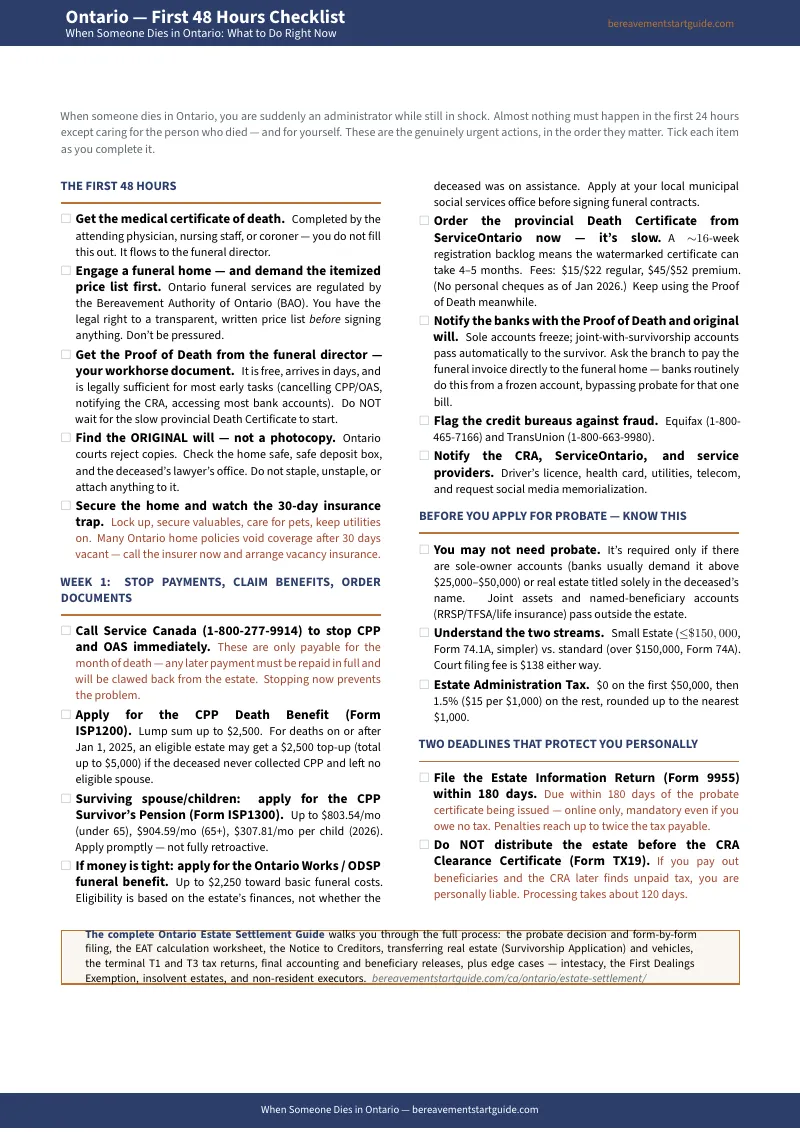
Not ready for the full guide? Download the free Ontario — First 48 Hours Checklist — 18 items covering everything that must happen in the first days after a death in Ontario: death certificates, securing the property, Service Canada notification, CPP Death Benefit application, and what not to pay. It is enough to get through tonight and tomorrow.
You did not ask for this job. But you can do it. The guide shows you how, one step at a time.